If your store’s support volume has outgrown you, an ecommerce BPO (a business process outsourcing firm that runs customer service on your behalf) is one of the two standard answers, and the market is crowded with lookalike websites. The useful question is not who claims ecommerce experience, but who can prove it. This list ranks the firms that can.
If you first want the model explained, start with what ecommerce BPO is. If you are still weighing outsourcing against automating, the BPO vs AI comparison covers that decision. This page is for the next step: choosing the firm.
How did we pick these BPO companies?
Every firm on this list had to show, on its own website, at least one named ecommerce client or case study, a stated service scope, and a verifiable delivery footprint. We checked each vendor’s site directly in June 2026, recorded pricing only where published, and labelled everything else quote-based rather than guessing.
That bar cut some big names. Concentrix, the largest CX outsourcer, publishes no named retail or ecommerce customer, only anonymised case studies, so it is out. Foundever names no retail client at all. TELUS Digital names brands, but for digital-consulting work rather than support outsourcing. Excluding them is an evidence call, not a quality verdict.
How do you choose an ecommerce BPO?
Choose on proof, fit and economics, not on the homepage promise. The five criteria below decide whether an outsourced team actually works for an online store, and they are the lens for every entry that follows. Weight them by what your ticket mix actually needs, not by what a sales deck leads with.
| Criterion | The question it answers |
|---|---|
| Named ecommerce proof | Has the firm published named ecommerce clients or case studies, with outcomes? |
| Pricing transparency | Can you see a rate before a sales call, and how does it scale? |
| Helpdesk compatibility | Does it work inside your Gorgias, Zendesk or similar, rather than its own tooling? |
| Coverage and delivery | 24/7, multilingual, and where the agents actually sit |
| Peak elasticity | Can it absorb Black Friday and seasonal spikes without weeks of ramp? |
What are the best ecommerce BPO companies in 2026?
Seven firms substantiate their ecommerce work: four specialists (Influx, Peak Support, Boldr, PartnerHero), two generalists with a real ecommerce practice (SupportNinja, Helpware), and one enterprise-scale option (TaskUs). Each entry below states what the firm does, its named proof, how it prices, and one honest limitation.
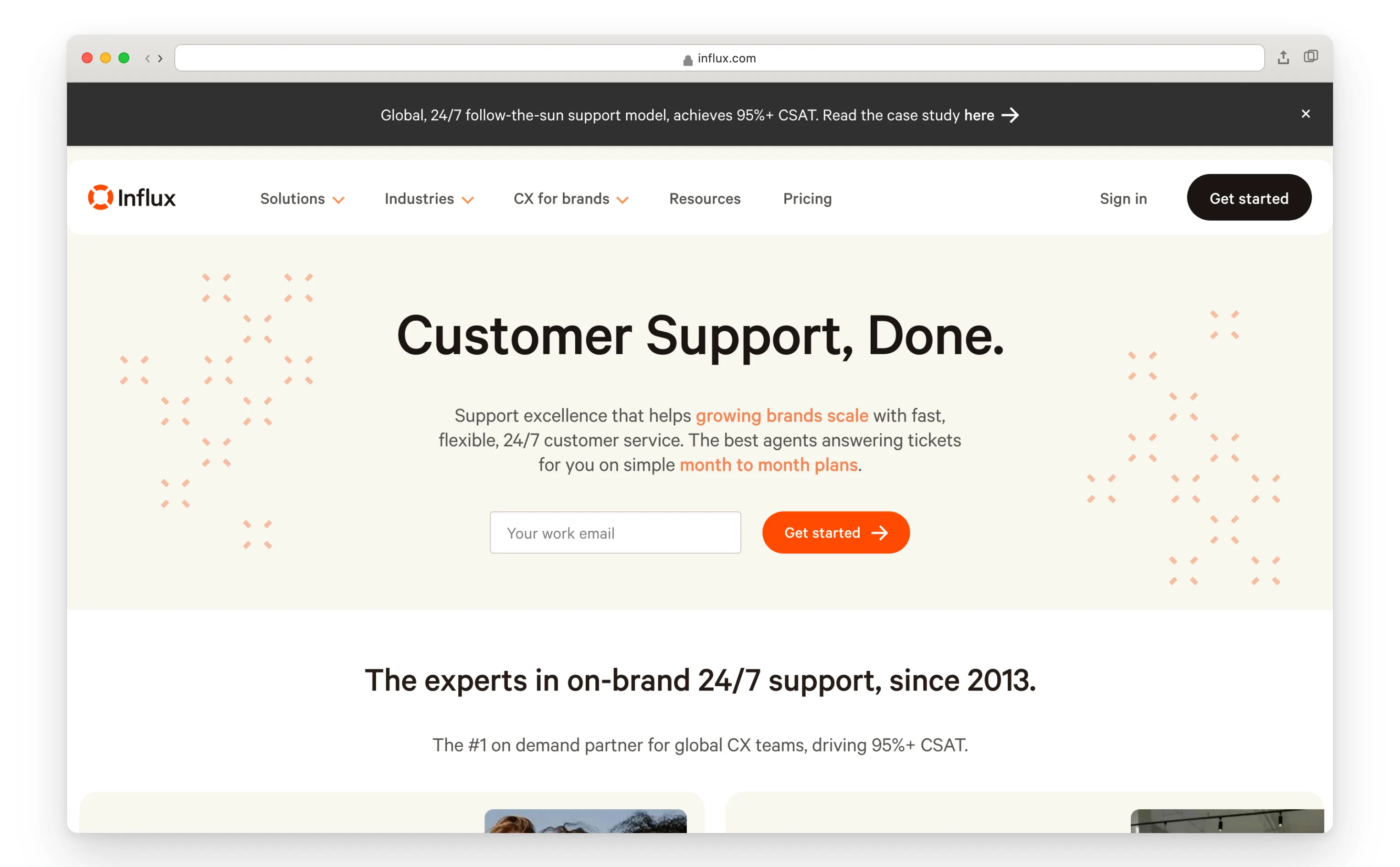
Influx. A support-as-a-service firm built around 24/7 “follow-the-sun” coverage, with a dedicated ecommerce practice and named case studies: fashion brand Meshki (95%+ CSAT, the standard customer satisfaction score), Blenders Eyewear (surges of up to 20,000 tickets in peak sales) and jewellery brand Melinda Maria (96% CSAT); all figures are vendor-reported (Influx). It plugs into Gorgias, Zendesk, Shopify and most major helpdesks (Influx).
Influx is also the rare BPO with published pricing: full-time agents from $1,400 (APAC) to $1,700 (Americas) per month, part-time from $1,000, with no setup fee (Influx, 2026). Honest limitation: per-agent pricing still stacks linearly with volume, and we could not verify Philippines delivery on its site.
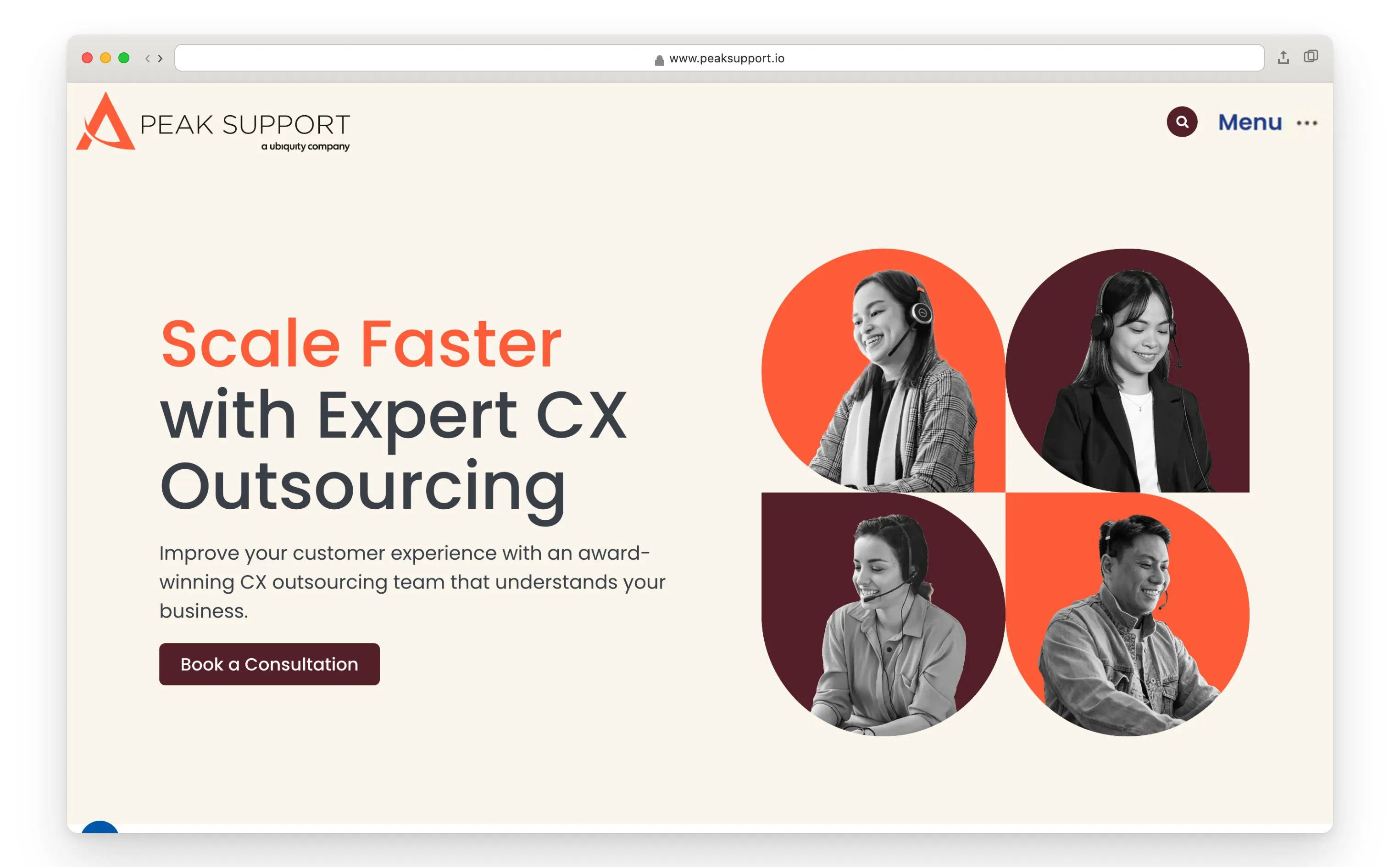
Peak Support. A US-led CX outsourcer with strong named ecommerce proof: subscription bakery Wildgrain (97% CSAT), running-apparel brand Tracksmith and BloomNation all appear as case studies (Peak Support). Its site explicitly lists Zendesk, Gorgias, Salesforce, Shopify and Freshdesk in its tech stack, and it runs Philippines, US, Colombia and Eastern Europe delivery.
Pricing is quote-based; Clutch lists hourly rates under $25 with a $10,000+ minimum engagement, the highest minimum on this list. A second thing to weigh: Peak Support was acquired by Ubiquity in September 2025 (Peak Support), so its scale and positioning may shift post-acquisition.
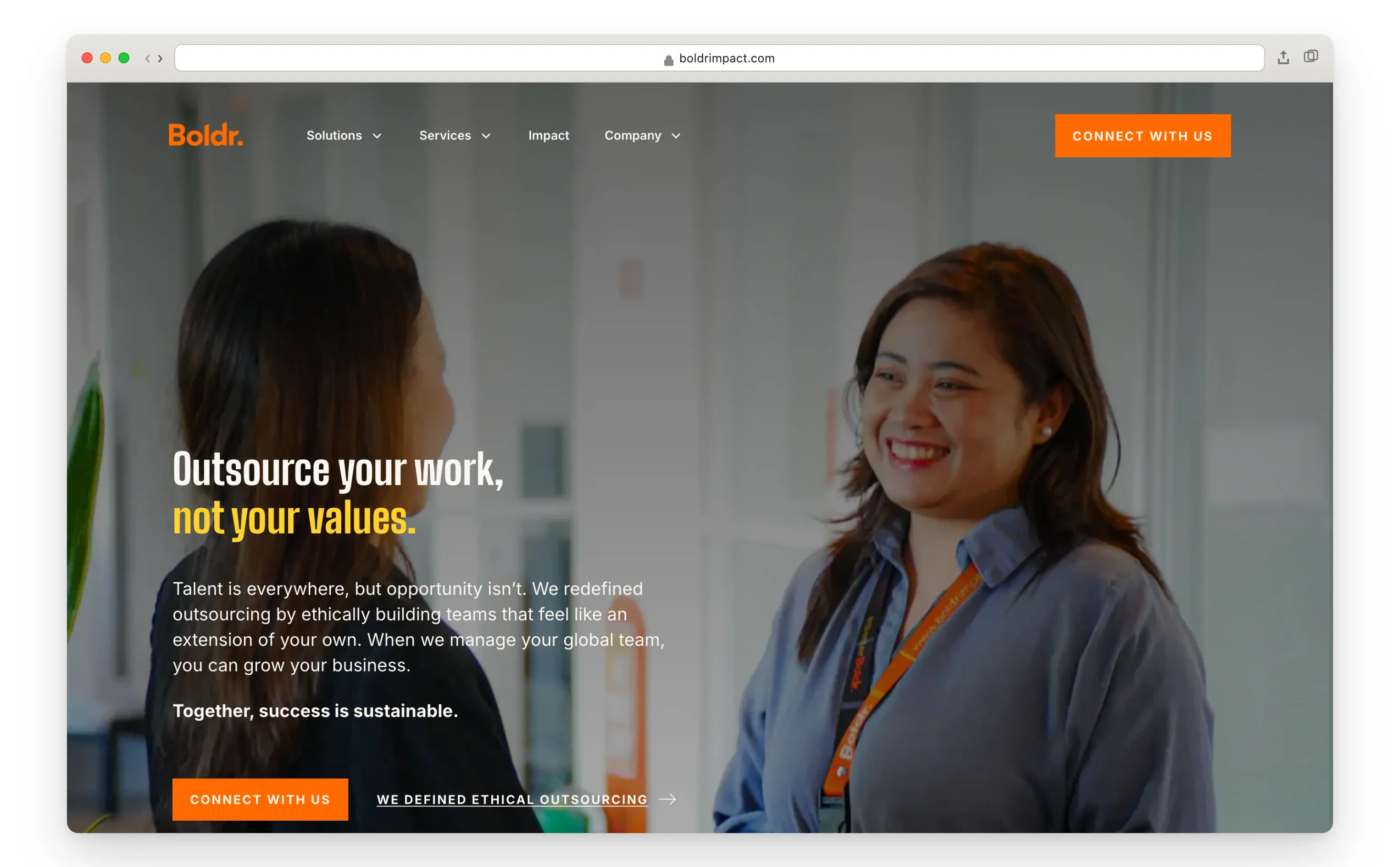
Boldr. The first B Corp certified BPO in the Philippines (a certification for social and environmental standards), with managed outsourcing and named ecommerce case studies: bedding brand Brooklinen grew its Boldr team from 7 to more than 70 people across four countries, florist UrbanStems uses it for “10x” seasonal surges, and registry platform Babylist scaled CX through it (Boldr).
Pricing is quote-based and not public, even on third-party listings. Honest limitation: Boldr’s positioning is broad managed-outsourcing and global employment rather than pure ecommerce CX, and it publishes no helpdesk compatibility details.
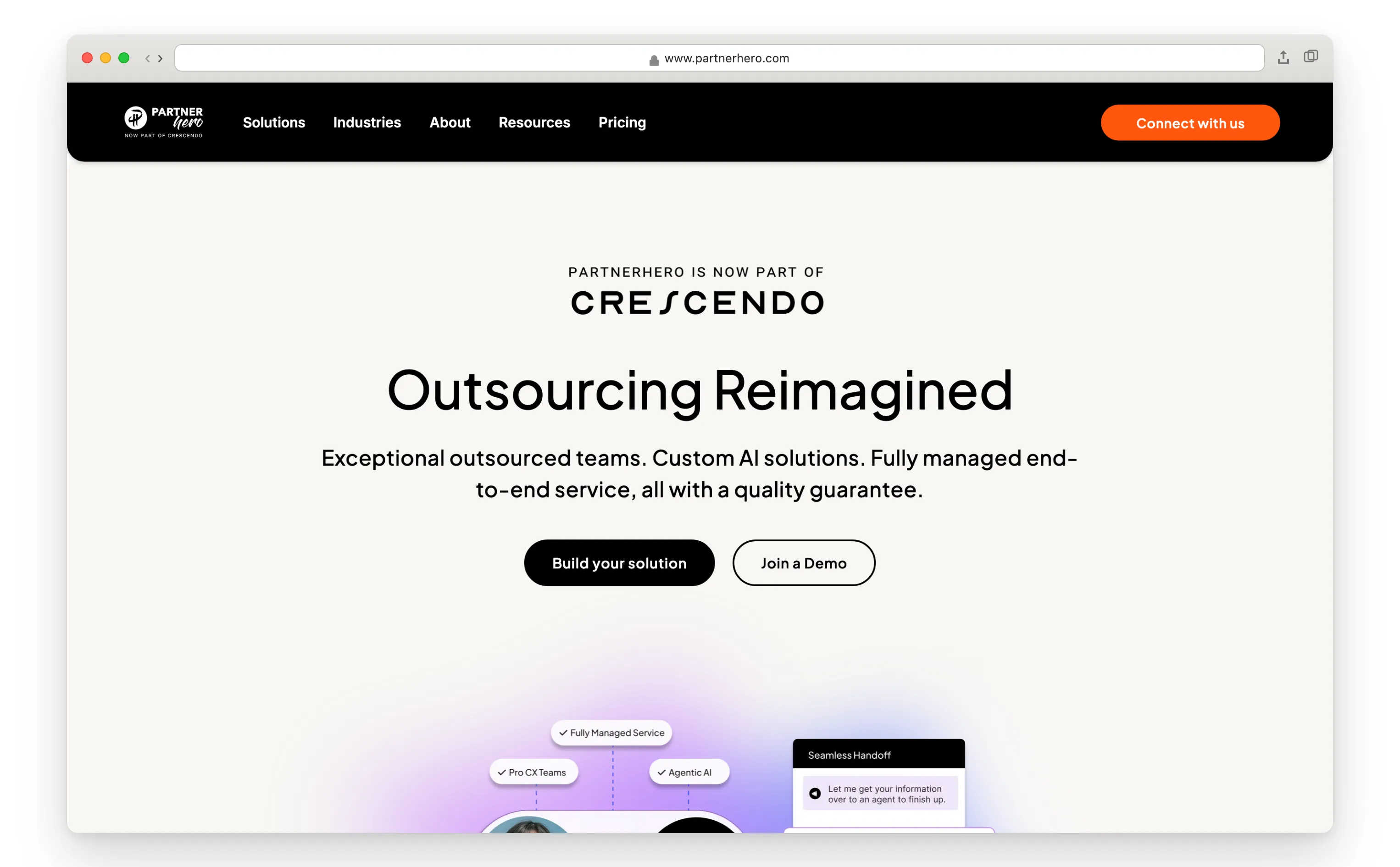
PartnerHero. An outsourced CX firm with a named ecommerce case study (Shark Tank brand Lovepop, scaled from the US to Honduras and the Philippines) and Etsy, Dr. Martens and Good Eggs on its ecommerce page, which claims “160+ retail brands” (PartnerHero).
PartnerHero was acquired by Crescendo in October 2024 (GlobeNewswire, 2024) and now sells an AI-plus-human bundle from $2.99 per resolution (Crescendo). That makes it the clearest sign of where the industry is going, and also its limitation: classic per-agent rates are no longer public.
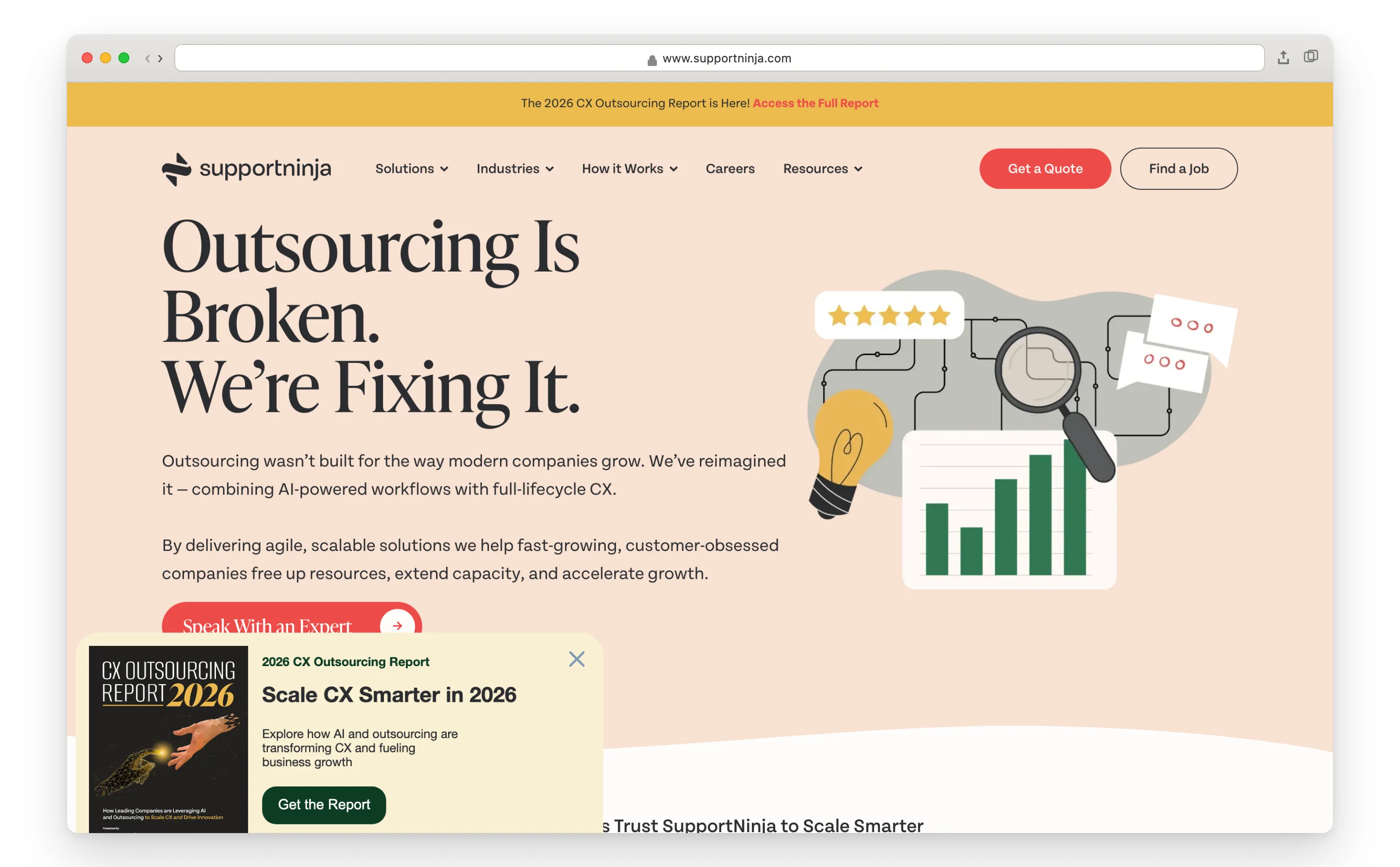
SupportNinja. A generalist outsourcer that positions for ecommerce alongside its SaaS-heavy client base, with two Philippines offices (Metro Manila and Clark) and explicit compatibility with Zendesk, Intercom, Gorgias and Salesforce (SupportNinja).
Its public ecommerce proof is thinner than the specialists above: a Happy Socks logo and an anonymised e-bikes case study (CSAT from 3.9 to 4.8 in 30 days) (SupportNinja). Pricing is quote-based only. A solid pick if you want a generalist with real Philippines depth.
Helpware. A generalist BPO with a dedicated ecommerce and retail vertical and delivery across the USA, Mexico, the Philippines, Ukraine and more (Helpware). Its ecommerce case studies report strong outcomes (a fashion brand cutting handle time 53%, a print platform 56%) but are anonymised; the only named ecommerce client is a SquadLocker testimonial.
Pricing is quote-based; Clutch lists hourly rates under $25 with a $5,000+ minimum. Honest limitation: the thinnest named public proof on this list, so ask for ecommerce references in the sales process.
TaskUs. The enterprise-scale option, with the strongest named proof of all: Shopify, for premium support across 80 critical processes, and Depop, for a fraud and trust-and-safety programme rather than support seats (TaskUs). It runs 11 named Philippines sites within a 31-centre global footprint and sells its own AI stack (TaskGPT, AssistAI).
Pricing is quote-based with a sales-led, enterprise client profile. Honest limitation: there is no self-serve or published SMB entry point, so it fits hypergrowth and marketplace-scale operations, not a five-person store.
How do the seven compare at a glance?
The table below compresses the roster to the facts that differ: named proof, pricing visibility, Philippines delivery and helpdesk compatibility. Use it to shortlist two or three firms, then verify the current details on a sales call, because BPO terms move faster than websites.
| Firm | Named ecommerce proof | Pricing | Philippines | Works in your helpdesk |
|---|---|---|---|---|
| Influx | Meshki, Blenders Eyewear, Melinda Maria | Published, from $1,400/agent/mo | Not verified | Gorgias, Zendesk, Shopify |
| Peak Support | Wildgrain, Tracksmith, BloomNation | Quote-based (<$25/hr via Clutch) | Yes | Gorgias, Zendesk, Shopify, more |
| Boldr | Brooklinen, UrbanStems, Babylist | Quote-based | Yes (first PH B Corp BPO) | Not published |
| PartnerHero | Lovepop; Etsy, Dr. Martens logos | From $2.99/resolution (via Crescendo) | Yes | Zendesk |
| SupportNinja | Happy Socks logo; anonymised cases | Quote-based | Yes (2 offices) | Zendesk, Gorgias, Intercom |
| Helpware | SquadLocker testimonial; anonymised cases | Quote-based ($5k+ min via Clutch) | Yes | Not published |
| TaskUs | Shopify; Depop (trust & safety) | Quote-based, enterprise | Yes (11 sites) | Not published |
One pattern from the table deserves its own picture, because it is the main thing a buyer cannot see from the homepages: only two of the seven publish any price at all.
Pricing visibility as published on each vendor’s own site, checked June 2026.
Which ecommerce BPOs deliver from the Philippines?
Six of the seven run verified Philippines delivery: SupportNinja (offices in Metro Manila and Clark), TaskUs (11 named sites), Boldr (the first B Corp certified BPO in the country), Peak Support, PartnerHero and Helpware. The Philippines remains the centre of gravity for outsourced ecommerce support because of its English fluency and cost base.
If “ecommerce BPO Philippines” is your actual search, shortlist from those six. The one caveat: Influx does not verify Philippines delivery on its site (it names regions plus Kenya and Brazil), so leave it off a Philippines-specific shortlist even though it leads on published pricing.
What is the alternative to an ecommerce BPO?
The main alternative to outsourcing is automating: an AI agent that resolves the repetitive volume inside the helpdesk you already run. Roughly two thirds of ecommerce tickets are repetitive (order status, returns, refunds): Otrium resolves 65% of its 120,000 annual tickets autonomously, and that share is exactly the work stores outsource.
Tellingly, the BPO industry itself is moving this way: every firm on this list now sells an AI offering, and PartnerHero’s owner Crescendo prices the blend per resolution rather than per agent.
The honest framing is the one we use across this cluster: a person first while volume is small, then AI on the front line as you scale, with humans (yours or a BPO’s) on the exceptions. HelloPrint took that path, automating 70% of its support and cutting first-response time by 90% while its team went from 100 agents to 28.
If that trade-off is live for you, the BPO vs AI comparison linked above works through cost curves and where each model wins, and the best AI agents for customer service ranks the tools if you go the AI route.
Frequently asked questions
What is an ecommerce BPO company?
An ecommerce BPO company is a third-party firm that runs an online store’s customer support (order status, returns, refunds, product questions) on the store’s behalf, usually inside the store’s existing helpdesk. The full model, costs and trade-offs are covered in our ecommerce BPO guide.
How much do ecommerce BPO companies charge?
Most quote per engagement rather than publishing rates. Influx is the main exception, listing full-time agents from $1,400 to $1,700 per month. Third-party listings put typical hourly rates under $25, with minimum engagements between $5,000 and $10,000, and PartnerHero’s Crescendo bundle starts at $2.99 per resolution.
Which ecommerce BPO companies operate in the Philippines?
SupportNinja, TaskUs, Boldr, Peak Support, PartnerHero and Helpware all verify Philippines delivery on their own sites. Influx is the exception on this list; it publishes regional coverage but no Philippines location.
Is an AI agent better than hiring a BPO?
Neither is universally better. A BPO brings trained people for complex, high-touch cases; an AI agent resolves the repetitive majority and scales per resolution rather than per hire. While volume is small a person is the right first touch; at scale AI usually wins on cost. Our BPO vs AI comparison breaks the decision down.
Which BPO is best for a small ecommerce store?
From this list, Influx is the most accessible for a small store: published per-agent pricing from $1,000 a month, with no setup fee. TaskUs sits at the other end, built for enterprise and marketplace scale. While volume is still small, also weigh whether one in-house hire covers you before outsourcing at all.