The phone still rings. Even as support shifts to chat and email, a slice of customers pick up the phone for order status, returns and quick questions, and someone has to answer. Voice AI promises to take those calls, day or night, without a hold queue or a voicemail box.
Voice is one slice of AI customer support. If you mainly automate email and chat, our e-commerce guide is the better starting point. Otherwise, here are the voice tools worth knowing in 2026, what they resolve, and what they cost.
What is voice AI for customer support?
Voice AI for customer support is software that answers a phone call, works out what the caller wants in natural speech, looks up their account or order, and either resolves the request or routes it to a human. The tools worth buying act on the ticket, reading the order status or starting a return, rather than only reading a script: the chatbot vs agent distinction, applied to the phone.
Adoption is real, not theoretical. Around 30% of customer service interactions were already handled by AI in 2025, projected to reach roughly 50% by 2027 (Salesforce, 2025). Voice is a growing part of that mix, and operators running it at scale describe a clear win on cost and speed:
May 2026 Reddit We're a fintech and our AI voice agent now handles around 100k inbound calls a month, billing questions, account issues, the usual mix. It's been a win on cost and response time. · r/CustomerSuccess View on RedditThe catch is that a phone call is unforgiving. A wrong answer cannot be re-read or quietly corrected, so the honest use case is the repetitive, structured call, not every case a human handles.
How fast is the voice AI market growing?
Fast, from a small base. The global voice AI agents market was worth roughly $2.4bn in 2024 and is forecast to grow at a 34.8% compound annual rate toward about $47.5bn by 2034 (Market.us, 2025). The exact dollar figure matters less than what the curve signals: phone support is going AI, quickly.
Source: Market.us, 2025. Treat the curve as a proxy for adoption pace, not a precise revenue count.
The driver is economics plus coverage. A voice agent answers a repetitive call for a fraction of the cost of a staffed one, and it does it around the clock, so the after-hours and overflow calls that used to hit voicemail now get answered. That is the same shift pulling text volume toward AI, arriving on the phone line.
How does voice AI actually work on a call?
A voice agent runs a four-step loop. Speech to text turns the caller’s words into text, an LLM works out intent and calls your systems, dialogue logic decides the action or the escalation, and text to speech speaks the reply. Telephony over SIP or VoIP connects the whole thing to a real phone number.
Latency is the whole game. A human hands a turn back in about 200ms, so a voice agent that takes over a second to answer feels broken, and callers repeat themselves or hang up. Most of that delay hides in the LLM step and in deciding when the caller has actually finished talking, not in the audio conversion itself.
Two problems make voice harder than chat. The agent has to handle barge-in, stopping instantly when a caller interrupts, and it has to cope with real phone conditions. Background noise, accents and people talking over each other push transcription error rates far above the clean-audio numbers shown in demos (AssemblyAI, 2026). That failure surface is exactly what a text channel never has to fight.
How should you evaluate a voice AI tool?
Score a voice tool on what it resolves and how well it holds up on a real line, not on how natural the demo voice sounds. For support specifically, action depth and clean escalation matter more than raw fluency, because a smooth voice that cannot read the order is just a nicer hold message.
| # | Criterion | The question it answers |
|---|---|---|
| 1 | Resolution depth | Can it act (read the order, start a return, take payment), or only answer and route? |
| 2 | Escalation | Does it hand off to a human cleanly, with context, on the cases it should not touch? |
| 3 | Latency | Does the reply land fast enough to feel like a conversation, not a walkie-talkie? |
| 4 | Robustness | How does accuracy hold up with accents, noise and interruptions, not just clean audio? |
| 5 | Integrations | Does it connect to your store, helpdesk and telephony, or need a build? |
| 6 | Pricing | Is the bill predictable, usually per minute or per call, as volume grows? |
| 7 | Languages | How many languages does it handle at production quality, not on the box? |
Treat every headline resolution rate as a ceiling. Vendors measure “resolution”, “containment” and “deflection” differently, and the number you get depends on your call mix, your integrations and how much you let the agent do unsupervised.
How do the leading voice AI tools compare?
The market splits into three groups: one e-commerce specialist, a set of builder platforms you assemble yourself, and enterprise agents sold done-for-you. Notes below state what each resolves, who it is for, the main catch, and how it prices. Resolution and cost figures are vendor-stated unless noted.
E-commerce specialist
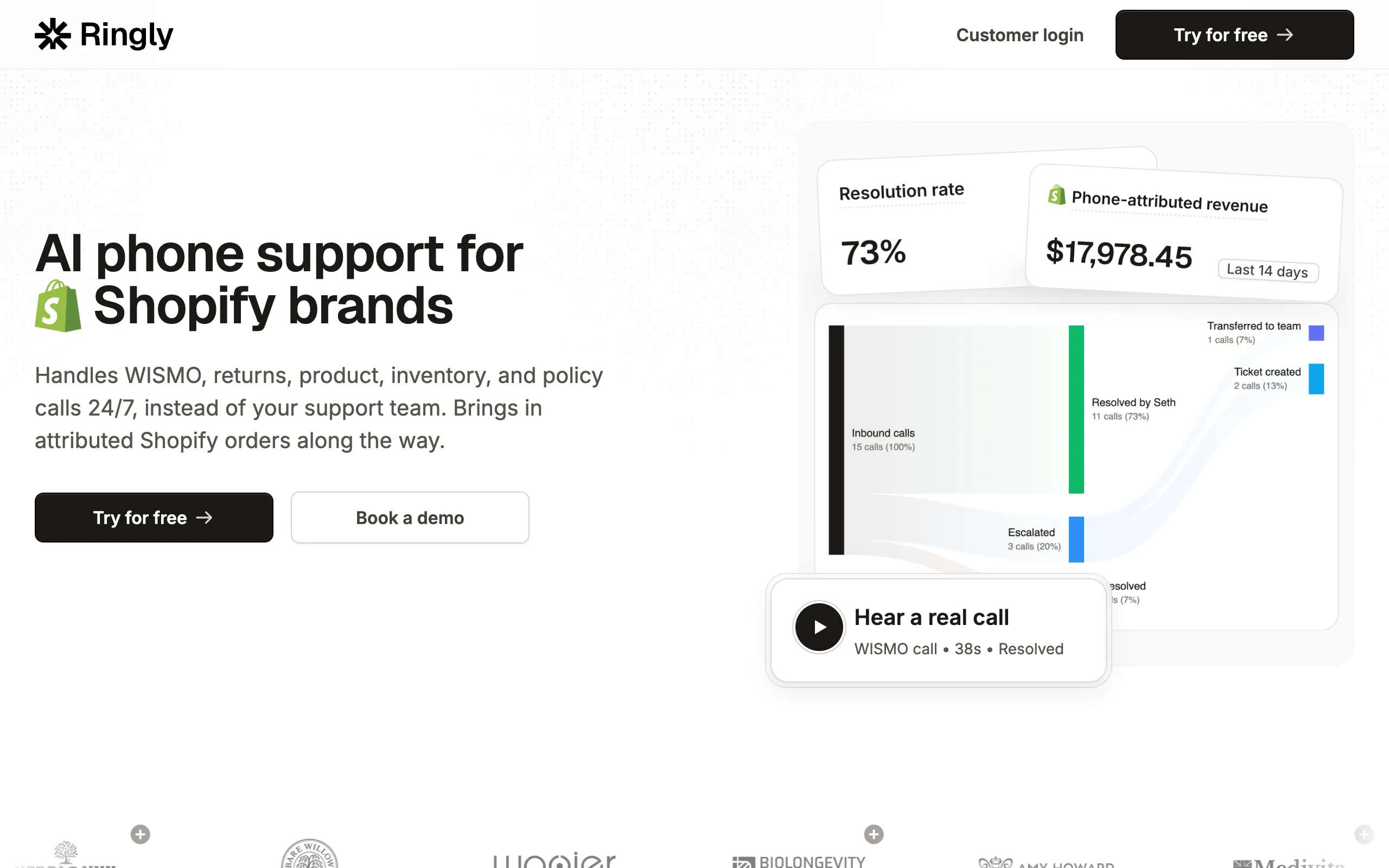
ringly.io is an AI phone agent purpose-built for Shopify brands, with an agent it calls Seth that answers order, returns and policy calls 24/7 and pulls Shopify order history on pickup. Pricing is public and usage-based, from $349/mo for 1,000 minutes and $799/mo for 2,500 minutes, then enterprise, with per-minute overage around $0.19 to $0.29 (see pricing).
Pros:
- Purpose-built for Shopify: identifies the caller and reads order history on the call.
- Acts on the call, from order lookups and return requests to ticket creation and human handoff.
- Honest about scope, with a resolution guarantee that refunds fees if it resolves under 65% over 90 days (vendor-stated).
- Public, usage-based pricing and a same-hour setup (vendor-stated).
Cons:
- Shopify-first, so non-Shopify stacks are a poor fit.
- Voice-only, so it covers the phone channel, not chat or email.
Builder platforms (assemble it yourself)
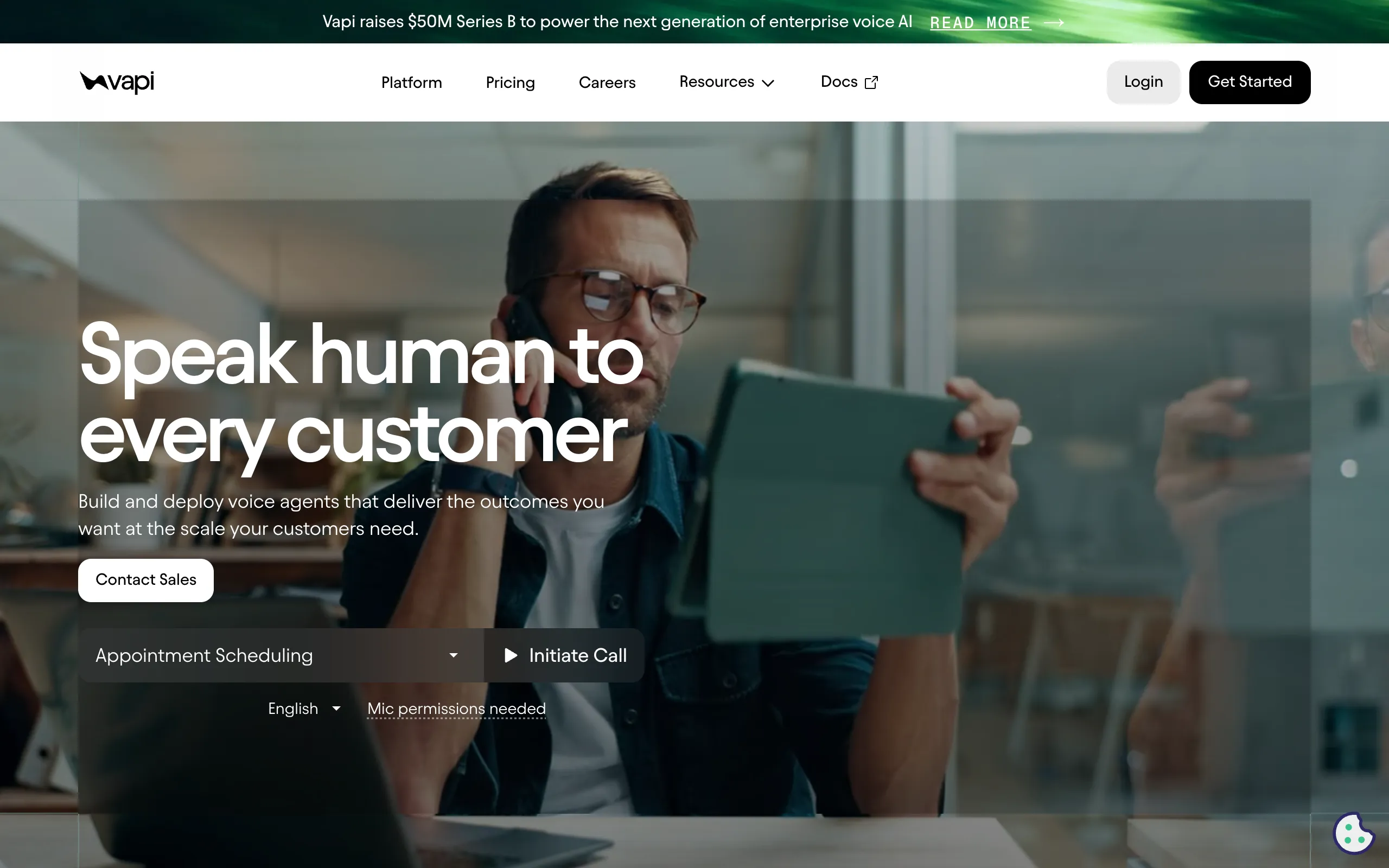
Vapi is a developer platform for building voice agents with maximum control over the model, voice and call flow. It bills usage-based at $0.05 per minute for call hosting, with speech, model and telephony costs passed through at cost, so a live agent typically lands around $0.10 to $0.20 per minute all-in (see pricing).
Pros:
- Deep control and flexibility for engineering teams.
- Among the fastest response times in third-party latency tests.
- Model, voice and telephony are all swappable.
Cons:
- A toolkit, so you design, integrate and maintain the agent yourself.
- Needs engineering resources, not a CX team alone.
Retell AI is a developer-friendly platform with a lower technical barrier than raw infrastructure and transparent per-minute pricing, from $0.055 per minute for the voice infrastructure, or roughly $0.07 to $0.31 all-in once you add a language model and voice (see pricing).
Pros:
- Faster to stand up than assembling raw infrastructure.
- Transparent, published per-minute pricing.
- A good middle ground between no-code and a full custom build.
Cons:
- Still a build, not a finished support solution.
- You own the integrations to your order and helpdesk systems.
Synthflow is a no-code voice AI platform with in-house telephony, voice cloning and 50-plus languages, now positioned around enterprise deployments. Pricing has moved upmarket, with enterprise contracts starting at $30,000 a year (see pricing).
Pros:
- No-code: build and deploy without engineers.
- In-house telephony, voice cloning and 50-plus languages.
- A proven deployment framework for enterprise rollouts.
Cons:
- Now enterprise-priced, from $30,000 a year, so no longer the cheap no-code option it once was.
- No-code can still plateau on the most complex, action-heavy calls.
Bland AI is built for raw scale and high-stakes, regulated phone calls, claiming support for very high concurrent call volumes and over 500 million calls resolved to date (vendor-stated). Pricing is per minute, from $0.14 on the Start plan down to $0.11 at Scale, bundling the model, speech-to-text and text-to-speech into one rate with no pass-throughs (see pricing).
Pros:
- Built for very high call concurrency and regulated, high-stakes use cases (vendor-stated).
- All-in per-minute rate with no model or token pass-throughs.
- Full control over the call pipeline.
Cons:
- Infrastructure-heavy, with middling latency versus the fastest platforms.
- Rewards teams that can engineer around it, not plug-and-play.
Enterprise agents (done-for-you)
PolyAI is an enterprise voice-first CX platform that claims high call containment and sells outcome-focused deployments to large contact centres. Pricing is enterprise and quote-based, with no public rate (see pricing).
Pros:
- Built for enterprise scale and governance.
- Voice-first, with high containment claimed on named deployments (vendor-stated).
- Handles complex, high-volume contact-centre workloads.
Cons:
- Enterprise sale with quote-based pricing and a heavier implementation.
- Not a same-week launch for a small store.
Sierra is an enterprise CX agent company that launched chat-first and added its own voice agent through its acquisition of Receptive AI in 2026. Pricing is outcome-based and quote only, with no public rate or pricing page.
Pros:
- Multi-channel: chat and, now, voice.
- Backed by large enterprise brands, with outcome-aligned pricing.
- Strong governance and depth for complex CX.
Cons:
- Aimed at the enterprise end, so more platform than plug-in.
- Voice is newer to the platform than chat.
| Tool | Group | Acts on the call | Pricing | Best for |
|---|---|---|---|---|
| ringly.io | E-commerce specialist | Yes | From $349/mo (1,000 min) | Shopify brands answering inbound calls |
| Vapi | Builder platform | Depends on build | $0.05/min + costs | Engineering teams wanting control |
| Retell AI | Builder platform | Depends on build | From $0.055/min | Teams building without deep telephony |
| Synthflow | Builder platform | Limited | Enterprise, from $30k/yr | No-code, multilingual rollouts |
| Bland AI | Builder platform | Depends on build | $0.11 to $0.14/min | High-volume, regulated, outbound |
| PolyAI | Enterprise agent | Yes | Quote-based | Large contact centres |
| Sierra | Enterprise agent | Yes | Outcome-based quote | Enterprise brands, multi-channel |
One name to skip: Air.ai drew a large settlement and a marketing ban over deceptive earnings and refund claims, a reminder that voice AI has its share of hype. Judge every tool on named results, not a demo reel.
What does voice AI cost?
Voice AI is usually billed per minute, roughly $0.05 to $0.31 depending on the tool and what is bundled, or as a monthly minutes package. As public anchors, ringly.io runs $349/mo for 1,000 minutes and $799/mo for 2,500 minutes, Vapi charges $0.05/min for call hosting plus model costs, Retell starts at $0.055/min for its voice infrastructure, and Bland runs $0.11 to $0.14/min all-in. Enterprise agents like PolyAI and Sierra are quote-based.
| Layer | What you pay | Who charges it |
|---|---|---|
| Platform fee | Monthly plan or minutes bundle | ringly, Synthflow, enterprise agents |
| Usage | Per minute or per call | Vapi, Retell, Bland, overage on bundles |
| Underlying costs | Speech, model and telephony pass-through | Builder platforms (you assemble) |
The honest comparison is cost per resolved call, not the per-minute rate. A cheap minute that ends in “let me put you through to an agent” still costs you the human call behind it.
Voice or text: which should you automate first?
For most e-commerce teams, text first. The bulk of support volume, order status (WISMO), returns and refunds and product questions, arrives through chat and email, where it is cheaper to handle, easier to automate accurately, and fully auditable through a transcript. Voice AI is best understood as covering the phone that still rings, especially after hours and overflow.
That is not a knock on voice. If a large share of your customers call, or the calls are urgent and emotional, a voice agent earns its place. But it skips the two hardest, most failure-prone steps only by adding them: transcription and turn-taking. Automating the text channels first captures more volume, at lower risk, for less money.
What about chat, email and the rest?
Voice covers one channel. Engaige covers the rest. We do not do voice, and we will not pretend otherwise. What Engaige does is resolve the text channels, chat, email and social, end to end on top of the helpdesk you already run.
Engaige is a continuously improving support agent, and Engaige AI configures and improves it.
You go live in Agent Assist within hours, and from day one it learns from your team’s normal work: what your team actually sends compared with what the agent suggested is one of its training signals. Engaige AI then proposes changes to policies and behaviour with its reasoning, which you approve.
Once a ticket type has learned enough, often within about a week, you switch it to autonomous, where it keeps learning from live outcomes and the cases it hands back to a human.
It is configuration and learning, not a setup wizard, instructed in plain language. The full reasoning for every answer and action sits in the Engaige dashboard, and at a hand-over the agent leaves a reasoning summary as an internal note on the ticket.
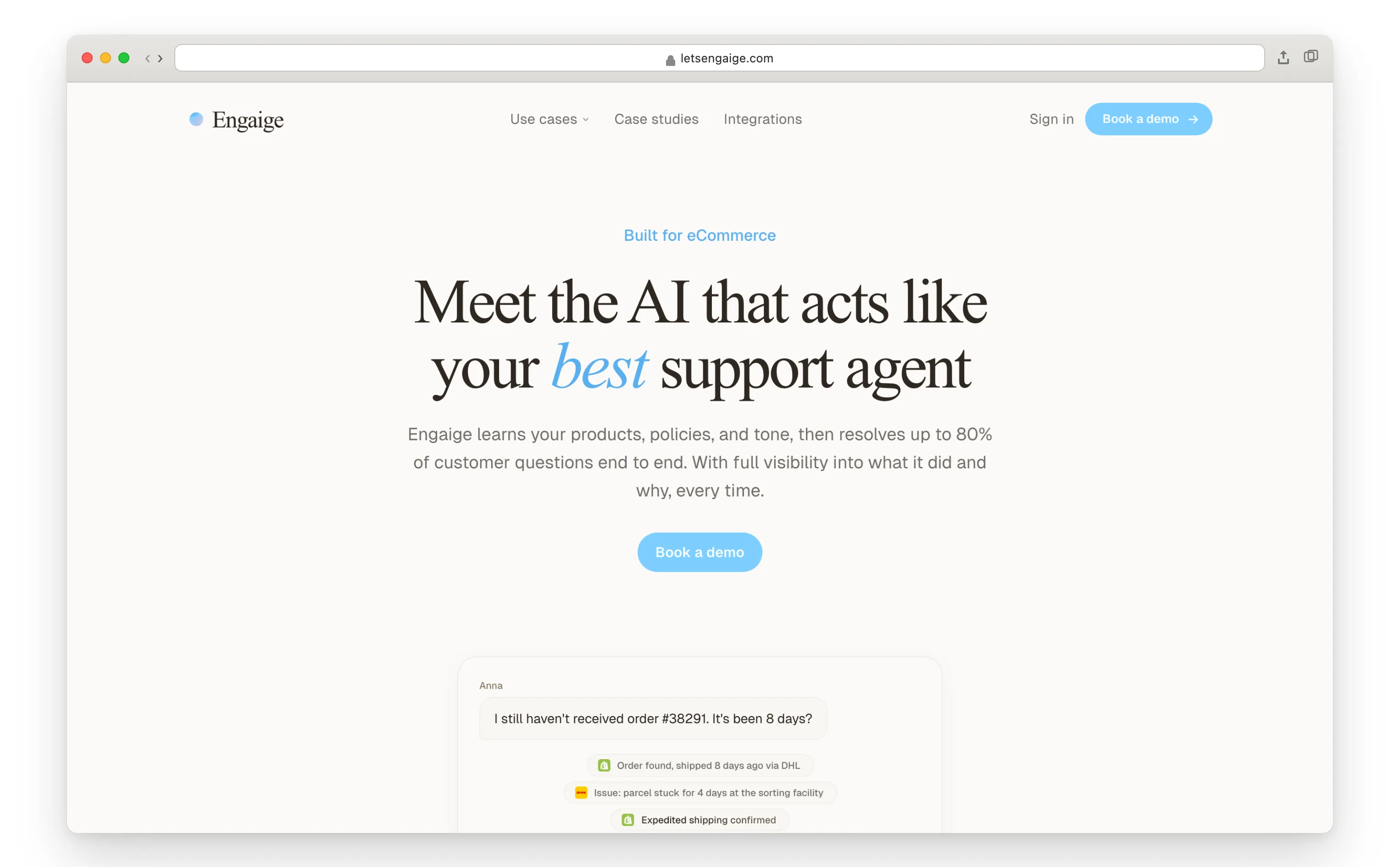
That is where most of the volume actually sits. At Otrium Engaige resolves 60% of 120,000 annual tickets end to end, and at HelloPrint it automated 80% of support and cut first-response time by 90%, figures that include the hard middle of refunds and exceptions, not just easy FAQs.
Engaige offered control, flexibility, and the ability to really incorporate AI in a more human way.

Engaige proved to be invaluable. Their hands-on support during the implementation phase resulted in significant improvements to our automated resolution rate and CSAT.

The practical setup for many stores is both: a voice tool for the phone line, and a text agent for the chat and email that carry the load. For the text side, our e-commerce guide scores the field on what each tool actually resolves.
Frequently asked questions
What is voice AI for customer support?
Voice AI for customer support is software that answers a phone call, understands the caller in natural speech, looks up their order or account, and either resolves the request or routes it to a human. The tools worth buying act on the call, reading the order or starting a return, rather than only reading a script.
What is the best voice AI tool for e-commerce?
For online stores, ringly.io is the clearest e-commerce fit: an AI phone agent for Shopify brands that pulls order history on pickup and handles order status, returns and policy calls. The builder platforms (Vapi, Retell, Synthflow, Bland) and enterprise agents (PolyAI, Sierra) suit teams that want to assemble or buy a broader deployment. The comparison table above shows which acts on the call.
How much does voice AI cost?
Voice AI is usually billed per minute or per call on top of a platform fee. ringly.io runs from $349/mo for 1,000 minutes, with per-minute overage around $0.19 to $0.29; builder platforms charge per minute plus underlying speech and telephony costs; enterprise agents are quote-based. Compare on cost per resolved call, not the headline per-minute rate.
Can voice AI actually resolve calls, or just answer them?
The better tools act: they read the order, start a return or take a payment, then confirm back. Weaker tools only answer and route. The dividing line is whether the agent connects to your order and account systems, and how much you let it do without a human. Treat vendor resolution rates as ceilings, not guarantees.
Is voice AI better than a chatbot for support?
They solve different channels. Voice covers the phone that still rings, useful for urgent or phone-first customers, but it adds the hard problems of transcription and turn-taking. Chat and email carry most e-commerce volume and are cheaper, easier to automate accurately and fully auditable, so most teams automate text first and use voice for the calls that remain.
Does voice AI replace human agents?
No, and the honest vendors say so. Voice AI deflects the repetitive, structured calls (order status, returns, policy) and escalates anything with real context or emotion to a human. A wrong answer spoken confidently on a call is hard to undo, so clean escalation matters as much as raw resolution.
What do I need to run a voice AI agent?
At minimum, a phone number connected over SIP or VoIP, a knowledge source for your policies, and integrations to your order and helpdesk systems so the agent can act rather than just talk. Builder platforms expect you to wire these up; e-commerce and enterprise tools bundle more of it, in exchange for less flexibility.