We compare the parts of customer service that genuinely create value, for you and for your customer, and show on each one which is stronger: an AI agent or your current team. This is the companion piece to our explainer on AI customer support: that one defines the whole category, this one takes the question we hear in almost every conversation with a Head of CX.
You already have a helpdesk, and it is starting to strain. Volume is growing faster than your team can handle, the queue builds up in the evenings and at weekends, and a large share of what comes in is the same thing over and over: where is my order, how do I return this, can I still change my address. The question that surfaces then is not “which helpdesk”, but: does a human still need to answer every ticket?
More and more often the answer is no, and not because AI replaces your team. A helpdesk routes a ticket to a human; an AI agent resolves it itself. That is the dividing line the whole market turns on in 2026, and it is the core of the difference between an AI agent and your current, traditional customer service.
It is not a replacement but a redistribution: the AI takes the repetitive volume, your team keeps the tickets that matter.
What is the difference between an AI agent and your current customer service?
The difference is who resolves the ticket. With traditional customer service your software routes the question to an agent, and that agent answers and acts. An AI agent resolves the ticket itself: it reads the order data, performs the action (start a return, process a refund, change an address) and brings in a human when it should.
Important: this is not your helpdesk versus an AI agent as two competing products. Your helpdesk stays. It is about who sits on the other side of the ticket. Today, in your setup, that is almost always a human, supported by ticket routing, tagging and some FAQ and self-serve deflection. The choice on the table in 2026 is whether you add a layer that handles the first line itself instead of passing it on.
Do not confuse that layer with the chatbot you may already run, either. A chatbot answers with scripts or short snippets and escalates the moment things get complex. An AI agent verifies in your systems and performs the action. We work through the full distinction between a chatbot and an agent in our guide to chatbot vs agent, and the chat side in live chat benefits; here we keep to the headline: a chatbot answers, an agent acts.
Why is this only now a real choice?
Because the technology is past the tipping point. In 2025 around 30% of all service conversations were already handled by AI; heading to 2027 that grows to 50% (Salesforce, 2025).
Until 2024 the trade-off was simple: AI caught FAQ questions, your team did the rest. The AI could not do enough to make the “human or AI” question worth asking. That has changed.
The agent now verifies in your order data and performs the action, and so the question shifts from “which questions can AI catch” to “which questions do I still want a human to handle”.
For an online store that already has a helpdesk, that means something concrete. Today your team spends a large part of its time on questions that need no judgement: where is my order, how do I return this, can I still change my address. That is exactly the kind of question an AI agent now handles end to end. What that looks like in practice is easiest to see in an example.



This is exactly the kind of ticket that, with traditional customer service, costs an agent a few minutes: look up the order, check the return status in the warehouse system, calculate the right amount, create the refund. The AI does the same steps, only without a queue and without it landing on anyone’s plate. That is the heart of the shift, and the reason it has become a real choice rather than a gadget.
April 2026Redditthe AI solutions that work are the ones with access to real customer context - account history, product usage, previous conversations. the ones that fail are basically a chatbot sitting on top of your help docs, giving technically correct answers to the wrong question. · r/CustomerSuccessView on RedditAI agent vs customer service: 7 dimensions side by side
It all comes down to that one distinction: a helpdesk routes the ticket to a human, an AI agent resolves it itself. That is the line the market turns on in 2026, and it is also the lens through which you read every dimension below. Put an AI agent and traditional customer service side by side and you win on one dimension with AI and on another with people. So it is not a ranking with a single winner, but a division. Below are the seven dimensions that make the difference in practice, each with the side that wins.
1. Response time and wait time
An AI agent replies in seconds, at any moment. A human team replies in minutes to hours (our guide to reply times shows how to measure it), and only during office hours unless you run shifts. For the customer with a simple question that is the biggest noticeable difference. Wins: AI, on speed and availability.
2. Coverage outside office hours
A large share of store tickets come in during evenings and weekends, exactly when your team is offline. The AI agent runs 24/7 without rosters or surcharges. Wins: AI, on coverage.
3. Scaling at peak volume
Black Friday, a sale, a viral moment: traditional customer service scales then with temporary staff and overtime, and the wait time climbs anyway. An AI agent absorbs the peak without extra hires. Wins: AI, on elasticity.
4. Consistency and tone of voice
The AI answers the same way every time, in the same tone, regardless of how busy it is or how late. A human varies: by agent, by day, by mood. At the same time an experienced agent adapts their tone better to a specific, sensitive situation. On broad consistency the AI wins, on fine-tuning a difficult conversation the human does. Wins: shared, depending on the ticket.
5. Empathy and emotion
With an angry customer, a complaint or a sensitive story, genuine empathy counts, and a human can bring it in a way an AI cannot match. An AI agent can miss tone-sensitive signals or answer too smoothly where acknowledgement is needed. Wins: human, clearly.
6. Executing actions in your systems
This is the real leap over a chatbot. An AI agent with integrations performs the action itself: start a return, process a refund, change an address, pause a subscription. A human does the same, but clicks through it manually across several systems. The deeper the AI connects into your stack, the more it handles itself. Which tool reaches how deep we analyse in our comparison of e-commerce chatbots. Wins: AI with good integration, otherwise even.
7. Failure mode
Neither is flawless, and naming that honestly is part of this. An AI agent can give a wrong answer with confidence (hallucinate) when context is missing. A human team makes mistakes through busyness, fatigue and inconsistency, and burns out at high volume. The question is not who is never wrong, but what you can control and correct. Wins: shared, provided you keep the AI transparent with logging and escalation rules.
The seven dimensions in one table
| Dimension | AI agent | Traditional customer service | Wins |
|---|---|---|---|
| Response and wait time | Seconds, instant | Minutes to hours | AI |
| Coverage | 24/7, no rosters | Office hours | AI |
| Scaling at peak | Absorbs instantly | Temporary hires, overtime | AI |
| Consistency and tone | Same every time | Varies, but finer-tuned | Shared |
| Empathy and emotion | Limited, can miss tone | The human’s strongest point | Human |
| Executing actions | Performs it via integrations | Manual across systems | AI with integration |
| Failure mode | Hallucination when context is missing | Busyness, fatigue, burnout | Shared |
The table shows the balance: the AI wins on speed, coverage, scale and execution, the human on empathy and judgement, and on consistency and error control it depends on your setup. That is why it is not a replacement, but a division.
Where humans win, and keep winning
One caveat, for honesty’s sake, because without it this piece is a sales pitch. There is a category of tickets where you do not want to replace your team, and should not want to. Broken products, claims, double charges, a customer coming back angry for the third time.
These are the tickets where acknowledgement, judgement and sometimes an exception to your own policy are needed. An AI agent that runs at those autonomously damages your brand faster than it saves tickets.
The market says this most sharply itself.
March 2026RedditReliability is the part people underestimate. The model can write a decent reply, but production support breaks on boring things: email threading, partial order data, refund edge cases, damaged packages, angry customers, and knowing when not to answer. · r/SaaSView on Reddit“Knowing when not to answer” is perhaps the most important skill in support, and it is exactly what you want to free your team up for. A good AI agent is therefore not the agent that tries to resolve everything, but the agent that knows when to escalate. That is not a weakness of the AI agent, it is the condition for deploying it responsibly.
Where is the line heading toward 2027?
The line does not stand still. In 2025 AI already resolved around 30% of all service conversations, heading to 2027 that grows to 50% (Salesforce, 2025). And the agent’s role widens. It does not only lower your support costs; it becomes a commercial layer with live product advice, and reaches deeper into your operation, into inventory and supply chain.
But that does not change the conclusion of this piece, it sharpens it. As the AI takes over more of the repetitive and operational volume, the human’s territory does not shrink away, it concentrates. Your team keeps exactly the tickets where judgement, emotion and exceptions count, the work where humans keep winning. The 2026 model, AI and human each on their strongest work, only becomes more pronounced toward 2027.
Does an AI agent replace your customer service team?
No. An AI agent does not replace a team, it redistributes the work. The mental model behind it is a spectrum, not a fault line, and it splits into three layers that in support are usually called tier-1, tier-2 and tier-3.
Tier-1 is simple and repetitive (“where is my order?”, “how do I return this?”, “can I change my address?”), around 65% of volume, and that you scale through the AI. Tier-2 is the harder middle that needs context (“I returned 2 of 3 items, do I get a partial refund?”, “which size fits me?”), roughly 25%, which the AI resolves with escalation when needed.
Tier-3 is the last 10%: the emotional and complex outliers (“my parcel arrived damaged”, “this is the third time it has gone wrong”) that deserve human attention, which you cannot and should not scale.
For your team that changes not the size of the work, but its nature. The simple, repetitive questions leave the board. What remains is harder, higher-value and often more interesting: resolving the complaints, judging the exceptions, winning the angry customer back. So your helpdesk does not disappear. It becomes the place where people resolve what the AI should not do on its own.
And that line does not stand still. What needs escalation today, the AI does on its own next year, as integrations deepen and models improve. The line moves left.
When do you put an AI agent on your helpdesk, and when not?
You already have a helpdesk, so the question is not whether, but whether now. Three signals give the answer.
- Your volume grows faster than your team. When the queue structurally builds up and the next step is another hire, that is the moment to put the repetitive 65% on the AI first. You keep your team for the work that grows in value, not in volume.
- Simple work eats your team’s time. Track-and-trace and return questions take agent hours that are better spent on judgement calls. Once an AI agent takes that volume over, the maths works out better.
- You miss coverage outside office hours or at peak. Evenings, weekends and sales peaks are where the customer experience leaks most. An AI agent covers that without rosters.
And when not, or at least carefully: if your products are complex and unique (technical, B2B, bespoke), with a high share of genuinely human casework. Then the AI works better as an assistant to your team than as an autonomous front door. So the choice depends less on your volume than on the mix of your questions. How to weigh that across complexity, volume and channel mix sits in our guide to the best AI agents.
April 2026Redditwe did try Zendesk’s AI in the past but they are better at being a helpdesk so we now use a dedicated AI platform. · r/CustomerSuccessView on RedditHow Engaige combines the two
To be honest: Engaige is not a helpdesk, so we do not pick a side in this comparison. We are the layer that sits in front of it. An AI agent for e-commerce, built for the harder middle that rises above standard FAQ: partial refunds, complex returns, product advice when unsure. Through deep native integrations and Engaige AI the agent handles a large share of tickets itself, up to 90% with deep stack integration.
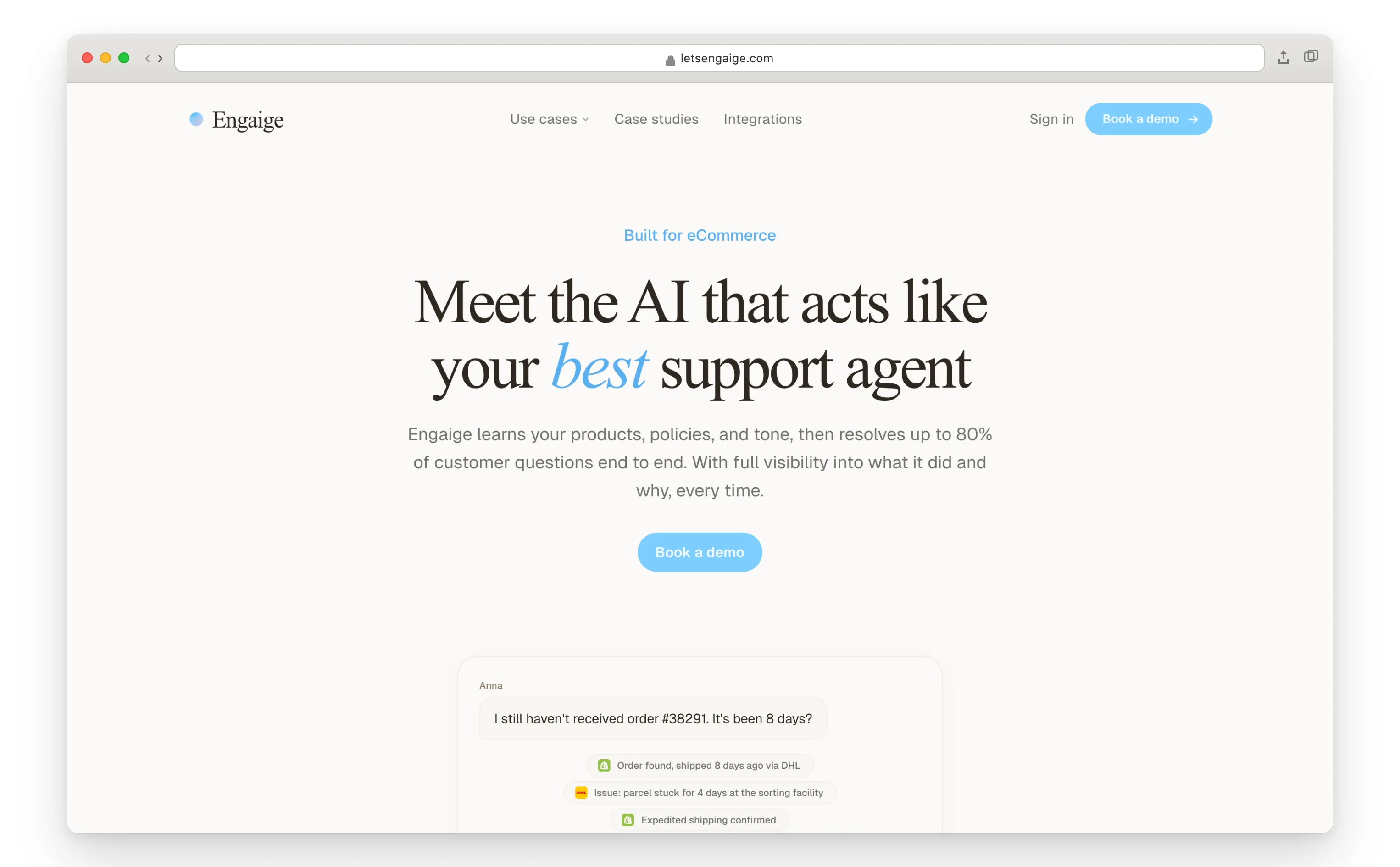
With Engaige AI you configure the agent by describing in plain language how it should work, the way you onboard a new colleague. “For customers with more than three returns in a year: ask the reason before generating a label.” No prompt engineer needed, no decision trees.
The full reasoning for every answer and action sits in the Engaige dashboard, and at a hand-over the agent leaves a reasoning summary as an internal note on the ticket. Policies support thresholds and a per-step choice between Automated and Agent Assist, and you test them in the Playground before launch.
But configuration is only the start. Engaige is a continuously improving agent, and Engaige AI drives that improvement. You go live in Agent Assist within hours, where the agent drafts replies your team approves or edits. From day one it learns from your team’s normal work: what your team sends compared with what the agent suggested is one of its training signals, and Engaige AI proposes changes to policies and behaviour with its reasoning, which you sign off on.
When a ticket type has learned enough, often within about a week, you switch it to autonomous, where it keeps learning from live outcomes and the cases it hands back to a human. So it improves in both modes: from your team’s replies while it assists, and from what happens live once it runs on its own.
And what the agent cannot do itself, it escalates to your team, with the context attached. That is where your helpdesk comes back in, now for the tickets that matter.
”Engaige offered control, flexibility, and the ability to really incorporate AI in a more human way.”

At Otrium our agent handles 60% of its 120,000 annual support tickets autonomously, tuned to their tone of voice and return policy, 24/7, with escalation to the team when it should. The team has not shrunk, it works on other things.
HelloPrint runs 80% of support automated, cut first response time by 90%, and reshaped its team from 100 to 28. If your store runs on Shopify, our guide to the top AI support agents for Shopify shows which agents act inside it.
”Engaige proved to be invaluable. Their hands-on support during the implementation phase resulted in significant improvements to our automated resolution rate and CSAT.”

Frequently asked questions
Does an AI agent replace my customer service team?
No. An AI agent does not replace a team, it redistributes the work. The AI handles the simple and mid-complex tickets (track-and-trace, returns, refunds, address changes), your team keeps time for the complex and emotional tickets that need human judgement. The size of the work changes less than its nature.
What can an AI agent do that a human team cannot?
Reply instantly in seconds, 24/7 without rosters, and absorb peak volume without extra hires. On top of that an AI agent with integrations performs the action itself in your systems, without a queue. On speed, coverage and scale an AI agent beats traditional customer service.
What can a human do that an AI agent cannot?
Genuine empathy on sensitive tickets, judgement on exceptions, and knowing when not to answer. Complaints, claims, angry customers and custom requests stay human work. That does not change, and it is exactly the work you want to free your team up for.
Is an AI agent reliable enough to handle customers itself?
For tier-1 and part of tier-2, yes, provided the agent has access to real customer context and clear escalation rules. The risks sit in edge cases: partial order data, refund exceptions, damaged parcels. A good AI agent does not resolve those at all costs, but escalates them. Keep the agent transparent with logging so you can trace and adjust every action.
What are tier-1, tier-2 and tier-3 tickets?
It is the standard way to sort support questions by complexity, and it sets what you do and do not leave to an AI agent. Tier-1 are the simple, repetitive questions you can handle directly: “where is my order?”, “how do I return this?”, “can I change my address?”.
Tier-2 needs context or a judgement: “I returned 2 of 3 items, do I get a partial refund?” or “which size fits someone who is 1.85m?”. Tier-3 are the complex or emotional cases: “my parcel arrived damaged, I want compensation” or “this is the third time it has gone wrong, I want to speak to someone”.
The 2026 model puts tier-1 and much of tier-2 on the AI agent, and keeps tier-3 with your team.
Do I still need a helpdesk if I use an AI agent?
Yes, for tier-2 and tier-3 escalations. The 2026 model is an AI agent as the front door for tier-1 questions (“where is my order?”, “how do I return this?”) with your helpdesk as the escalation layer for what needs human attention. The ratio shifts: your helpdesk handles less volume, but every ticket that lands there is harder and higher-value.
How many of my tickets can an AI agent take over?
Industry benchmarks show 40 to 60% autonomous resolution within three to six months, depending on your ticket complexity and how deeply the tool integrates into your stack. With deep integration into the operational stack, up to 90% is achievable. At Otrium, Engaige handles 60% of 120,000 annual tickets autonomously.