Every customer service vendor now sells “AI customer support”. The phrase sits on homepages from scripted chatbot builders to autonomous agents, and it hides an enormous range. Some of these tools only answer a question. Others read your order data and resolve the ticket end to end. Buying the wrong one for the job is how support tools end up annoying the customers they were meant to help.
This guide is the definitional starting point for the whole topic. It defines AI customer support, maps the six types you will actually meet onto a single answer-to-act axis, and shows what the category can do for an online store. The rankings live elsewhere: when you want to compare named tools, our guide to the best AI agents scores them in a weighted matrix. Here we define the field.
What is AI customer support?
AI customer support is software that uses artificial intelligence to handle customer service interactions, from answering a question to resolving the request end to end. The meaningful split inside the category is assist vs act: some tools only tell the customer something, while others read the context, apply your rules and perform the action in your systems.
That split matters more than any feature list. G2’s AI Customer Support Agents category requires that a product execute tasks on the customer’s behalf, such as refunds, renewals and scheduling, via function calling (G2, 2026). AWS defines agentic AI as “an autonomous AI system that can act independently to achieve pre-determined goals” (AWS, 2025). The simplest test for any tool: can it do something, or only say something?
What are the types of AI customer support?
There are six common types, and they sit at different points between pure answering and full resolution. A rule-based chatbot only answers (our Crisp chat box guide shows one in a store); an AI agent resolves. The four types in between either answer more fluently, assist a human, or act on the workflow without holding a conversation. The table maps them, with a named example of each.
| Type | What it does | Answers or acts | Example |
|---|---|---|---|
| Rule-based chatbot | Walks a fixed decision tree or button flow; anything off-script hits a fallback | Answers | Tidio Flows |
| AI chatbot | Uses NLP or generative AI to answer in natural language; the job ends at the answer | Answers | Help Scout |
| Agent-assist / copilot | Drafts replies and surfaces context for a human agent who stays in control | Assists | Zendesk Copilot |
| Automation / deflection layer | Classifies, tags and routes tickets inside the helpdesk; not a conversation | Acts on workflow | Zendesk triage |
| Voice AI | The reason-and-act logic on the phone channel, with natural speech | Acts | Retell AI |
| AI agent | Reads context, applies policy, performs the action in your systems, escalates | Resolves | Intercom Fin |
The first type is where most disappointment starts. A rule-based chatbot is built to contain volume, not to resolve, and customers feel the difference fast.
May 2026RedditNot too long ago, the obsession for almost every enterprise company was throwing in a rigid chatbot, the kind with buttons or endless decision trees, just to contain ticket volume. It didn’t really matter if the user actually got an answer; success was measured by how many people didn’t reach a human agent. In the end, all it did was leave customers incredibly frustrated, spending three minutes spamming “agent” on their screens. · r/CustomerSuccessView on RedditThe act side of the axis is a different product. Where a chatbot answers and an agent resolves is the distinction the whole category turns on, and we walk through it in full in our guide to chatbot vs agent. Voice AI applies that same act-side logic to the phone line, and we compare the voice tools in a dedicated guide.
Why AI customer support in 2026?
Because the technology crossed the line from assisting to resolving, and the money followed. The market for AI in customer service is projected to grow from $12.06bn in 2024 to $47.82bn by 2030, a 25.8% compound annual growth rate (MarketsandMarkets, 2024). That is not chatbot spend; it is investment in tools that act.
Adoption is tracking the spend. Around 30% of customer service interactions were already handled by AI in 2025, projected to reach roughly 50% by 2027 (Salesforce, 2025). Until recently the question was which FAQ questions AI could absorb. Now it is which tickets you still want a human to handle, because the tools can do the rest.
What can AI customer support actually do?
On the act side, it resolves the request, not just describes it. For an online store that means the action-shaped tickets that dominate volume: order status, returns and refunds, address changes, subscription edits and product advice. It reads the order, applies your policy, performs the change in the backend and confirms back, escalating anything outside the rules.
The clearest way to see the difference is to watch one ticket resolve end to end.


That is the act side at work: order looked up, carrier history read, the underlying problem spotted, a replacement shipped, all without a queue or a human touch. The same logic now runs on the phone too. One fintech operator described running an AI voice agent at real volume:
May 2026RedditWe’re a fintech and our AI voice agent now handles around 100k inbound calls a month, billing questions, account issues, the usual mix. It’s been a win on cost and response time. · r/CustomerSuccessView on RedditWhat are the benefits?
The headline benefits are speed, coverage and cost. An agent answers in seconds, runs 24/7 without rosters, and absorbs peak volume without temporary hires. On cost, an AI resolution runs a fraction of a human-handled ticket, on the order of ten times less per ticket (eesel, third-party comparison), and on the act side it also lifts revenue through product advice at the moment of doubt.
The benefit operators rate highest, though, is what it does for the team. The assist types make people better rather than replacing them, and the act types take the repetitive volume off the board so the team can spend its time where judgement matters.
May 2026Redditthe single most useful thing i ever built there wasn’t an autonomous bot, it was a setup that made the humans way better. the common platforms are only really safe to run unsupervised on the boring high-volume stuff. anything with real context or emotion attached, you want a human reading the draft before it goes. · r/CustomerSuccessView on RedditWhat are the risks and challenges?
The biggest risk is miscasting: putting an answer-only tool in front of action-shaped tickets it can never finish. A bot that confidently gives the wrong answer, or a vague non-answer, does not just fail to resolve; it loses the customer silently.
April 2026Redditcustomer asks something slightly off, maybe a weird edge case, maybe they just worded it differently than your docs. if you haven’t handled that, the bot either confidently says something wrong or gives this vague nothing answer like “i’m sorry i didn’t understand that.” customer reads that and just closes the chat. doesn’t email. doesn’t call. just leaves. · r/CustomerSuccessView on RedditOn the act side, the risk shifts to autonomy and governance. An agent that resolves can also resolve wrongly, and the subtle failures are the dangerous ones. The fix is not to avoid autonomy but to bound it: clear escalation rules, full logging, and a human on anything that carries judgement.
June 2026Redditthe failure mode that surprised me is that 90%-right drafts are more dangerous than 50%-right ones. when drafts are clearly bad CSMs rewrite from scratch. when drafts read “fine” they get shipped with stale info, and you don’t notice until the customer comes back asking why the answer is from the old pricing page. · r/CustomerSuccessView on RedditThe other recurring challenge is integration depth. A capable model on top of shallow data answers confidently and wrongly, because it cannot see the order, the policy or the history it needs. Depth of access, not the model, is usually the real bottleneck.
How do you evaluate AI customer support?
Score it on what it resolves and how it is governed, not on its feature list. Six criteria separate the tools that act from the ones that merely answer, and each answers a question the marketing page will not.
| Criterion | The question it answers |
|---|---|
| Resolution level | What share of tickets does it close autonomously, and how complex? |
| Integration depth | How far can it act per connection, not just how many it lists? |
| Transparency and control | Can you see what it did and why, and set escalation rules? |
| Pricing predictability | How forecastable is the bill as volume grows? |
| Configurability | Can a CX team adjust it in plain language, without developers? |
| Time-to-value | How fast does it ramp to a meaningful resolution level? |
Two of them catch most buyers out. Integration depth is usually the real ceiling on what a tool can resolve, and pricing predictability decides how well you can forecast the bill as volume grows. We apply all six across named tools in the full matrix in our guide to the best AI agents.
Does AI customer support replace human teams?
No. It redistributes the work. The agent becomes the front door for the repetitive, action-shaped volume, and the team keeps the exceptions, complaints and judgement calls, with every escalation arriving with full context. Gartner frames the destination as an “intelligent front door”: one entry point that understands intent, executes a transaction, and escalates when it should (Gartner, 2025).
The escalation half of that matters as much as the execution half. Teams that do this well keep humans close to the conversation stream, because early customer contact is a learning channel, not just a cost. Whether a tool replaces or augments your team is its own question, which we take apart in replace or augment.
Which AI customer support fits your market?
The six types are universal, but the right starting point shifts with your market. An online store leans on deep store actions, a SaaS or subscription business on account and billing depth, and a large multi-sector team on governance and breadth. Same assist-to-act axis, different priorities, and a different shortlist to start from.
| Your market | What matters most | Where to start |
|---|---|---|
| E-commerce and online retail | Store-action depth: WISMO, returns, refunds, order edits, subscriptions and product advice, executed in the store | Our best AI chatbots, scored on what each tool resolves in your store |
| SaaS, subscriptions and fintech | Account and billing context, technical troubleshooting, and breadth across a wider tool stack | Our best AI agents, scored across industries |
| Large or multi-sector support teams | Governance, transparency, routing, and many channels and languages at scale | The horizontal enterprise agents in that same best AI agents matrix |
| Small teams starting out | Fast setup, an assist-first model, and predictable cost at low volume | The SMB and assist-leaning tools, also covered in that matrix |
The rule holds across all four: match the tool to the work your market actually generates, not to the longest feature list. An online store that buys a horizontal suite inherits a shallow store integration, and a SaaS team that buys an e-commerce-native agent pays for store actions it never uses.
Where does Engaige fit?
Engaige sits on the act side: an AI agent built for e-commerce that resolves tickets end to end (WISMO, returns, refunds, subscription changes) on top of your existing helpdesk, configured and taught in plain language through Engaige AI. It learns from your team’s normal work from day one.
You go live in Agent Assist within hours. What your team sends compared with what the agent suggested is one of its training signals, and Engaige AI proposes improvements with their reasoning, which you approve, so resolution compounds.
When a ticket type has learned enough, often within about a week, you switch it to autonomous, and it keeps learning there too: it surfaces emerging trends and the cases where the agent hands a ticket back to a human, and learns from those.
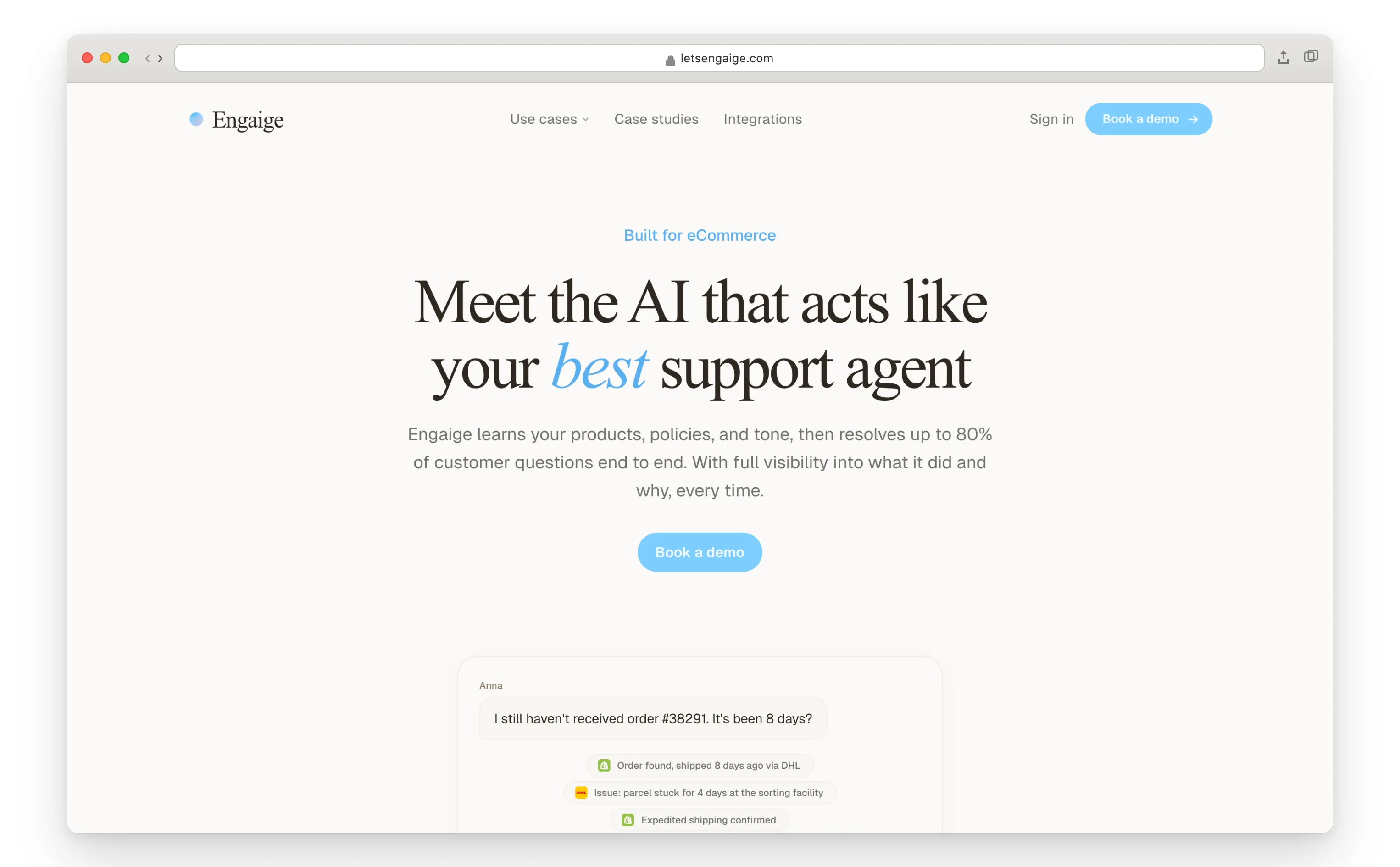
The proof is named. Otrium resolves 60% of its 120,000 annual tickets autonomously, where resolved means the agent closed the ticket end to end with no human touch. HelloPrint runs 80% of support automated at steady state, cut first response time by 90%, and reshaped its team from 100 to 28.
The “up to 90%” we cite is our ceiling at the deepest integrations, the same kind of vendor claim you should challenge every supplier on. Pricing is flat to a ticket volume. The catch: Engaige is e-commerce-specialised, not horizontal.
”Engaige offered control, flexibility, and the ability to really incorporate AI in a more human way.”

”Engaige proved to be invaluable. Their hands-on support during the implementation phase resulted in significant improvements to our automated resolution rate and CSAT.”

Every decision the agent takes is visible: the reasoning, the policies applied, the actions performed, and the source behind each answer. When something needs adjusting, you change the rule in plain language and the agent follows it.
Frequently asked questions
What is AI customer support?
AI customer support is software that uses artificial intelligence to handle customer service interactions, from answering a question to resolving the request end to end. The meaningful split is assist vs act: some tools only tell the customer something, while others read the context, apply your rules and perform the action in your systems.
What are the main types of AI customer support?
Six: a rule-based chatbot, an AI chatbot, agent-assist or copilot, an automation and deflection layer, voice AI, and an AI agent. They sit at different points between answering and resolving. A rule-based chatbot only answers; an AI agent reads context and performs the action; the others answer more fluently, assist a human, or act on the workflow.
How do you use AI in customer service?
Start with the tickets that repeat most, such as order status, returns and cancellations, and connect the AI to your helpdesk and store data so replies use live order information. Let it draft answers first, move to autonomous resolution once accuracy is proven, and measure resolution rate rather than deflection. Our customer service automation guide walks through this step by step.
Is AI customer support the same as a chatbot?
No. A chatbot is one type of AI customer support, and the most limited one. It answers questions from scripts or FAQ content, while other types, especially the AI agent, take actions in your systems and resolve the ticket. The simplest test is whether the tool can do something or only say something.
Can AI customer support resolve issues on its own?
The agent type can, when it is integrated deeply enough with your store backend and your policies allow it. It can process refunds, change orders and update subscriptions, then escalate anything outside the rules. Not every product marketed as AI customer support goes beyond answering, so ask each vendor which actions it can execute in your platform.
Does AI customer support replace human agents?
It redistributes the work rather than removing the people. The agent takes the repetitive, action-shaped volume as the front door; humans keep the complaints, exceptions and judgement calls, with each escalation arriving with full context. Teams that do this well keep people close to the conversation stream as a learning channel.
How much does AI customer support cost?
It depends on the model. An AI resolution runs a fraction of a human-handled ticket, on the order of ten times less per ticket (third-party comparison), but pricing structure matters as much as unit cost: per-resolution models bill each resolution, while flat models tie a monthly fee to a ticket volume, so you can forecast it as volume grows. The full cost picture sits in our guide to the best AI agents.