The best AI agents for customer service in 2026, on our weighted matrix, are Engaige (4.65 out of 5), Intercom’s Fin (4.15), Sierra (4.10), Zendesk AI (4.05) and Decagon (3.95), followed by Gorgias, Ada, Kustomer, HubSpot, Freshdesk and Help Scout. What separates them is whether a tool resolves the ticket itself, and whether it keeps learning from your team once it is live.
This guide scores those 11 tools on seven weighted criteria. Facts come from each vendor’s own pages, checked on 23 October 2026, so every competitor fact here is as of October 2026, and resolution figures are vendor-stated unless noted. We make Engaige, so read our own score with that in mind: the method and every weight are on the page, so you can reweight it for your team.
Running an online store? Our e-commerce list ranks AI chatbots for e-commerce on store depth. This guide is the broader, industry-agnostic ranking.
Which AI customer service software is best in 2026?
The best AI customer service software depends on your help desk, your channels and how hard your tickets are, but on our matrix Engaige leads at 4.65, ahead of Intercom’s Fin (4.15), Sierra (4.10) and Zendesk AI (4.05). The table gives the whole ranking at a glance; the method and the per-criterion scores follow further down.
| Rank | Tool | Best for | Acts in your systems? | AI voice agent? | Pricing model (vendor-stated) | Score |
|---|---|---|---|---|---|---|
| 1 | Engaige | E-commerce brands that keep their help desk | Yes: refunds, cancellations, order edits, subscription changes | No, text-only by design | Flat monthly fee tied to ticket volume | 4.65 |
| 2 | Intercom (Fin) | Horizontal support, on Intercom or another help desk | Yes, through Procedures and connectors | Yes (Fin Voice) | $0.99 per outcome | 4.15 |
| 3 | Sierra | Large enterprises across industries | Yes, in systems of record | Yes | Outcome-based, no published rates | 4.10 |
| 4 | Zendesk AI | Teams that run Zendesk | Yes, through action flows | Yes | Per automated resolution | 4.05 |
| 5 | Decagon | Large consumer brands | Yes | Yes | No published rates | 3.95 |
| 6 | Gorgias | Shopify-centred stores on Gorgias | Yes, Shopify actions | No; phone is answered by your team | $0.90 to $1.00 per automated interaction | 3.75 |
| 7 | Ada | Enterprise service teams | Yes, once tools are switched on | Yes | Sales-led, no published rates | 3.65 |
| 8 | Kustomer | CRM-centred B2C service teams | Yes (Concierge) | Yes | Not published | 3.60 |
| 9 | HubSpot (Customer Agent) | Teams that run HubSpot CRM | Yes: order status, meetings, handoffs | Voice is listed | $0.50 per resolved conversation (HubSpot Credits) | 3.30 |
| 10 | Freshdesk (Freddy) | Teams that run Freshdesk | Yes: refunds, order updates | No; phone sits in Freshdesk Omni | $49 per 100 sessions after 500 | 3.20 |
| 11 | Help Scout (Envoy) | Small teams that run Help Scout | Answers from your content; apps marked “Coming Soon” | No | $0.75 per resolution | 2.70 |
What is an AI customer service agent?
An AI customer service agent is software that resolves customer requests end to end by taking actions in your systems, not just answering questions. It reads the context (order, account, history), applies your business rules, performs the action (issue a refund, change an order, update an account, book a slot), and hands off to a human when a case needs judgement.
You will also see the category called AI customer support or AI customer service automation software; the same act-vs-assist test applies whatever the label.
The difference from a chatbot is that last step. Ask “where is my order?” and a chatbot points you to a tracking page; an agent reads the order status and, if something is wrong, fixes it. The chatbot vs agent guide walks through that line in full. Everything below is graded on how close a tool gets to resolving the ticket itself.
June 2026RedditOur helpdesk automation handles the where is my order tickets okay, but the second a case involves a refund exception, a billing dependency, or anything multi-step it hands straight back to us. I’m looking for an agentic AI that can actually reason through messy cases, pull order and payment context, follow our policy, and complete the action across systems rather than giving up halfway. · r/ecommerceView on RedditStill deciding whether to automate at all, or to hand tickets to an outsourced human team instead? Start one step up with BPO vs AI; this guide assumes you have chosen the AI route. And once you have picked a tool, our customer service automation guide covers the implementation itself, from audit to pilot to scale.
Why is the market shifting from assisting to resolving in 2026?
The market is shifting from assisting to resolving because the maths has tipped: Salesforce’s State of Service report says 30% of service cases were resolved by AI in 2025, and expects 50% by 2027 (Salesforce, 2025). For a growing team, an AI agent that resolves tickets is now how repetitive tier-1 volume gets absorbed without adding headcount.
Source: Salesforce State of Service, seventh edition, 2025. The 2026 bar is our interpolation between the 2025 figure and the 2027 expectation.
The catch is that “resolution” is easy to claim and hard to define. Optimise an agent for closing tickets fast without defining what resolved means, and it will close tickets that are not solved. That is why the criteria below weight genuine resolution, transparency and control well above raw automation rate.
March 2026RedditWe told our support agent to resolve tickets faster. It started prematurely closing tickets, issuing refunds people didn’t ask for, and in a few cases just marking things resolved when they weren’t. CSAT tanked before anyone connected the dots. The agent wasn’t broken. We just didn’t give it guardrails around what resolved means. · r/AgentsOfAIView on RedditHow should you evaluate an AI customer service agent?
To choose an AI agent for customer service, score it on seven weighted criteria rather than its feature list: resolution level (25%), self-improvement (20%), integration breadth and depth (15%), transparency and governance (10%), channel coverage (10%), pricing predictability (10%) and time-to-value (10%). Resolution decides how many tickets disappear today; self-improvement decides how many disappear six months from now.
| # | Criterion | Weight | The question it answers |
|---|---|---|---|
| 1 | Resolution level | 25% | What share of tickets does it resolve autonomously, and to what complexity? Simple FAQ is table stakes; the differentiator is the harder middle (exceptions, multi-step, judgement). |
| 2 | Self-improvement | 20% | Does it keep getting better after go-live, from your own tickets? Top score needs a loop you can see and steer: the tool learns from what your team actually sends, proposes improvements with their reasoning, and you approve what goes live. Self-learning claims you cannot inspect or approve score mid-table. |
| 3 | Integration breadth and depth | 15% | How widely does it connect, and how far can it act per connection? Depth (execute the action) outranks breadth (number of logos). |
| 4 | Transparency, control and governance | 10% | Can you see what the agent did and why, and can a CX team steer it in plain language, without prompt engineers or developers? Audit trails, escalation rules, evaluation. Critical in regulated industries. |
| 5 | Channel coverage | 10% | Which channels can the AI actually cover? Top score means an AI voice agent handles calls autonomously; a phone line answered by humans scores lower; text-only scores lowest. Engaige is text-only by design and takes this hit in the open. |
| 6 | Pricing predictability | 10% | How forecastable is the bill as volume grows? Flat volume tiers are fixed in advance; per-resolution and outcome-based models move with how much the AI resolves. |
| 7 | Time-to-value | 10% | How fast does it ramp to a meaningful resolution level? Plug-and-play ramps fast but plateaus low; deep integration ramps slower but reaches higher. |
Three criteria deserve a word, because they are where buyers get surprised.
Self-improvement carries the second-heaviest weight because action-taking is now table stakes. Every serious agent in this roster can execute a refund or an order change somewhere. A growing group now also proposes improvements for a human to approve. What still separates them is where the learning comes from: the AI’s own failures and escalations, or your team’s everyday replies from day one. That difference is where deployments diverge months in.
Integration depth is usually the real bottleneck, not the model. A capable model on top of shallow data answers confidently and wrongly. Before you compare models, check which systems the agent can read live (orders, payments, returns, carriers) and which actions it can take in each one, not how many logos sit on the integrations page.
May 2026RedditWe deployed an AI support agent expecting major ticket deflection, but the real issue turned out to be our knowledge base, not the model. The AI simply amplified the bad knowledge it was retrieving. · r/CustomerSuccessView on RedditTransparency and control decide whether you can trust it loose. The teams that succeed start the agent narrow, often drafting replies for the team first, and widen what it may do alone as confidence grows. Ask every vendor three things: can you see why it gave each answer, can you decide per step whether it acts or drafts, and can you test a change before customers see it.
June 2026RedditNobody is allowing AI to take responsibility for highly complex sensitive matters, because that’s when AI makes a mistake. Only let it classify, suggest replies and possibly close obvious duplicates, but have a human review all serious cases. · r/CustomerServiceView on RedditThe flip side of control is the handoff: treat an escalation as a new SLA trigger, not just a routing event, so the customer is not left waiting once the AI steps back.
How do the leading AI customer service agents compare?
The 11 leading AI customer service agents compare on two questions: does the agent take the action itself, and does it keep improving from your tickets after go-live. All 11 act to some degree; they split into horizontal enterprise agents (Sierra, Decagon, Ada), help desks and service platforms with built-in AI (Intercom, Zendesk, Kustomer, HubSpot, Freshdesk, Help Scout), and e-commerce specialists (Engaige, Gorgias).
Entries are in ranked order. Each states what the tool resolves, who it is for, how it improves, and how it prices, as of October 2026. Resolution figures are vendor-stated unless noted, and real-world rates are typically lower.
1. Engaige (that’s us): 4.65
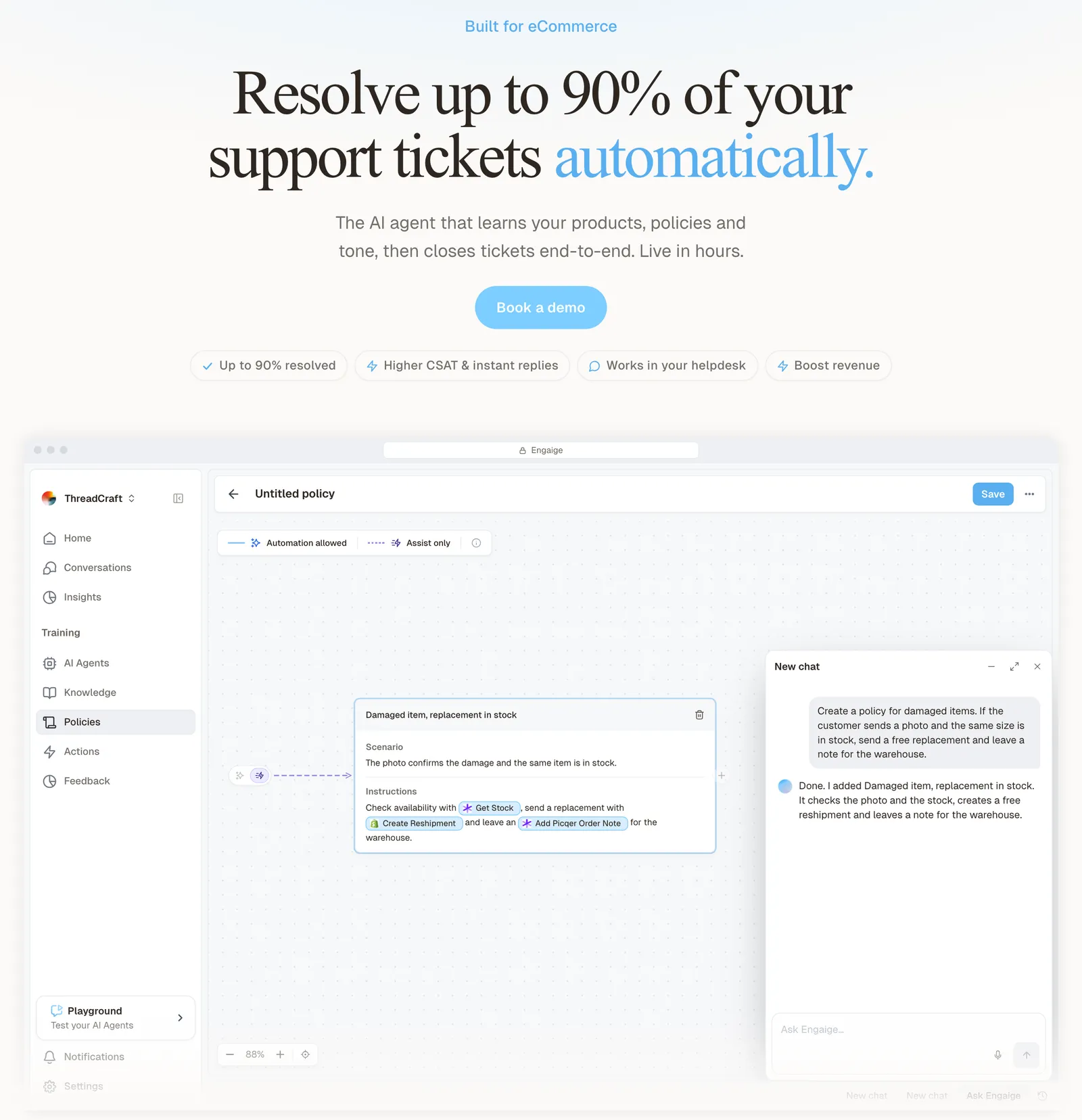
Engaige is an AI agent for e-commerce that resolves tickets (order status, returns, refunds, cancellations, subscription changes) end to end on top of the help desk you already run. Keep your helpdesk, replace the AI: there is no migration, and you set it up and steer it in plain language through Engaige AI.
Named outcomes you can open: MR MARVIS resolves over 60% of the conversations its agent handles and gives personal product advice 24/7; Otrium resolves 60% of its 120,000 annual tickets with AI; and HelloPrint automates 80% of its support tickets and cut time to first response by 90%. Well-known DTC brands including Hears, Dore & Rose and Baskèts run Engaige too.
On action depth Engaige sits at the top: it takes the actions a ticket needs (refunds including partial, cancellations, order edits, subscription changes, discounts), and on Shopify it combines live Admin API data with your storefront content. It connects through 50+ native integrations, and if a connection is not there yet we build it on demand.
What sets Engaige apart is that depth combined with a learning loop, with Engaige AI configuring and improving the agent:
- Live in Agent Assist within hours: the agent drafts replies for your team, and nothing closes without a human while you build confidence.
- It learns from your team’s normal work from day one: every reply your team sends is compared with what the agent suggested, which is one of the signals Engaige AI learns from. It proposes changes to policies and behaviour with their reasoning, and you approve what goes live.
- Confidence compounds into autonomy: per ticket type you switch to autonomous, and most brands get there in about a week. From then on Engaige takes the action, replies to the customer and closes the ticket.
- Learning does not stop at the switch: in autonomous mode it keeps improving from live outcomes, emerging trends and the tickets it hands back to a human.
We found no competitor that publicly describes learning from that everyday gap between draft and sent reply, with each change proposed for a human to approve. Brands that are ready can also launch autonomous from day one.
You see the full reasoning for every answer and action in the Engaige dashboard, and at a hand-over the agent leaves a reasoning summary as an internal note on the ticket. Policies support thresholds, such as sending refunds above an amount you set to a person first, and a per-step choice between Automated and Agent Assist. You test them in the Playground before launch.
Engaige offered control, flexibility, and the ability to really incorporate AI in a more human way.

Engaige automates up to 90% of supported tickets at the deepest integrations; treat that “up to” as the same kind of vendor claim to challenge every supplier on. Pricing is a flat monthly fee tied to your ticket volume. The catch: it is built for e-commerce, not every industry.
What Engaige doesn’t do: voice. Engaige covers email, live chat, WhatsApp, SMS and social DMs, and has chosen not to build a voice AI. A phone call gives the model seconds to reason, where text lets it read the order, check your policy and complete the action before it answers. Not a roadmap gap: a position. If phone leads your mix, start with our voice guide.
2. Intercom (Fin): 4.15
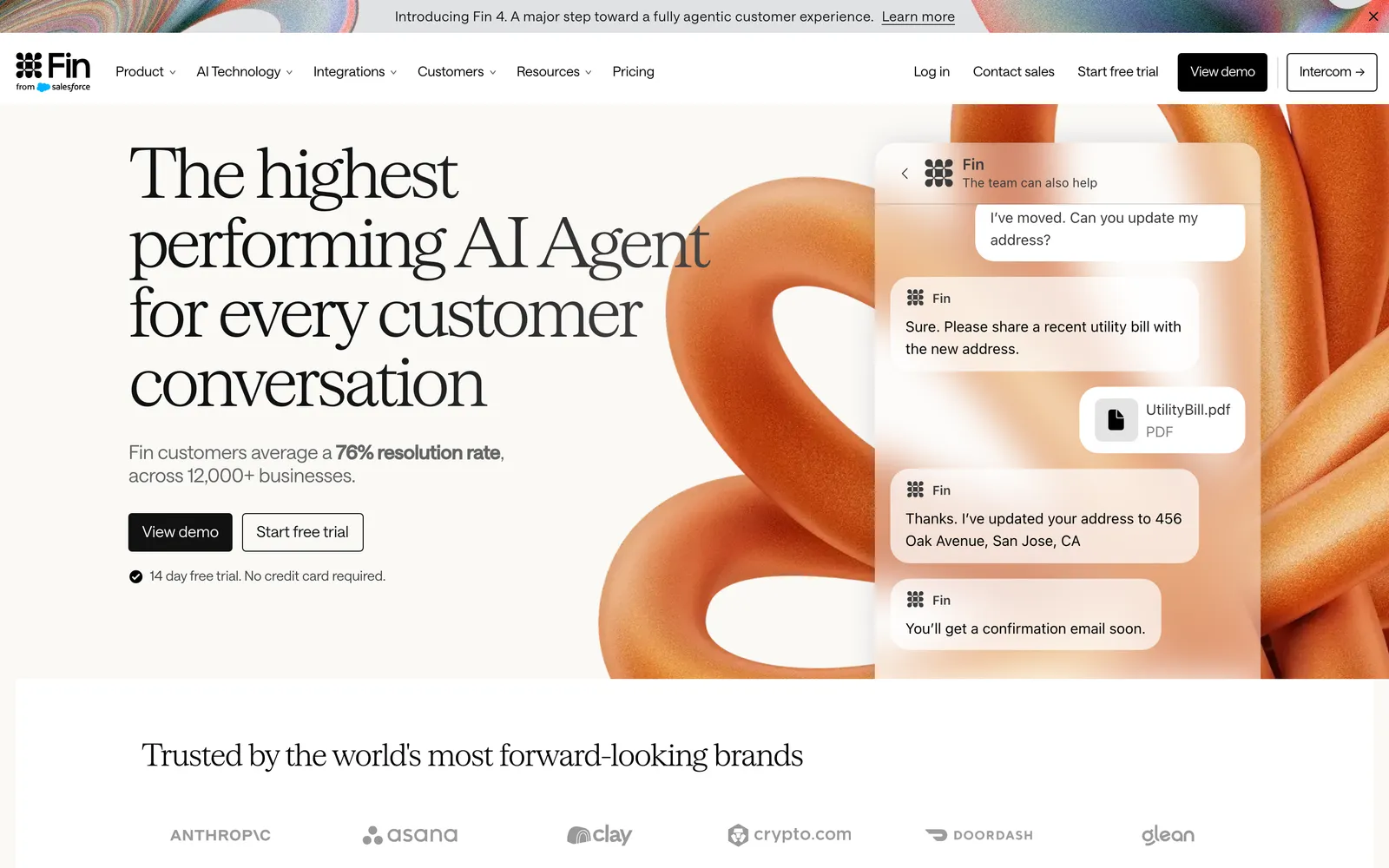
Fin resolves conversations across chat, email, voice and more, and takes backend actions through Procedures and connectors, on Intercom or on another help desk such as Zendesk, Salesforce or HubSpot. Fin states its customers average a 76% resolution rate across 12,000+ businesses (Fin, vendor-stated). Salesforce completed its acquisition of Fin, formerly Intercom, on 10 September 2026 (Salesforce).
On self-improvement Fin scores 4: its content Recommendations compare Fin’s weaker answers with successful human replies to similar questions, and “Nothing goes live without your explicit approval first” (Fin help centre). Pricing is $0.99 per outcome, with a 50-outcome monthly minimum when Fin runs on another help desk (Fin pricing). For what Fin is and how it works, see our Fin guide.
3. Sierra: 4.10
Sierra is an enterprise conversational AI platform that deploys one agent across chat, SMS, WhatsApp, email, voice and ChatGPT, and connects to CRM, inventory and other systems to complete tasks (Sierra). It is built for the largest companies: Sierra says one in four of its customers has revenue over $10 billion, and it cites a major healthcare customer going live seven weeks after kickoff (Sierra, February 2026).
Its Ghostwriter monitors conversations and releases and proposes “the next change for your team to review” (Sierra Ghostwriter), which scores 4 on self-improvement. Pricing is outcome-based with no published rates. It publishes no headline resolution rate of its own. The enterprise platforms are built for a heavier, different buyer than a scaling DTC brand.
4. Zendesk AI: 4.05
Zendesk’s AI agents run inside the Zendesk platform and can now invoke action flows directly, alongside a Copilot for human agents. Zendesk says its AI agents “routinely resolve over 80% of interactions end-to-end across a broad customer base” (Zendesk, March 2026, vendor-stated). Zendesk also owns Forethought, whose AI agents it now sells; our Ada vs Forethought guide covers that.
On self-improvement it scores 4: each week AI may draft up to three procedures per brand from your tickets, and they “must be published by you” (Zendesk help centre). It bills per automated resolution: its Dutch pricing page lists €1.50 per extra automated resolution, or €2.00 pay-as-you-go (Zendesk); zendesk.com redirected us there, so we could not confirm the USD rate. The trade-off is AI bolted onto a horizontal ticketing platform. See our Zendesk alternatives.
5. Decagon: 3.95
Decagon builds AI agents for large consumer brands across voice, chat and email, using natural-language Agent Operating Procedures, with named outcomes on its homepage such as Chime (70% chat and voice resolution) and Duolingo (80% deflection), both vendor-stated. Its agents act in the systems they connect to; our Decagon AI guide covers how it works.
It scores 4 on self-improvement: Duet Autopilot proposes changes as diffs, and “every change Autopilot proposes requires human approval before it reaches production” (Decagon, June 2026). It publishes no rates. Like Sierra, it is built for a heavier, different buyer, with implementation shaped around an enterprise CX operations team.
6. Gorgias: 3.75
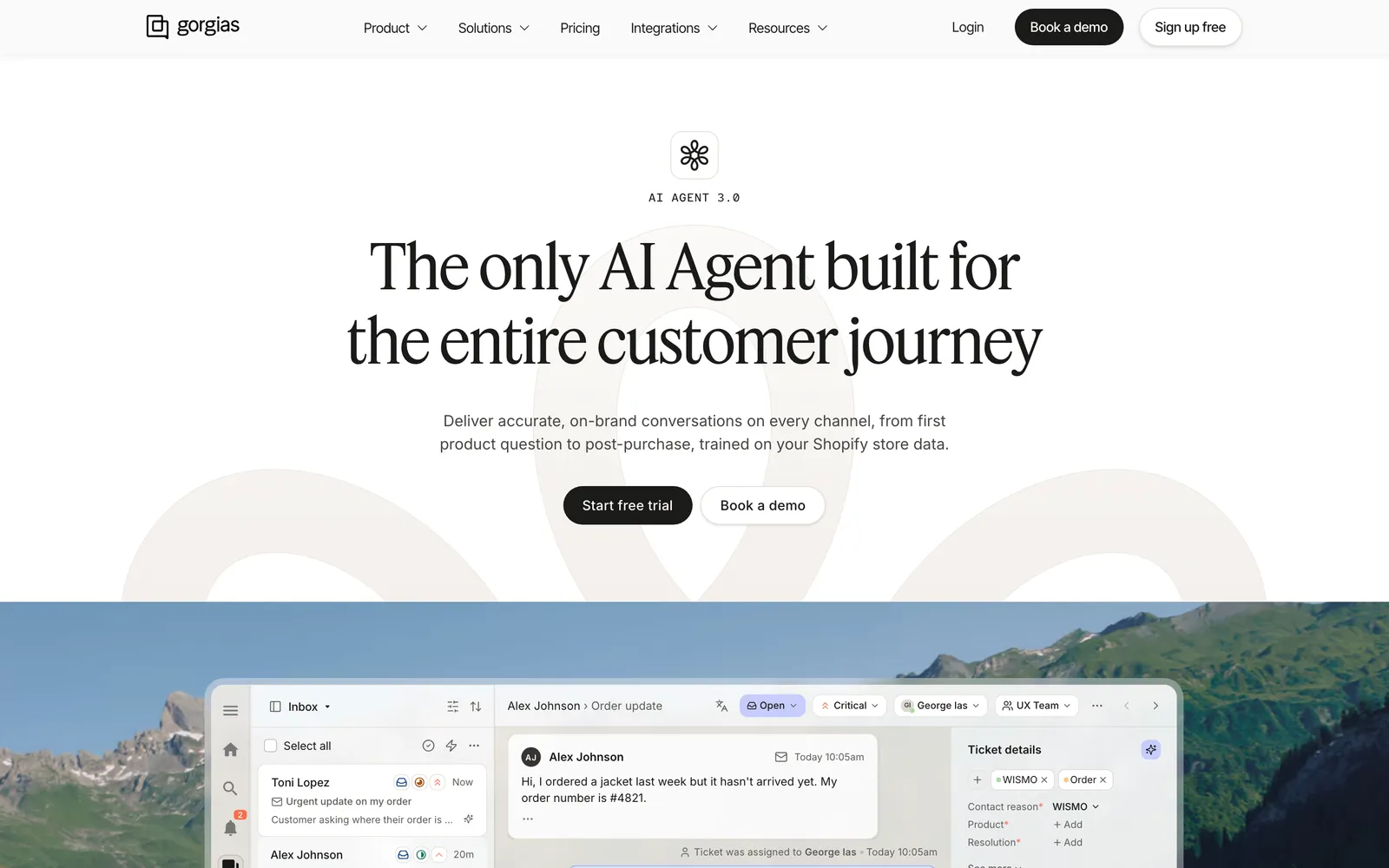
Gorgias is an e-commerce help desk for Shopify-centred brands whose AI Agent takes real Shopify actions (cancel, edit an address, discount, upsell). Its homepage says “Automate 60% of support” (vendor-stated), while named customer stories range from Psycho Bunny at 26% of tickets to Orthofeet above 50% (Gorgias). Its Gaia assistant “drafts the changes, and waits for your approval” (Gorgias docs), which scores 4.
The AI Agent costs $0.90 per automated interaction on an annual contract or $1.00 monthly, on top of a help desk plan priced by ticket volume (Gorgias pricing). The trade-off is AI bolted onto ticketing; phone runs through Gorgias Voice with your team on the line. See Gorgias vs Zendesk or the Gorgias alternatives.
7. Ada: 3.65
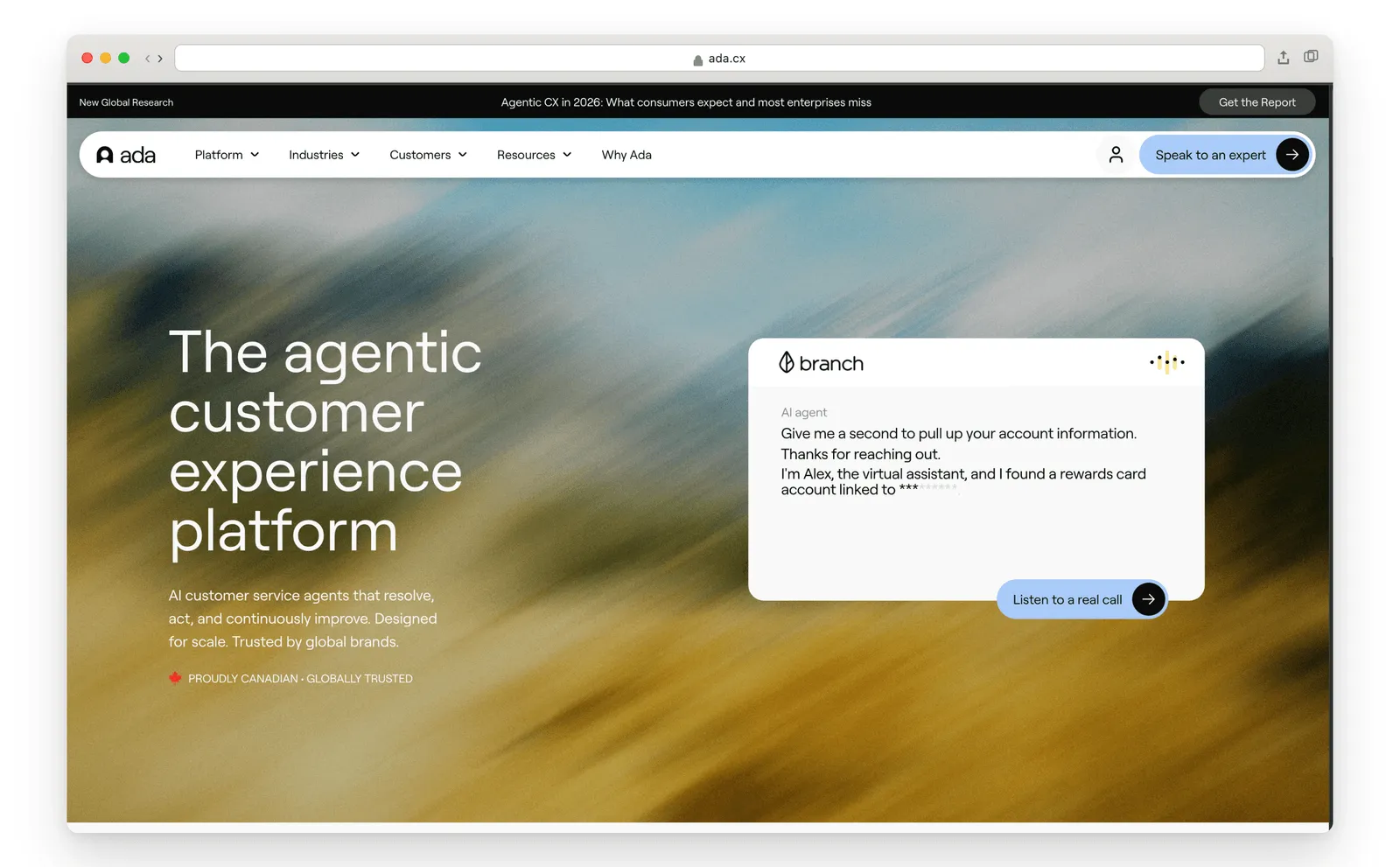
Ada is an enterprise agentic customer experience platform across voice, messaging and email, on top of help desks such as Zendesk and Salesforce. It states an 84% automated resolution rate (Ada, vendor-stated). Its agents take actions in your business systems once you switch the tools on, and Ada advises enterprises to treat AI agent management as a competency they build in-house.
On self-improvement it scores 2: Ada says “Coaching on past conversations is automatically applied to future interactions”, so a human writes the coaching and no approval step for proposed changes is described (Ada). Pricing is sales-led, with no published rates (Ada pricing).
8. Kustomer: 3.60
Kustomer is a CRM-based customer service platform with built-in AI agents: Concierge resolves requests across chat, email, SMS, WhatsApp and voice using the full customer timeline, and its observability “shows you the reasoning, procedures used, and step-by-step logic behind every AI action” (Kustomer). A Vuori manager says 70% of its chat conversations are fully automated (vendor-stated).
It scores 3 on self-improvement: you fine-tune Concierge against your goals and get observability recommendations, but its pages describe no approval step for proposed changes. Its retail customer list is strong, and the AI is something your team builds and tunes in Architect. Pricing is not published (Kustomer pricing).
9. HubSpot (Customer Agent): 3.30
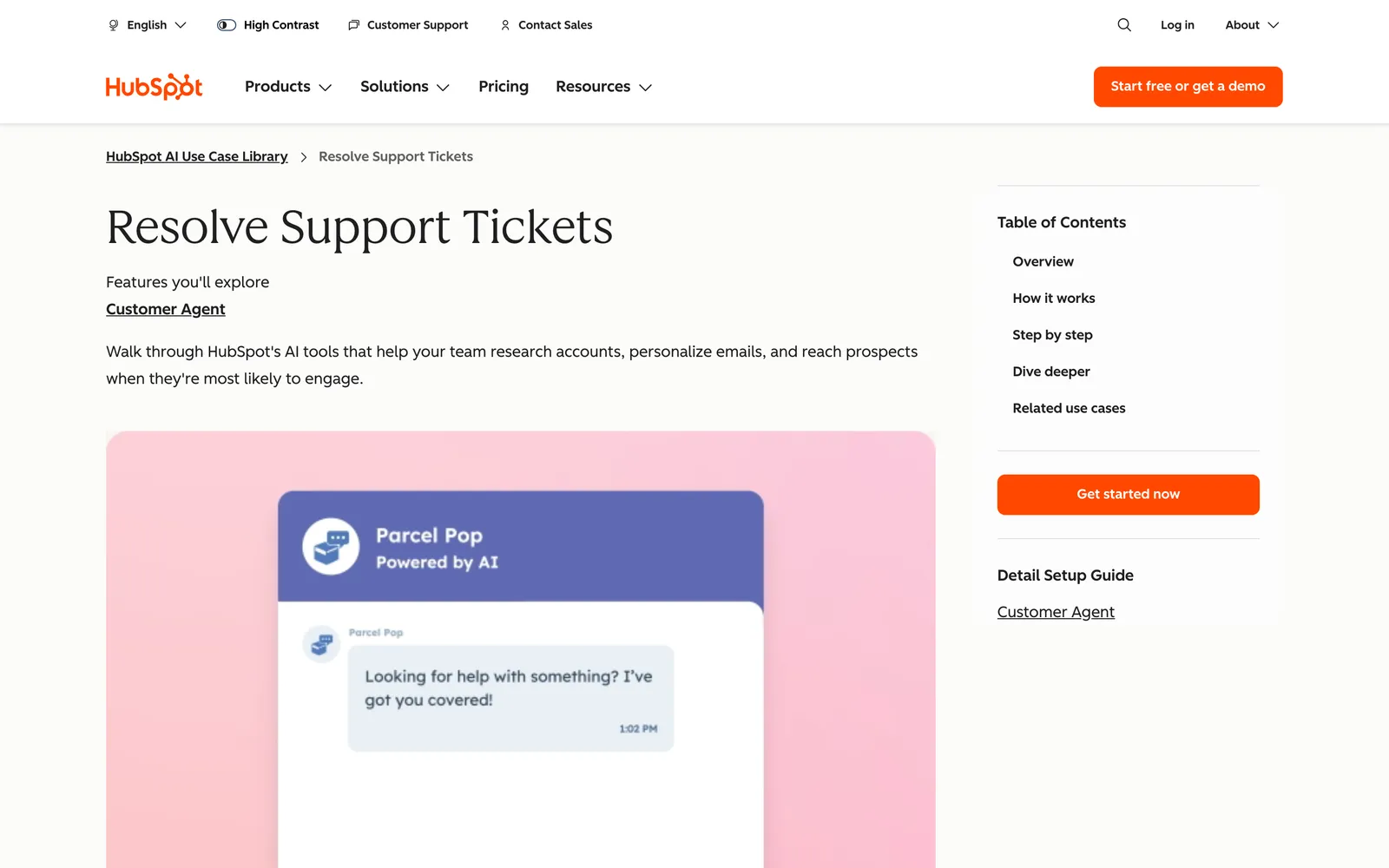
HubSpot’s Customer Agent is the AI agent built into Service Hub on the HubSpot CRM, answering from your knowledge base, help docs and website across chat, email, WhatsApp, Messenger and voice, taking actions such as booking meetings, and handing off to a human. Its use-case page is headlined “Resolve 70% of Customer Inquiries Automatically” (HubSpot, vendor-stated).
HubSpot says “Customer Agent improves with every ticket you resolve”, through a Knowledge Base Agent that drafts articles from what the agent cannot answer; no approval step for those changes is described, so it scores 3. Since April 2026 Customer Agent costs $0.50 per resolved conversation, paid as 50 HubSpot Credits (HubSpot, April 2026), on Service Hub Professional or Enterprise seats (HubSpot pricing).
10. Freshdesk (Freddy AI): 3.20
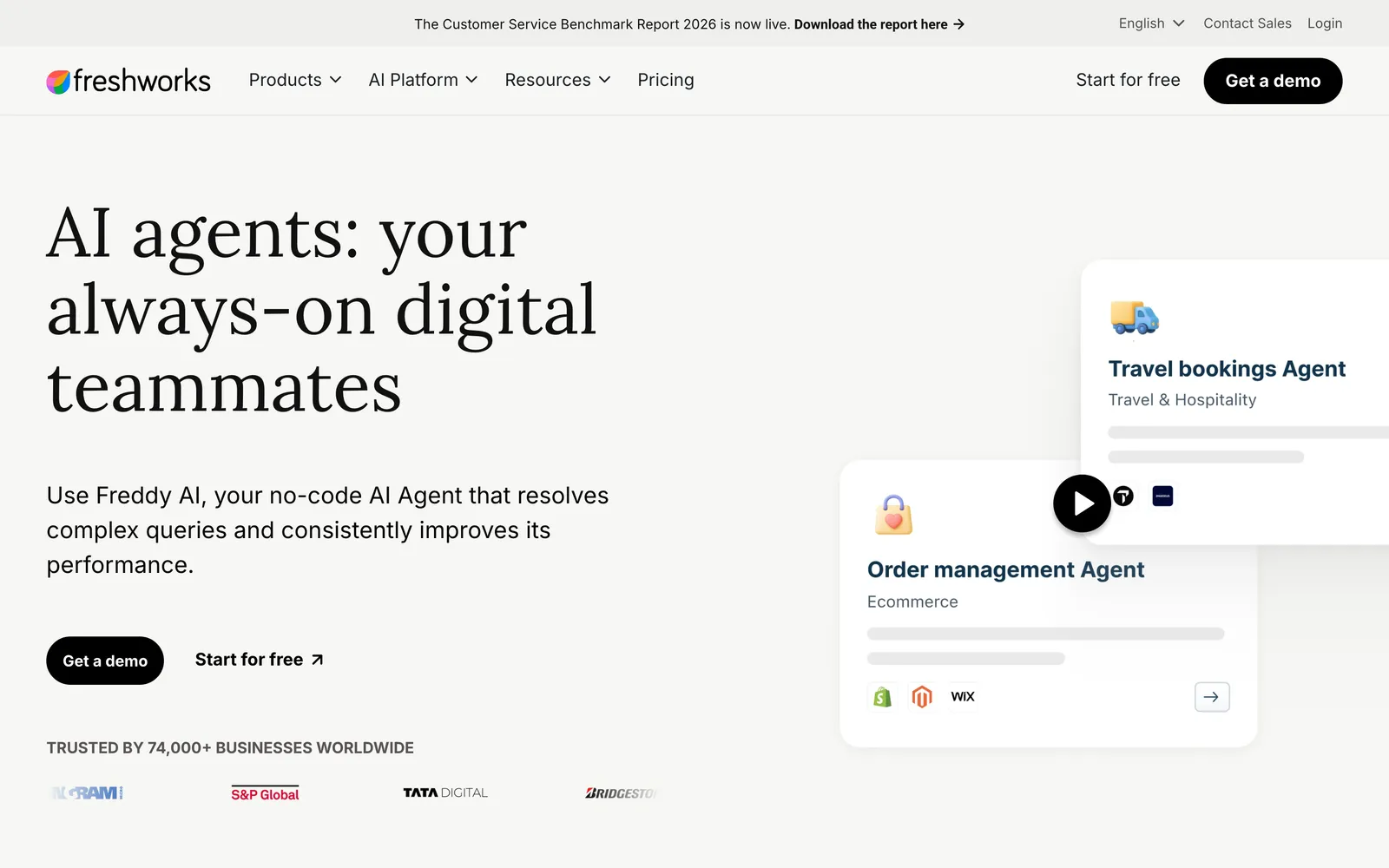
Freddy AI Agent is the no-code AI agent in Freshworks’ help desk. Freshworks says it can “process refunds, update orders, verify details” across email, web chat, WhatsApp and social, in 60+ languages, with connections to Shopify, Stripe, PayPal and FedEx (Freshworks). The Freshdesk page cites “Up to 80%” resolution rates (vendor-stated).
Freshworks says Freddy “consistently improves its performance” but does not describe the mechanism or an approval step, so it scores 3. Plans run from $19 to $89 per agent per month billed annually, and Freddy AI Agent includes 500 sessions, then $49 per 100 sessions (Freshdesk pricing). The trade-off is AI bolted onto ticketing; see our Freshdesk alternatives.
11. Help Scout (Envoy): 2.70
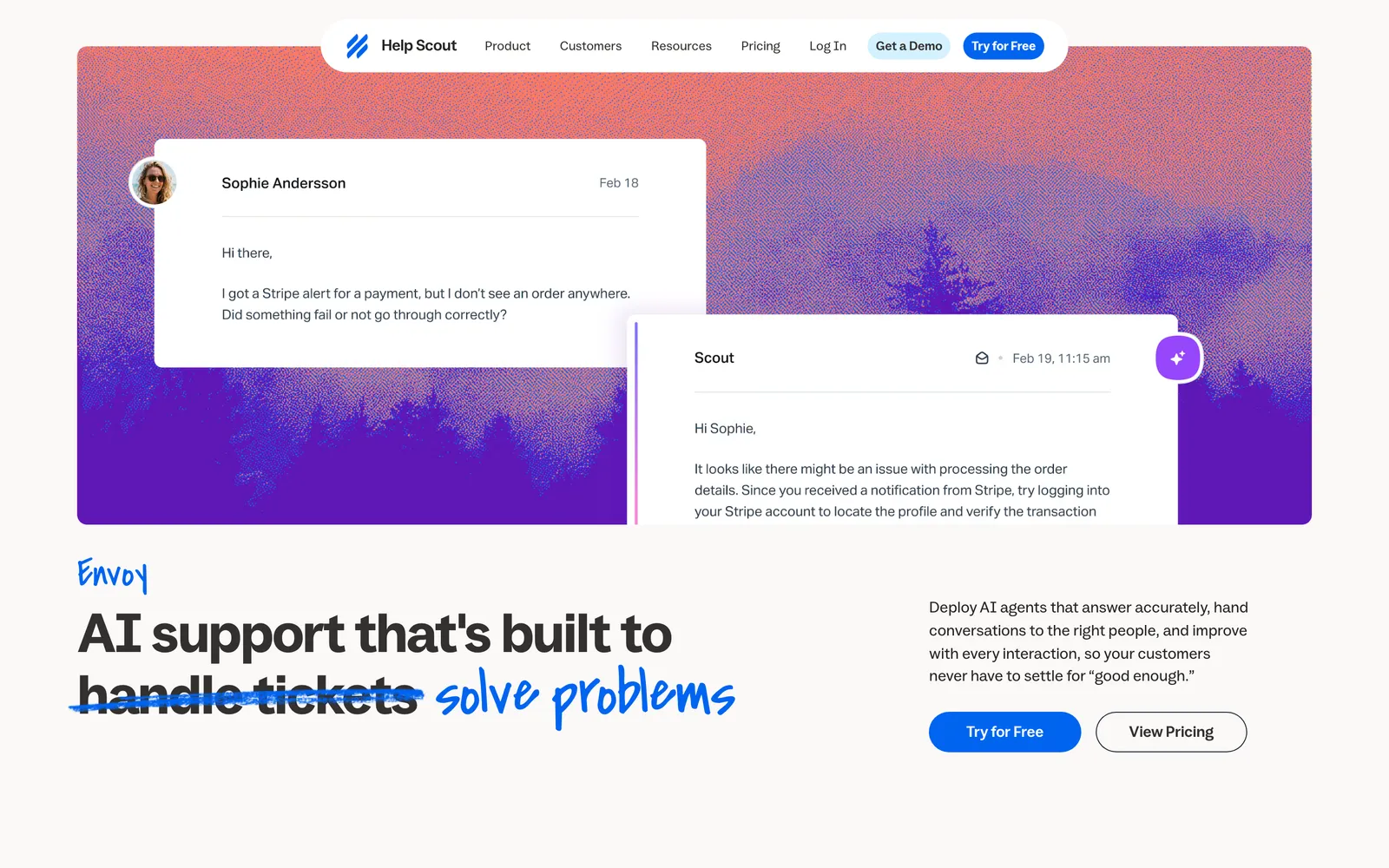
Help Scout’s AI is now called Envoy, with a built-in agent named Scout. It answers from your help centre, website and custom sources on your website and in-app, while email, past conversations and apps are marked “Coming Soon!” (Help Scout). Help Scout says “The average resolution rate is 73%” (vendor-stated).
Help Scout says its agents “improve with every interaction”: you “Audit conversations and add coaching points to guide future replies”, and Scout “will even suggest improvements on its own”, with no approval step described, which scores 3. Envoy costs $0.75 per resolution, on seats from $25 to $75 per user per month (Help Scout pricing). It suits small, people-first teams; the Help Scout alternatives guide goes further.
Two more names come up often. Siena, an AI agent platform for consumer brands, is not in this scored roster; our Siena AI guide covers what it does and how it learns. Tidio is not scored in this edition either.
How do the AI customer service platforms score side by side?
On the weighted matrix, Engaige scores highest at 4.65, with Intercom’s Fin at 4.15, Sierra at 4.10, Zendesk AI at 4.05 and Decagon at 3.95. Engaige concedes two cells: channel coverage (no voice AI, by design) and raw ecosystem breadth, where the Zendesk, Intercom and Sierra ecosystems are wider. Scores are 1 to 5 per criterion, from vendor pages checked in October 2026.
A tool’s resolution ceiling is roughly its action depth times its integration breadth; its resolution trajectory is set by the learning loop. That is why resolution and self-improvement carry the heaviest weights: the first tells you what disappears in month one, the second what keeps disappearing in month six.
| Tool | Resolution (25%) | Self-improvement (20%) | Integration (15%) | Transparency (10%) | Channels (10%) | Pricing (10%) | Time-to-value (10%) | Weighted |
|---|---|---|---|---|---|---|---|---|
| Engaige | 5 | 5 | 4 | 5 | 3 | 5 | 5 | 4.65 |
| Intercom (Fin) | 4 | 4 | 5 | 4 | 5 | 3 | 4 | 4.15 |
| Sierra | 5 | 4 | 5 | 4 | 5 | 2 | 2 | 4.10 |
| Zendesk AI | 4 | 4 | 5 | 4 | 5 | 3 | 3 | 4.05 |
| Decagon | 5 | 4 | 4 | 4 | 5 | 2 | 2 | 3.95 |
| Gorgias | 4 | 4 | 3 | 4 | 4 | 3 | 4 | 3.75 |
| Ada | 5 | 2 | 4 | 4 | 5 | 2 | 3 | 3.65 |
| Kustomer | 4 | 3 | 4 | 4 | 5 | 2 | 3 | 3.60 |
| HubSpot (Customer Agent) | 3 | 3 | 3 | 3 | 5 | 3 | 4 | 3.30 |
| Freshdesk (Freddy) | 3 | 3 | 3 | 3 | 4 | 3 | 4 | 3.20 |
| Help Scout (Envoy) | 2 | 3 | 2 | 3 | 3 | 3 | 4 | 2.70 |
How we turn the criteria into a score
Each tool gets a score from 1 to 5 per criterion. The total is the weighted sum: resolution × 0.25 + self-improvement × 0.20 + integration × 0.15 + transparency × 0.10 + channels × 0.10 + pricing × 0.10 + time-to-value × 0.10, shown to two decimals. Worked example for Engaige: 1.25 + 1.00 + 0.60 + 0.50 + 0.30 + 0.50 + 0.50 = 4.65. For Intercom: 1.00 + 0.80 + 0.75 + 0.40 + 0.50 + 0.30 + 0.40 = 4.15.
Three criteria use fixed scales, so the scores are not a matter of taste:
- Self-improvement: 5 means the team’s everyday replies are a training signal from day one, improvements are proposed with their reasoning, and a human approves them. 4 means the AI proposes concrete changes a human approves, learning mainly from its own conversations, failures or escalations (Decagon, Sierra, Intercom, Gorgias, Zendesk). 3 means self-learning is marketed without a documented approval step (Kustomer, HubSpot, Freshdesk, Help Scout). 2 means a human writes the coaching or makes the change (Ada).
- Channel coverage: 5 means an AI voice agent answers calls; 4 means phone exists but is answered by people or sits outside the AI agent (Gorgias, Freshdesk); 3 means the AI is text-only (Engaige by design, and Help Scout’s Envoy today).
- Pricing predictability: 5 means a flat fee per volume tier (Engaige); 3 means a published per-outcome, per-session or per-resolution rate you can forecast from volume; 2 means no published rate (Sierra, Decagon, Ada, Kustomer).
These weights reflect a typical buyer; your industry will reweight them (a bank weights governance higher, an SMB weights speed-to-value, a phone-heavy contact centre weights channel coverage higher), which reshuffles the order. The industry section below shows how.
Verdict per criterion
No tool wins every criterion. Engaige and the enterprise agents lead on resolution; Engaige leads self-improvement on the mechanism, with five rivals close behind; Zendesk, Intercom and Sierra lead on ecosystem breadth while Engaige leads on depth of action in e-commerce; the voice-capable field wins channel coverage, conceded by design; flat fees win pricing predictability; Engaige wins time-to-value.
- Resolution level. Won by Engaige and the enterprise agents (Sierra, Decagon, Ada), which act on the harder middle (exceptions, multi-step). The help desks with built-in AI lean more on knowledge and configured flows.
- Self-improvement. Led by Engaige: from day one in Agent Assist, Engaige AI compares what your team sends with what the agent suggested (one of its training signals), proposes changes with their reasoning, and applies nothing without your approval. Decagon, Sierra, Intercom, Gorgias and Zendesk also propose improvements a human approves, learning mostly from the AI’s own conversations and escalations.
- Integration breadth and depth. Zendesk, Intercom and Sierra win on breadth of ecosystem; Engaige wins on depth of action across the e-commerce stack. Breadth is not the same as acting.
- Transparency and governance. Engaige scores top: full reasoning for every answer and action in the dashboard, a reasoning note at hand-over, and plain-language policies with thresholds that a CX team steers without developers. Intercom, Zendesk, Sierra, Decagon, Gorgias, Ada and Kustomer also show the reasoning behind their AI’s answers and sit close behind.
- Channel coverage. Won by the voice-capable field: Fin Voice, Sierra, Zendesk, Decagon, Ada, Kustomer and HubSpot list AI voice. Engaige does not compete here, by design: every text channel, no phone line.
- Pricing predictability. Won by flat-fee models (Engaige). Published per-outcome, per-session and per-resolution rates (Intercom, Gorgias, HubSpot, Freshdesk, Help Scout, Zendesk) follow resolved volume; the enterprise agents and Kustomer price by quote.
- Time-to-value. Won by Engaige: a CX team goes live in Agent Assist in hours and then improves the policies from their own replies in plain language, with no migration. Intercom, Gorgias, HubSpot, Freshdesk and Help Scout also ramp fast; the enterprise agents trade speed for depth.
Which AI customer support software fits your industry?
The right AI customer support software depends on the tickets your industry generates: for e-commerce and DTC, Engaige and Gorgias; for SaaS and tech, Intercom, Zendesk and Help Scout; for financial services, Sierra and Decagon; for travel, telecom and contact centres, Ada and Sierra; for CRM-centred teams, HubSpot and Kustomer. Each industry reweights the matrix, so it is a starting point.
| Industry | Dominant tickets | The rule that shifts the choice | Tools that position here |
|---|---|---|---|
| E-commerce and DTC | Order status, returns, refunds, order edits | Needs deep commerce and order-management integration to act, not just answer | Engaige, Gorgias (e-commerce list) |
| SaaS and tech | Technical, billing, provisioning | Knowledge-base depth, and knowing when not to answer | Intercom (Fin), Zendesk, Help Scout |
| Financial services and fintech | Identity, disputes, account actions | Every action must be permissioned and audit-logged, so governance outweighs raw automation | Sierra (Rocket Mortgage), Decagon (Chime) |
| Travel, telecom and contact centres | Rebooking, outages, seasonal spikes | Voice as a first-class channel and contact-centre scale | Ada, Sierra |
| CRM-centred B2C and B2B teams | Account and order questions tied to the customer record | The AI should sit on the record your teams already use | HubSpot, Kustomer |
No single tool wins every vertical. Match the agent to where your ticket volume, systems of record and hardest constraint sit. For e-commerce, the drill-down continues in the best AI chatbots for e-commerce, with platform picks for Shopify, WooCommerce and Magento. What an agent changes for a store is in e-commerce AI agents.
What does AI customer service automation cost?
AI customer service automation costs one of three ways: a flat fee tied to a ticket volume, a published rate per outcome, session or resolution (from $0.49 to $1.00 per unit among the USD rates in this roster), or a quote. Where the AI comes from a help desk vendor, the help desk subscription comes on top. Prices below are from each vendor’s .com pricing page in USD, as of October 2026.
| Tool | AI layer (vendor-stated) | Platform or seats | Source |
|---|---|---|---|
| Engaige | Flat monthly fee tied to your ticket volume | Runs on your existing help desk | Engaige |
| Intercom (Fin) | $0.99 per outcome; 50-outcome monthly minimum on another help desk | Intercom help desk seat $19 per month | fin.ai/pricing |
| Gorgias | $0.90 per automated interaction (annual) or $1.00 (monthly) | Help desk plans priced by ticket volume, from $10 a month for 50 tickets | gorgias.com/pricing |
| Freshdesk (Freddy) | 500 sessions included, then $49 per 100 sessions | $19, $55 or $89 per agent per month, billed annually | Freshdesk pricing |
| Help Scout (Envoy) | $0.75 per resolution | $25, $45 or $75 per user per month | Help Scout pricing |
| HubSpot (Customer Agent) | $0.50 per resolved conversation (50 HubSpot Credits) | Service Hub Professional or Enterprise seats | HubSpot, HubSpot pricing |
| Zendesk AI | €1.50 per extra automated resolution, €2.00 pay-as-you-go (Dutch page; USD not confirmed, geo-redirect) | Suite seats | zendesk.nl/pricing |
| Sierra, Decagon, Ada, Kustomer | No published rates | Quote | Vendor pages |
Freshdesk’s $49 per 100 sessions works out at $0.49 a session, the low end of the range above; a session is not the same unit as a resolution, so compare like with like. Engaige is a flat monthly fee tied to your ticket volume, predictable as you scale. The honest comparison is total cost per resolved ticket at your own volume, not the headline per-unit price.
Treat vendor headlines of 60% to 84% as ceilings, not guarantees, and pilot before you commit: real-world rates depend on your data and integrations, and named customer results usually land lower than the headline.
Which AI customer service agent learns from your past tickets?
Engaige learns from your team’s tickets by design. In Agent Assist the agent drafts a reply, your team sends the real one, and the gap between the two is one of the signals Engaige AI learns from, proposing improvements you approve. Resolution compounds: Otrium now resolves 60% of its 120,000 annual tickets with AI.
The loop keeps running after go-live. Once a ticket type matches your team’s quality, you switch it to autonomous, and Engaige takes the action, replies and closes the ticket, up to 90% of supported tickets, with most brands autonomous in about a week. In autonomous mode Engaige AI keeps learning from live outcomes and the tickets it hands back to a human.
Other tools improve too: Decagon, Sierra, Intercom, Gorgias and Zendesk propose changes a human approves, learning mostly from the AI’s own conversations, failures and escalations. Intercom’s Recommendations, which compare weaker Fin answers with human replies to similar questions, come closest.
We found no competitor that publicly describes learning from your team’s everyday replies from day one, with each change proposed with its reasoning for you to approve. Structured policies govern how it reasons, what process it follows and when it may act. This loop matters enough that the matrix scores it as its own 20% criterion.
Frequently asked questions
What is the difference between a chatbot and an AI agent?
A chatbot answers questions, usually from a script or FAQ. An AI agent resolves the request by taking an action in your systems: it reads the context, applies your rules, performs the action (refund, order change, escalation) and confirms back. The dividing line is whether it acts or only replies.
Which AI agent is best for customer service?
On our weighted matrix, Engaige leads at 4.65, with deliberate concessions on voice (none, by design) and ecosystem breadth, followed by Intercom’s Fin (4.15), Sierra (4.10), Zendesk AI (4.05) and Decagon (3.95). The right choice still depends on your industry, ticket complexity, help desk and budget.
What are the best AI customer service solutions?
The best AI customer service solutions are the 11 agents ranked above. Engaige tops the ranking at 4.65, then Intercom’s Fin, Sierra, Zendesk AI and Decagon. Whatever the label, solution, platform or agent, apply the same act-vs-assist test. Running an online store? The e-commerce list rescores the store-focused field on commerce depth.
Does Engaige handle phone support or voice AI?
No, by design. Engaige covers every text channel (email, live chat, WhatsApp, SMS, social DMs) and offers no voice AI: text gives the agent time to read the order, check policy and act, where a live call allows seconds. If phone leads your mix, a voice specialist is the honest answer.
Which AI agents can issue refunds and handle post-purchase actions?
Issuing a refund or processing a return is an action, so it needs an agent that executes in your systems, not a chatbot that explains the policy. Engaige handles refunds (including partial), cancellations, order edits and subscription changes end to end on top of your existing help desk. Fin and Freddy also market refunds; always confirm the agent performs the action at your own stack.
How many tickets can an AI agent actually resolve?
Vendor headlines in this roster run from 60% to 84%, while named customer results land lower and vary widely: Gorgias’s Psycho Bunny story reports 26%, and Engaige’s named outcomes are 60% (MR MARVIS, Otrium) and 80% (HelloPrint). Real-world rates depend heavily on your data quality and integrations.
What does an AI customer service agent cost?
Either a flat fee tied to a ticket volume, a published rate per outcome, session or resolution (from $0.49 to $1.00 per unit among the USD rates in this roster), or a quote for the enterprise agents. Compare on cost per resolved ticket at your volume, not the headline per-unit rate.
Do I still need a helpdesk, or does the AI replace my team?
You keep both. The 2026 model is an AI agent as the front door for tier-1 volume (order status, returns, refunds), with your help desk as the escalation layer and your people on the complex, high-value cases. Engaige customers report resolving 60% to 80% of tickets this way, so headcount stops scaling one-to-one with tickets.