Gorgias vs Zendesk used to be a simple trade-off: Shopify speed against enterprise structure. In 2026 both vendors sell something bigger, AI that resolves tickets rather than routing them, and both charge for it per resolution. That changes what this comparison should actually test.
This head-to-head looks at what each AI completes inside an online store, how each prices it, and which operation each platform fits. It is the comparison spoke of our guide to AI support tools, where both platforms are scored against the wider field.
What are Gorgias and Zendesk?
Gorgias is a Shopify-first e-commerce helpdesk whose AI Agent takes real actions in your store: cancelling orders (with a refund), editing subscriptions and updating shipping details. Zendesk is a horizontal support platform that repositioned itself in 2026 as a Resolution Platform, with 1,500+ integrations, strong QA tooling and the Ultimate and Forethought acquisitions folded in.
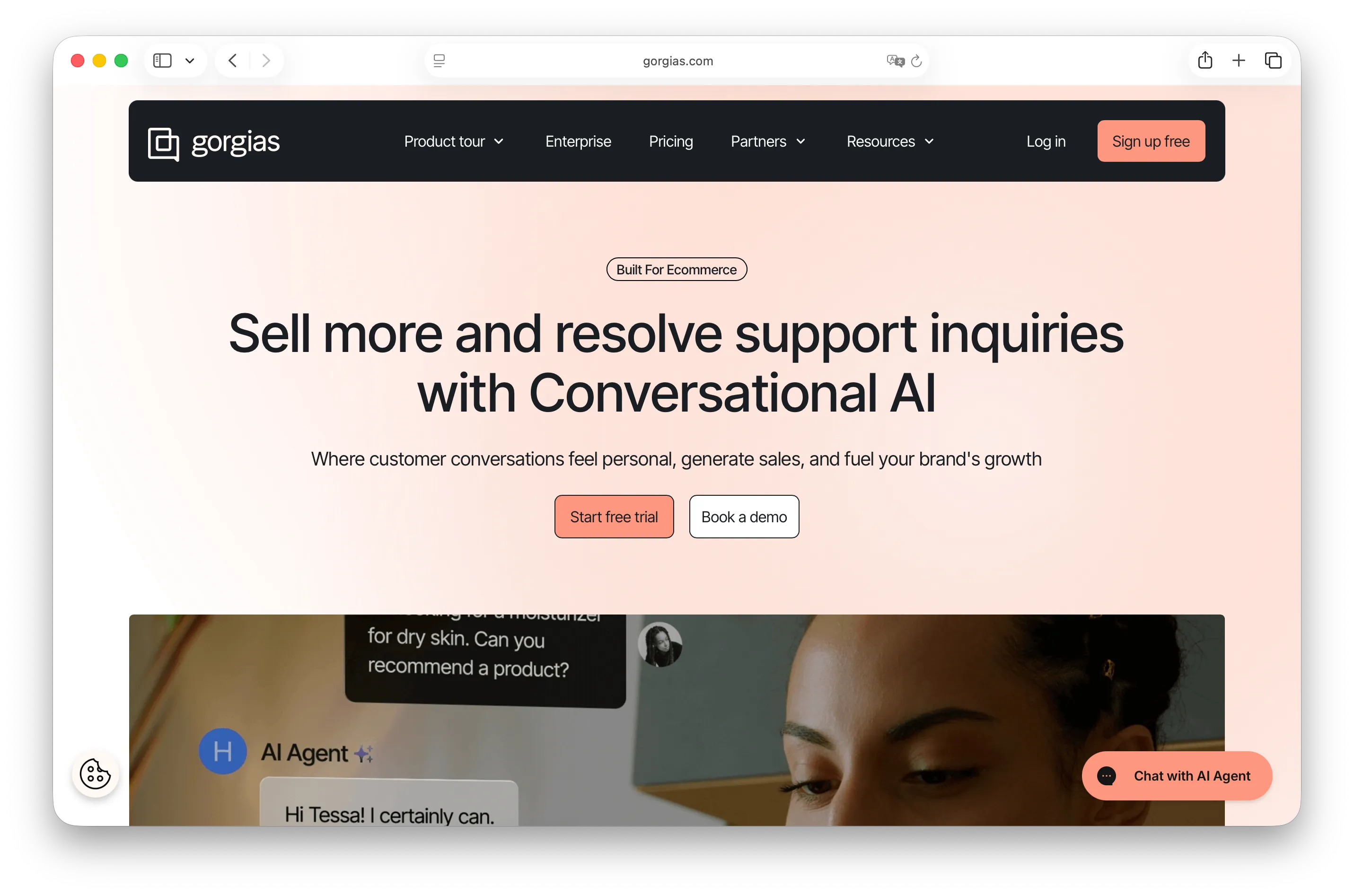
Gorgias built its helpdesk around Shopify from day one, and its AI Agent now acts rather than suggests: it cancels orders (with a refund), edits subscriptions and updates shipping details. It runs deepest on Shopify; BigCommerce, WooCommerce and Magento are supported, but the integrations are shallower there. How the connection itself works is covered in our Gorgias Shopify integration guide. For the live chat widget and how its AI answers shoppers, see our Gorgias Chat guide.
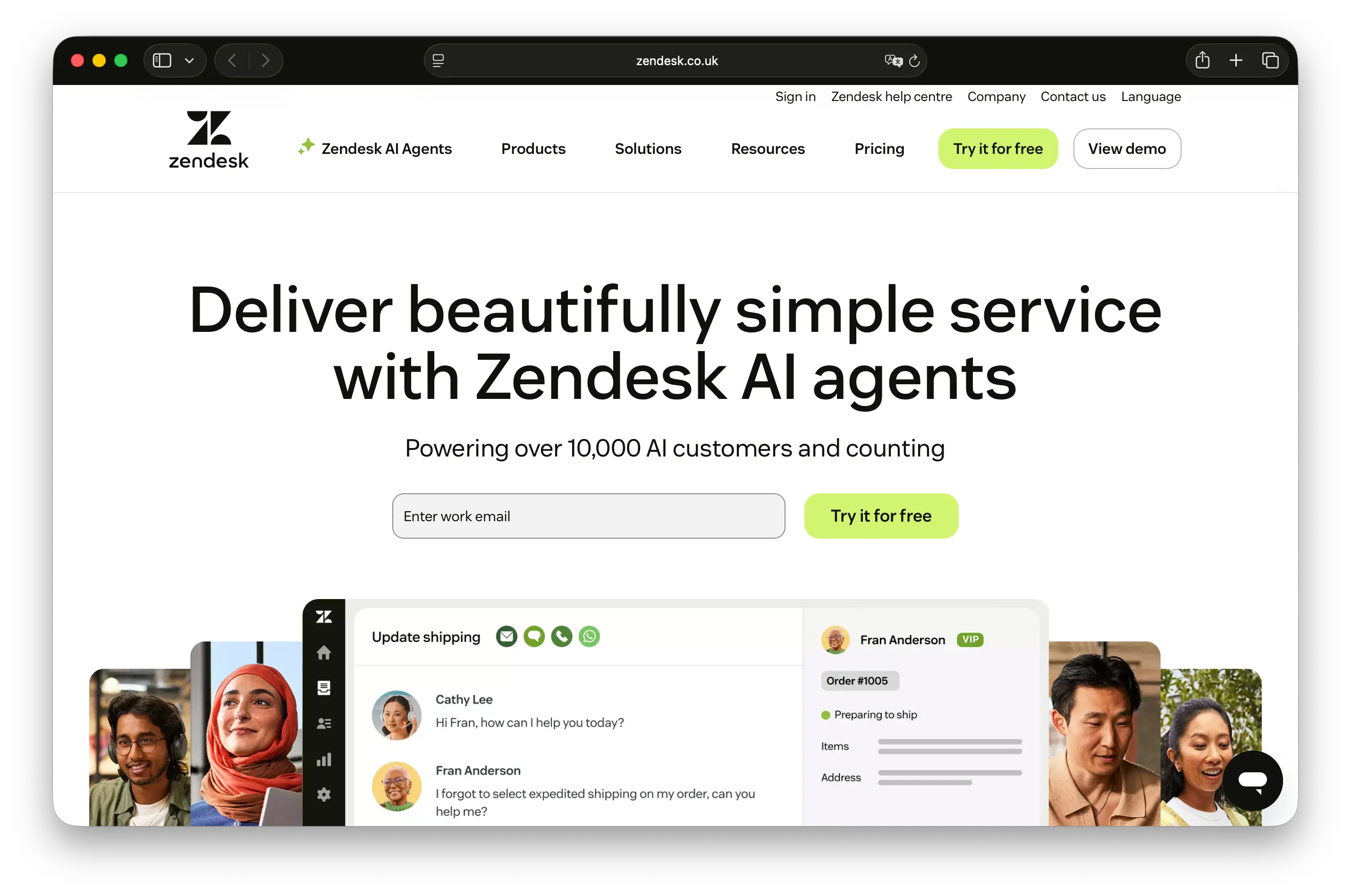
Zendesk spent 2026 repositioning around outcomes, with its Relate 2026 announcements framing the product as a Resolution Platform and folding in the Ultimate and Forethought acquisitions. Its strengths are breadth and governance: 1,500+ integrations and strong QA tooling. Its Shopify app shows order context, and Shopify order search, cancellation and refund run through action flows you configure (checked October 2026).
What is each built for?
Both AIs now act rather than only draft, but in different territory. Gorgias is built for Shopify-first brands: its AI Agent performs commerce actions such as cancelling orders (with a refund), subscription edits and shipping updates, deepest on Shopify. Zendesk is built for scale, resolving across a much wider range of industries and workflows, with Shopify actions set up through action flows.
Gorgias markets up to 60% of inquiries resolved instantly (vendor-stated), while a third-party review notes it caps automation around 60% of email and chat and named case studies land lower, with Psycho Bunny at 26%. The headline is a ceiling from its best deployments; your real rate depends on your catalogue, your policies and how much the AI Agent is allowed to act.
Zendesk states its agents routinely resolve over 80% of interactions (vendor-stated). That is a platform-wide figure across every industry Zendesk serves, not an e-commerce benchmark. For store work specifically, the Shopify app surfaces order context, and actions such as cancellations and refunds run through action flows you configure. Our Shopify listicle ranks every tool on exactly that action depth.
Where does each fall short?
Each platform’s catch is the mirror of its strength. Gorgias is Shopify-first and acts in the store, but its AI is tied to the Gorgias helpdesk and its realised resolution rate sits below its headline. Zendesk scales across channels, but it is horizontal, so store actions take action-flow setup.
Gorgias publishes a 60% headline, yet a third-party review notes it caps automation around 60% and named case studies land lower, with Psycho Bunny at 26%. The gap between marketed and realised needs reading carefully against your catalogue and policies. Gorgias has added real control: a reasoning summary under every AI message, and Gaia, which drafts changes you approve.
Zendesk’s over 80% figure is platform-wide, not an e-commerce-specific benchmark, so a store should pilot against its own ticket mix. Because it is horizontal, store actions such as cancellations and refunds run through action flows you configure, and address changes and discounts were not documented as of October 2026.
How do Gorgias and Zendesk compare?
The short version: Gorgias is the speed-and-Shopify pick, Zendesk is the scale-and-structure pick, and both now price AI resolution alongside their base plans. The table sets the two side by side, and the two areas where the choice is usually decided, resolution depth and pricing, are unpacked in the sections around it.
| Category | Gorgias | Zendesk |
|---|---|---|
| Built for | Shopify-first e-commerce support | Horizontal support at scale, repositioned as a Resolution Platform |
| AI resolution claim | up to 60% of inquiries resolved instantly (vendor-stated) | Agents routinely resolve over 80% of interactions (vendor-stated) |
| Reality check | Named case studies land lower, e.g. Psycho Bunny at 26% | Platform-wide figure, not an e-commerce-specific benchmark |
| Commerce actions | AI Agent cancels orders, edits subscriptions, updates shipping | Shopify app shows order context; order search, cancel and refund via action flows |
| Integrations | Deepest on Shopify; BigCommerce, WooCommerce and Magento shallower | 1,500+ integrations, strong QA tooling |
| Pricing model | Ticket-volume plan plus ~$0.90-1.00 per AI resolution (vendor-stated) | Seats plus per-resolution fees |
| Main limitation | AI bolted onto the Gorgias helpdesk; deepest on Shopify only | Horizontal, so store actions need action-flow setup |
| Best fit | Shopify-first brands wanting commerce automation fast | Larger, multi-team, multi-channel operations |
Both AIs act rather than only draft, but the territory differs. Gorgias’s AI Agent performs commerce actions deepest on Shopify, while Zendesk’s agents resolve across a far wider range of industries and workflows. The resolution figures tell the same story: a high headline on each side, and a more sober reality once you read the per-merchant and platform-wide footnotes.
Sources: Zendesk press release, 2026; Gorgias AI Agent page; named Gorgias case study (Psycho Bunny). Vendor figures are vendor-stated.
Operators increasingly point out that the standard feature-checklist comparison misses the dimension that breaks in production: whether the AI is grounded in live catalogue data. One thread on r/ecommercemarketing put it directly:
June 2026 Reddit The gorgias vs zendesk comparison gets done at the helpdesk feature level almost every time. Pricing, UI, integrations, SLA features. It very rarely gets evaluated on product knowledge accuracy, which is the thing that breaks down in production... For stores with complex or frequently changing catalogs, this is the comparison dimension that matters. · r/ecommercemarketing View on RedditThat gap cuts both ways. Whichever platform you pick, test it against your live catalogue before you commit: ask about a specific variant, a recent price change, an order that shipped this morning. A fluent answer built on stale product data fails exactly the customers who were ready to buy.
What do Gorgias and Zendesk cost?
Neither bill is a single line item. Gorgias charges around $0.90-1.00 per AI resolution (vendor-stated) alongside its ticket-volume helpdesk plan, with no per-seat fee. Zendesk combines per-seat licences with a per-resolution charge.
| Cost layer | Gorgias | Zendesk |
|---|---|---|
| Platform | Ticket-volume helpdesk plan, no per-seat fee | Per-seat licences |
| AI layer | ~$0.90-1.00 per AI resolution, alongside the helpdesk plan | A fee per verified resolution (third-party estimates ~$1.50-2.00, not vendor-confirmed); the former Advanced AI add-on was folded into the base plans in mid-2026 |
| What a resolved ticket costs | Helpdesk ticket cost plus resolution fee | Seat fee plus resolution fee |
| Predictability | Model AI resolutions at your volume | Model seats and verified resolutions at your volume |
The honest comparison is cost per resolved ticket, not the headline per-unit price. On Gorgias, add the resolution fee to the ticket-volume plan. On Zendesk, third-party estimates put the per-resolution charge at roughly $1.50-2.00 (not vendor-confirmed), alongside seats.
Both models tie the AI fee to outcomes, so model a peak month as well as an average one before you sign.
A worked example shows the shape. Take 10,000 tickets a month with half closed by AI, so 5,000 resolutions. At Gorgias’ roughly $1 per resolution, that is about $5,000 a month in AI fees alongside the helpdesk plan. At Zendesk’s third-party-estimated $1.50 to $2.00, the same volume runs roughly $7,500 to $10,000, alongside seats.
| At 5,000 AI resolutions/month | Gorgias | Zendesk |
|---|---|---|
| Per-resolution rate | ~$1.00 (vendor-stated) | ~$1.50-2.00 (third-party estimate, not vendor-confirmed) |
| AI fees alone | ~$5,000 | ~$7,500-10,000 |
| Plus | Ticket-volume plan | Seat plan |
These figures are illustrative, not quotes: actual seat counts, committed discounts and your real resolution rate all move them. The point is the shape, not the cents: the headline per-unit price is only part of the total, so include the base plan underneath it.
Which should you choose?
Pick Gorgias if you are a Shopify-first brand whose support is dominated by order questions and you want commerce actions working quickly. Pick Zendesk if you run a larger, multi-team operation that needs broad integrations, QA tooling and structured workflows more than built-in store depth. Volume and pricing maths decide the rest.
Two honest caveats. Gorgias is not Shopify-only, so do not rule it out on BigCommerce, WooCommerce or Magento; rule it in or out on how deep the integration goes for your platform. And Zendesk is not commerce-blind: with action-flow setup its platform reaches deep; the question is whether you want to own that setup.
If this comparison is pushing you off one of the two platforms entirely, we keep separate guides for each direction: the best Zendesk alternatives if the platform is the dealbreaker, and the best Gorgias alternatives if you want a different AI on the inbox you keep.
Where does Engaige fit?
Engaige, an AI ecommerce support tool, is the third option when the question shifts from which helpdesk to how much of the queue an AI can close. It resolves e-commerce tickets end to end on top of your existing helpdesk, including Gorgias or Zendesk. Keep your helpdesk, replace the AI. Pricing is a flat monthly fee tied to your ticket volume, predictable as you scale.
Want us against either one directly? We set out the differences with Gorgias and Zendesk in full.
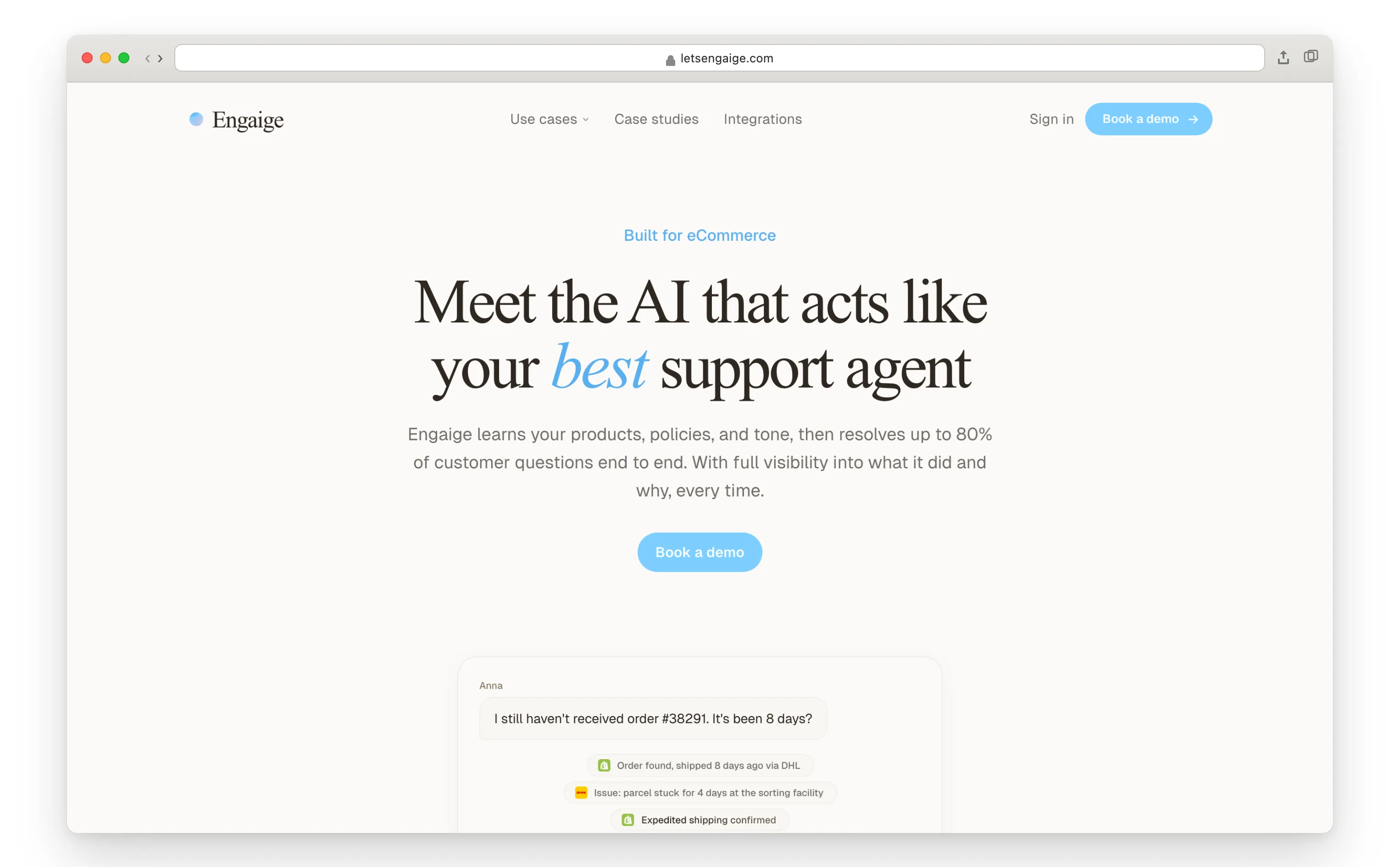
It is e-commerce-specialised rather than horizontal: you instruct it in plain language through Engaige AI, and it acts on live order data across the repetitive middle of the queue, WISMO, returns and refunds and subscription changes.
The numbers are named and open to inspection: Otrium resolves 60% of 120,000 annual tickets end to end, with no human touch, and HelloPrint automated 80% of support at steady state, cut first response times by 90%, and went from 100 agents to 28.
Engaige offered control, flexibility, and the ability to really incorporate AI in a more human way.

Engaige proved to be invaluable. Their hands-on support during the implementation phase resulted in significant improvements to our automated resolution rate and CSAT.

Hold us to the same standard as the other two. Our “up to 90%” of supported tickets is our ceiling at the deepest integrations, not a promise, so challenge it the way you should challenge Gorgias’ 60% and Zendesk’s 80%.
Engaige is the agent; Engaige AI configures and improves it from plain-language briefs. You go live in Agent Assist within hours, and every reply your team sends is compared with what the agent suggested, one of the signals Engaige AI learns from. It proposes changes with its reasoning for your approval. Gorgias and Zendesk both draft improvements too; we found no competitor that publicly describes learning from the team’s normal replies from day one with human approval.
When a ticket type matches your team’s replies, you switch it to autonomous (most brands get there in about a week), and it keeps learning there too, surfacing emerging trends and the cases where it hands a ticket back to a human.
Full reasoning for every answer and action sits in the Engaige dashboard, a hand-over leaves a reasoning summary as an internal note in the ticket, and there is no migration. The catch: it does not replace your helpdesk; many teams keep Gorgias or Zendesk for the human queue and let Engaige close the repetitive volume.
Frequently asked questions
Is Gorgias or Zendesk better for Shopify stores?
Gorgias is Shopify-first and its AI Agent acts directly in the store, cancelling orders (with a refund), editing subscriptions and updating shipping details, so Shopify-first brands usually start there. Zendesk’s Shopify app shows order context, and actions such as cancellations and refunds run through action flows you configure, which suits larger teams with admin resource.
How much does Gorgias’ AI Agent actually resolve?
Gorgias markets up to 60% of inquiries resolved instantly (vendor-stated), but named case studies land lower, with Psycho Bunny at 26%. Treat the headline as a ceiling: your rate depends on your catalogue, your policies and how much the AI Agent is allowed to act.
What does Zendesk’s “over 80%” resolution claim mean?
It is a vendor-stated, platform-wide figure tied to Zendesk’s 2026 Resolution Platform repositioning, covering every industry it serves rather than e-commerce specifically. It is not a store-level benchmark, so pilot against your own ticket mix and measure what gets resolved end to end before relying on it.
How do Gorgias and Zendesk pricing models differ?
Both price in two layers. Gorgias charges around $0.90-1.00 per AI resolution alongside its ticket-volume helpdesk plan, with no per-seat fee. Zendesk combines per-seat licences and a per-resolution fee (its former Advanced AI add-on was folded into the base plans in mid-2026). Compare them on total cost per resolved ticket, modelled on a peak month.
Can I keep Gorgias or Zendesk and still automate more?
Yes. Engaige runs on top of your existing helpdesk, including Gorgias or Zendesk, and resolves repetitive e-commerce tickets end to end for a flat monthly fee tied to ticket volume. Otrium resolves 60% of 120,000 annual tickets that way, and HelloPrint automated 80% of its support.
Is Zendesk or Gorgias better for e-commerce?
For most stores the Zendesk vs Gorgias decision comes down to depth versus breadth. Gorgias acts deepest inside Shopify, cancelling orders (with a refund), editing subscriptions and updating shipping details from the ticket, so Shopify-first brands usually start there. Zendesk brings breadth, governance and 1,500+ integrations, with commerce actions set up through action flows, which suits larger teams with admin resource. Model total cost per resolved ticket either way before you commit.
How hard is it to migrate from Gorgias to Zendesk?
A Gorgias to Zendesk migration means moving tickets, macros and integrations, then rebuilding your Shopify actions on Zendesk as action flows. If you are switching over the AI rather than the helpdesk itself, you can skip the migration: Engaige layers an agent that resolves e-commerce tickets end to end on top of either Gorgias or Zendesk, so you keep your inbox and history.