If you are weighing Gorgias against Yuma, the first thing to get straight is that they are not the same kind of product. Gorgias is an e-commerce helpdesk with its own built-in AI Agent. Yuma is an AI agent that installs inside a helpdesk you already run, and Gorgias is one of the helpdesks it supports.
So this is rarely a head-to-head replacement decision. It is usually a layering decision: is Gorgias’s own AI enough, or do you keep the Gorgias inbox and put Yuma’s AI on top?
In this Gorgias vs Yuma comparison we break down how each resolves tickets, how deeply each acts inside your store, how transparently each substantiates its numbers, and what each one does to your bill. We also look at where both leave a gap, and how Engaige fits.
We are upfront that this comparison lives on the Engaige blog, so we have opinions. We also took it seriously: every figure below comes from official sources, third-party reviews or real merchant feedback, captured in June 2026 and labelled where it is vendor-stated.
What are Gorgias and Yuma?
Gorgias is a Shopify-first e-commerce helpdesk with a built-in AI Agent built into the inbox. Yuma is an AI agent that installs inside a helpdesk you already run, Gorgias included. So the choice is rarely a swap: it is Gorgias’s own AI versus a Yuma layer on the same helpdesk.
Gorgias is a Shopify-first helpdesk used by tens of thousands of brands, with a built-in AI Agent built into the inbox. The AI and the helpdesk are one product, with the AI priced per resolution. It states “60% of inquiries resolved instantly” (vendor-stated).

Yuma describes itself as the layer “where automated customer experience runs,” and is explicit that it “installs inside the helpdesk you already use,” not as a standalone chatbot. Its integrations page lists Gorgias, Zendesk, Kustomer, Salesforce Service Cloud, Front, Gladly, Re:amaze, Zoho Desk and Sprinklr.

The practical divide is built-in versus layered. Gorgias gives you one vendor and deep built-in Shopify actions. Yuma gives you a published per-customer resolution record and the freedom to keep your inbox, with a second vendor to manage.
What is each built for?
Gorgias is built for brands that want depth on a single platform: the AI reads real-time Shopify data and acts inside the ticket. Yuma is built for teams that like their current inbox but want a higher, more transparent resolution rate, or an AI that survives a future helpdesk change.
Gorgias is built for depth on one platform. The AI reads real-time Shopify data and issues refunds, edits subscriptions through Recharge, updates shipping and processes returns through Loop, all without leaving the ticket. The trade is that the AI and the helpdesk are one product, tied together.
Yuma is built to sit inside your current helpdesk. For Gorgias specifically it offers to “refund, reship, cancel, or tag tickets before an agent reaches for the keyboard.” Purpose-built for Shopify, it now also connects to WooCommerce, BigCommerce and Magento through partners. You keep the inbox your team knows and change only the AI doing the resolving, and if you later move helpdesks, Yuma is designed to come with you.
Where does each fall short?
Neither tool is weak, but each carries a structural cost. Gorgias’s realised resolution rate sits well below its headline in its own case studies, and its AI is bolted onto the helpdesk. Yuma lifts the ceiling and reports openly, but its action depth is bounded by the helpdesk underneath, and it absorbs your team’s edits without a described review step.
Gorgias publishes a 60% headline, yet its own Psycho Bunny case study reports 26% of tickets resolved by the AI Agent, and a third-party review notes it caps automation at around 60% of email and chat. The gap between marketed and realised needs reading carefully, and the AI cannot leave Gorgias if you ever want a different one.
Yuma reports openly and reaches higher, but two things are worth checking. Its FAQ says that when a human edits or overrides an AI draft, Yuma absorbs that correction into future replies, with no review step described (checked October 2026). And how deeply it can act is bounded by what the underlying helpdesk exposes, which is inherent to any layered agent rather than a Yuma fault.
How do Gorgias and Yuma compare?
Both put an AI agent that takes real actions in front of your e-commerce tickets. The difference is architecture: Gorgias owns the inbox and the AI together, while Yuma rents space inside whatever inbox you run. That single fact shapes how you adopt it, how each resolves, how deeply each acts, and whether you are locked in.
| Category | Gorgias (built-in AI Agent) | Yuma (layered on your helpdesk) |
|---|---|---|
| How you adopt it | ✅ One product, AI built into the inbox ❌ AI is tied to the Gorgias helpdesk | ✅ Keeps your existing inbox, swap only the AI ❌ Adds a second tool to manage |
| Automation and resolution | ✅ 60% instant (vendor-stated), mature and built in ❌ 26% resolved in its own Psycho Bunny case | ✅ 45-89% across named customers (vendor-stated) ❌ Depth depends on the helpdesk underneath |
| E-commerce action depth | ✅ Built-in refunds, order edits, subscriptions, returns ❌ Deepest on Shopify only | ✅ Refunds, reships, cancellations, label creation ❌ Acts through the helpdesk’s connectors |
| Transparency of claims | ✅ Publishes named case studies ❌ Headline rate sits well above the cases | ✅ Publishes per-customer rates, including low ones ❌ No independent audit of the numbers |
| Pricing and scalability | ✅ Unlimited seats, no per-seat fee Model: ~$0.90-1.00 per AI resolution | ✅ Pay for outcomes, keep your current plan Model: quote-based, per resolved ticket |
| Portability and lock-in | ✅ Deeply integrated, nothing to wire up ❌ The AI cannot leave Gorgias | ✅ Travels across helpdesks if you switch ❌ Still bound by what each helpdesk exposes |
This comparison is based on how Gorgias and Yuma behave once they are live in an e-commerce support team, not on feature lists. We read official product, pricing and integration pages (captured June 2026, labelled vendor-stated), published case studies for the named resolution rate and definition of “resolved”, third-party reviews and pricing breakdowns, and Reddit communities (r/ecommerce, r/shopify, r/ecommercemarketing) for unfiltered merchant experience within the last 90 days.
How you adopt it: built-in versus layered
Gorgias and Yuma start you in two different places. With Gorgias, the AI Agent is a switch inside a helpdesk you are already using or migrating to. With Yuma, the helpdesk stays exactly as it is and you add an AI layer on top.
Gorgias builds the AI into the product. If Gorgias is already your inbox, turning on the AI Agent is a configuration job, not an integration project, and the AI inherits the order data, macros and history that already live there. The flip side is that the AI is part of Gorgias: adopting it deepens your commitment to that one platform.
Yuma is built to sit inside your current helpdesk. Its integrations page is explicit that you “add Yuma AI inside Gorgias” and let routine workflows run, which means you can keep the Gorgias inbox your team knows and change only the AI doing the resolving. If you later move helpdesks, Yuma is designed to come with you. The trade is that you are now running two vendors instead of one.
There is a second dependency in the deal, too: Yuma’s FAQ is upfront that there is no DIY setup, and a dedicated account manager configures your automations and writes your automation processes (vendor-stated, checked October 2026). Your team can edit the Handbook in plain language afterwards, with changes as drafts.
For the wider field of tools that take this layered approach, our guide to Gorgias alternatives groups them by exactly this question.
Automation and resolution
Both resolve tickets autonomously rather than only drafting replies, so the real question is how much, and how honestly each reports it. This is where Yuma’s record is unusually open and Gorgias’s headline is unusually optimistic.
Gorgias states that its AI Agent resolves “60% of inquiries instantly” (vendor-stated). Its own published case studies sit lower: Psycho Bunny reports 26% of tickets resolved by the AI Agent, alongside a 99.4% faster resolution time. A third-party review notes Gorgias caps automation at around 60% of email and chat. The AI is mature and built into the inbox, but the realised rate is some distance below the headline.
Yuma publishes a span of named per-customer rates, including the unflattering ones, in its case studies: 89% at EvryJewels, 79% at Petlibro, 70% at Clove, 64% at Tediber and MFI Medical, down to 45% at FINN and 40% at The Koin Club. It frames the spread as “top deployments reach 89%” (vendor-stated): a real distribution, not a single ceiling.
Sources: Gorgias AI Agent page and Psycho Bunny case study (vendor-stated); Yuma case studies, June 2026. Yuma publishes the full range of named rates between 89% and 40%.
E-commerce action depth
Depth is the question of what the AI can actually do in your store, not just answer. Here Gorgias has the home advantage, because it owns the Shopify integration, while Yuma’s reach is real but mediated by the helpdesk and connectors beneath it.
Gorgias acts from inside its own platform. Its AI Agent reads live Shopify orders, products, inventory and customer tags, and can issue refunds, edit subscriptions via Recharge, update shipping and process returns through Loop, directly from the ticket. Because Gorgias built the integration, there is nothing to wire up and no middleware in the path. This depth is genuinely strong, and it is the main reason brands stay.
Yuma takes the same kinds of actions, refunds, reships, cancellations and label creation, but it does so through the helpdesk it is installed in and the connectors you enable (Recharge, Loop, Skio and others for subscriptions). On a Shopify store running Gorgias, that reaches deep. The honest caveat, inherent to any layered agent rather than a Yuma fault, is that how far it can act is bounded by what the underlying helpdesk exposes.
Transparency of claims
How a vendor reports its numbers tells you how the AI will behave when it is unsure. The pattern to watch is whether a tool answers from real data or guesses confidently, and whether the vendor publishes the rates that flatter it or all of them.
Yuma’s published distribution names customers at 45% and 40% as readily as 89%. Gorgias publishes strong case studies too, and shows a summary of the AI Agent’s reasoning under every message, but its 60% headline sits well above the 26% in its own Psycho Bunny story, so the gap between marketed and realised needs reading carefully.
The deeper failure mode is an AI that infers instead of reading live store data. One operator put it this way on r/ecommercemarketing:
April 2026 Reddit For straight logistics and order support, gorgias is fine. The problems show up when a meaningful percentage of chat volume is pre-purchase and product-specific, and the AI layer starts giving confident wrong answers because it's inferring rather than reading live catalog data. · r/ecommercemarketing View on RedditThat is worth testing in any pilot, of Gorgias or Yuma. The fix is not a cleverer model, it is an agent that reads the actual order, catalogue and policy before it replies.
Portability and lock-in
The last difference is what happens if your needs change. Gorgias’s AI is inseparable from Gorgias; Yuma’s whole premise is that the AI is separable from the helpdesk.
Gorgias rewards commitment with depth. Because the AI, the inbox and the Shopify integration are one system, everything works together out of the box. The cost is mobility: if you outgrow Gorgias or want a different AI, the agent does not come with you, and a helpdesk migration moves macros, history and integrations together.
Yuma is designed to detach. Keep your helpdesk and change the AI, or change helpdesks later and keep Yuma, because it supports nine of them. That portability is the hedge you are buying. You do carry the overhead of a second vendor, and on any given helpdesk Yuma can only act as deeply as that helpdesk allows.
If you are still comparing inboxes themselves, our Gorgias vs Zendesk and Gorgias vs Tidio comparisons cover that layer.
What do Gorgias and Yuma cost?
Gorgias charges roughly $0.90 to $1.00 per AI resolution with unlimited agent seats and no per-seat fee. Yuma is quote-based, estimated at $0.65 to $0.70 per resolution by third parties, and runs alongside the helpdesk you already use.
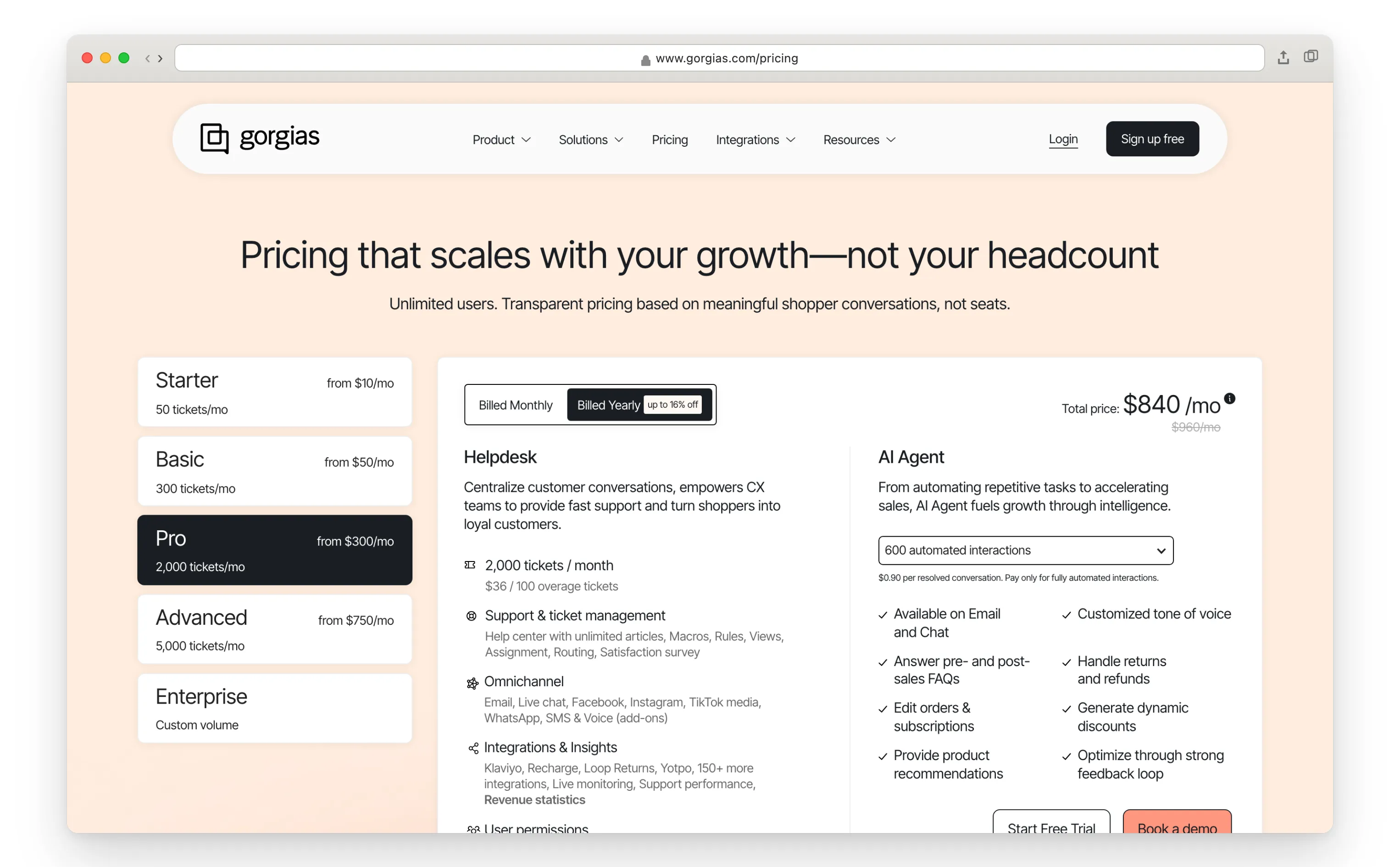
Gorgias prices its AI Agent at $0.90 per resolved conversation on annual plans and $1.00 on monthly per its pricing page, with Starter plans from $1, and now markets unlimited agent seats with no per-seat fee, so you pay when the AI fully resolves rather than for headcount.
Plans run from 90 to 2,500+ interactions per month, and overages are charged per interaction (around $1.50 on combined plans).
Yuma does not publish prices; its pricing page is demo-gated. Third-party breakdowns put it on an outcome model of roughly $0.65 to $0.70 per resolution in published tiers (third-party estimate, not vendor-confirmed). Its FAQ says brands pay only for tickets fully resolved by AI. If you keep Gorgias as your helpdesk and add Yuma as the AI, compare the combined total per resolved ticket.
The cost layer makes the difference concrete:
| Cost layer | Gorgias (built-in AI) | Yuma (layered on) | Engaige |
|---|---|---|---|
| Helpdesk fee | Included, this is the helpdesk | What you already pay your helpdesk | What you already pay your helpdesk |
| AI pricing model | Per resolution | Per resolution, quote-based | Flat monthly fee tied to your ticket volume |
| Per-resolution rate | $0.90 annual, $1.00 monthly (vendor-stated) | ~$0.65-0.70 (third-party estimate) | Included in the flat fee |
| Seats | Unlimited, no per-seat fee | Set by your helpdesk | Set by your helpdesk |
| Bill shape as you grow | Tracks AI resolutions | Helpdesk fee plus AI resolutions | Predictable as you scale |
For a wider view of how these models play out, our Gorgias alternatives guide runs the total-cost-per-resolved-ticket maths across the field.
Which should you choose?
There is no universal winner, because these tools answer different questions. The right call depends on whether the Gorgias inbox is staying and how many vendors you want to manage. Stay with the built-in AI for depth and one vendor; layer Yuma for a higher, better-documented ceiling and AI portability.
Stay with Gorgias’s built-in AI if:
- Gorgias is your helpdesk and you want one vendor and the least to manage
- You need deep built-in Shopify actions with nothing to wire up
- Your ticket mix is mostly post-purchase logistics, where Gorgias’s AI is strongest
- A 60% ceiling on the resolvable share is acceptable at your volume
Layer Yuma on if:
- You like your inbox but want a higher, better-documented resolution rate from the AI specifically
- You may change helpdesks later and want the AI to survive the move
- You value a vendor that publishes per-customer rates, including the low ones
- You are happy for setup to run through Yuma’s account manager
Where both leave a gap:
Gorgias asks you to accept its resolution ceiling as the price of built-in depth. Yuma lifts the ceiling and publishes its rates, but setup runs through its team, its depth is set by the helpdesk underneath, and it absorbs your team’s edits without a described review step. Neither combines a layer on the helpdesk you keep with an improvement loop your team approves. That is the gap Engaige is built to close.
Where does Engaige fit?
That is where Engaige comes in, and yes, that is us 😊
Want us against Gorgias directly? Our Gorgias comparison sets out where each one lands.
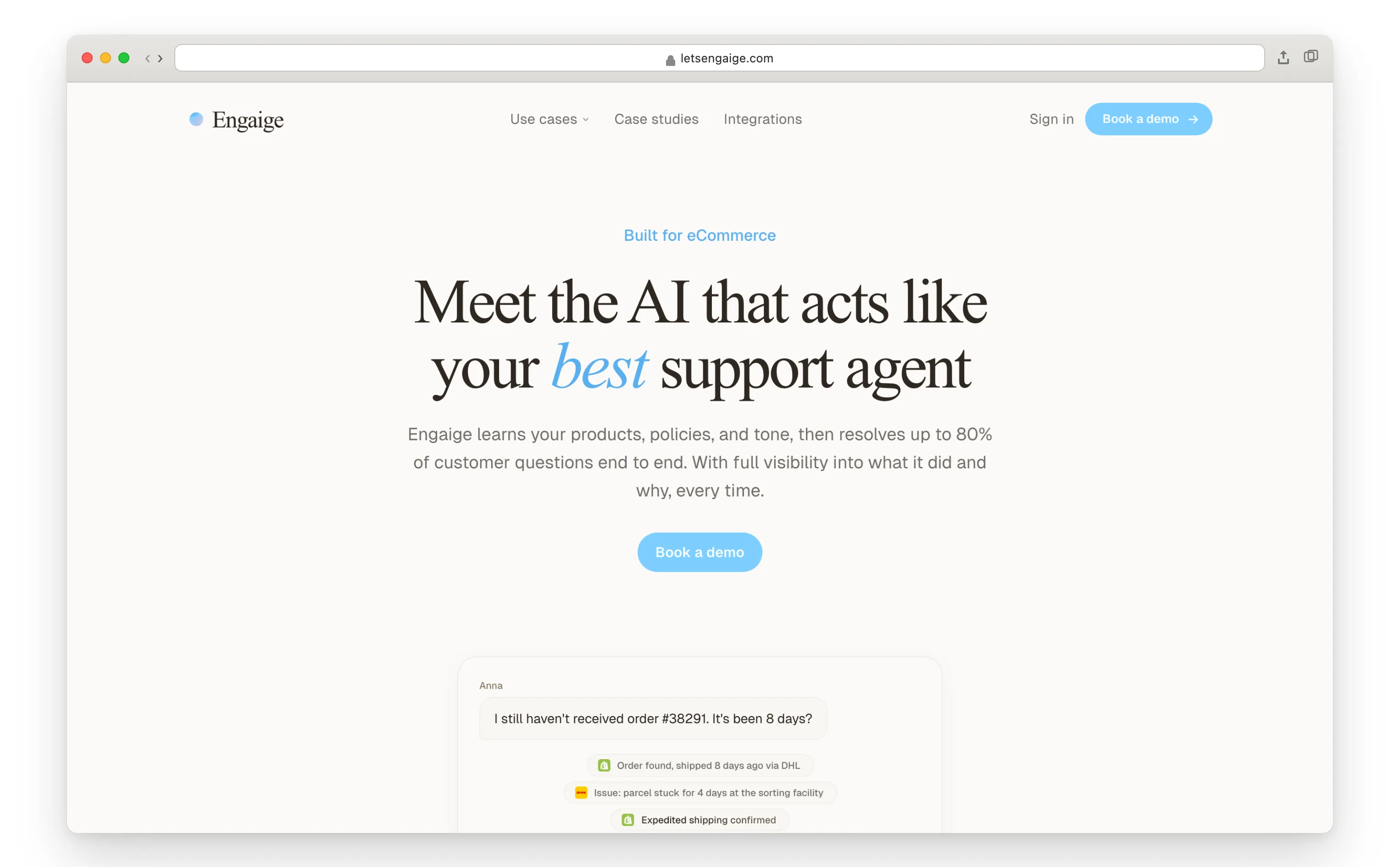
Like Yuma, Engaige is an AI agent that layers onto the helpdesk you already run, including Gorgias itself, so you do not migrate your inbox. Keep your helpdesk, replace the AI. Pricing is a flat monthly fee tied to your ticket volume, predictable as you scale.
Yuma learns from your team’s edits too, so the difference is the gate. You go live in Agent Assist within hours: Engaige drafts replies alongside your team, and every reply your agents send is compared with what it suggested, one of the signals Engaige AI learns from. Engaige AI then proposes changes with its reasoning, and nothing changes until you approve it. We found no competitor that publicly describes that combination.
When a ticket type matches your team’s replies, you switch it to autonomous (most brands get there in about a week), and it keeps learning there too, from emerging trends and the cases it hands back to a human.
So it learns in both modes, from your team’s replies while it assists and from live outcomes once it runs on its own.
Once autonomous, the AI handles full conversations end to end. It reads the customer’s intent, checks the order status, applies your return policy, issues the refund and closes the ticket, with no inference where live data exists and no human in the loop for routine requests.
Engaige AI is configuration and learning, not a setup wizard: you brief it in plain language. Full reasoning for every answer and action sits in the Engaige dashboard, and a hand-over leaves a reasoning summary as an internal note in the Gorgias ticket.
The proof is in named, openable case studies rather than a homepage ceiling. Otrium resolves 60% of 120,000 tickets a year end to end, and HelloPrint automated 80% of support, cut first response times by 90% and went from 100 agents to 28. Hold us to the same test we asked you to apply to Gorgias and Yuma.
Engaige offered control, flexibility, and the ability to really incorporate AI in a more human way.

Engaige proved to be invaluable. Their hands-on support during the implementation phase resulted in significant improvements to our automated resolution rate and CSAT.

Frequently asked questions
The questions e-commerce teams ask most when deciding between Gorgias’s built-in AI and layering Yuma on top.
Is Yuma a replacement for Gorgias?
No. Yuma is an AI layer that installs inside a helpdesk you already run, and Gorgias is one of the helpdesks it supports. You can keep the Gorgias inbox and use Yuma as the AI that resolves tickets, rather than swapping one helpdesk for another. That is why the decision is usually “Gorgias’s built-in AI versus a Yuma layer on Gorgias,” not a straight replacement.
Does Gorgias or Yuma resolve more tickets?
On published evidence, Yuma’s top deployments reach higher. Gorgias states 60% of inquiries resolved instantly but reports 26% resolved in its own Psycho Bunny case study, while Yuma publishes named per-customer rates from 89% at EvryJewels down to 40% at The Koin Club (all vendor-stated). Real results depend on your ticket mix, so pilot both against the same tickets and measure end-to-end resolution, not deflection.
How does Yuma pricing compare to Gorgias?
Gorgias charges roughly $0.90 to $1.00 per AI resolution with unlimited agent seats and no per-seat fee. Yuma does not publish prices; third-party breakdowns estimate around $0.65 to $0.70 per resolution (not vendor-confirmed). If you keep Gorgias as your helpdesk and add Yuma, compare the combined total per resolved ticket.
Can Yuma take real actions like refunds inside Gorgias?
Yes. Yuma’s integrations page offers to refund, reship, cancel and tag tickets inside the Gorgias inbox, and it edits subscriptions through partners such as Recharge and Loop. How deeply it can act depends on what the underlying helpdesk exposes, which is inherent to any layered agent rather than a Yuma limitation. Gorgias’s own AI takes the same actions from inside the helpdesk because it owns the Shopify integration.
Which is better for a Shopify store?
Both work on Shopify. Gorgias is the deeper built-in option with nothing to wire up and one vendor, and is strongest on post-purchase logistics. Yuma suits a store that likes its current inbox but wants a higher, better-documented resolution rate from the AI, or that wants the AI to be portable across helpdesks. Decide on total cost per resolved ticket and the resolution rate against your real tickets.
Is there a tool that resolves end to end on the helpdesk you keep?
This is the gap Engaige fills. As an AI support tool, it layers onto the helpdesk you already run, Gorgias included, and resolves conversations end to end with real e-commerce actions. Engaige AI learns from your team’s replies and proposes changes you approve, and pricing is a flat monthly fee tied to your ticket volume. Otrium resolves 60% of 120,000 tickets a year on this model.
What are the alternatives if neither fits?
If Gorgias’s ceiling does not work for you, look at an AI ecommerce tool that resolves on your existing helpdesk. Other routes include Richpanel and Zendesk if you are willing to replace the helpdesk, or Intercom Fin if you want a per-resolution agent that also layers on. Our Gorgias alternatives guide compares the field on resolution, cost and stack fit.
Our Yuma alternatives guide covers the same ground when it is Yuma you are weighing.