The best Zendesk alternatives for an online store in 2026 split into two routes. Keep Zendesk and replace only its AI with Engaige, Intercom Fin, Yuma or Siena, or replace the help desk itself with Gorgias, Richpanel, Freshdesk, Help Scout, HubSpot Service Hub, Front or Kustomer. Which route fits depends on whether your problem is the AI or the platform underneath it.
Zendesk is the most recognisable help desk in the world, and in 2026 it rebuilt its pitch around AI: a “Resolution Platform” whose agents, a Zendesk press release states, “routinely resolve over 80% of interactions” (vendor-stated). In our research, teams rarely leave over capability. They leave over fit: a horizontal platform with AI bolted onto ticketing, built for large support operations, where a lean store team wants e-commerce depth and a lighter setup.
This guide compares the alternatives on what each one resolves, how it fits your stack, which pricing model it uses and what switching costs you, with facts from each vendor’s public pages as of October 2026. For how Zendesk’s own AI handles a store, start with our Zendesk AI guide; for the wider field, see our ranked guide to the best AI agents.
Why do teams look for Zendesk alternatives in 2026?
Three triggers come up again and again: pricing fit, because teams want a cost they can forecast at their own volume; e-commerce depth, because Zendesk is horizontal and store actions run through flows you configure; and a platform whose admin weight outgrows a lean e-commerce team. Capability is rarely the trigger.
Trigger one is pricing fit. Zendesk prices on two layers: a plan per agent, with AI agents included, and automated resolutions, where each plan carries a monthly allowance and extra resolutions are billed. Its pricing page lists extra resolutions at $1.50 each committed or $2.00 pay-as-you-go (checked October 2026). That is one of several common models; which one suits you depends on your volume and how you budget.
Illustrative anatomy of the two billing structures, based on each model’s published pricing components, not list prices. Bar heights are schematic.
Trigger two is e-commerce depth. Zendesk is built for support at scale across every industry, so store work, the refunds, cancellations and order edits that dominate a store’s queue, runs through action flows and procedures you configure rather than e-commerce policies out of the box.
Trigger three is weight. For a two-or-three-person store team, the admin surface of an enterprise helpdesk is a job in itself. One commenter on r/helpdesk put the squeeze plainly:
April 2026RedditThe pricing and complexity feels like it was designed for a company with a dedicated support ops team and a product manager just for the helpdesk, which is not the situation for most stores doing sub-$3M revenue… The integration depth is what keeps people on it even when it’s clearly oversized, it connects to everything, and switching means auditing all of those integrations and rebuilding them somewhere else, which nobody wants to take on mid-season · r/helpdeskView on RedditNotice the second half of that quote. The same integration depth that makes Zendesk feel oversized is also what makes leaving feel impossible. That tension, wanting out but dreading the rebuild, shapes the whole alternatives decision, and it is why this guide treats “stay and automate on top” as a route alongside “replace”.
What does Zendesk still do well?
A lot. The 2026 Resolution Platform is a serious AI play: Zendesk states its agents routinely resolve over 80% of interactions (vendor-stated), it owns Ultimate and Forethought, its Marketplace lists 1,800+ apps, partners and integrations, and its QA and transparency tooling is among the strongest in the category. Leaving is not a capability upgrade by default.

The acquisitions matter here. Zendesk now owns both Ultimate and Forethought, whose self-improving agents it is folding into the Resolution Platform. The press release prints no Forethought-specific resolution rate; Forethought’s own homepage claims up to 98% (vendor-stated). If you were comparing standalone agents, that consolidation changes the maths; our Ada vs Forethought comparison covers what the acquisition means for that shortlist.
It sells self-improving AI agents too: each week its AI can draft new procedures from solved tickets for you to publish, and conversation logs show the agent’s plan and reasoning. For e-commerce specifically, the picture is more mixed. The Shopify app surfaces order context inside tickets, and Shopify order search, cancellation and refund run through action flows you configure (checked October 2026). Our Shopify AI agent guide shows how to test that Shopify action depth.
The catch: the 80% figure is vendor-stated and measured across Zendesk’s deployments, not a guarantee for your queue. The question is not whether Zendesk’s AI works; it is whether a horizontal platform with AI bolted on is the right fit for an e-commerce team.
How should you evaluate a Zendesk alternative?
Five checks separate a genuine upgrade from a sideways move. The first two address why you are leaving (cost and forecastability), the next two address whether the move is practical (stack fit and migration), and the last one protects you from swapping one vendor headline for another that hides the same gap.
| # | Check | The question to ask |
|---|---|---|
| 1 | Total cost per resolution | At twice today’s volume, what does a resolved ticket cost once you add seats and any per-resolution fee? |
| 2 | Forecastability | Can you forecast the bill at your volume a year from now? |
| 3 | Stack fit | Does it layer onto the Zendesk you already run, or does adopting it mean a full migration? |
| 4 | Migration and data | Can you export years of ticket history cleanly, or is there a “data ransom” phase that forces a read-only seat? |
| 5 | Claim substantiation | Does the vendor publish named per-customer rates, including unflattering ones, or one headline figure? |
A practical shortcut for check one: model the bill at today’s volume and at twice today’s volume before reading any vendor site, for every tool, ours included, and add the migration cost for any replacement helpdesk.
What are the best Zendesk alternatives?
The best Zendesk alternatives in 2026 are Engaige, Intercom Fin, Yuma and Siena if you want to keep Zendesk and replace only its AI; Gorgias or Richpanel for an e-commerce help desk instead; Freshdesk, Help Scout, HubSpot Service Hub or Front for an omnichannel or inbox-led help desk; and Kustomer for a CRM model.
Resolution figures below are vendor-stated unless noted, and real-world rates depend on your catalogue, policies and integrations. Treat every headline number as a ceiling to challenge, ours included. Prices are as of October 2026.
Keep Zendesk, replace the AI
These agents work inside the Zendesk you already run, so tickets, macros and history stay where they are. They replace the built-in AI, including what Zendesk now sells from Ultimate and Forethought, not the help desk.
Engaige (that’s us)
Engaige is the e-commerce AI support agent that works inside your Zendesk and replaces its built-in AI, never the help desk, so there is no migration and no data ransom phase (see the Zendesk integration). At MR MARVIS, a Shopify Plus brand handling 120,000 questions a year, it resolves over 60% of the conversations it is involved in.
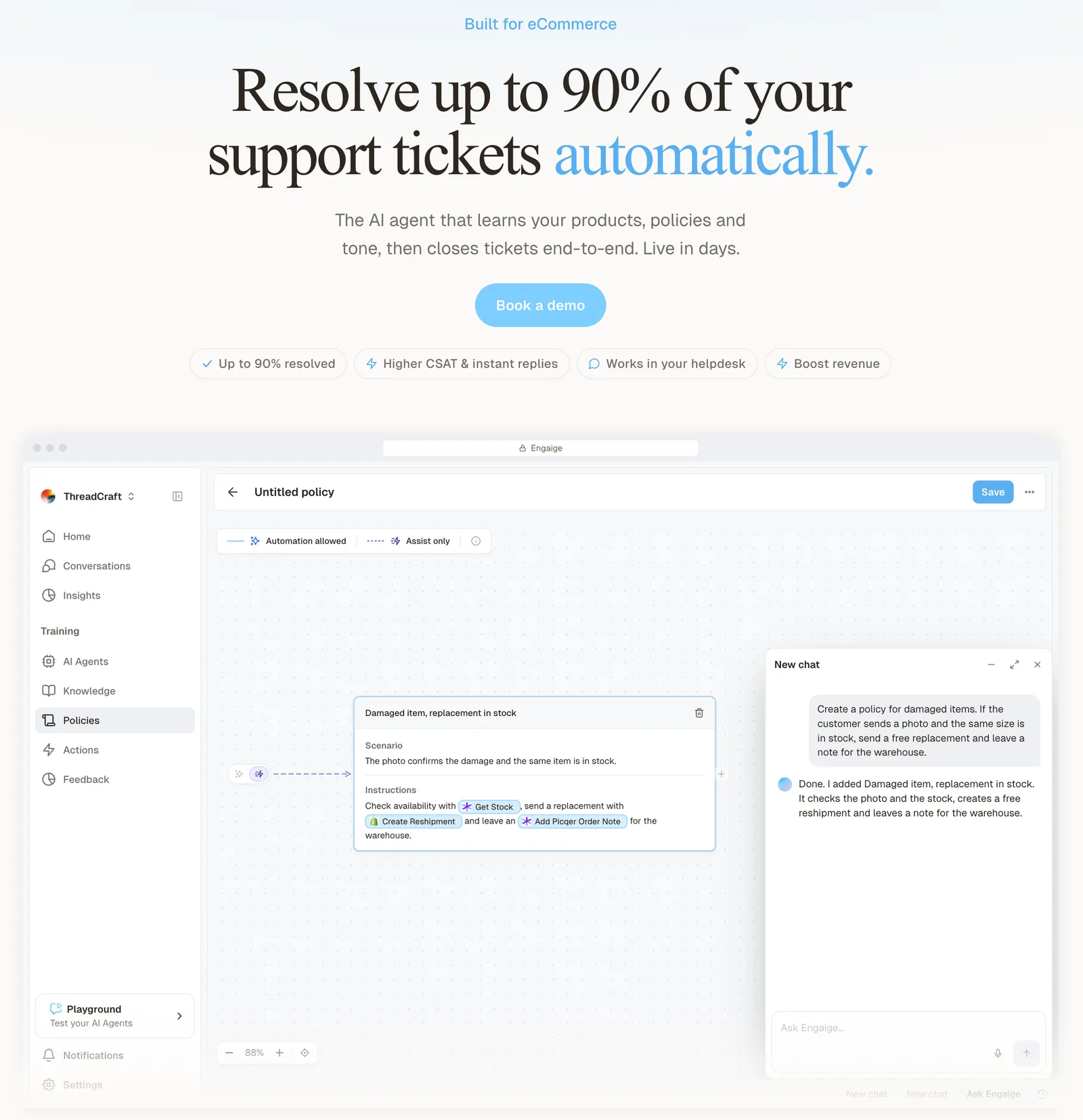
Where Zendesk is horizontal, Engaige reasons in the order lifecycle. It reads live order, catalogue and policy data before it replies and resolves the hard middle end to end: WISMO with a complication, multi-step refunds, conditional returns and subscription changes. It runs on 50+ native integrations with vetted, plug-and-play actions, is deepest on Shopify (live Admin API data plus your storefront content), and covers WooCommerce, Magento, BigCommerce and custom systems too.
You go live in Agent Assist within hours. Comparing every reply your team sends with what the agent suggested is one of the signals Engaige AI learns from, alongside conversations, your inputs, hand-offs and emerging trends. Engaige AI proposes changes to policies and behaviour with its reasoning, and you approve what goes live. Zendesk drafts procedures from solved tickets for you to publish; we found no competitor that publicly describes learning from the team’s normal replies from day one with changes a person approves.

Hello Potential New Client
What would you like to get done today?
Could you analyse this week's conversations and show me some automation opportunities?
Ask Engaige…
Searched and found 4 contact reasons · 2.4s
Your agent resolved 426 of 512 conversations. 86 were handed over, and one contact reason accounts for most of them.
Searched and found 1 policy · 1.6s
Delivery status hands over whenever tracking is older than 24 hours, which is 40 of those 46.
Editing Delivery status · 1.9s
Done. It now handles stale tracking itself. Those 40 a week stay with your agent.
What were the reasons for handover, and how can we improve?
Fix it.
Reply…
Once a ticket type matches your team’s quality, you switch it to autonomous. Brands that move quickly get there in about a week, up to 90% of supported tickets, and Engaige AI keeps learning from live outcomes and hand-offs. Otrium resolves 60% of 120,000 annual tickets end to end, and HelloPrint automated 80% of support, cut first response times by 90% and went from 100 agents to 28.
You set the limits. Policies can carry thresholds, such as sending refunds above a set amount to a person first, and each step runs Automated or in Agent Assist. You test policies in the Playground before they go live, for example by pasting in a past ticket. Full reasoning for every answer and action sits in the Engaige dashboard, and a hand-over leaves a reasoning summary as an internal note in the Zendesk ticket.
Engaige offered control, flexibility, and the ability to really incorporate AI in a more human way.

Pricing is a flat monthly fee tied to your ticket volume, predictable as you scale. Want us against Zendesk one to one? Our Zendesk comparison covers where each one lands on resolution, control and cost.
Pros
- Works inside the Zendesk you already run, live in hours with no migration.
- Resolves the hard middle end to end (multi-step refunds, conditional returns, WISMO with a complication) from live order, catalogue and policy data.
- Engaige AI keeps learning, from your team’s replies in Agent Assist and from live outcomes once autonomous, and you approve every change.
- Named, openable case studies (MR MARVIS 60%+, Otrium 60%, HelloPrint 80%) and a flat monthly fee tied to ticket volume.
Cons
- E-commerce-specialised by design, not a generic horizontal tool.
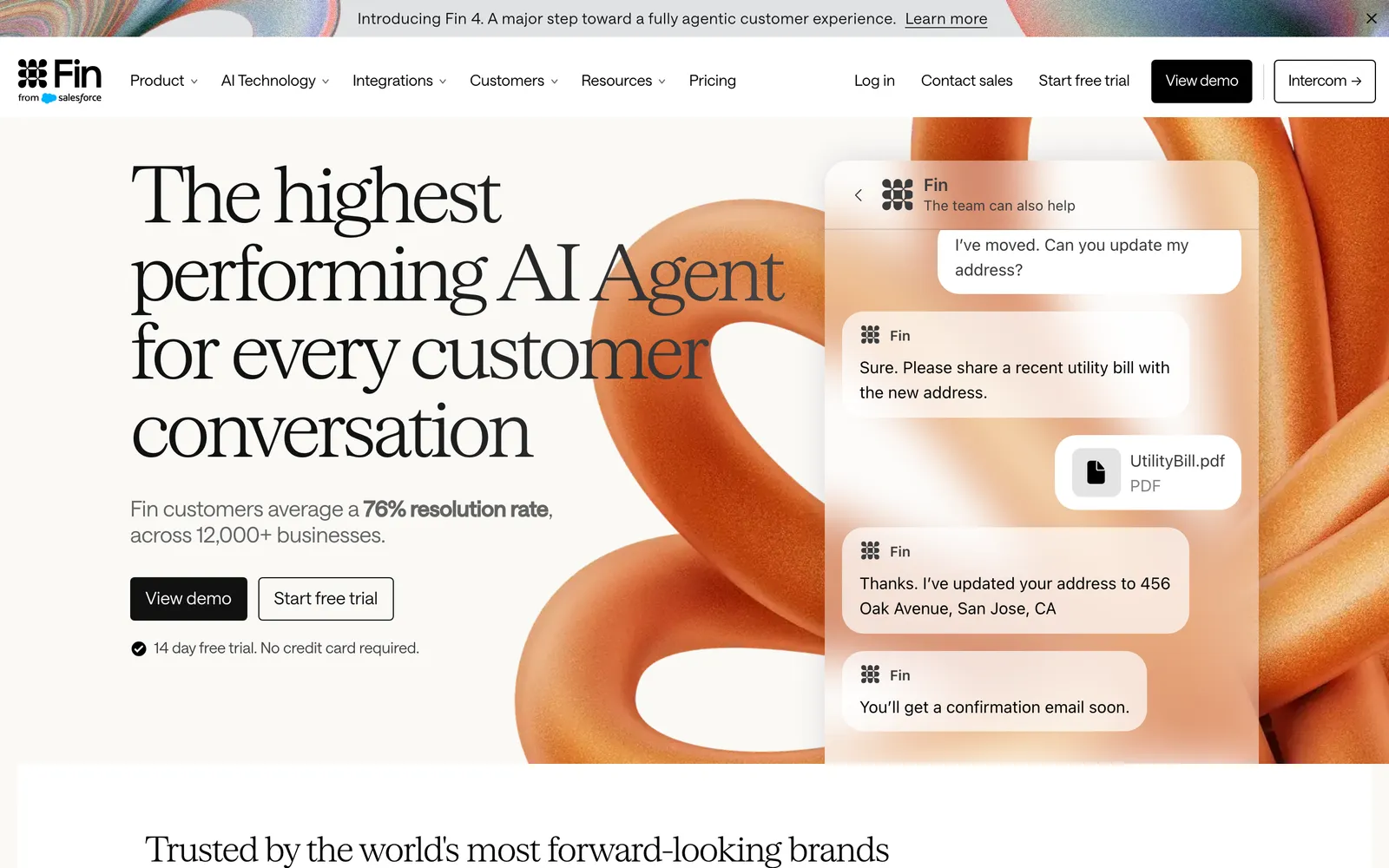
Fin is Intercom’s AI agent, and it runs on help desks other than Intercom’s own: fin.ai says it works with Salesforce, Zendesk, HubSpot and Freshdesk (October 2026). It acts through Procedures and connectors, and its pricing is $0.99 per outcome, such as a resolution, with a 50-outcome monthly minimum when it runs on your current help desk.
Fin states an average 76% resolution rate across 12,000+ customers (vendor-stated, October 2026). Fin Operator proposes changes as reviewable diffs that you approve. The catch: Fin is horizontal rather than commerce-specialised, so on Zendesk its store actions depend on the connectors you build. Our Intercom guide covers Fin in depth.
Pros
- Works on Zendesk, with public per-outcome pricing ($0.99, 50-outcome monthly minimum).
- Fin Operator proposes improvements as reviewable diffs that a person approves.
Cons
- The 76% is an average across all Fin customers, so ask for named results at your own ticket mix.
- Horizontal rather than commerce-specialised, so store actions depend on the connectors you build.
Yuma is an AI agent built for Shopify brands that works inside an existing help desk, with Zendesk, Gorgias, Kustomer and Front among those its homepage names, and takes real actions: refunds, label creation, subscription edits. It states that top deployments automate “up to 89% of support tickets” (Yuma, vendor-stated) and names per-customer results: EvryJewels 89%, Clove 70% and MyVariations 62% of tickets automated.
Brands “only pay for tickets fully resolved by AI”, according to its homepage (October 2026). The catch: its FAQ says it absorbs your team’s edits into future replies automatically, with no review step described. Our Yuma alternatives guide compares it with the other layered agents.
Pros
- Takes real actions inside the help desks it supports, Zendesk included: refunds, labels, subscription edits.
- Names per-customer automation rates rather than one headline.
Cons
- Learns from your team’s edits automatically, with no review step described, so check how you approve changes.
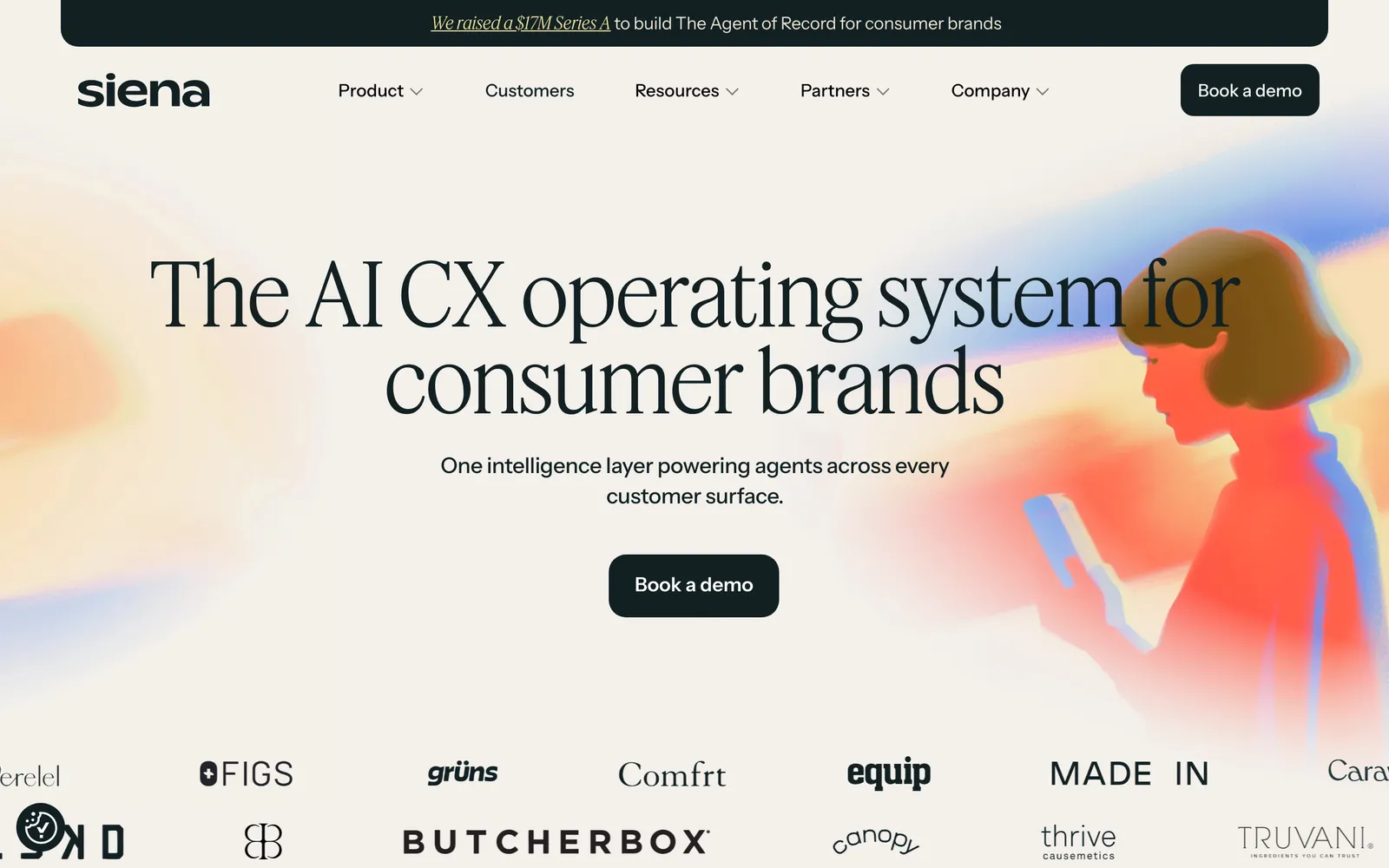
Siena positions itself as the AI CX operating system for consumer brands and runs agents that act, issuing refunds, generating labels and sending replacements in a single flow. Its integrations page lists Zendesk among its help desks, and since its October 2026 Series A it says “the help desk is included”. Its customers page names automation rates from over 36% (Canopy) to 80% (True Sea Moss, Bad Birdie), vendor-stated.
Pricing is public: a $750 monthly platform fee plus $0.90 per automated ticket, per its pricing page (October 2026). The difference with Engaige is how each improves: we found no Siena description of an approval step for the changes it learns (siena.cx, October 2026), while Engaige AI proposes each change with its reasoning for you to approve. Our Siena guide goes further.
Pros
- Acts in one flow (refunds, labels, replacements), with case studies naming per-customer rates.
- Public pricing, and it works on Zendesk or with a help desk of its own.
Cons
- No approval step for learned changes is described on its pages (October 2026).
E-commerce help desks that replace Zendesk

Gorgias is the Shopify-first help desk and a common destination for stores leaving Zendesk. Its AI Agent takes real actions, issuing refunds, editing subscriptions and updating shipping inside your store, and shows a summary of its reasoning under every AI message. Our Gorgias vs Zendesk comparison covers that pair in detail, migration included.
Its pricing page starts at $10 a month for 50 tickets, says the help desk is “never priced per agent”, and charges $0.90 per AI Agent interaction on annual plans or $1.00 on monthly plans. It quotes Orthofeet at above 50% automation (October 2026). The catch: the AI is bolted onto a ticketing platform, so choosing Gorgias means a full help desk migration.
Pros
- Shopify-first, with an AI Agent that issues refunds, edits subscriptions and updates shipping.
- A help desk priced by ticket volume rather than per agent.
Cons
- AI bolted onto a ticketing platform, so adopting it means a help desk migration.
Richpanel is an e-commerce help desk whose AI agent uses your tools to resolve the whole ticket, for example holding a Shopify shipment or saving a subscription in Recharge, and you choose which actions need approval first. A QA AI checks every closed conversation and flags repeat problems for your team. It markets high autonomous resolution and names brands such as Ridge and Jones Road Beauty among its customers.
Its pricing page lists $99 per seat a month on annual billing, with AI billed per conversation, at about $0.20 each, and no separate resolution fee (October 2026). The catch: the deeper value needs full Richpanel platform adoption, so this is a true migration off Zendesk, and the rates it markets are not the norm for every brand. Our Richpanel alternatives guide weighs the wider field.
Pros
- AI built for commerce that acts across Shopify and Recharge, with per-action approvals.
- A QA AI that reviews every closed conversation.
Cons
- The deeper value needs full platform adoption, so leaving Zendesk is a full migration.
- Ask for named results at your own ticket mix before relying on the marketed rates.
Omnichannel and inbox help desks
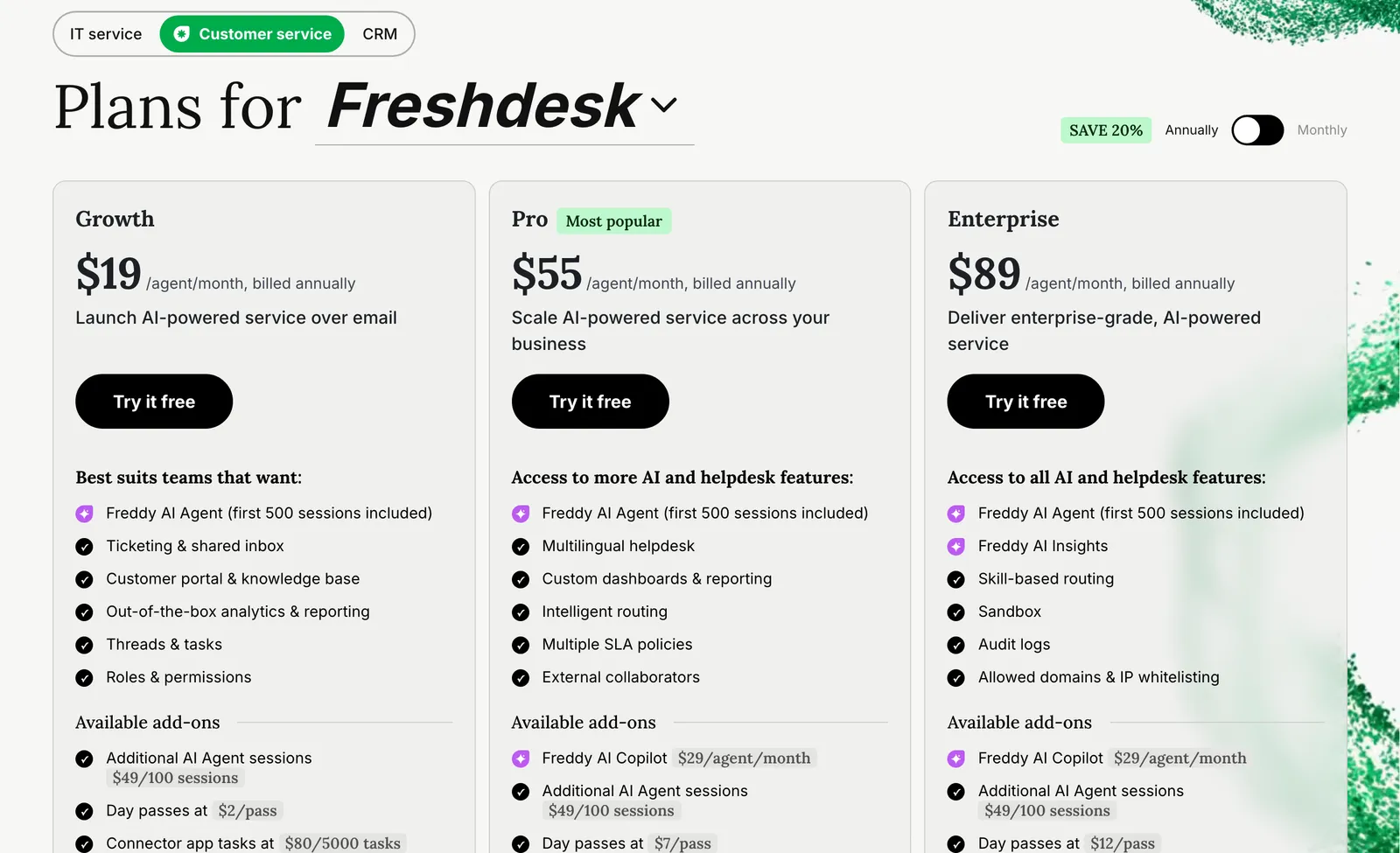
Freshdesk is a common budget-friendly step away from Zendesk: an omnichannel help desk with per-agent plans at $19, $55 and $89 a month billed annually, and no free plan listed, only a 14-day trial (October 2026). Its Freddy AI Agent is on all three plans, with the first 500 sessions included and $49 per 100 sessions after that.
Freddy takes actions and ships pre-loaded workflows that connect to Shopify and Stripe, and Freshworks markets up to 80% resolution (vendor-stated). The catch: Freddy is AI bolted onto a horizontal ticketing platform, so store actions beyond those workflows are built in AI Agent Studio. Our Freshdesk vs Zendesk comparison covers the pair, and our Freshdesk alternatives guide the wider field.
Pros
- Broad channels on a per-agent plan, with an AI agent that takes actions.
- Pre-built workflows that connect Freddy AI Agent to Shopify and Stripe.
Cons
- Horizontal like Zendesk, so store actions beyond the pre-built workflows are yours to build.
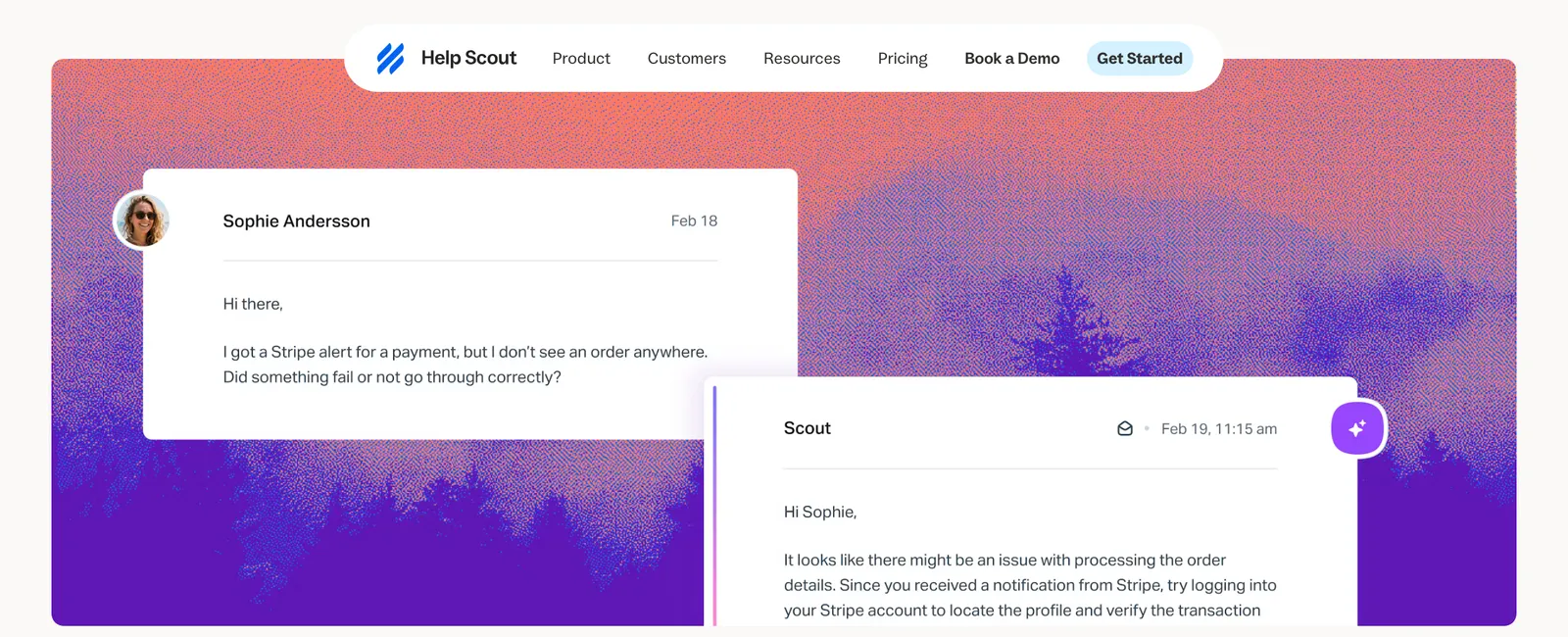
Help Scout is a people-first shared inbox for small and growing teams, with a free plan for 5 users, 1 inbox and 1 Docs site, and paid plans at $25, $45 and $75 per user a month (pricing, October 2026). Its AI agent resolves 73% of requests on average, according to Help Scout (vendor-stated), at $0.75 per resolution.
For a store, the detail that matters is where actions live today: human agents can refund, cancel and edit Shopify orders from the conversation sidebar, while the AI agent answers from your knowledge, with apps marked “coming soon” as of October 2026. Our Help Scout alternatives guide covers it in depth.
Pros
- Simple, well-loved inbox with a free plan for up to five users.
- Human agents act on Shopify orders without leaving the conversation.
Cons
- The AI agent answers from knowledge today; app connections were marked “coming soon” in October 2026.
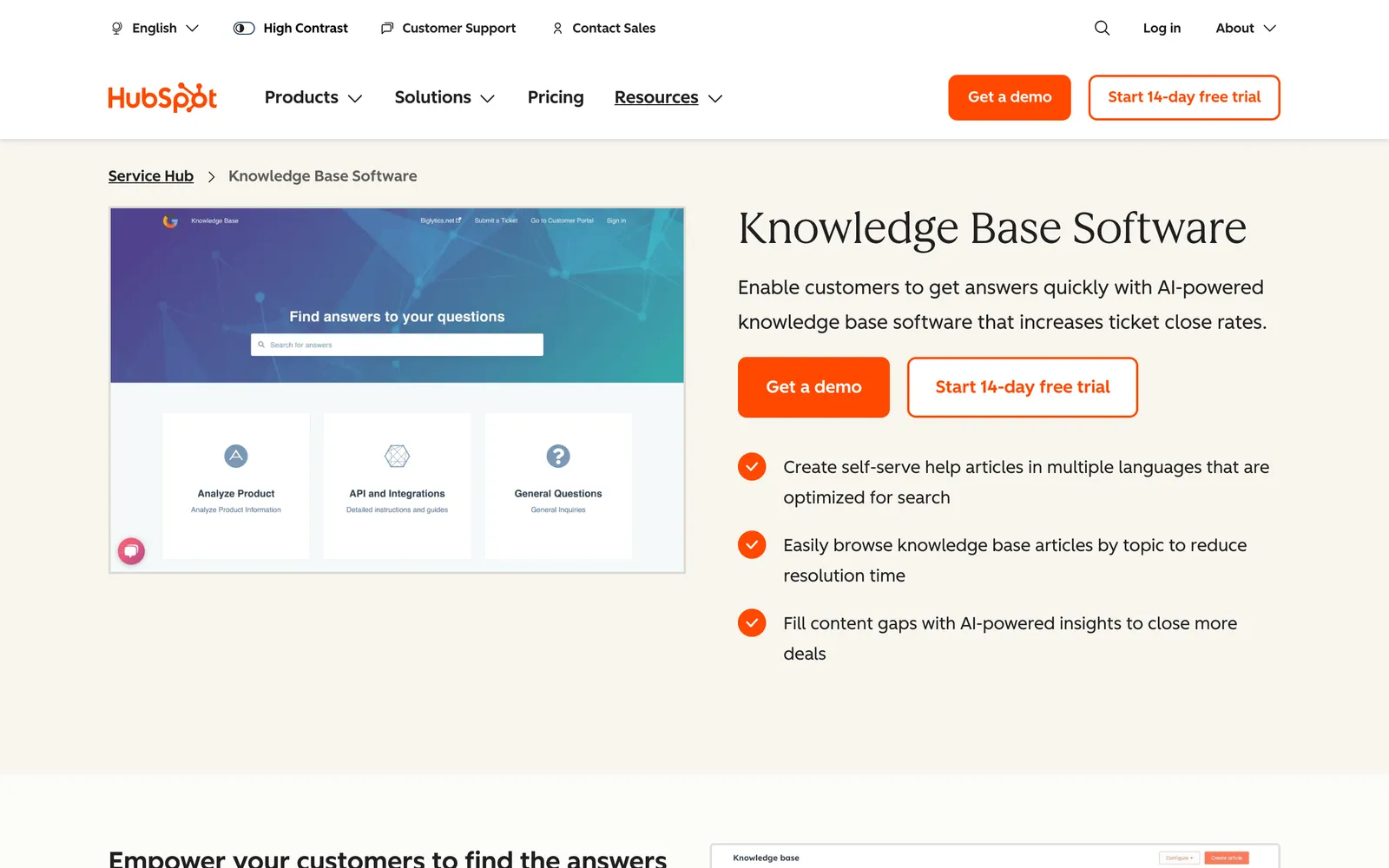
HubSpot Service Hub is the help desk on HubSpot’s CRM, so every ticket carries the full customer record from marketing and sales. Its Breeze Customer Agent answers from your knowledge base and website, checks order status, books meetings and hands off to a person. It fits best when HubSpot is already your system of record.
HubSpot says the agent resolves 65% of conversations across more than 8,000 customers who have activated it, and since 14 April 2026 it costs $0.50 per resolved conversation (HubSpot, vendor-stated). The catch for a store: Shopify orders sync one way into HubSpot, so check which order actions the agent can take before you move.
Pros
- One CRM record across marketing, sales and service, with an AI agent that resolves and hands off.
- Pay per resolved conversation for the agent.
Cons
- Shopify data arrives through a one-way sync, so confirm the order actions you need.
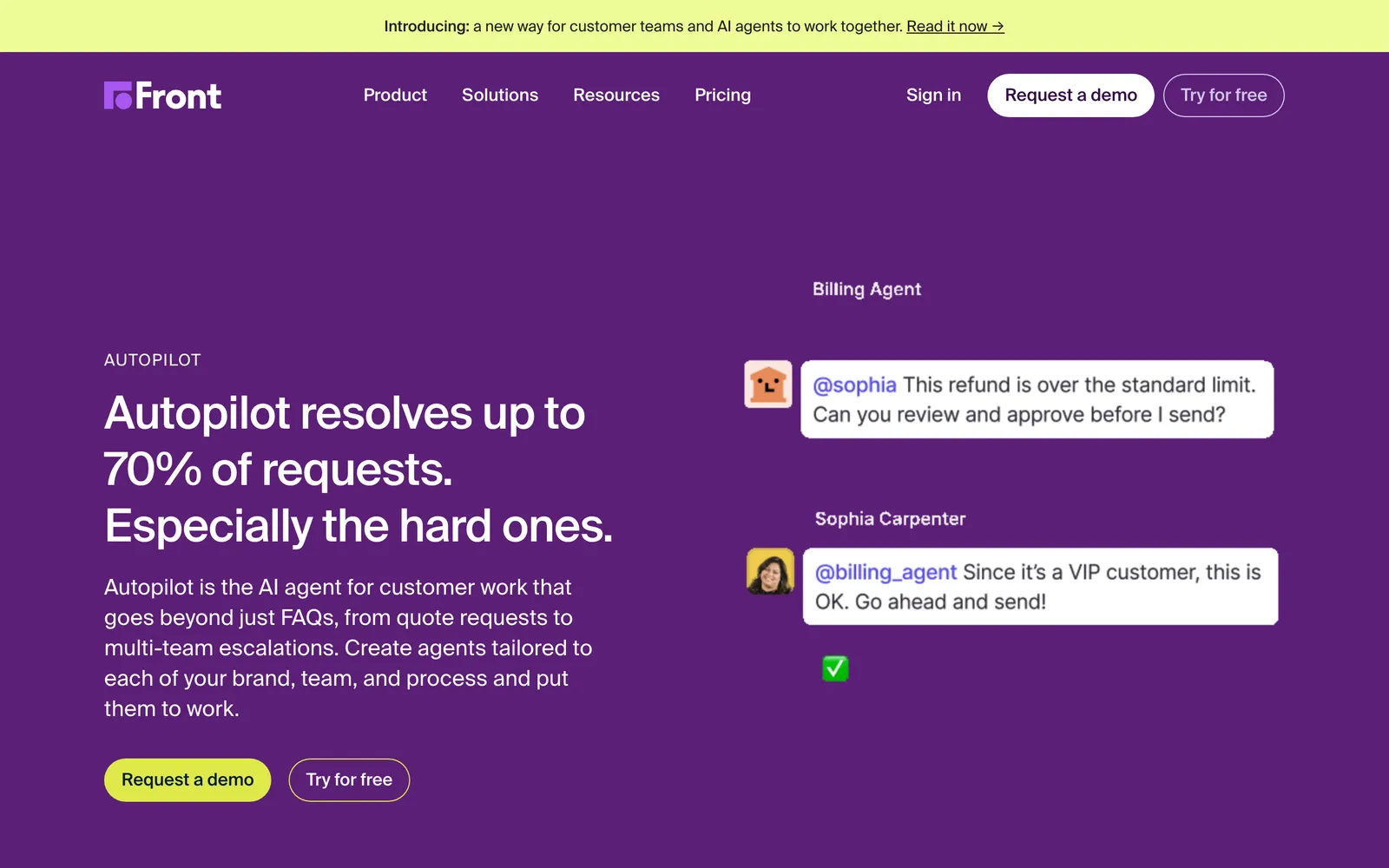
Front is a collaborative customer-operations inbox, strongest for teams that live in shared email. Its Autopilot agent takes action in your systems through Playbooks written in plain language, and Front says it “resolves up to 70% of requests” (Front, vendor-stated). Seats run $25 to $105 a month billed annually (pricing), with Autopilot from $0.05 per conversation (October 2026).
Front is also open about AI: since 6 October 2026 you can bring an external AI agent into the inbox, so the inbox and the AI are separate choices. For a store, check e-commerce depth: its Shopify integration is documented as displaying orders, refunds and addresses inside Front. Our Front alternatives guide goes further.
Pros
- Best-in-class collaborative inbox, with an acting AI agent and step visibility.
- Open to external AI agents, so the inbox and the AI are separate choices.
Cons
- The Shopify integration is documented as displaying order data, so confirm the actions you need.
A CRM platform instead of a help desk
Kustomer replaces the help desk with a CRM model: instead of counting tickets, it unifies order history, loyalty status and every conversation on one customer timeline, with AI agents that work across that data. It is the natural pick if your reason for leaving Zendesk is data spread across too many tools.
Kustomer does not publish its pricing; it builds a quote after an assessment (Kustomer, October 2026). Its AI’s built-in Shopify tool is documented as read-only, with writes built as custom tools (help centre, March 2026). The catch: adopting the CRM is a full migration, heavier than adding an agent to the Zendesk you already run.
Pros
- Unifies order history, loyalty status and conversations on one customer timeline.
- The natural fit when data fragmentation is your reason to leave Zendesk.
Cons
- Adopting the CRM is a full migration.
How do Zendesk competitors compare at a glance?
The table sorts Zendesk’s competitors by the questions that matter most after Zendesk: does the tool layer on or replace, does its AI act or assist, and which pricing model does it use? Resolution figures are vendor-stated unless marked otherwise, and the headline-versus-reality gap applies to every number below, ours included. Prices are as of October 2026.
| Tool | How it fits your stack | Acts or assists | Headline rate | AI pricing model |
|---|---|---|---|---|
| Zendesk (baseline) | Your current help desk | Acts (action flows you configure) | Over 80% | Seats + automated resolutions ($1.50 committed, $2.00 pay-as-you-go beyond the allowance) |
| Engaige | Works inside Zendesk | Acts | MR MARVIS 60%+, Otrium 60%, HelloPrint 80% (verified case studies) | Flat monthly fee tied to ticket volume |
| Intercom Fin | Works inside Zendesk, or runs on Intercom | Acts | 76% average | $0.99 per outcome, 50/month minimum |
| Yuma | Works inside Zendesk | Acts | Up to 89% top deployments; named 62-89% | Per ticket fully resolved by AI |
| Siena | Works inside Zendesk, or its own help desk | Acts | Named cases 36-80% | $750/month platform fee + $0.90 per automated ticket |
| Gorgias | Replaces the help desk | Acts | Orthofeet above 50% (testimonial) | Ticket-volume plan + $0.90-1.00 per AI interaction |
| Richpanel | Replaces the help desk | Acts (with approvals) | High rates marketed; varies by brand | Seats ($99) + about $0.20 per AI conversation, no resolution fee |
| Freshdesk | Replaces the help desk | Acts (pre-built and custom workflows) | Up to 80% | $19-89 per agent + $49 per 100 Freddy sessions after 500 included |
| Help Scout | Replaces the help desk | AI answers; human agents act on Shopify | 73% average | Seats ($25-75, free plan for 5 users) + $0.75 per resolution |
| HubSpot Service Hub | Replaces the help desk (CRM) | Acts | 65% of conversations | Seats + $0.50 per resolved conversation |
| Front | Replaces the help desk (inbox) | Acts (Playbooks) | Up to 70% | Seats ($25-105) + from $0.05 per Autopilot conversation |
| Kustomer | Replaces the help desk (CRM) | Acts | No public rate | Not published |
A fair word on our own row: we are Engaige, so we hold it to the same test we apply to everyone. Our numbers are named, verifiable case studies you can open, MR MARVIS, Otrium and HelloPrint, rather than homepage claims. Our “up to 90%” ceiling is the kind of vendor figure you should challenge on every supplier, us included. Yuma and Siena earn the same credit for publishing per-customer rates.
What does a Zendesk alternative cost?
Two things: the licence model and the migration. On the licence, flat-rate pricing ties a monthly fee to a ticket volume (Engaige), so the bill is predictable as orders grow. Per-outcome pricing charges when the AI closes a ticket: Intercom Fin at $0.99, Gorgias at $0.90 to $1.00, Help Scout at $0.75, HubSpot at $0.50, Siena at $0.90 on top of a platform fee, Yuma per ticket fully resolved, and Zendesk’s own automated resolutions.
Per-session or per-conversation pricing charges per AI interaction: Freddy at $49 per 100 sessions after the first 500, Front’s Autopilot from $0.05 per conversation, and Richpanel’s AI, billed per conversation on top of $99 seats. Kustomer does not publish its pricing. For Zendesk’s own plans and add-ons, see our guide to Zendesk products.
The honest comparison is total cost per resolved ticket, not the headline per-unit price: platform fee plus AI fee, divided by tickets closed without a human. Each model suits a different volume and budgeting style, so none is wrong in itself. Run the number at today’s volume and at twice today’s volume, for every tool on your shortlist, ours included. Then add the cost of leaving, which the next section covers.
How hard is it to switch from Zendesk?
It depends on the route. Keeping Zendesk and swapping the AI moves nothing: Engaige, Fin, Yuma or Siena connects to your account, and tickets, macros and history stay put. Replacing the help desk is a project, and operators describe a “data ransom” phase where exports flatten or drop data. Some teams keep a read-only Zendesk seat for years after switching, purely to keep access to their own history. One r/SaaS post described it:
April 2026RedditEvery few weeks there is a thread here about Zendesk alternatives. Pricing jumped, seats are too expensive, so you decide to migrate… But I rarely see anyone talk about the architectural nightmare of actually getting your historical data out before you cancel. Most teams end up keeping a “read-only” Zendesk seat for years just because the migration scripts failed. · r/SaaSView on RedditIf you do replace the help desk, three steps make it smoother:
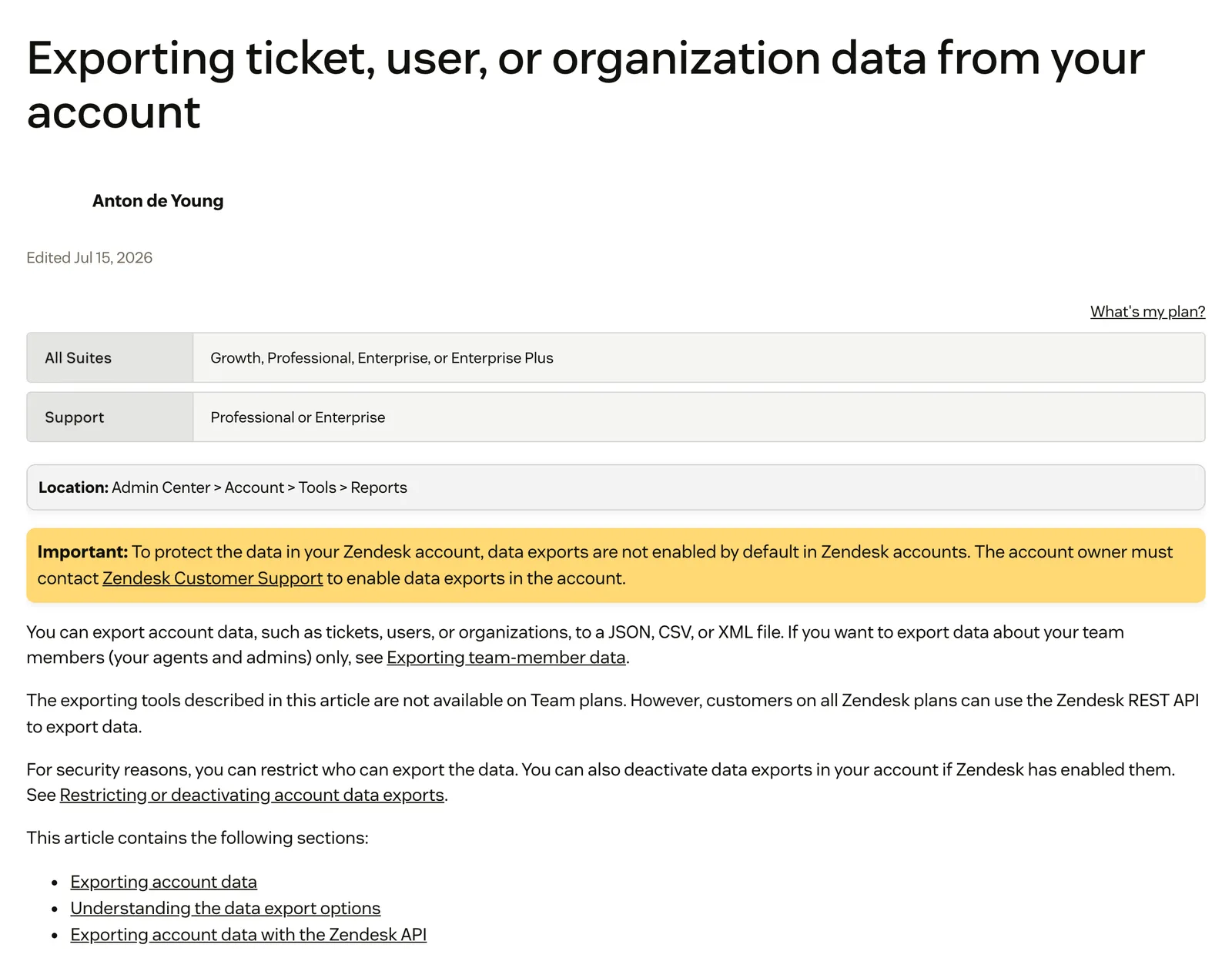
- Check export access early. Zendesk’s account export is off by default, so the account owner asks Zendesk Support to enable it; it is not available on Team plans, where the REST API is the route, and AI agent tickets are not in the account export (Zendesk, October 2026). Our export guide walks through every route.
- Rebuild, don’t copy. Triggers, automations, macros, SLAs and Marketplace apps do not carry over one to one, so map each to the new tool’s equivalent and drop what you no longer use.
- Run in parallel. Keep Zendesk live while the new help desk takes a share of traffic, then cut over channel by channel, ideally well before your renewal date.
If Gorgias is the destination, our Gorgias vs Zendesk comparison covers that move. If you stay, test rule changes in a Zendesk sandbox first, and know how the ticket requester behaves when tickets are merged.
If the reason you are leaving is the AI rather than the help desk, the lightest migration is none: pilot an agent on Zendesk first, and move the help desk only if the platform itself is the constraint.
Which Zendesk alternative fits your store?
Match the route to your trigger. If you want a different AI but migration is the blocker, layer an agent on top of the Zendesk you already run. If the platform is oversized for your team, move to a lighter help desk. Whatever the route, test vendor-stated rates against named customers first.
| Your migration trigger | The route that addresses it | Shortlist |
|---|---|---|
| Want e-commerce depth without migrating | Keep the helpdesk, layer an e-commerce agent on top | Engaige, Yuma |
| Want a different AI on Zendesk, outside e-commerce too | An agent that runs on Zendesk | Intercom Fin, Engaige |
| Premium DTC brand, high LTV | Brand-grade CX with actions in one flow | Engaige, Siena |
| Want a Shopify-first help desk with an acting AI | Full replacement with an e-commerce help desk | Gorgias, Richpanel |
| Want a cheaper omnichannel help desk | Per-agent help desk with a built-in AI agent | Freshdesk |
| Platform oversized for a two-or-three-person team | A lighter shared inbox | Help Scout, Front |
| Marketing and sales already run on HubSpot | One CRM record for every ticket | HubSpot Service Hub |
| Data spread across many tools | One customer timeline | Kustomer |
| Small store, simple ticket mix | Fast setup, low entry price | Help Scout, Tidio |
| Historical data makes leaving feel impossible | Stay on Zendesk as the system of record, automate on top | Engaige, Yuma |
There is no universal winner here, and the wrong move is paying a full migration cost without fixing the problem that sent you looking. Decide first whether your problem is the helpdesk or the AI on top of it; the shortlist falls out of that answer.
Frequently asked questions
Why do teams look for Zendesk alternatives?
Rarely because of capability. The triggers that come up are pricing fit at their own volume, e-commerce depth on a horizontal platform with AI bolted on, and a platform that feels oversized for a lean e-commerce team.
Is Zendesk’s AI weak, then?
No. Zendesk states its agents routinely resolve over 80% of interactions (vendor-stated), it owns Ultimate and Forethought, and its QA and transparency tooling is among the strongest in the category. Teams usually leave because of fit, store depth and platform weight, not because of what the AI can do.
Do I have to migrate off Zendesk to replace the AI?
No. Engaige, Yuma, Siena and Intercom’s Fin all work on top of your existing Zendesk. You keep Zendesk as the system of record and replace the AI, without the data ransom phase of a full migration. Engaige resolves tickets end to end inside Zendesk and learns from your team’s replies, with changes you approve.
Is there a free Zendesk alternative?
Help Scout has a free plan for 5 users, 1 inbox and 1 Docs site, according to its pricing page (October 2026). Zendesk lists no free plan, only a 14-day trial, and Freshdesk’s pricing page lists none either. A free plan suits a small team; for a store, compare what the AI resolves, not only the seat price.
What is the “data ransom” problem when leaving Zendesk?
Operators report that getting historical data out is harder than expected: exports flatten or drop data, and migration scripts fail partway. Zendesk’s account export is also off by default until Zendesk enables it. Some teams keep a read-only Zendesk seat for years after switching just to access history. Budget for migration engineering, or pick a route that leaves the data where it is.
What is the cheapest Zendesk alternative?
It depends what you count. On entry price, Help Scout’s free plan and Gorgias from $10 a month for 50 tickets are the lowest listed in October 2026. The honest comparison is total cost per resolved ticket at your volume, for every model. Engaige is a flat monthly fee tied to your ticket volume, and Kustomer prices by quote.