Richpanel is one of the more ambitious e-commerce helpdesks, built around what it calls an autonomous AI support team: agents that resolve refunds, order tracking, cancellations and damage claims on their own, with a QA agent reviewing every conversation. On Reddit it is often the answer merchants reach for when Gorgias gets expensive, and usually for good reason. So if you are searching for a Richpanel alternative, it is rarely because the AI cannot act.
It is usually one of three things: the migration, the pricing model or the depth. Adopting Richpanel means replacing your entire helpdesk, its AI is priced per conversation alongside seats, and its deepest transactional actions run Shopify-side.
This guide compares eleven Richpanel alternatives on those axes: whether you have to migrate at all, which pricing model each one uses, and how deeply it can act in your store. Facts and figures are based on public information and our own research, verified July 2026 and labelled where vendor-stated.
It is the brand-specific spin-off of our ranked guide to the best AI chatbots for e-commerce, which scores the wider field on six weighted criteria. If Richpanel specifically is the tool you are weighing, and you are deciding whether its autonomy is worth a migration, our Gorgias vs Richpanel comparison runs that exact trade-off in detail.
Why do teams look for Richpanel alternatives in 2026?
Most people who reach this page are not fleeing Richpanel. They are deciding whether to migrate to it in the first place, and want to see the field before they commit. That reframes the question: the real comparison is not Richpanel against another platform you would also have to migrate to, it is Richpanel’s migration against layering an agent onto the helpdesk you already run. Three triggers come up.
The migration. Richpanel’s autonomous agent is part of the Richpanel helpdesk, so adopting it means moving your inbox, macros, history, channels and integrations across. Richpanel de-risks this with one-click, done-for-you migration and a money-back resolution guarantee for the first 30 days, but a platform switch is still a platform switch. Tools that layer onto whatever helpdesk you run avoid the project entirely, which is why teams who like their current inbox start here.
The pricing model. Richpanel prices its AI agent at roughly $0.20 per AI-handled conversation, billed on your actual token use, plus $100 per human seat per month (vendor-stated, verified July 2026). Merchants often cite its cost as a draw. Whichever model you compare it with, the honest yardstick is total cost per resolved ticket at your real volume, not the per-conversation sticker.
The depth beyond Shopify. Richpanel names Shopify, WooCommerce, Magento and Amazon among its integrations, so it provides helpdesk coverage across them. But its deepest transactional actions, such as subscription edits and returns, run through Shopify-side partners like Recharge and Loop. If you are on WooCommerce or Magento, confirm the specific actions you need are covered before assuming parity, the same caution that applies to most e-commerce agents.
There is a fourth thing worth naming, because it applies to Richpanel exactly as it applies to every tool below: a marketed rate is not the norm for every store. We come back to that next.
What does Richpanel still do well?
A lot, and it is worth being honest about it. Richpanel’s AI graduates through three modes, copilot (it drafts, your team approves), supervised autopilot (it sends, your team reviews after), and autonomous (it handles and escalates edge cases), typically reaching autopilot in two to three weeks.
A separate QA AI reviews closed conversations and groups the misses into recommended fixes your team approves, and the “escalate when uncertain” rule gives your team a real on-ramp rather than an all-or-nothing switch.
Merchants who have actually run it tend to rate it well.
The catch is the one that applies to every vendor: the headline and the reality sit some distance apart. Richpanel markets high autonomous resolution at maturity (vendor-stated). A few stores may reach rates like that, but they are not the norm, and without control over the agent’s reasoning and deep store actions, many land lower.
That is not a mark against Richpanel; it is how vendor ceilings work. It just changes the maths: plan around your likely rate, not the ceiling.
Use the same test on every tool below, ours included: which named customer produced the number, over what period, and what counts as “resolved”? A rate with none of those attached is marketing, not a benchmark.
How should you evaluate a Richpanel alternative?
Five checks separate a genuine alternative from a lateral move. The first two address why you are weighing a change (the migration and pricing fit), the next two address whether the move actually helps (resolution and stack fit), and the last one protects you from buying the same headline-versus-reality gap under a different logo.
| # | Check | The question to ask |
|---|---|---|
| 1 | Migration, or no migration | Does it layer onto the helpdesk you already run, or does adopting it mean a full platform switch like Richpanel? |
| 2 | Pricing predictability | What is the total cost per resolved ticket at today’s volume and at twice today’s volume? |
| 3 | Resolution, not deflection | Does it complete the refund, return or order edit in your store, or draft a reply for an agent to send? |
| 4 | Platform depth | Can it act in your platform (Shopify, BigCommerce, WooCommerce or Magento), not just read order data? |
| 5 | Claim substantiation | Does the vendor publish named per-customer rates, including unflattering ones, or one headline figure? |
A practical shortcut for check three: feed every candidate your three ugliest recent tickets, the WISMO case with a stuck parcel, the part-refund, the damaged item with a replacement. Whether it completes those, rather than deflecting them, predicts your real resolution rate better than any demo.
What are the best Richpanel alternatives?
The best Richpanel alternatives in 2026 are Engaige (acts on live store data end to end, learns from your team, no migration) and Yuma if you want to keep your helpdesk; Intercom Fin, Siena or DigitalGenius if you want a layered agent but expect a heavier, higher-touch build; Gorgias, Zendesk, eDesk or Freshdesk if you are open to replacing the helpdesk anyway; and Tidio or Re:amaze for smaller stores.
Which one fits depends on the trigger that sent you here. If you would rather not migrate, add an agent that acts on the helpdesk you already run. If you are open to a platform switch regardless, a replacement helpdesk is fair game. And within the layered route, the real divide is how much of the work is on you: some tools are self-serve, others are enterprise-built and need a services engagement to stand up.
Layer-on agents that keep your helpdesk: self-serve
These resolve tickets on top of the inbox you already run, so there is no migration, and you can stand them up yourself.
Engaige (that’s us)
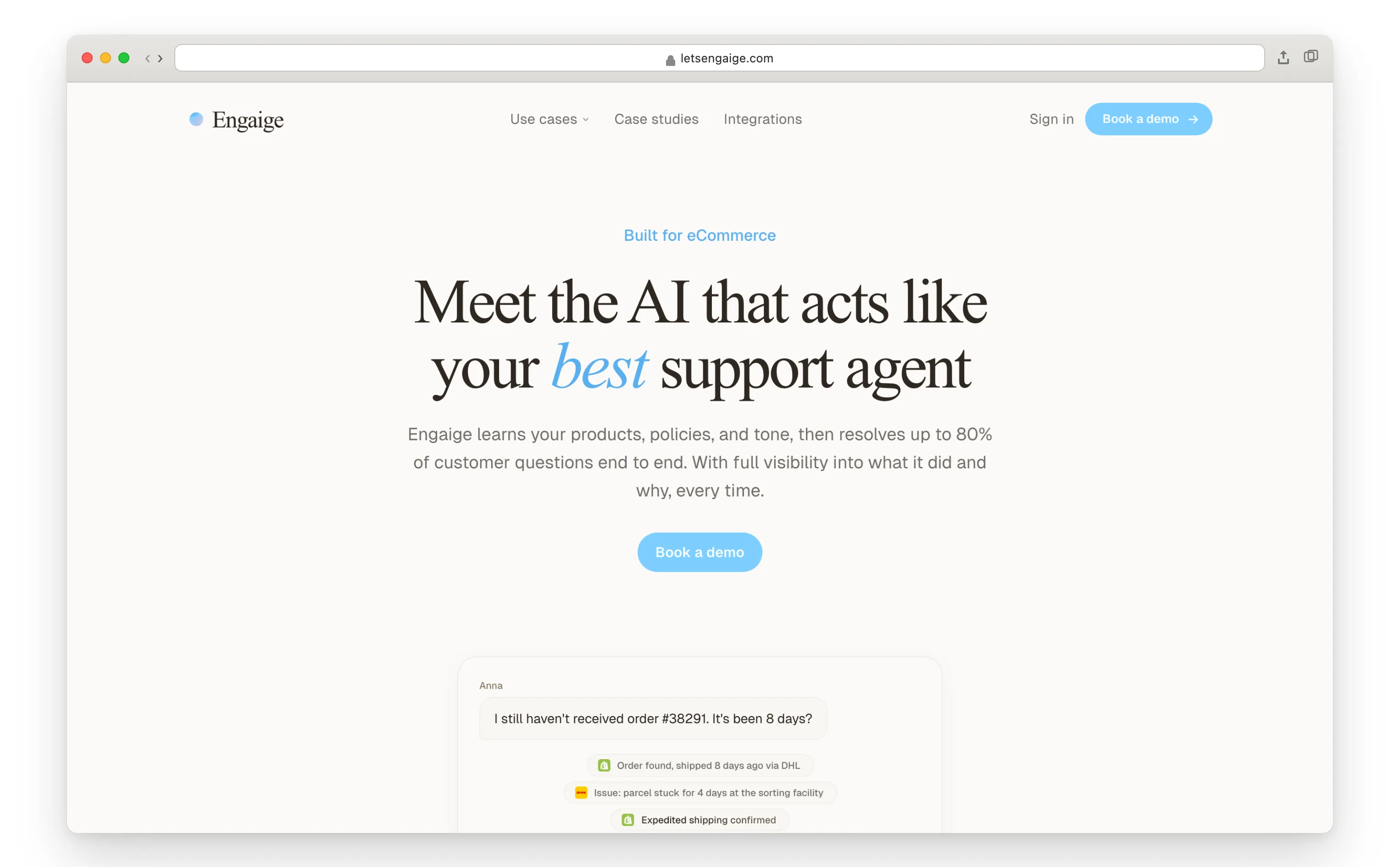
Engaige is a hybrid AI agent built for e-commerce that resolves tickets end to end (WISMO, returns, refunds, subscription and warranty changes) on top of the helpdesk you already run, Gorgias and Zendesk included. Where Richpanel asks you to migrate to unlock its agent, Engaige adds the agent to the stack you keep. It reads live order, catalogue and policy data before replying rather than inferring, so it does not guess.
Want the one to one? Our Richpanel comparison covers the migration question in full.
Its resolution comes from the hard middle: the multi-step refunds, conditional returns and WISMO-with-a-complication cases that need live data and judgement to close, rather than the easy questions any tool can deflect.
Engaige is the agent; Engaige AI configures and improves it from plain-language briefs. You go live in Agent Assist within hours, and comparing every reply your team sends with what the agent suggested is one of the signals Engaige AI learns from. It proposes changes to policies and behaviour with its reasoning, and you approve what goes live. We found no competitor that publicly describes learning from the team’s normal replies from day one with changes a person approves.
Once a ticket type matches your team’s quality, you switch it to autonomous (most brands get there within about a week), and it keeps learning from emerging trends and hand-offs. Full reasoning for every answer and action sits in the Engaige dashboard, and a hand-over leaves a reasoning summary as an internal note in the ticket. Policies can carry thresholds, and each step runs Automated or in Agent Assist. No decision trees, no prompt engineers.
Pricing is a flat monthly fee tied to your ticket volume, predictable as you scale.
Verified outcomes: MR MARVIS resolves over 60% of the conversations its agent handles across 120,000 questions a year, Otrium 60% of 120,000 end to end with no human touch, and HelloPrint automated 80% of support at steady state, cutting first response times by 90% and going from 100 agents to 28. You test policies in the Playground before they go live, for example by pasting in a past ticket, with no migration.
Pros
- Layers on the helpdesk you already run, live in hours with no migration, the opposite of a Richpanel platform switch.
- Reads live order, catalogue and policy data rather than inferring, and resolves the hard middle end to end (multi-step refunds, conditional returns), not just FAQs.
- Engaige AI learns in both modes, from your team’s replies in Agent Assist and from live outcomes and hand-offs once autonomous, with changes you approve.
- A flat monthly fee tied to your ticket volume, predictable as you scale, and named, openable case studies (Otrium 60%, HelloPrint 80%).
Cons
- E-commerce-specialised by design, not a generic horizontal tool.
Engaige offered control, flexibility, and the ability to really incorporate AI in a more human way.

Engaige proved to be invaluable. Their hands-on support during the implementation phase resulted in significant improvements to our automated resolution rate and CSAT.


Yuma is purpose-built for Shopify and sits inside the helpdesk you already use (Gorgias, Zendesk, Kustomer, Re:amaze, Gladly and more), taking real actions: refunds, label creation, subscription edits. Like Engaige, it is a layer rather than a migration, so you can add it without moving your inbox, or take it with you if you later change helpdesks.
Yuma states “top deployments reach 89%” (Yuma, vendor-stated) and publishes per-customer rates rather than one headline, including unflattering ones: EvryJewels 89%, Clove 70%, Tediber 64%, FINN 45%, and 40% at The Koin Club. The catch: its FAQ says it absorbs your team’s edits into future replies automatically, with no review step described, and how deeply it can act depends on the helpdesk underneath.
Pros
- Acts inside the helpdesk you already use (Gorgias, Zendesk, Kustomer, Re:amaze, Gladly): refunds, labels, subscription edits, with no migration.
- Publishes per-customer rates including unflattering ones (40-89%), the substantiation bar this guide asks for.
Cons
- Learns from your team’s edits automatically, with no review step described, so check how you approve changes.
- How deeply it can act depends on the helpdesk underneath.
Layer-on agents that keep your helpdesk: enterprise and higher-touch
These also connect to your existing helpdesk rather than replacing it, but they are enterprise-built: expect a heavier implementation and a services engagement to stand them up, closer in effort to a migration than to a self-serve launch.

Fin is Intercom’s AI agent, and unusually for a suite vendor it deploys on helpdesks that are not Intercom’s own. It acts through Procedures and connectors, and pricing is a flat $0.99 per resolution with a 50-resolution monthly minimum; on Intercom’s own stack, seats are extra.
Intercom cites a 67% platform benchmark (vendor-stated), while an independent 60-day test found around 38% average resolution, against Intercom’s “up to 50%” marketing. Fin Operator proposes changes as reviewable diffs you approve. The catch: Fin is horizontal rather than commerce-specialised, so store actions depend on the connectors you wire up. We pair it with an e-commerce helpdesk in our Intercom vs Gorgias comparison.
Pros
- Public flat per-resolution pricing ($0.99, 50-resolution monthly minimum) and deploys on helpdesks beyond Intercom’s own.
- Acts through Procedures and connectors.
Cons
- Its 67% benchmark sits against the ~38% average an independent 60-day test found.
- Horizontal rather than commerce-specialised, so store actions depend on the connectors you wire up.
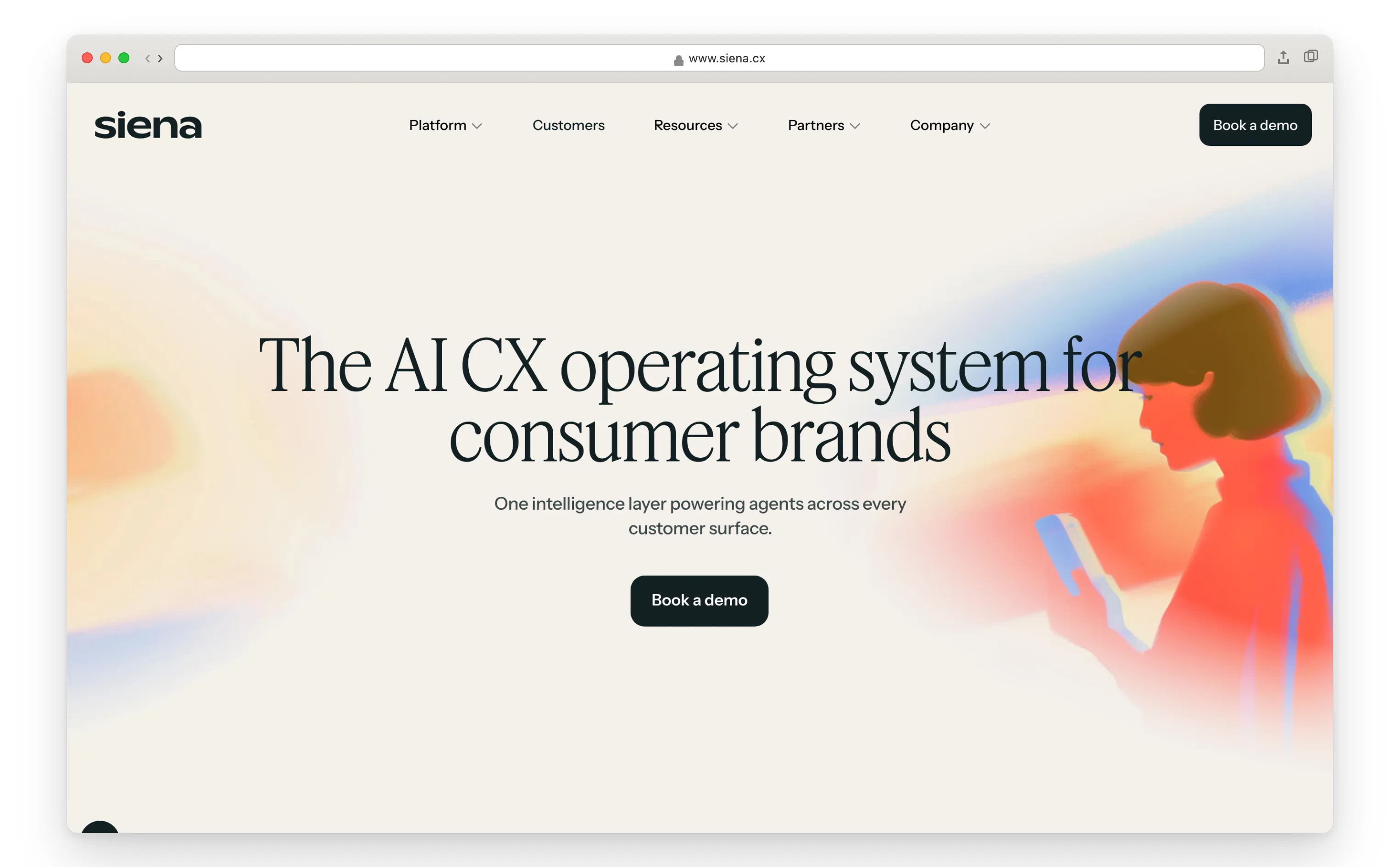
Siena positions itself as the AI CX operating system for consumer brands and runs agents that act, issuing refunds, generating labels and sending replacements in a single flow, connecting to helpdesks like Gorgias, Zendesk and Gladly. It states brands “automate up to 80% of customer interactions” (Siena, vendor-stated) and backs that with 15 named case studies publishing per-customer rates, from 80% at True Sea Moss down to 49% at Verb.
The catch: pricing is quote-based, the build is brand-bespoke and higher-touch rather than self-serve, and its integrations page lists Shopify as the only commerce platform, so confirm anything beyond Shopify before committing.
Pros
- Acts in one flow (refunds, labels, replacements) on top of your helpdesk, with 15 named case studies publishing per-customer rates (49-80%).
- Brand-grade CX positioning for consumer brands.
Cons
- Pricing is quote-based and the build is higher-touch, not self-serve.
- Integrations list Shopify as the only commerce platform, so confirm anything beyond it.

DigitalGenius is an enterprise retail AI agent that fully resolves queries, returns, warranty claims and order amendments for established brands including On, AllSaints, Rapha and MyTheresa, and reports outcomes such as On cutting customer wait times by 93% (vendor-stated). It integrates into your existing helpdesk and systems rather than replacing them.
The catch: pricing is quote-based, implementation is heavy and services-led, and it sits at the enterprise end, so it is impractical for a smaller store wanting a fast launch, further from self-serve than anything above.
Pros
- Enterprise-grade resolution of queries, returns, warranty claims and order amendments for established brands, layered onto your systems.
- Named outcomes such as On cutting customer wait times by 93%.
Cons
- Quote-based pricing and heavy, services-led implementation.
- Sits at the enterprise end, impractical for a smaller store wanting a fast launch.
Helpdesk replacements: a migration, like Richpanel
If you are open to a platform switch regardless, these replace the helpdesk outright, the same shape of decision as adopting Richpanel.

Gorgias is the Shopify-first helpdesk Richpanel most directly targets, with a built-in AI Agent that issues refunds, edits subscriptions through Recharge and processes returns through Loop, without leaving the ticket. It states “60% of inquiries resolved instantly” (vendor-stated), while its own Psycho Bunny case study reports 26%.
Gorgias prices its AI Agent at roughly $0.90 to $1.00 per AI resolution with unlimited seats. The trade versus Richpanel is store depth against a different pricing model, and in both cases the AI is bolted onto the helpdesk. We put the two head to head in our Gorgias vs Richpanel comparison, and weigh the wider field in our Gorgias alternatives guide.
Pros
- Built-in Shopify depth (refunds, Recharge subscriptions, Loop returns) with nothing to wire up, and unlimited agent seats.
- Mature and widely used, with published case studies.
Cons
- AI bolted onto a ticketing platform, so adopting it is a helpdesk migration.
- Deepest on Shopify; other platforms run shallower.
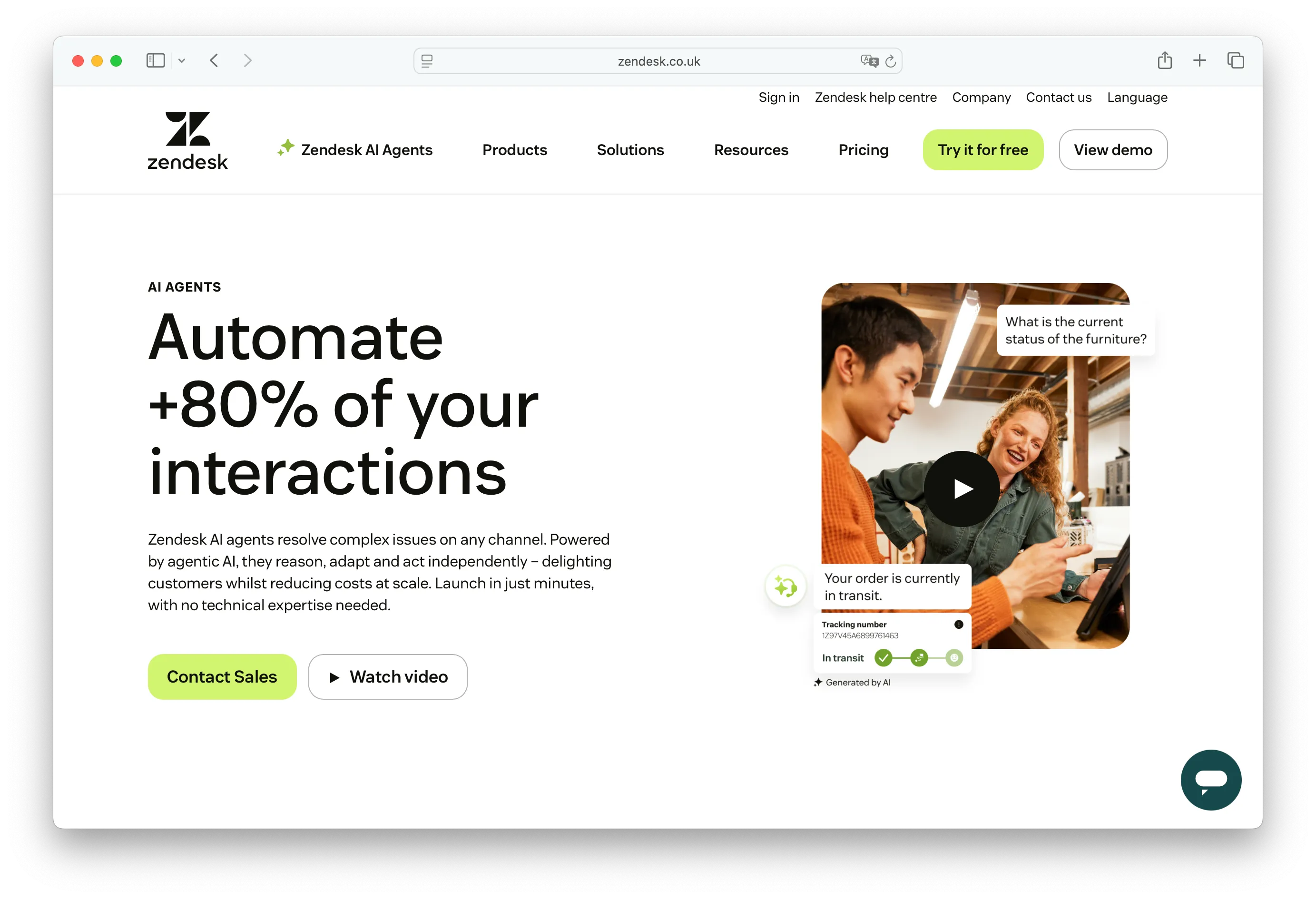
Zendesk repositioned itself in 2026 as a “Resolution Platform” and states its AI agents “routinely resolve over 80% of interactions” (press release, vendor-stated). It brings enterprise-grade omnichannel routing, 1,500+ integrations (third-party count), strong QA tooling, and now owns Ultimate and Forethought. It is the heavier, more horizontal replacement where Richpanel is built for e-commerce.
It prices with per-seat fees plus an AI add-on plus a fee per verified resolution (third-party estimates put that around $1.50 committed and $2.00 pay-as-you-go, not vendor-confirmed). The catch: its AI is bolted onto a horizontal platform, and Shopify actions run through action flows you configure. We unpack it in our Zendesk alternatives guide and our Gorgias vs Zendesk comparison.
Pros
- Enterprise-grade omnichannel routing, 1,500+ integrations and strong QA tooling, with vendor-stated over 80% resolution.
- Broad, mature platform that now owns Ultimate and Forethought.
Cons
- Horizontal platform with AI bolted on, rather than e-commerce-specialised.
- Shopify actions run through action flows you configure.
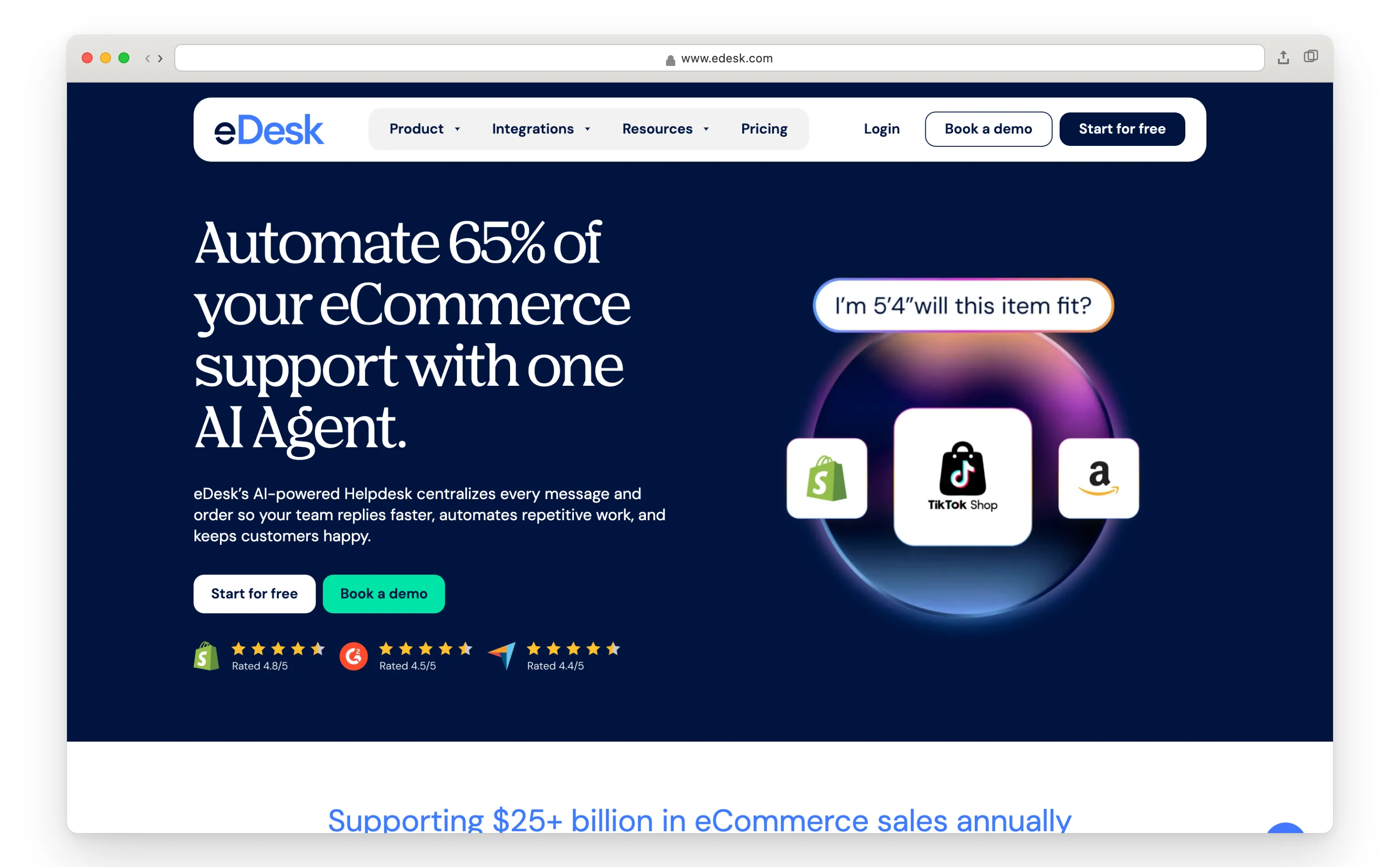
eDesk is an e-commerce and marketplace helpdesk whose AI aims to automate up to 65% of support (vendor-stated). Its edge over Richpanel is marketplace breadth: Amazon, eBay, Walmart and TikTok Shop alongside Shopify, WooCommerce, BigCommerce and Magento, which makes it the natural shortlist entry for marketplace-heavy sellers. The catch: the automation leans more on rules and FAQs than autonomous reasoning, so the hardest multi-step cases still route to your team.
Pros
- Marketplace breadth: Amazon, eBay, Walmart and TikTok Shop alongside the major storefronts.
- Vendor-stated up to 65% automation, a natural fit for marketplace-heavy sellers.
Cons
- Automation leans on rules and FAQs more than autonomous reasoning, so the hardest cases still route to your team.
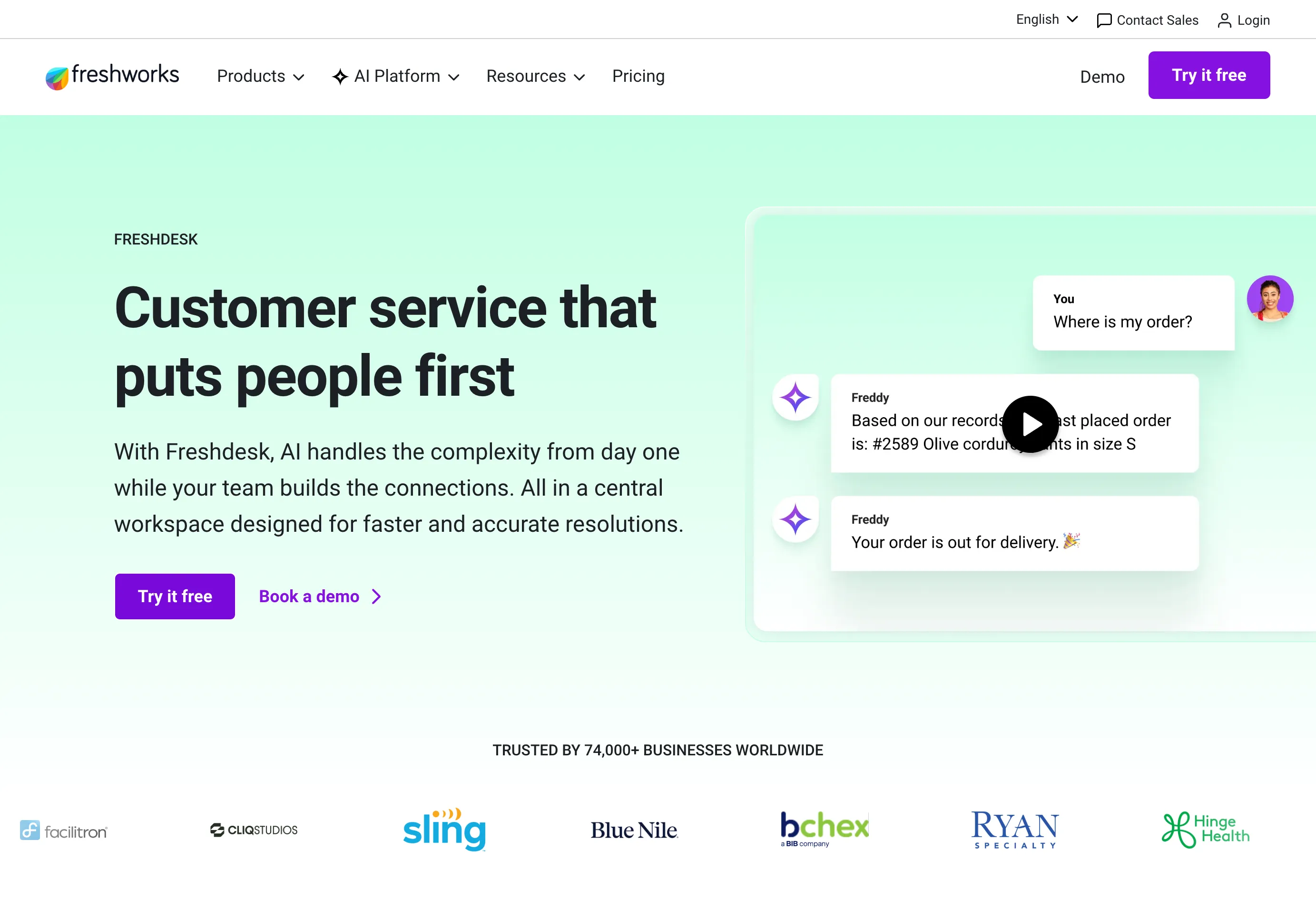
Freshdesk is the omnichannel helpdesk built for scaling teams on a budget: email, chat, phone and social in one workspace, with Freddy AI on first-line resolution, marketed at up to 80% (vendor-stated). It is the budget replacement where channel breadth matters more than e-commerce depth.
The catch: published case studies range from roughly 23% to 75% depending on coverage, Freddy is AI bolted onto ticketing, priced per session alongside per-agent seats, and it is horizontal rather than built for commerce, so refunds and order edits depend on the connectors you wire up. We cover the field in our Freshdesk alternatives guide.
Pros
- Omnichannel breadth (email, chat, phone and social) on budget-friendly per-agent tiers.
- Freddy AI marketed up to 80%, a common pick when channel coverage matters more than store depth.
Cons
- Published case studies range from roughly 23% to 75%.
- Horizontal rather than built for commerce, so refunds and order edits depend on connectors.
Lighter routes for smaller stores
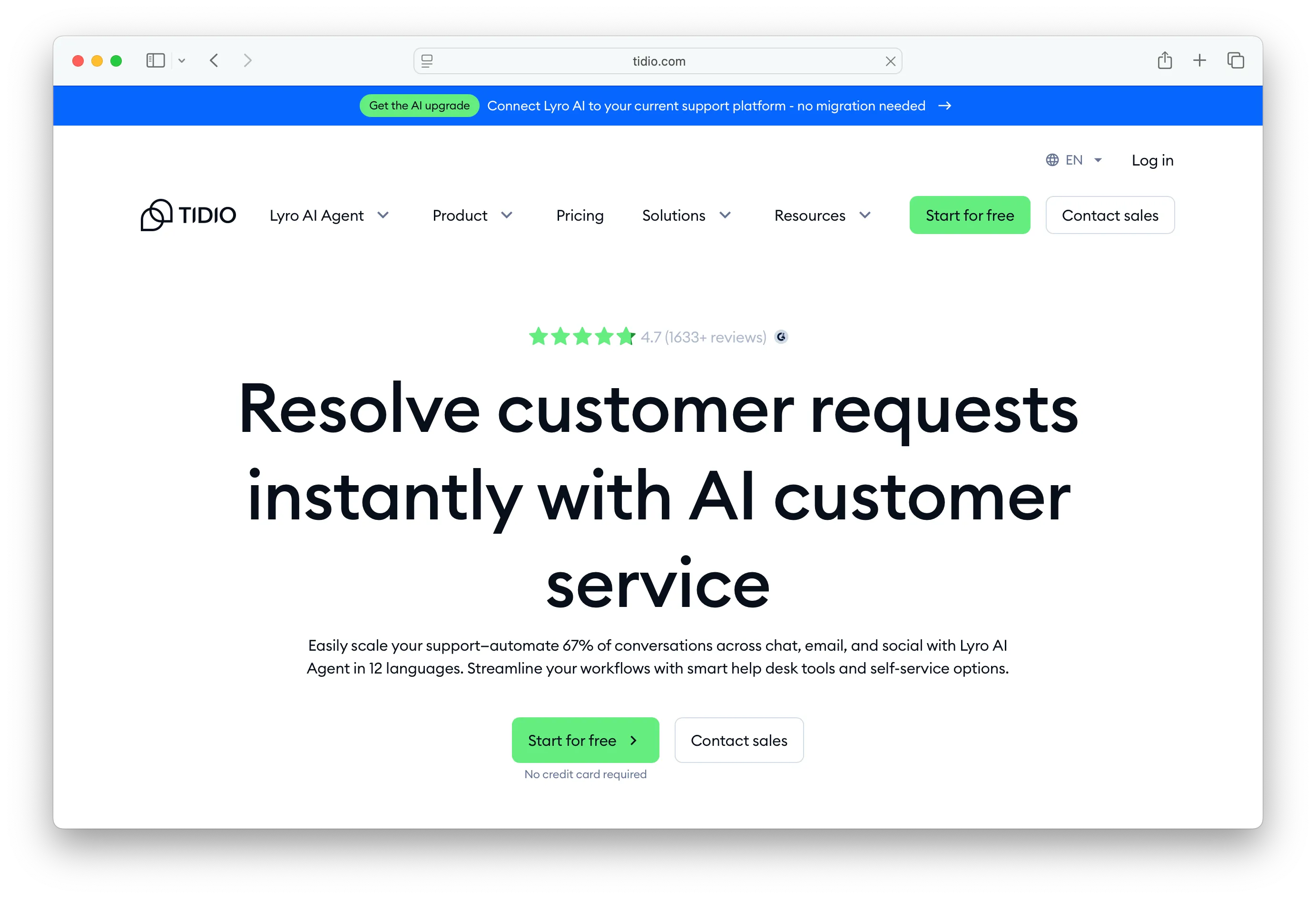
Tidio is the SMB option: Tidio states its customers average a 75% resolution rate with Lyro (vendor-stated, checked October 2026), and its Premium plan lists a guaranteed 50% Lyro resolution rate.
Pricing is flat helpdesk tiers plus a per-conversation Lyro add-on of roughly $0.50 marketed, nearer $0.58 as an effective minimum (pricing breakdown, third-party estimate). The catch: it is strongest on FAQs, and its commerce actions are newer and connector-dependent, so it is a lighter tool than Richpanel rather than a like-for-like autonomous agent.
Pros
- SMB-friendly: Tidio states a 75% average for Lyro, with a guaranteed 50% on the Premium plan.
- Flat helpdesk tiers with a low per-conversation Lyro add-on.
Cons
- Strongest on FAQs, with commerce actions that are newer and connector-dependent.
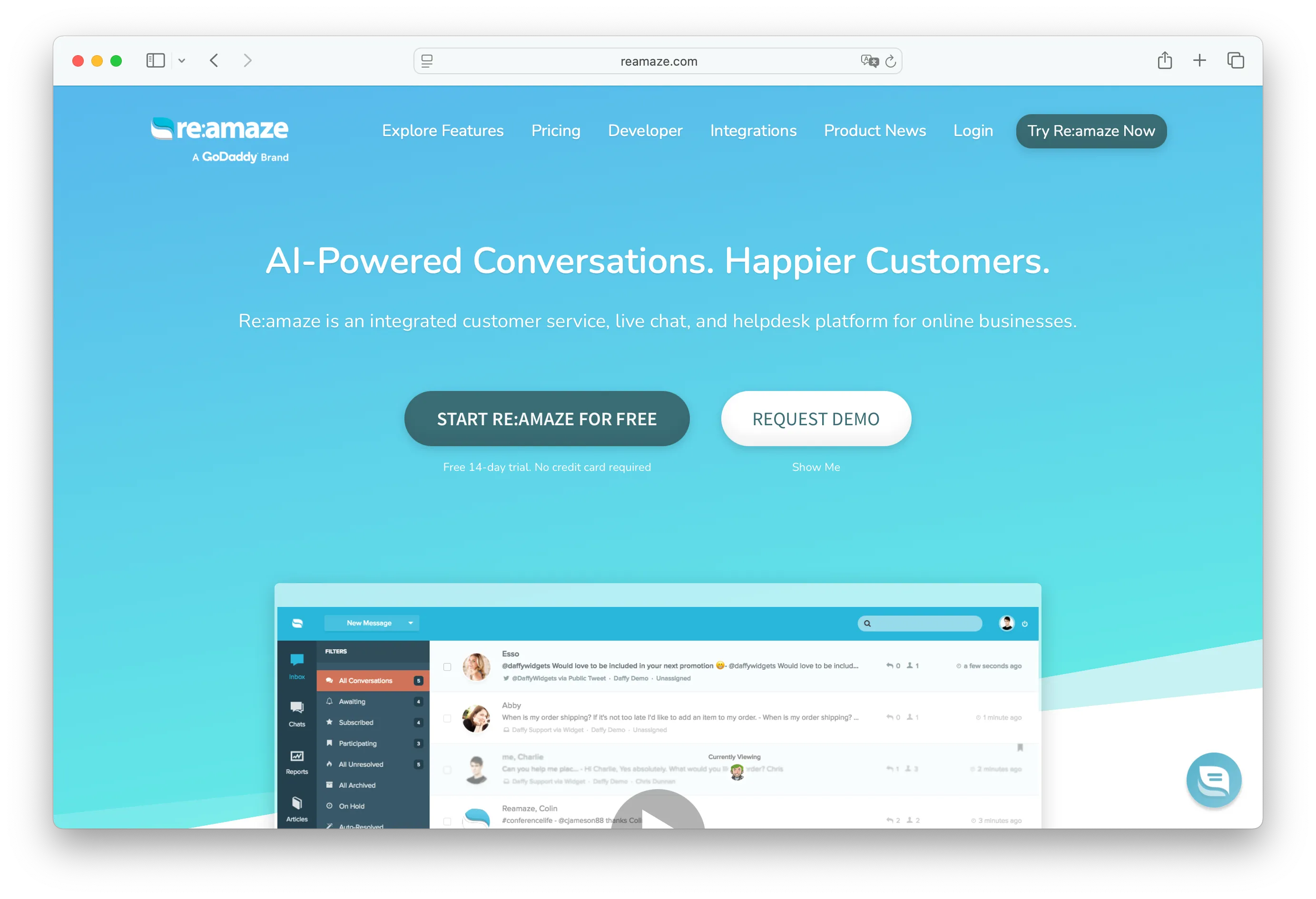
Re:amaze is an omnichannel inbox that unifies chat, email, social and SMS with flat-tier pricing that is friendly to small teams. Its AI is assist-leaning, drafting replies and summarising conversations, while human agents view and modify Shopify and BigCommerce orders from the dashboard. The catch: most work beyond information retrieval stays with your team, and its integrations page lists Shopify and BigCommerce only, so WooCommerce and Magento stores should look elsewhere.
Pros
- Omnichannel inbox (chat, email, social and SMS) with small-team-friendly flat tiers.
- Agents view and modify Shopify and BigCommerce orders from the dashboard.
Cons
- AI is assist-leaning, so most work beyond information retrieval stays with your team.
- Integrations cover Shopify and BigCommerce only.
How do the alternatives compare at a glance?
The table sorts the field by the two questions that matter most after Richpanel: does adopting the tool mean a migration or a layer, and which pricing model does it use? Resolution figures are vendor-stated unless marked otherwise, and the headline-versus-case-study gap you saw with Richpanel applies to every rate below too.
| Tool | How it fits your stack | Acts or assists | Headline rate | Pricing model |
|---|---|---|---|---|
| Richpanel (baseline) | Replace the helpdesk (migration) | Acts (staged autonomy) | High rates marketed; varies by brand | ~$0.20 per AI conversation + $100/seat |
| Engaige | Layers on, self-serve | Acts | Otrium 60%, HelloPrint 80% (verified case studies) | Flat monthly fee tied to ticket volume |
| Yuma | Layers on, self-serve | Acts | 89% top deployments (vendor-stated, per-customer rates published) | Quote-based |
| Intercom Fin | Layers on, enterprise | Acts | 67% benchmark (vendor-stated); independent 60-day test ~38% | $0.99 per resolution, 50/month minimum |
| Siena | Layers on, enterprise | Acts | Up to 80% (vendor-stated); cases 49-80% | Quote-based |
| DigitalGenius | Layers on, enterprise | Acts | 93% shorter waits at On (vendor-stated) | Quote-based |
| Gorgias | Replace the helpdesk (migration) | Acts | 60% instant (vendor-stated); Psycho Bunny case 26% | Seats + ~$0.90-1.00 per AI resolution |
| Zendesk | Replace the helpdesk (migration) | Acts | Over 80% (vendor-stated) | Seats + AI add-on + per verified resolution |
| eDesk | Replace the helpdesk (migration) | Mixed, rules-leaning | Up to 65% (vendor-stated) | Not covered in our research |
| Freshdesk | Replace the helpdesk (migration) | Acts | up to 80% (vendor-stated); cases 23-75% | Per-agent seats + per-session AI |
| Tidio (Lyro) | Replace the helpdesk (SMB) | Mixed, FAQ-strongest | 75% average (vendor-stated, Oct 2026) | Flat tiers + ~$0.50 per Lyro conversation |
| Re:amaze | Replace the helpdesk (SMB) | Assists | No public rate | Flat tiers |
What does a Richpanel alternative cost?
One of two models. Flat-rate pricing ties a monthly fee to a ticket volume (Engaige, Tidio’s core tiers, Re:amaze), so the bill is predictable as orders grow. Usage pricing charges per conversation, resolution or session (Richpanel at roughly $0.20 per AI-handled conversation, Gorgias at $0.90 to $1.00 per resolution, Intercom Fin at $0.99, Zendesk’s outcome billing and Freshdesk’s per-session charge). Yuma, Siena and DigitalGenius are quote-based.
Richpanel is the reference point. It prices its AI agent at roughly $0.20 per AI-handled conversation, billed on actual token use, plus $100 per human seat per month; a sample bill it shows is 1,000 AI conversations plus one seat at $300 a month (vendor-stated, verified July 2026). Each model suits a different volume and forecasting style, so none is wrong in itself; what matters is the total at your own numbers.
The honest comparison is total cost per resolved ticket: platform fee plus AI fee, divided by tickets actually closed without a human. Run that number at today’s volume and at twice today’s volume, for every tool on your shortlist, ours included, and add the cost of the migration itself.
Which Richpanel alternative fits your store?
There is no universal winner, only a fit per situation. The first fork is whether you are willing to migrate at all. If not, layer an agent onto your existing helpdesk. If you are open to a switch regardless, a replacement platform is fair game. The shortlist below maps the common situations to the tools that fit them.
| Your situation | The deciding factor | Shortlist |
|---|---|---|
| Like your current helpdesk, do not want to migrate | An agent that acts via your existing inbox | Engaige, Yuma |
| Weighing Richpanel’s autonomy but unsure the migration is worth it | Higher resolution without a platform switch | Engaige; see Gorgias vs Richpanel |
| Enterprise brand, want a layered agent with a services partner | Heavier build, deep integrations, managed onboarding | Siena, DigitalGenius, Intercom Fin |
| Open to a migration, want Shopify depth | Built-in store actions in a mature helpdesk | Gorgias, Zendesk |
| Marketplace-heavy seller (Amazon, eBay, TikTok Shop) | Channel breadth alongside the storefront | eDesk, Zendesk |
| Heavy pre-purchase and product questions | Live catalogue and order data, not inference | Engaige |
| Small store, simple ticket mix | Fast setup, low flat cost | Tidio, Re:amaze |
Whichever route you take, pilot with your real ticket mix and measure end-to-end resolution, not deflection. The tool that completes your ugliest refund case at a predictable cost per ticket is the right alternative, whatever the headline rates say.
Frequently asked questions
The questions e-commerce teams ask us most often when they are weighing Richpanel or looking for an alternative to it.
Is Richpanel worth switching to?
It can be, and merchants who run it often rate it well.
The honest caveats are that adopting it is a full helpdesk migration, its pricing is usage-based at roughly $0.20 per AI-handled conversation plus $100 per seat (vendor-stated, July 2026), and its marketed resolution rates are not the norm for every store.
If you would rather not migrate, an agent that layers onto your existing helpdesk reaches similar resolution without the switch.
What is the best alternative to Richpanel?
It depends on your trigger. If you want higher resolution without migrating, Engaige resolves tickets end to end on top of the helpdesk you already run, for a flat monthly fee tied to your ticket volume, with verified 60-80% client outcomes. If you are open to a migration anyway, Gorgias, Zendesk or eDesk are replacement helpdesks worth weighing. No tool wins every situation, so match the choice to whether you will migrate and to your volume.
Can I get Richpanel-style autonomy without migrating my helpdesk?
Yes, and that is the main reason to look at a layered agent. Engaige and Yuma add an autonomous agent on top of the helpdesk you already run, Gorgias and Zendesk included, and resolve tickets end to end with real store actions, no migration required. Engaige is a flat monthly fee tied to your ticket volume, predictable as you scale.
How much does Richpanel cost in 2026?
Richpanel prices its AI agent at roughly $0.20 per AI-handled conversation, billed on actual token use, plus $100 per human seat per month, with a sample bill of 1,000 AI conversations and one seat at $300 a month (vendor-stated, verified July 2026). It also offers a money-back resolution guarantee for the first 30 days. Compare it, like every tool, on total cost per resolved ticket at your real volume.
Does Richpanel work outside Shopify?
Yes. Richpanel names Shopify, WooCommerce, Magento and Amazon among its integrations, so it provides helpdesk coverage across them. Its deepest transactional actions, such as subscription edits and returns, run through Shopify-side partners like Recharge and Loop, so if you are on WooCommerce or Magento, confirm the specific actions you need before switching. The same caution applies to most e-commerce agents, ours included.