The best Freshdesk alternatives for an online store in 2026 are Engaige or Intercom Fin if you want to keep Freshdesk and replace only Freddy AI, and Gorgias, Zendesk, Richpanel, Help Scout, HubSpot Service Hub, Front or Kustomer if you want to replace the help desk itself. Yuma and Siena are e-commerce AI agents worth a look if you are changing help desk anyway.
Freshdesk is one of the most popular budget-friendly help desks, and its Freddy AI Agent takes real actions on first-line tickets. So if you are searching for an alternative, it is probably not because Freshdesk lacks automation. It is usually the gap between the headline rate and named results, how much commerce depth you have to assemble yourself, or wanting an agent that learns from your own team.
This guide compares the alternatives on those axes: how much each one resolves, which pricing model it uses, whether it acts on live store data, and what switching costs you. Facts and figures come from each vendor’s public pages and our own research as of October 2026. For Freshdesk’s own products, plans and pricing, start with our Freshworks guide; for the wider field, see our ranked guide to the best AI agents.
Why do teams look for Freshdesk alternatives in 2026?
Three triggers come up consistently: the gap between Freddy’s headline rate and the rates named customers report; commerce depth, because Freshdesk is a horizontal help desk rather than one built for stores; and the AI itself, because Freddy was added onto a ticketing platform rather than built as an agent that learns from your team. Missing capability is rarely the genuine complaint.
The bolt-on question. Freddy is AI added onto Freshdesk’s ticketing platform: Freddy Self Service arrived in 2023 and the Freddy AI Agent in 2024. It runs prebuilt workflows well, and Freshworks says it “self-improves”, without describing the mechanism on its pages as of October 2026. So the useful question is what it learns from after go-live, and whether a person approves each change.
The headline gap. Freshworks markets up to 80% resolution (vendor-stated), while the customers it names on the same page report lower figures. That is context rather than a flaw, since vendor headlines are ceilings, but a lower real rate means more tickets stay with your team.
The depth question. Freshdesk serves every industry, so e-commerce is one vertical among several. Freddy AI Agent ships pre-built skills for Shopify and Stripe, such as order tracking and refund processing; beyond those, your team builds the actions in AI Agent Studio. Depth also shows in pre-purchase questions, where an agent without live catalogue data tends to infer. One shopper on r/ecommerce described the failure mode bluntly:
June 2026Reddit…an AI bot that basically just sorts what should be your FAQ page and can’t quickly or immediately talk to a real person, then I’ll stop just using your service/product. · r/ecommerceView on RedditThat failure mode, deflecting to an FAQ instead of resolving from live store data, is worth testing in any pilot, of Freshdesk or of an alternative. The fix is not a cleverer model; it is an agent that reads the actual order, catalogue and policy before it replies. Engaige is built that way, and we cover where it fits below.
What does Freshdesk still do well?
Plenty. It is an omnichannel help desk built for scaling teams on a budget: email, chat, phone and social in one workspace, with per-agent plans at $19, $55 and $89 a month, billed annually. Freddy AI Agent is on all three plans and takes real-time actions such as refunds and order updates across email, web chat, WhatsApp and social. If your volume is modest and its pricing model suits you, staying put is a legitimate decision.
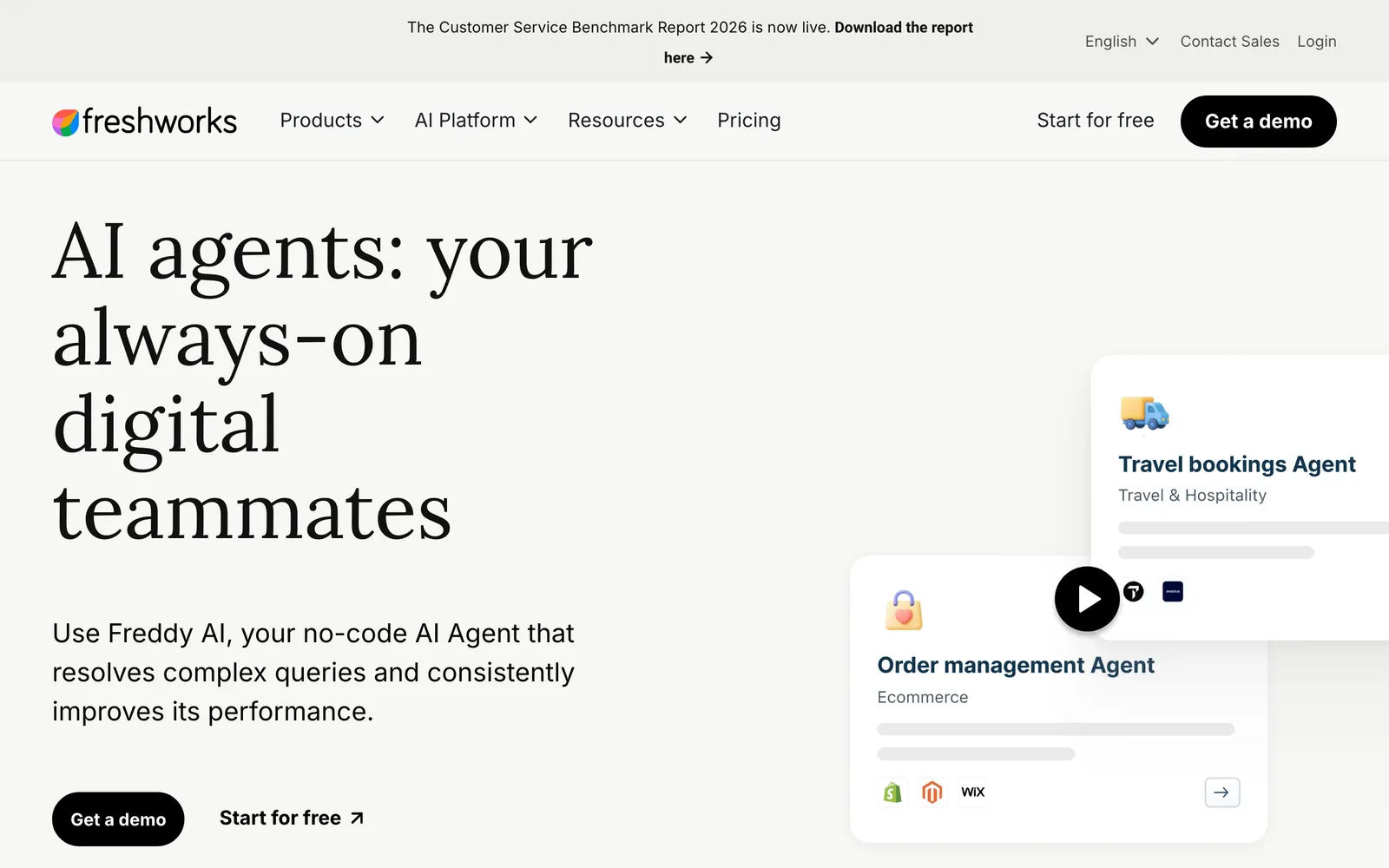
The catch is the distance between the headline and named results. Freshworks markets up to 80%, while the customers it names on the same page report 54% of queries resolved with AI (iPostal1) and 30% of queries handled by AI agents (Hobbycraft), as of October 2026. That is how vendor ceilings work, not a scandal, but it changes the maths: at a lower real rate, more of the work stays with your team.
Source: Freshworks’ Freshdesk page, checked October 2026. All figures vendor-stated; iPostal1 is labelled “queries resolved with AI” and Hobbycraft “queries handled by AI”.
Use the same test on every tool below, ours included: which named customer produced the number, over what period, and what counts as “resolved”? A rate with none of those attached is marketing, not a benchmark.
How should you evaluate a Freshdesk alternative?
Five checks separate a genuine upgrade from a sideways move. The first two address why you are leaving (resolution and pricing fit), the next two address whether the move is practical (stack fit and commerce depth), and the last one protects you from buying the same headline-versus-reality gap under a different logo.
| # | Check | The question to ask |
|---|---|---|
| 1 | Resolution, not deflection | Does it complete the refund, return or order edit in your store, or draft a reply for an agent to send? |
| 2 | Pricing predictability | What is the total cost per resolved ticket at today’s volume and at twice today’s volume? |
| 3 | Stack fit | Does it work on the Freshdesk you already run, or does switching mean a full migration? |
| 4 | Commerce depth | Can it act on live store data (Shopify, WooCommerce, Magento), not just read it through a connector? |
| 5 | Claim substantiation | Does the vendor publish named per-customer rates, or one headline figure? |
A practical shortcut for check one: feed every candidate your three ugliest recent tickets, the WISMO case with a stuck parcel, the part-refund, the damaged item with a replacement. Whether it completes those, rather than deflecting them, predicts your real resolution rate better than any demo.
What are the best Freshdesk alternatives?
The best Freshdesk alternatives in 2026 are Engaige (acts on live store data end to end, learns from your team, no migration) and Intercom Fin if you want to keep Freshdesk; Gorgias, Zendesk, Richpanel, Help Scout, HubSpot Service Hub or Front if you want to replace it; Kustomer if you want a CRM model; and Yuma or Siena as e-commerce AI agents on a different help desk.
Which one fits depends on the trigger that sent you here. If you like the Freshdesk inbox, swap only the AI. If the help desk itself is the constraint, replace it; the comparison teams run most often is Freshdesk vs Zendesk, and our Zendesk alternatives guide covers the enterprise field.
Keep Freshdesk, replace Freddy AI
Engaige (that’s us)
Engaige is the e-commerce AI support agent that works inside the Freshdesk you keep. It replaces Freddy AI, never your inbox, so tickets, history and workflows stay where they are, with no migration (see the Freshdesk integration). At MR MARVIS, a Shopify Plus brand handling 120,000 questions a year, it resolves over 60% of the conversations it is involved in.
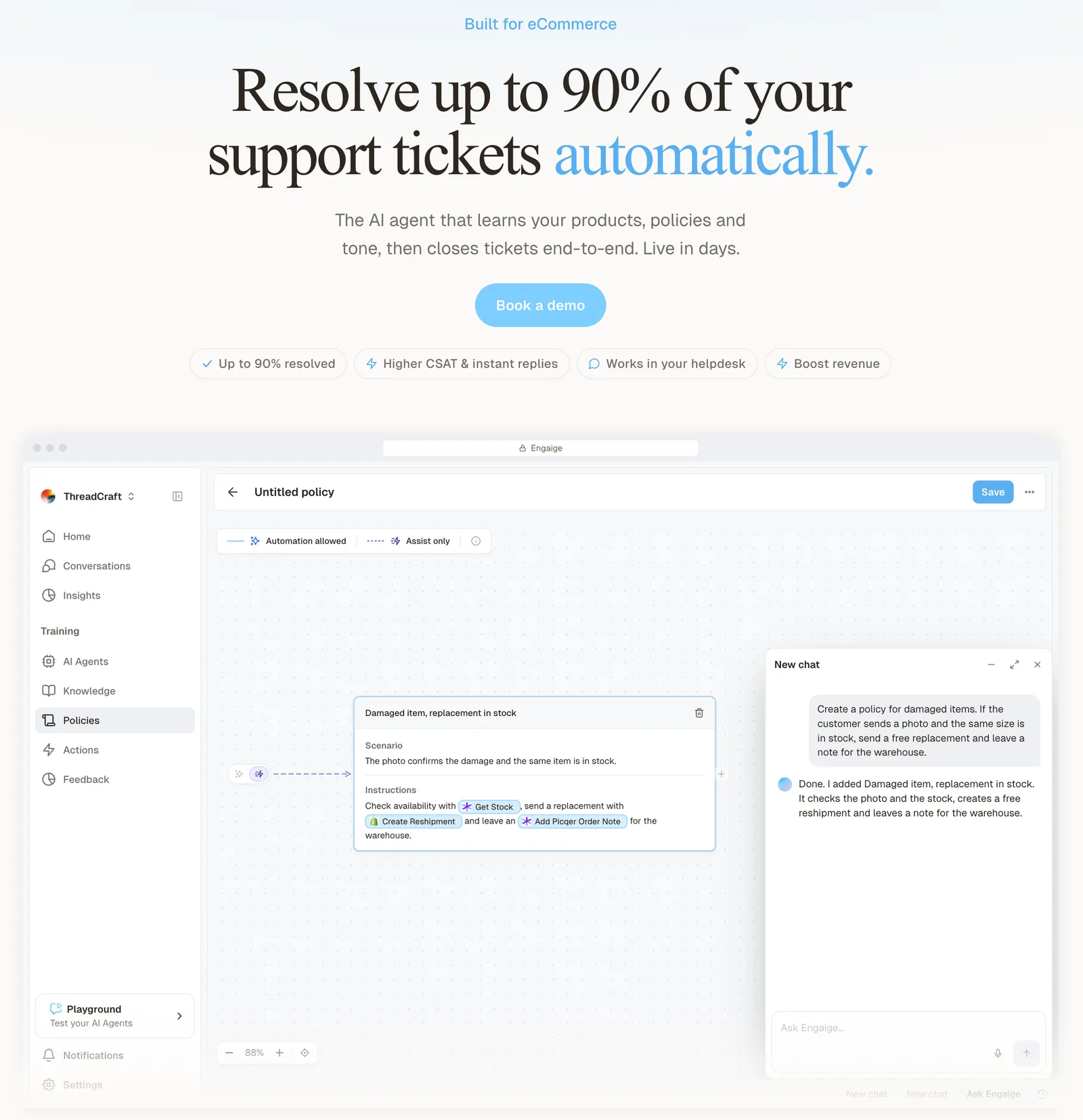
Engaige reads live order, catalogue and policy data before it replies rather than inferring, which is the fix for the deflect-to-FAQ failure mode above. It resolves the hard middle end to end: WISMO with a complication, multi-step refunds, conditional returns, subscription and warranty changes. It runs on 50+ native integrations with vetted, plug-and-play actions, is deepest on Shopify (live Admin API data plus your storefront content), and covers WooCommerce, Magento, BigCommerce and custom systems too.
You go live in Agent Assist within hours. Comparing every reply your team sends with what the agent suggested is one of the signals Engaige AI learns from, alongside conversations, your inputs, hand-offs and emerging trends. Engaige AI proposes changes to policies and behaviour with its reasoning, and you approve what goes live. We found no competitor that publicly describes learning from the team’s normal replies from day one with changes a person approves.

Hello Potential New Client
What would you like to get done today?
Could you analyse this week's conversations and show me some automation opportunities?
Ask Engaige…
Searched and found 4 contact reasons · 2.4s
Your agent resolved 426 of 512 conversations. 86 were handed over, and one contact reason accounts for most of them.
Searched and found 1 policy · 1.6s
Delivery status hands over whenever tracking is older than 24 hours, which is 40 of those 46.
Editing Delivery status · 1.9s
Done. It now handles stale tracking itself. Those 40 a week stay with your agent.
What were the reasons for handover, and how can we improve?
Fix it.
Reply…
Once a ticket type matches your team’s quality, you switch it to autonomous. Brands that move quickly get there in about a week, up to 90% of supported tickets, and Engaige AI keeps learning from live outcomes and hand-offs. Otrium resolves 60% of 120,000 annual tickets end to end, and HelloPrint automated 80% of support, cut first response times by 90% and went from 100 agents to 28.
You set the limits. Policies can carry thresholds, such as sending refunds above a set amount to a person first, and each step runs Automated or in Agent Assist. You test policies in the Playground before they go live, for example by pasting in a past ticket. Full reasoning for every answer and action sits in the Engaige dashboard, and a hand-over leaves a reasoning summary as an internal note in the Freshdesk ticket.
Engaige offered control, flexibility, and the ability to really incorporate AI in a more human way.

Pricing is a flat monthly fee tied to your ticket volume, predictable as you scale.
Pros
- Works inside the Freshdesk you already run, live in hours with no migration.
- Resolves the hard middle end to end (multi-step refunds, conditional returns, WISMO with a complication) from live order, catalogue and policy data.
- Engaige AI keeps learning, from your team’s replies in Agent Assist and from live outcomes once autonomous, and you approve every change.
- Named, openable case studies (MR MARVIS 60%+, Otrium 60%, HelloPrint 80%) and a flat monthly fee tied to ticket volume.
Cons
- E-commerce-specialised by design, not a generic horizontal tool.
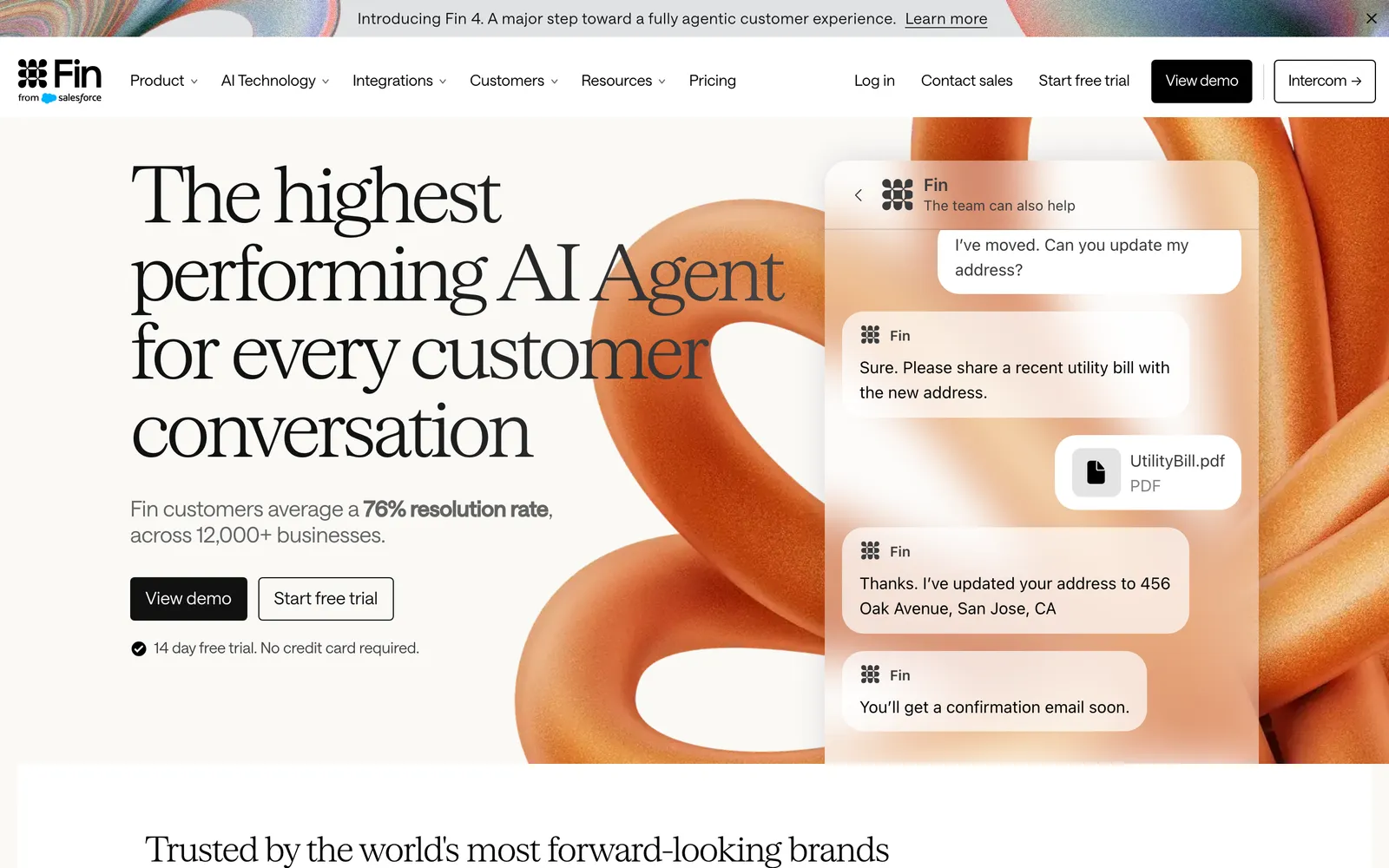
Fin is Intercom’s AI agent, and unusually for a suite vendor it runs on help desks that are not Intercom’s own, Freshdesk included, according to fin.ai (October 2026). It acts through Procedures and connectors, and its pricing is $0.99 per outcome, such as a resolution, with a 50-outcome monthly minimum when it runs on your current help desk.
Fin states an average 76% resolution rate across 12,000+ customers (vendor-stated, October 2026), while an independent 60-day test found around 38% average resolution. Fin Operator proposes changes as reviewable diffs that you approve. The catch: it is horizontal rather than commerce-specialised, so store actions beyond Intercom’s Shopify templates depend on the connectors you build. We pair the two in our Intercom comparison.
Pros
- Works on Freshdesk, with public per-outcome pricing ($0.99, 50-outcome monthly minimum).
- Fin Operator proposes improvements as reviewable diffs that a person approves.
Cons
- Its 76% average sits against the ~38% an independent 60-day test found.
- Horizontal rather than commerce-specialised, so store actions depend on the connectors you build.
E-commerce AI agents for a new help desk
Yuma is an AI agent built for Shopify brands that works inside an existing help desk and takes real actions: refunds, label creation, subscription edits. Its homepage names Gorgias, Zendesk, Kustomer, Front, Salesforce Service Cloud and others, but not Freshdesk (October 2026), so for a Freshdesk team it fits alongside a help desk move rather than instead of one.
Yuma states that top deployments automate “up to 89%” of tickets (Yuma, vendor-stated) and names per-customer results: EvryJewels 89%, Clove 70% and MyVariations 62% of tickets automated. The catch: its FAQ says it absorbs your team’s edits into future replies automatically, with no review step described. We weigh the agent layer against a built-in help desk AI in our Yuma comparison.
Pros
- Takes real actions inside the help desks it supports: refunds, labels, subscription edits.
- Names per-customer automation rates rather than one headline.
Cons
- Learns from your team’s edits automatically, with no review step described, so check how you approve changes.
- Freshdesk is not on its listed help desks (October 2026), so it pairs with a help desk move.
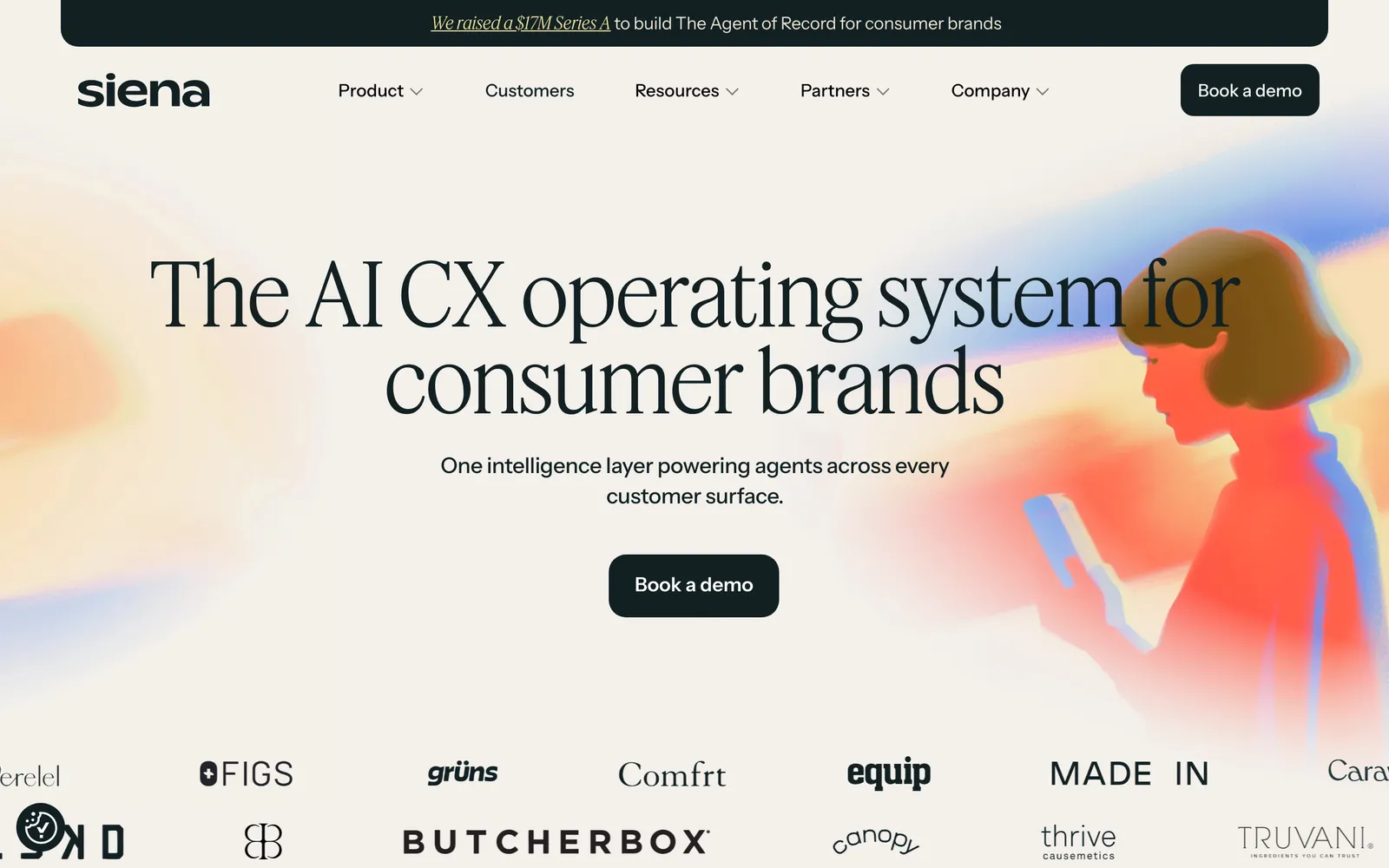
Siena positions itself as the AI CX operating system for consumer brands and runs agents that act, issuing refunds, generating labels and sending replacements in a single flow. It connects to help desks such as Gorgias, Zendesk and Kustomer, and since its October 2026 Series A it says “the help desk is included”. Its customers page lists 36 case studies, with named automation rates from 36% (Canopy) to 80% (True Sea Moss, Bad Birdie), vendor-stated.
Pricing is public: a $750 monthly platform fee plus $0.90 per automated ticket, per its pricing page (October 2026). The difference with Engaige is how each improves: we found no Siena description of an approval step for the changes it learns (siena.cx, October 2026), while Engaige AI proposes each change with its reasoning for you to approve.
Pros
- Acts in one flow (refunds, labels, replacements), with 36 case studies naming per-customer rates.
- Public pricing and a help desk of its own included since October 2026.
Cons
- No approval step for learned changes is described on its pages (October 2026).
- Freshdesk is not among the help desks on its integrations page (October 2026), so check the route before you choose it.
Help desks that replace Freshdesk

Zendesk is the enterprise step up from Freshdesk. It repositioned itself in 2026 as a “Resolution Platform”, sells self-improving AI agents after buying Forethought, and states its AI agents “routinely resolve over 80% of interactions” (press release, vendor-stated), with 1,500+ integrations (third-party count) and enterprise-grade routing.
It prices with per-seat fees plus a fee per verified resolution (third-party estimates put that around $1.50 to $2.00). The catch: its AI is bolted onto a horizontal ticketing platform, so e-commerce actions run through flows you configure.
Pros
- Enterprise-grade omnichannel routing, 1,500+ integrations, and strong QA tooling.
- Self-improving AI agents with weekly AI-drafted procedures you publish.
Cons
- Horizontal platform with AI bolted on, rather than e-commerce-specialised.
- Shopify actions run through action flows you configure.

Gorgias is the Shopify-first help desk, and a common destination for Freshdesk leavers whose priority flips from channel breadth to store depth. Its AI Agent takes real actions, issuing refunds, editing subscriptions and updating shipping inside your store, and shows a summary of its reasoning under every AI message. Our Gorgias vs Zendesk comparison sets it against the other common destination.
Its pricing page charges $0.90 per AI Agent interaction on annual plans or $1.00 on monthly plans, alongside a help desk plan that is never priced per agent, and quotes Orthofeet at above 50% automation (October 2026). The catch: the AI is bolted onto a ticketing platform, so for a Freshdesk team it comes with a help desk migration.
Pros
- Shopify-first, with an AI Agent that issues refunds, edits subscriptions and updates shipping.
- Strong fit when store depth matters more than Freshdesk’s channel breadth.
Cons
- AI bolted onto a ticketing platform, so adopting it means a help desk migration.
Richpanel is an e-commerce help desk whose AI agent uses your tools to resolve the whole ticket, for example holding a Shopify shipment or saving a subscription in Recharge, and you choose which actions need approval first. A QA AI checks every closed conversation and flags repeat problems for your team (October 2026). It markets high autonomous resolution, with named brands including Ridge and Jones Road.
Unlike Freshdesk, it is built for commerce rather than horizontal, so order actions are built in rather than wired up. The catch: the deeper value needs full Richpanel platform adoption, so you are trading the Freshworks suite for another platform. We weigh it in our Richpanel comparison, with the wider field in our Richpanel alternatives guide.
Pros
- AI built for commerce that acts across Shopify and Recharge, with per-action approvals.
- Markets high resolution rates, with named brands.
Cons
- The deeper value needs full platform adoption, trading one suite for another.
- Deepest transactional integrations are Shopify-side, so confirm WooCommerce and Magento depth.
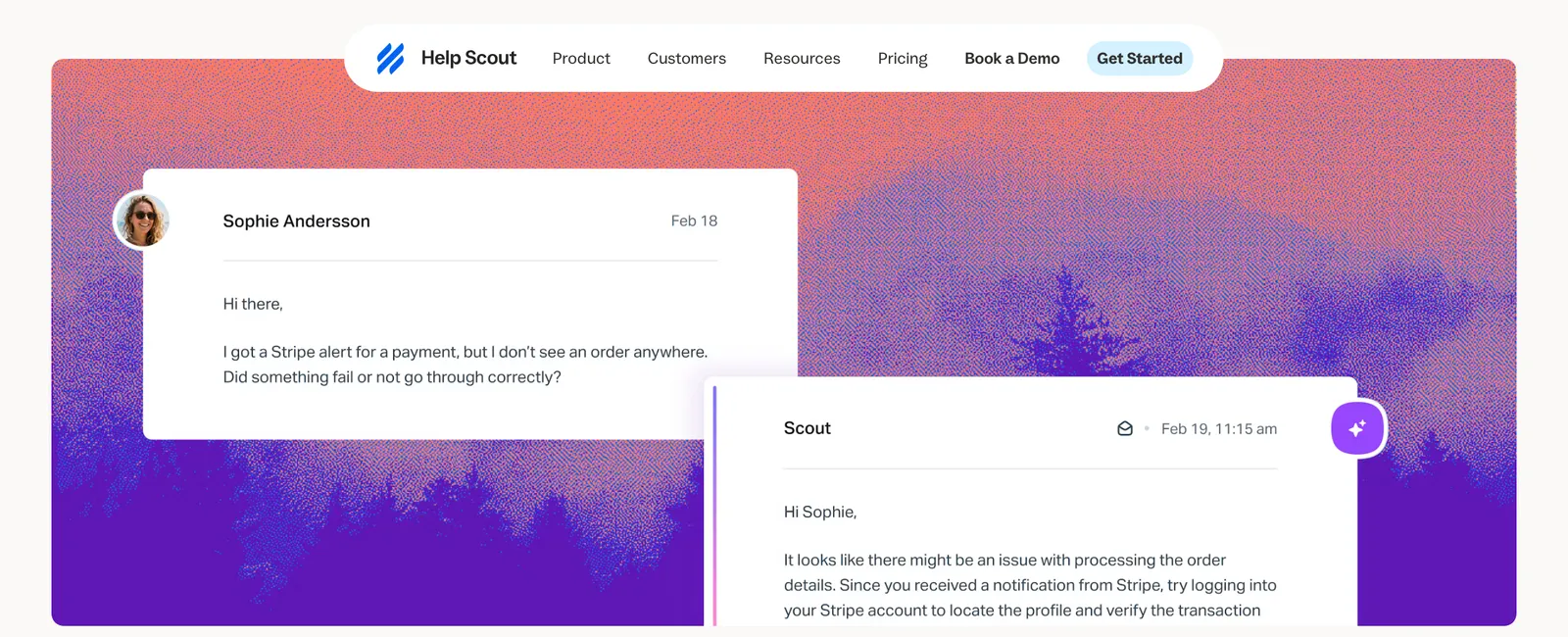
Help Scout is a people-first shared inbox for small and growing teams, with a free plan for up to five users and paid plans from $25 to $75 per user a month (pricing). Its AI agent resolves 73% of requests on average, according to Help Scout (vendor-stated, October 2026), at $0.75 per resolution.
For a store, the detail that matters is where actions live today: human agents can refund, cancel and edit Shopify orders from the conversation sidebar, while the AI agent answers from your help centre and website, with apps marked “coming soon” as of October 2026. Our Help Scout alternatives guide covers it in depth.
Pros
- Simple, well-loved inbox with a free plan for up to five users.
- Human agents act on Shopify orders without leaving the conversation.
Cons
- The AI agent answers from knowledge today; app connections were marked “coming soon” in October 2026.
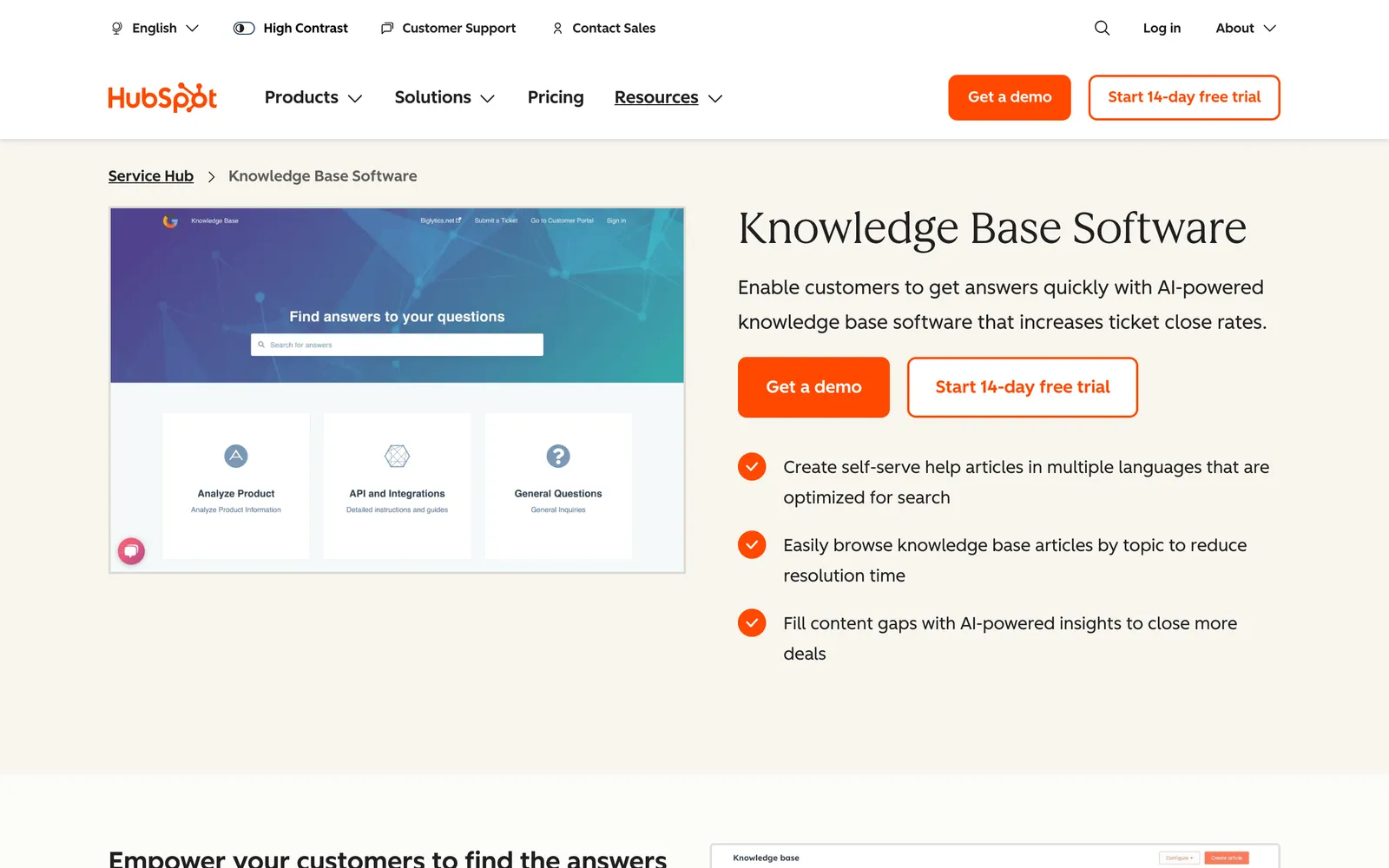
HubSpot Service Hub is the help desk on HubSpot’s CRM, so every ticket carries the full customer record from marketing and sales. Its Breeze Customer Agent answers from your knowledge base and website, checks order status, books meetings and hands off to a person. It fits best when HubSpot is already your system of record.
HubSpot says the agent resolves 65% of conversations across more than 8,000 customers who have activated it, and since 14 April 2026 it costs $0.50 per resolved conversation (HubSpot, vendor-stated). The catch for a store: Shopify orders sync one way into HubSpot, so check which order actions the agent can take before you move.
Pros
- One CRM record across marketing, sales and service, with an AI agent that resolves and hands off.
- Pay per resolved conversation for the agent.
Cons
- Shopify data arrives through a one-way sync, so confirm the order actions you need.
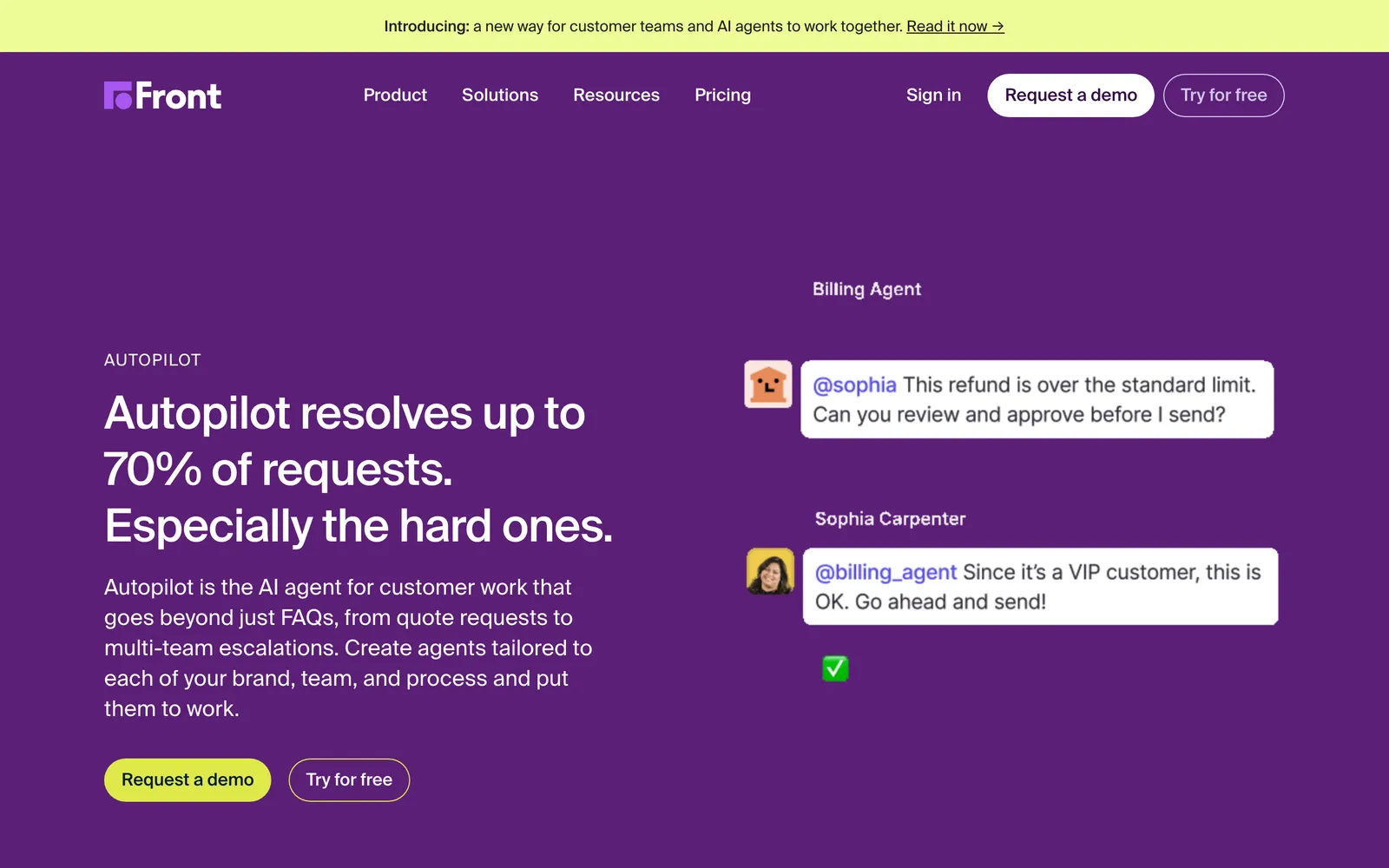
Front is a collaborative customer-operations inbox, strongest for teams that live in shared email. Its Autopilot agent takes action in your systems through Playbooks written in plain language, and Front says it “resolves up to 70% of requests” (Front, vendor-stated). Seats run $25 to $105 a month billed annually (pricing), with Autopilot from $0.05 per conversation.
Front is also open about AI: since 6 October 2026 you can bring an external AI agent into the inbox, and Front answers “No” to whether you have to use its own. For a store, check e-commerce depth: its Shopify integration is documented as displaying orders, refunds and addresses inside Front. Our Front alternatives guide goes further.
Pros
- Best-in-class collaborative inbox, with an acting AI agent and step visibility.
- Open to external AI agents, so the inbox and the AI are separate choices.
Cons
- The Shopify integration is documented as displaying order data, so confirm the actions you need.
A CRM platform instead of a help desk
Kustomer replaces the help desk with a CRM model: instead of counting tickets, it unifies order history, loyalty status and every conversation on one customer timeline, with AI agents that work across that data. It is the natural pick if your reason for leaving Freshdesk is data fragmentation.
Kustomer does not publish its pricing; it follows an ROI assessment (Kustomer, October 2026). Its built-in Shopify tool is documented as read-only, with writes built as custom tools (help centre, March 2026). The catch: adopting the CRM is a full migration, heavier than adding an agent to the stack you already run.
Pros
- Unifies order history, loyalty status and conversations on one customer timeline.
- The natural fit when data fragmentation is your reason to leave Freshdesk.
Cons
- Adopting the CRM is a full migration.
How do the alternatives compare at a glance?
The table sorts the field by the questions that matter most after Freshdesk: does the tool act or assist, how does it fit your stack, and which pricing model does its AI use? Resolution figures are vendor-stated unless marked otherwise, and the headline-versus-reality gap you saw with Freddy applies to every headline below too. Prices are as of October 2026.
| Tool | How it fits your stack | Acts or assists | Headline rate | AI pricing model |
|---|---|---|---|---|
| Freshdesk (baseline) | Your current help desk | Acts (skills and workflows) | Up to 80%; named customers 30-54% | $19-89 per agent + $49 per 100 Freddy sessions after 500 included |
| Engaige | Works inside Freshdesk | Acts | MR MARVIS 60%+, Otrium 60%, HelloPrint 80% (verified case studies) | Flat monthly fee tied to ticket volume |
| Intercom Fin | Works inside Freshdesk, or runs on Intercom | Acts | 76% average; independent test ~38% | $0.99 per outcome, 50/month minimum |
| Yuma | Works inside other help desks (Freshdesk not listed) | Acts | Up to 89% top deployments | Per ticket fully resolved by AI |
| Siena | Works inside other help desks, or its own | Acts | Named cases 36-80% | $750/month platform fee + $0.90 per automated ticket |
| Zendesk | Replaces the help desk | Acts | Over 80% | Seats + per verified resolution |
| Gorgias | Replaces the help desk | Acts | Orthofeet above 50% (testimonial) | Ticket-volume plan + $0.90-1.00 per AI interaction |
| Richpanel | Replaces the help desk | Acts (with approvals) | High rates marketed; varies by brand | Seats ($99) + AI per conversation, no resolution fee |
| Help Scout | Replaces the help desk | AI answers; human agents act on Shopify | 73% average | Seats ($25-75, free up to 5 users) + $0.75 per resolution |
| HubSpot Service Hub | Replaces the help desk (CRM) | Acts | 65% of conversations | Seats + $0.50 per resolved conversation |
| Front | Replaces the help desk (inbox) | Acts (Playbooks) | Up to 70% | Seats ($25-105) + from $0.05 per Autopilot conversation |
| Kustomer | Replaces the help desk (CRM) | Acts | No public rate | Not published |
What does a Freshdesk alternative cost?
One of three models. Flat-rate pricing ties a monthly fee to a ticket volume (Engaige), so the bill is predictable as orders grow. Per-outcome pricing charges when the AI closes a ticket: Intercom Fin at $0.99, Gorgias at $0.90 to $1.00, Help Scout at $0.75, HubSpot at $0.50, Siena at $0.90 on top of a platform fee, Zendesk’s outcome billing and Yuma, which bills only for tickets fully resolved by AI.
Per-session or per-conversation pricing charges per AI interaction: Freddy at $49 per 100 sessions after the first 500 (Freshdesk pricing), Front’s Autopilot from $0.05 per conversation, and Richpanel’s AI, billed per conversation on top of $99 seats. Kustomer does not publish its pricing.
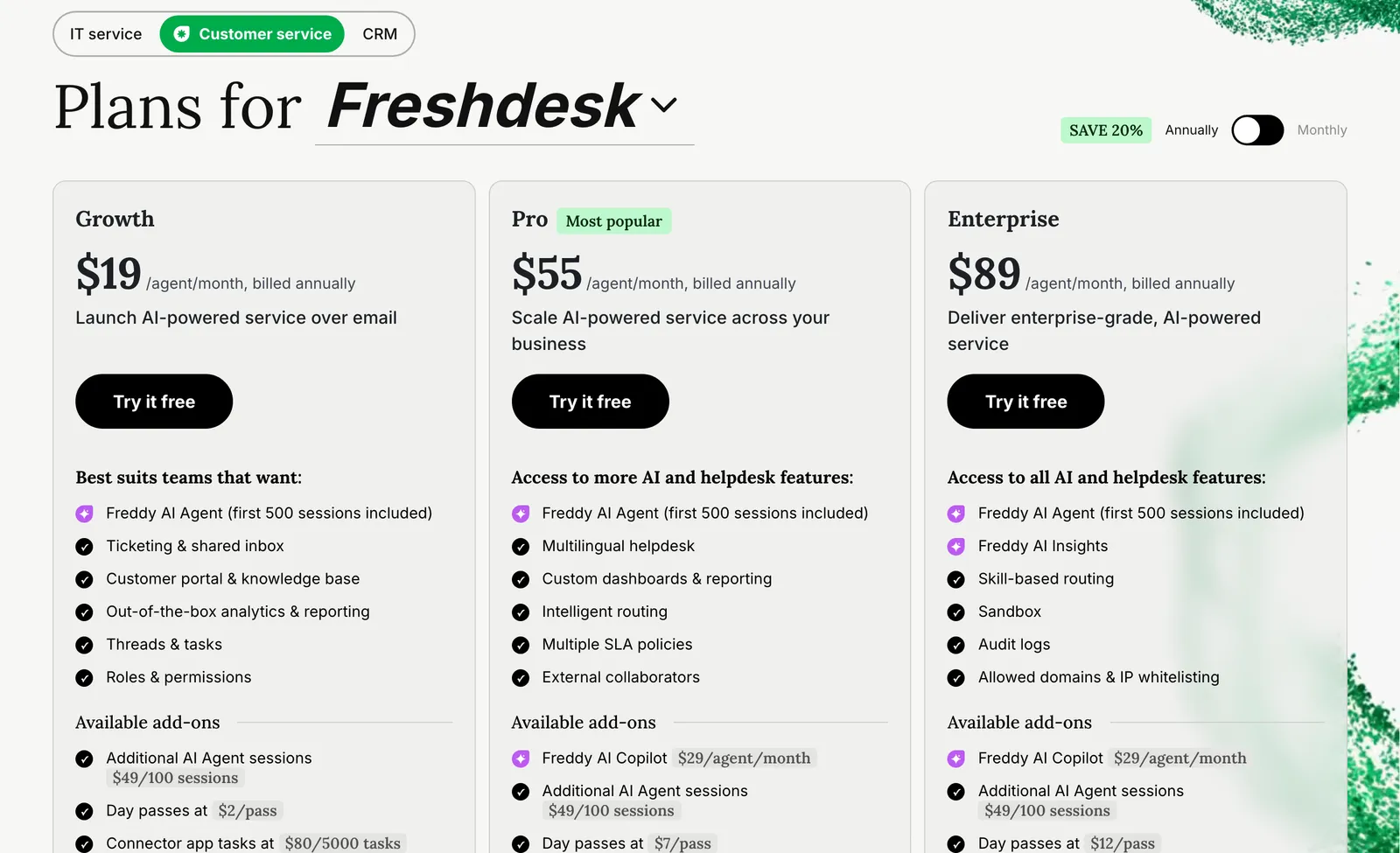
Freshdesk pricing is the reference point: $19, $55 or $89 per agent per month billed annually, Freddy AI Agent sessions on top, and a $29 per agent Freddy Copilot add-on on Pro and Enterprise. The pricing page lists no free plan, only a 14-day trial of Enterprise (October 2026); our Freshworks guide breaks down every plan and add-on. Each model suits a different volume and forecasting style, so none is wrong in itself; what matters is the total at your own numbers.
The honest comparison is total cost per resolved ticket: help desk fee plus AI fee, divided by tickets actually closed without a human. Run that number at today’s volume and at twice today’s volume, for every tool on your shortlist, ours included.
How hard is it to switch from Freshdesk?
It depends on the route. Keeping Freshdesk and swapping the AI moves nothing: Engaige or Fin connects to your account, and your tickets, macros and history stay put. Replacing the help desk is a project, and three steps make it smoother:
- Export early. Admins and supervisors can export tickets as CSV or Excel (Freshdesk support); check what your destination’s importer accepts before you choose it.
- Rebuild, don’t copy. Automations, SLAs, canned responses and Freddy skills do not carry over one to one, so map each to the new tool’s equivalent and drop what you no longer use.
- Run in parallel. Keep Freshdesk live while the new help desk takes a share of traffic, then cut over channel by channel.
If Zendesk is the destination, our Freshdesk vs Zendesk comparison covers that pair in detail.
If the reason you are leaving is the AI rather than the inbox, the lightest migration is none: pilot an agent on Freshdesk first, and move the help desk only if the inbox itself is the constraint.
Which Freshdesk alternative fits your store?
There is no universal winner, only a fit per situation. If you like Freshdesk’s breadth but want a different AI, add an agent on top. If the help desk itself is the constraint, replace it. The shortlist below maps the common situations to the tools that fit them.
| Your situation | The deciding factor | Shortlist |
|---|---|---|
| Happy with the inbox, want a different AI | An agent that acts inside Freshdesk | Engaige, Intercom Fin |
| Heavy pre-purchase and product questions | Live catalogue and order data, not inference | Engaige, Richpanel |
| Want the enterprise step up | Platform depth, governance, routing | Zendesk |
| Want Shopify-first store depth | Built-in order actions over channel breadth | Gorgias, Engaige |
| Marketing and sales already run on HubSpot | One CRM record for every ticket | HubSpot Service Hub |
| Team lives in shared email | A collaborative inbox | Front, Help Scout |
| Premium DTC brand, high LTV | Brand-grade CX with actions in one flow | Engaige, Siena |
| Data spread across many tools | One customer timeline | Kustomer |
| Small store, simple ticket mix | Fast setup, low flat cost | Help Scout, Tidio |
Whichever route you take, pilot with your real ticket mix and measure end-to-end resolution, not deflection. The tool that completes your ugliest refund case at a predictable cost per ticket is the right alternative, whatever the headline rates say.
Frequently asked questions
The questions e-commerce teams ask us most often when they are weighing a move away from Freshdesk.
Can Freshdesk automate customer support?
Yes. Freshdesk’s Freddy AI Agent takes actions, ships pre-built Shopify and Stripe skills and is marketed at up to 80% resolution (vendor-stated), while the customers Freshworks names report 30% to 54%. Teams usually switch over that gap, commerce depth or wanting an agent that learns from their team, not missing automation.
Is there a better alternative to Freshdesk?
It depends on your trigger. If you want to keep your help desk, Engaige resolves tickets end to end inside Freshdesk for a flat monthly fee tied to your ticket volume, reads live store data rather than inferring, learns from your team’s replies with changes you approve, and publishes verified 60-80% client outcomes. If the help desk itself is the constraint, a replacement platform fits better.
Is there a free Freshdesk alternative?
Help Scout has a free plan for up to five users, according to its pricing page (October 2026). Freshdesk itself lists no free plan as of October 2026, only a 14-day trial of Enterprise; our Freshworks guide covers its plans in full.
How hard is it to migrate away from Freshdesk?
Keeping Freshdesk and replacing only the AI needs no migration. Moving to a new help desk means exporting tickets as CSV or Excel, rebuilding automations, SLAs and canned responses, and running both tools in parallel before you cut over.
Is Freshchat different from Freshdesk here?
Not in the way that matters for this decision. Freshchat is Freshworks’ messaging product and runs the same Freddy AI, so the headline-versus-reality gap applies just as it does to Freshdesk. The alternatives above, and the cost test, hold for both.
Can I keep Freshdesk and still automate more?
Yes. Engaige adds an agent that resolves tickets end to end inside Freshdesk, reading live order, catalogue and policy data rather than inferring, with verified 60-80% client outcomes. That keeps your inbox, channels and history intact and avoids a migration project entirely.
How do Freshdesk alternatives price their AI?
Either a flat fee tied to a ticket volume, which stays predictable as you grow, or usage pricing that bills per outcome, per session or per conversation. Kustomer does not publish pricing. Always compare on cost per resolved ticket at today’s volume and at twice today’s volume.