Forethought AI is an AI agent platform for customer support at forethought.ai, owned by Zendesk since March 2026 and now sold as Forethought AI Agents by Zendesk. This is the company, not the everyday word for planning ahead. Its agents resolve tickets, route them, help human agents and find knowledge gaps.
This page covers Forethought and compares it with Ada. Facts below are as of October 2026. For the wider field, see our ranked list.
What is Forethought AI?
Forethought AI is an AI agent layer that sits on top of your help desk. Its agents resolve customer conversations (Solve), route tickets (Triage), draft replies for your team (Assist), find gaps in your knowledge (Discover) and score quality, on top of 70+ help desks and connectors. Zendesk has owned it since March 2026.
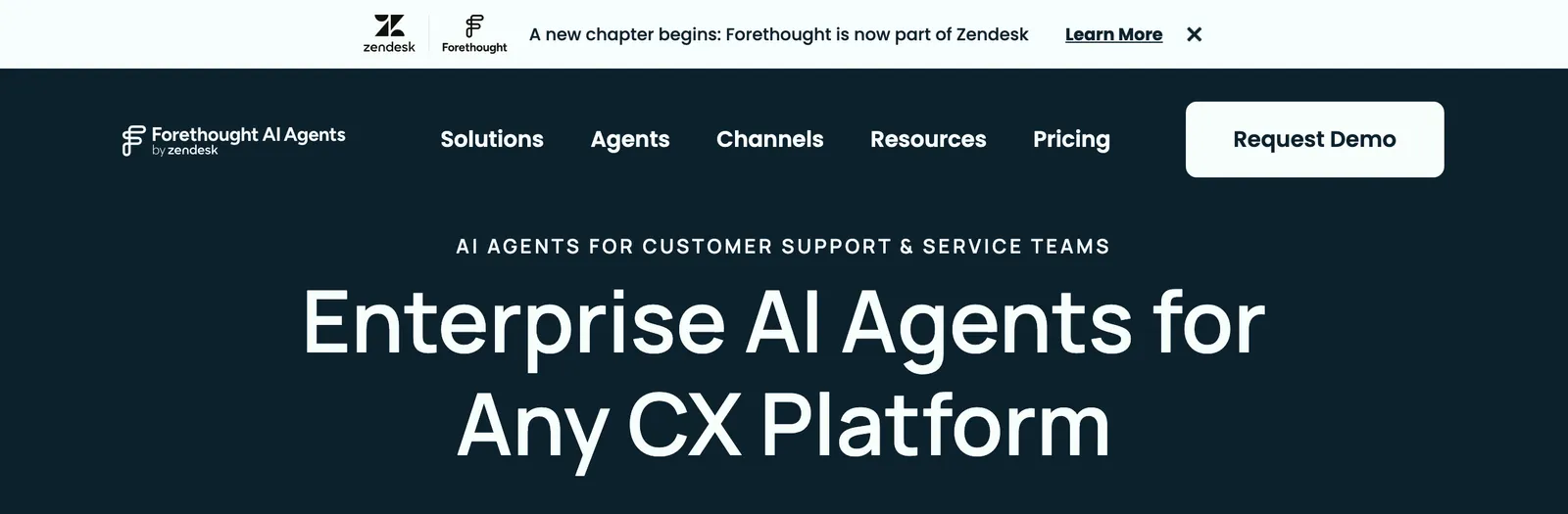
Its homepage heading reads “Enterprise AI Agents for Any CX Platform”, and it calls itself “The only multi-agentic system for all of customer support”, which is its own claim. A banner on the same page says “Forethought is now part of Zendesk” (October 2026).
Who owns Forethought AI now?
Zendesk owns Forethought. It announced a definitive agreement on 11 March 2026 and completed the acquisition on 26 March 2026. Zendesk sells the product as Forethought AI Agents by Zendesk across chat, email and voice.
The announcement says the deal “will expand Zendesk’s AI agent offering on the Resolution Platform”. The completion release is headed “Company Advances Resolution Platform with Self-Improving AI Agents”. Zendesk describes Forethought as part of its Resolution Platform.
Zendesk also says new customers can adopt it “with no requirement to use the Zendesk platform”, and its help centre says it “can operate independent of the Zendesk platform”. Purchase details are in Zendesk’s availability notice.
The history is short. It won the Startup Battlefield at TechCrunch Disrupt SF in 2018, as its homepage says.
What does Forethought do?
Forethought is a suite of agents. Solve resolves conversations end to end, built from Autoflows written as plain-text instructions. Triage tags and routes tickets, Assist drafts replies inside your help desk, Discover finds knowledge and workflow gaps, and QA agents score human and AI conversations. Channels include chat, email, voice, headless API and Slack.
| Agent | What it does | Notes |
|---|---|---|
| Solve | Resolves customer questions end to end, powered by Autoflows | Chat, email, voice, headless and Slack |
| Triage | Classifies, prioritises and routes tickets | Add-on |
| Assist | Copilot that drafts replies and recommends workflows and articles | Add-on, browser extension |
| Discover | Trends, content gaps; generates Autoflows and knowledge articles | Add-on |
| Agent QA and AI QA | Scores human and AI conversations against rubrics | Add-ons |
Source: Zendesk’s help centre article, October 2026.
Autoflows let CX managers build and update flows by typing instructions in plain text, as Forethought’s Birdy Grey story describes. Its FAQ calls Autoflows its “agentic AI reasoning engine”. Web Calling, announced on 29 June 2026, puts voice, chat and visuals into one in-browser conversation.
| Where it plugs in | Examples listed on its integrations page |
|---|---|
| Help desks and CRM | Zendesk, Salesforce, Gorgias, Kustomer, Gladly, Front, Help Scout, Intercom, Freshworks, HubSpot, ServiceNow |
| Connectors | Shopify, Google Drive, Snowflake, MCP, Whiplash, WordPress |
| Call-centre software | Amazon Connect, Five9, Genesys, Dixa, RingCentral |
The integrations page counts 70+ help desks, knowledge sources and connectors. Shopify is one connector in that list.
How does Forethought learn, and who controls it?
Zendesk sells Forethought as “self-improving AI agents”. Forethought says its agents learn from your past tickets and help-centre content and refine their responses from past successful resolutions. Discover finds gaps and generates new Autoflows and articles, and teams still run QA on AI-resolved tickets.
A Forethought plateau post says “Agentic systems analyze past successful ticket resolutions and customer outcomes to refine their responses automatically over time.”
On control, its Discover page says it will “automatically generate new Autoflows and knowledge articles”. Zendesk’s acquisition announcement frames its Resolution Learning Loop as improving “autonomously over time”.
Who uses Forethought?
Forethought’s named customers are support teams across industries. Named customers include Upwork, YAZIO, UPS, Acorns, Carta and Fetch Rewards, plus e-commerce brands Cotopaxi and Birdy Grey. Its homepage claims 15x average ROI and up to 98% resolution; both are vendor-stated.
Birdy Grey, a bridesmaid-dress brand, told its story on Forethought’s blog on 13 August 2026. During a wave of order delays the agent checked order numbers and gave contextual updates, and urgent wedding dates were fast-tracked to a human. Forethought states a 45% resolution rate across channels and CSAT of 4.2, up from 2.2 (vendor-stated, per the same post).
Cotopaxi, an outdoor-gear brand, runs Forethought with Kustomer and Shopify. Its case study states CSAT of 4.5, deflection up 28% and 168% ROI in six months (vendor-stated). Every figure here comes from Forethought’s own pages, so ask for references you can call.
How does Forethought, now part of Zendesk, compare with Ada?
Both are cross-industry AI agent platforms that sit alongside your help desk. Ada is independent and was founded in 2016, with voice among its channels and customers served in 60 languages. Forethought is now Zendesk’s AI agent, which Zendesk describes as part of its Resolution Platform. For what AI agents change for the customer in general, see AI customer experience.
| Ada | Forethought | |
|---|---|---|
| Ownership | Independent, founded 2016, “proudly Canadian” | Zendesk since March 2026 |
| How it describes itself | ”The agentic customer experience platform" | "Enterprise AI Agents for Any CX Platform” |
| Channels | Voice, messaging and email; customers served in 60 languages | Chat, email, voice, headless, Slack; Web Calling |
| How it improves | Coaching “automatically applied to future interactions”; simulations before go-live | Learns from past tickets and successful resolutions; Discover generates Autoflows and articles |
| Seeing why it answered | Docs describe “a complete trace of the steps taken by the AI Agent and the resources it used” per conversation | Says its agents “reason, decide, and take action using your business policies” |
| Operating model | Advises building AI-agent management in-house as a core competency | Learns from past resolutions; teams still run QA on AI-resolved tickets |
| E-commerce proof | IPSY, iHerb, Simba Sleep, Endy, Indigo | Cotopaxi, Birdy Grey |
| Help desk | Hands off into Zendesk, Gorgias, Kustomer and others | 70+ help desks and connectors |
Sources: Ada’s platform, e-commerce and about pages, its conversation docs, and the Forethought pages cited above, October 2026.
The choice is less about features than about the buyer. Both suit a large support operation that runs AI as a discipline. Ada says successful enterprises treat AI agent management as “a core competency, one they build and own in-house”, and Forethought’s agents learn from past resolutions while teams still run QA on AI-resolved tickets.
Is Forethought a fit for a scaling e-commerce brand?
Forethought has e-commerce customers, including Cotopaxi and Birdy Grey. In our reading of the sources, its centre of gravity is a cross-industry support team.
Forethought is horizontal across industries, with Shopify as one connector among 70+; Engaige is built around the order lifecycle, with Shopify Admin API data plus storefront content. As of October 2026, its industry menu spans SaaS, e-commerce and retail, fintech, health and wellness, mobile apps and education. On speed, its e-commerce page says “Launch in under 30 days with a dedicated implementation engineer” (vendor-stated).
Forethought offers voice among its channels. Engaige is text-first by design: email, chat, WhatsApp, SMS and social DMs, no voice AI. If phone is a big share of your mix, a voice specialist is the honest answer. If you are weighing Zendesk itself, read our guide to Zendesk alternatives.
Where does Engaige fit?
Engaige (that’s us) is the AI support agent that works inside your help desk, in the same slot as Forethought, but independent of any help-desk vendor and built for e-commerce. Engaige AI configures and improves it.
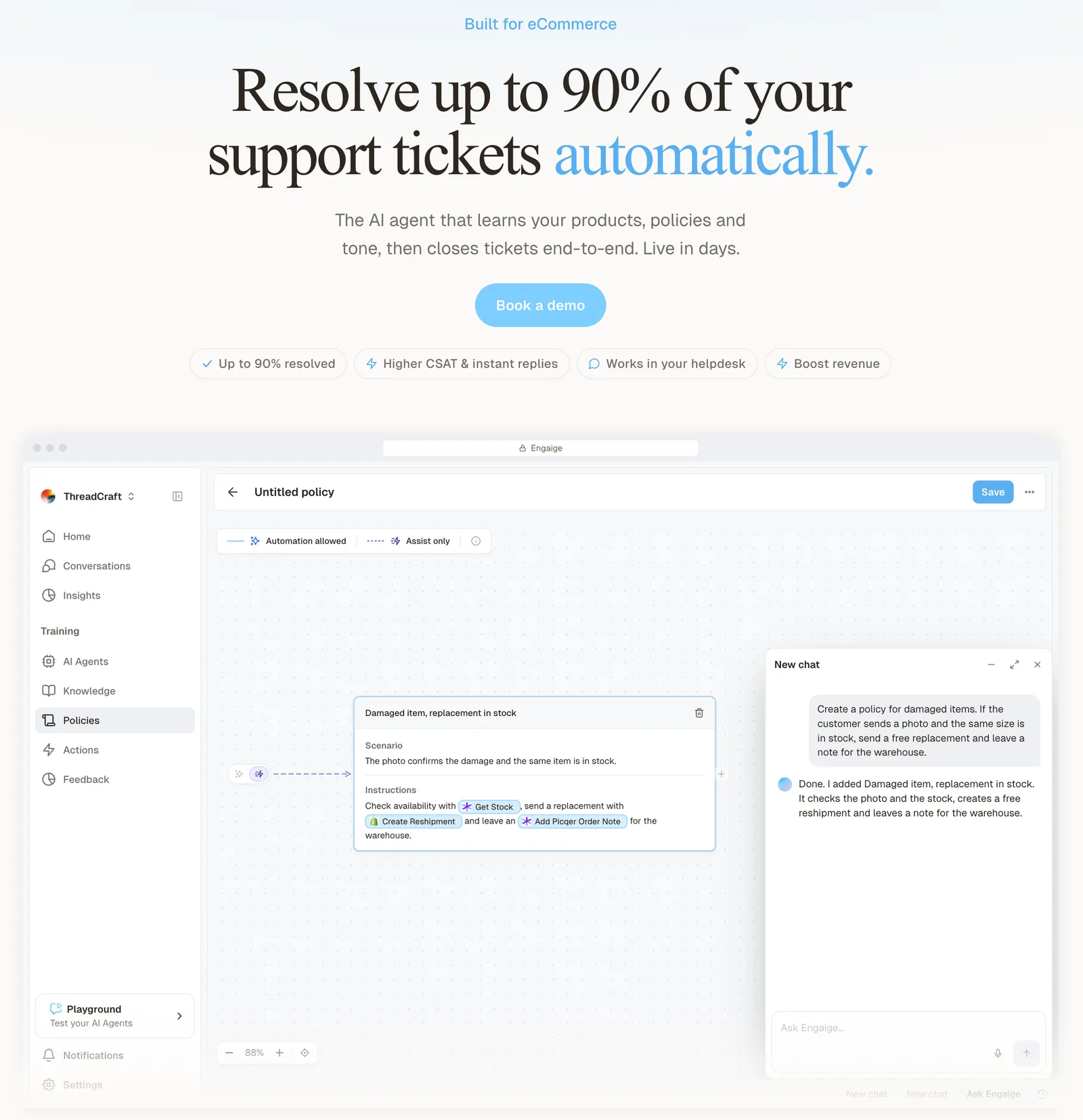
Forethought is horizontal, built for support teams across industries; Engaige is built around the order lifecycle. Keep your help desk, whichever it is. If you run Zendesk, you keep Zendesk and replace the AI, and Engaige is built for resolution, not enterprise overhead; our Zendesk integration shows how Engaige plugs in without a migration, and the Zendesk comparison sets the two side by side.
Our angle is answering from the order. Engaige reads several live systems in one answer. On Shopify, it combines live Admin API data (pricing across markets and SKUs, inventory, orders and customers) with the marketing content from your storefront, and it also reads returns, subscriptions and carriers. Then you see why it answered: open any conversation and you see the full reasoning behind every answer and action. When the agent hands a ticket to your team, it leaves a summary of its reasoning as an internal note in the ticket.
Hi, where is my order? It's been eight days and the tracking hasn't moved.

Shopify
Order 48219 · fulfilled

Picqer
Still processing Contradicts Shopify

DHL
Returned to depot · 3 delivery attempts
Settles it: the parcel is not with the customer
Reasoning…
Not deliverable. Reship to a confirmed address, booked in Picqer.
Suggested reply
Your parcel went back to the depot after three delivery attempts, so it will not arrive. I have booked a reshipment to the address you confirmed, arriving Thursday.
Engaige resolves the ticket end to end: it reads the order, takes the action (refund, cancellation, address change, discount), replies to the customer and closes the ticket. The depth is e-commerce: 50+ native integrations with vetted actions, and a connection to any other system you run. You decide per step whether the agent acts on its own or drafts for your team, and you can set thresholds, such as sending refunds above a certain amount to a person first.
You go live in Agent Assist in hours. Every reply your team sends is compared with what the agent suggested, one of the signals Engaige AI learns from, next to the conversations, your inputs, hand-offs and emerging trends. Engaige AI proposes changes with its reasoning and you approve what goes live. It keeps learning once autonomous, from emerging trends and the tickets handed back to your team. Ticket types go autonomous one at a time, most brands in about a week, with up to 90% of supported tickets automated.
The enterprise platforms are built for a heavier, different buyer; Engaige AI does the setup and tuning in plain language, so a scaling brand needs no in-house AI-management discipline.
MR MARVIS handles over 120,000 questions a year with Engaige, resolving over 60% of the conversations it’s involved in.
Otrium resolves 60% of its 120,000 annual tickets end to end, as the Otrium case shows.
With Engaige, we are able to automatically resolve 60% of the 120,000 support tickets that we receive annually.

To see it on your own tickets, demo it. For other vendor reads, see Decagon AI and Siena AI.
Frequently asked questions
Is Forethought AI part of Zendesk?
Yes. Zendesk announced the deal on 11 March 2026 and completed it on 26 March 2026. It sells the product as Forethought AI Agents by Zendesk.
Can you use Forethought without Zendesk?
Zendesk says new customers can adopt it “with no requirement to use the Zendesk platform”, and its help centre says it can operate independent of the Zendesk platform. Forethought lists 70+ help desks and connectors, including Gorgias, Kustomer, Salesforce and Intercom.
What is Forethought Solve?
Solve is the customer-facing agent. It resolves conversations end to end across chat, email, voice and more, and is built from Autoflows written as plain-text instructions.
Does Forethought work with Shopify?
Shopify is listed as a connector. Cotopaxi runs it with Kustomer and Shopify. Engaige combines live Shopify Admin API data with your storefront content in one answer.
Is Forethought better than Ada?
Neither is better in general: both are cross-industry platforms, so choose by buyer and operating model.
How is Engaige different from Forethought?
Engaige takes the action, replies and closes the ticket, answering from live order data, and Engaige AI learns from your team’s normal work with your approval.
Can Engaige run on top of Zendesk instead of Forethought?
Yes, Engaige plugs into the help desk you run with no migration.