Decagon AI calls itself “the AI concierge for every customer”. It is an agent platform that large consumer brands across industries use to run customer service agents on voice, chat and email, alongside their existing help desk, CRM and contact centre. Its agents are built from natural-language Agent Operating Procedures (AOPs) and improved with its Duet tooling.
This page covers Decagon only. Where it is scored against other vendors, see our agent ranking. Facts below are as of October 2026.
What is Decagon AI?
Decagon describes itself as “The AI concierge for every customer”: a platform to build, optimise and scale AI agents, offered on voice, chat and email. It lists financial services, travel and hospitality, health and wellness, technology, retail, telecommunications and media as its industries.
It is an agent, not a scripted bot. If you want the difference spelled out, our chatbot guide covers it.

Who is behind Decagon AI Inc?
Decagon was co-founded by Jesse Zhang (CEO) and Ashwin Sreenivas (President), according to its About page. It announced a $250M Series D on 27 January 2026, led by Coatue Management and Index Ventures, per its Series D post. Other investors named on its site are a16z, Accel and Bain Capital Ventures.
The same post cites more than 100 new global enterprise customers, a figure Decagon states itself. Gartner also named Decagon a Cool Vendor in its 2026 CRM report, according to a Decagon post dated 7 October 2026.
What does Decagon do?
Decagon gives a CX team the tools to build an agent with AOPs, improve it with Duet, test and monitor it, and run it on voice, chat and email, connected to the help desk and contact-centre tools already in place. Its AOP page is the best starting point.
| Component | What it does | Source |
|---|---|---|
| AOPs | Natural language plus code; CX teams edit procedures, engineers add code-level controls | AOP page, SOPs-to-AOPs post (26 November 2025) |
| Duet | Agent-building partner that iterates on the agent from launch | Duet page |
| Duet Autopilot | Proposes fixes from production conversations, validated, with diffs and human approval | Autopilot post (9 June 2026) |
| Duet Apprentice | Learns from escalations and from Slack and Teams; in beta | Apprentice post (1 October 2026) |
| Experiments | A/B tests agent changes against a control group in production | Experiments page |
| Testing and QA | Simulations that validate agent behaviour, including recurring runs | QA page |
| Watchtower | Reviews every interaction against criteria written in natural language | Watchtower page |
| Voice | Voice 3, built on Chord, a speech model Decagon Labs trained | Voice 3 post (1 October 2026) |
| Decagon Assist | Copilot for human reps inside Salesforce, Zendesk and Front | Assist post (19 August 2026) |
| Integrations | Zendesk including Sunshine, Intercom, Salesforce, Kustomer, Confluence, Contentful, Amazon Connect, RingCentral, MCP, custom APIs and SIP | Integrations page |
How does Decagon’s agent improve, and who controls it?
Duet Autopilot reads production conversations, traces an issue to its cause and proposes a fix. It validates the fix against the original conversation and a golden test set, then shows the diff. Decagon states that every change it proposes requires human approval before it reaches production. Apprentice, still in beta, adds learning from escalations and team chat.
On control, AOPs pair natural language with code. Decagon’s SOPs-to-AOPs post says CX teams write agent logic in everyday language, and engineers then add the code-level controls for critical operations.
Decagon also shows its reasoning. A Decagon post dated 12 December 2025 describes Trace View, which shows per turn which steps ran, what instructions the model received and how it responded. A later Autopilot post (9 September 2026) adds a projected impact on deflection that reviewers see before accepting a change, and, for context rules in Vault, an audit trail of what was approved and when.
Who uses Decagon? What do Decagon reviews say?
Decagon names large consumer and tech brands, including Chime, Duolingo, ClassPass, Oura, Curology, Hunter Douglas, Rippling, Noom and Rituals. The results below appear on Decagon’s own homepage (decagon.ai), so treat every figure as vendor-stated.
| Customer | Result (vendor-stated, decagon.ai, October 2026) |
|---|---|
| Chime | 70% chat and voice resolution |
| Duolingo | 80% deflection rate |
| ClassPass | 95% cost reduction |
| Hunter Douglas | $1M revenue from fully AI-handled conversations |
| Oura | 3x increase in CSAT |
| Curology | 65% reduction in costs |
| Rippling | 32% increase in deflection |
| Noom, Rituals | Logo only, no result stated |
Independent reviews are thin. As of 15 October 2026, Decagon’s Trustpilot profile is unclaimed and shows no reviews. We could not load its G2 page, so we quote no G2 rating here. If you are evaluating Decagon, ask for customer references you can call.
Is Decagon a fit for a scaling e-commerce brand?
Decagon is built for a cross-industry enterprise buyer with a CX operations function, and it has direct-to-consumer customers such as Oura, Curology and Rituals.
Experiments, golden test sets and QA programmes point to a heavier, different buyer: a team with CX operations, where, as Decagon’s own post describes, engineers add the code-level controls.
On commerce platforms, its integrations page names none as of October 2026, while a retail post from August 2025 says its agents integrate with platforms like Shopify. Ask Decagon directly which commerce systems it connects to.
Voice is the other fork. Voice 3 suits contact-centre-heavy brands. Engaige is text-first by design: email, live chat, WhatsApp, SMS and social DMs. Text gives the agent time to read the order, check the policy and take the action before it answers, so all of Engaige’s depth goes into the channels where quality can be highest. If phone is a big share of your mix, a voice specialist is the honest answer.
Where does Engaige fit?
Engaige (that’s us) is built for a different job than a cross-industry platform like Decagon: it is the e-commerce-native, text-first AI support agent for scaling DTC brands, and it plugs into the help desk you already run. Engaige AI configures and improves it: Otrium resolves 60% of its 120,000 annual tickets end to end, as the Otrium case shows. On Shopify, Engaige combines live Admin API data with your storefront content; see the Shopify integration.
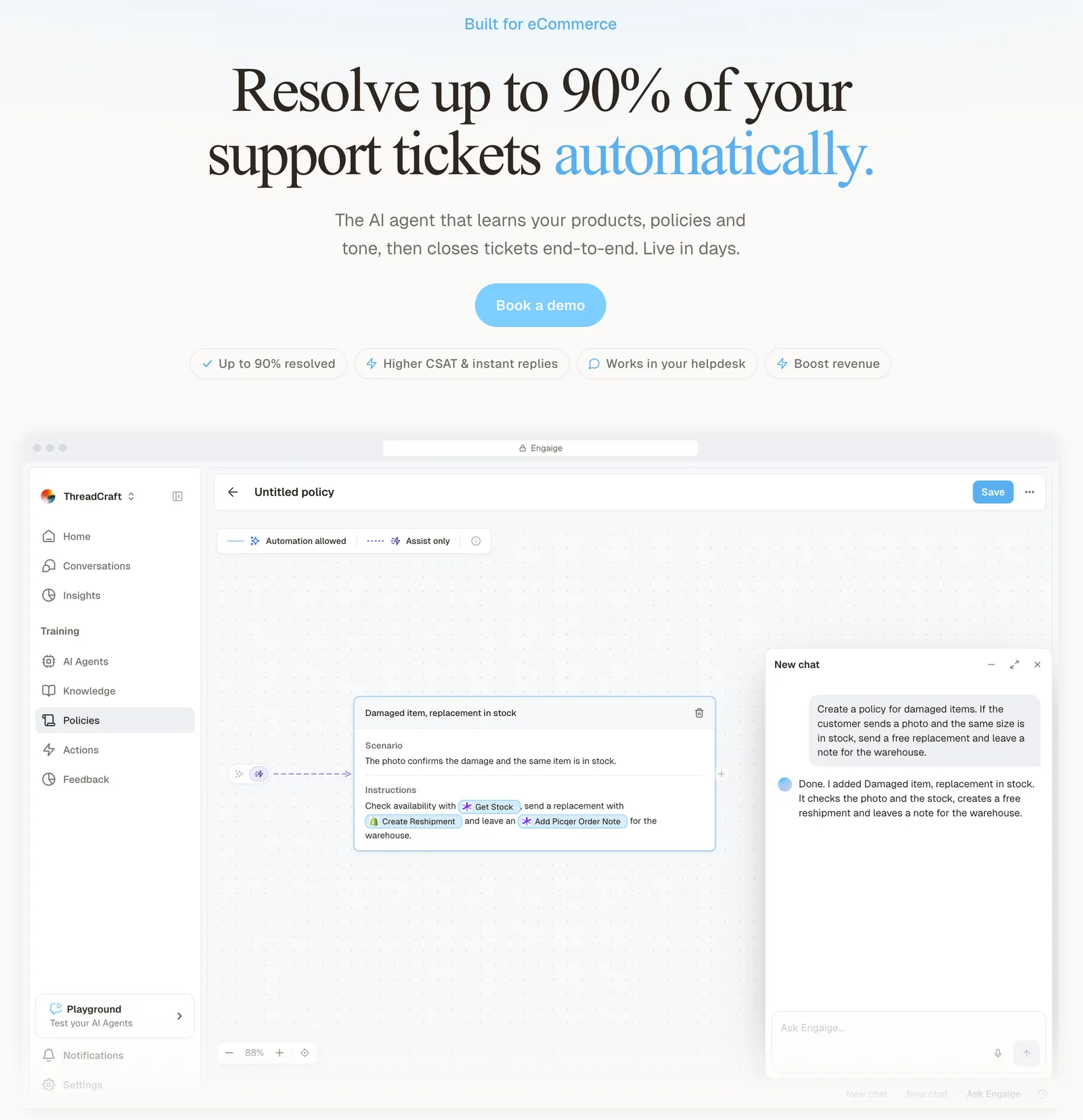
Engaige resolves tickets end to end: it checks the order, takes the action (refund, cancellation, address change, discount, reshipment), replies to the customer and closes the ticket. You can run any ticket type in Agent Assist or fully automated, up to 90% of supported tickets.
Our angle is speed and control. You go live in Agent Assist in hours, and most brands go fully autonomous in about a week, one ticket type at a time. Engaige AI drafts your first policies from the integrations you enable and some initial information, then tunes them in plain language.
Decagon’s AOP page describes AOPs as combining “the flexibility of natural language with the reliability of code”, and its SOPs-to-AOPs post says engineers then add the code-level controls for critical operations. With Engaige, you brief Engaige AI in plain language and it configures and tunes the agent for you.
You decide, per step or ticket type, whether the agent acts on its own or drafts for your team. You can set thresholds, such as sending refunds above a certain amount to a person first. Test every policy in the Playground before it goes live, including real past tickets you paste in.
Engaige offered control, flexibility, and the ability to really incorporate AI in a more human way.

Scenario
The customer asks about a delivery address.
Instructions
Read the order with Get order , then take the branch that matches.
 Get order
Scenario
The order has not been picked yet.
Instructions
Move it with Change picqer shipping address .
 Change picqer shipping address
Scenario
The parcel has already left the warehouse.
Instructions
Say it cannot be redirected, then offer Process refund .
In Agent Assist, every reply your team sends is compared with what the agent suggested; that is one of the signals Engaige AI learns from. Engaige AI proposes changes with its reasoning, you approve them, and it keeps learning once autonomous from emerging trends and hand-backs. Open any conversation in Engaige and you see the full reasoning behind every answer and action, with a summary left as an internal note at hand-over.
To see it on your own tickets, demo it. For other vendor reads, see Siena AI and Forethought.
Frequently asked questions
Is Decagon a chatbot?
No. Decagon is an agent platform. AOPs define workflows that take actions across connected systems on voice, chat and email, rather than returning scripted answers. For other e-commerce options, see our e-commerce chatbots comparison.
Who founded Decagon?
Jesse Zhang (CEO) and Ashwin Sreenivas (President) co-founded it. Decagon names a16z, Accel, Bain Capital Ventures, Coatue and Index Ventures as investors.
Does Decagon replace my help desk?
No. It connects to Zendesk, Intercom and Salesforce, escalates live chats through Zendesk Sunshine and Salesforce, and syncs knowledge from Kustomer, Confluence and Contentful. Decagon Assist, its copilot for human reps, runs inside Salesforce, Zendesk and Front.
Does Decagon work with Shopify?
Its integrations page names no commerce platform as of October 2026, while a 2025 Decagon retail post says its agents integrate with platforms like Shopify. Ask Decagon which commerce systems it connects to. Engaige combines live Shopify Admin API data with your storefront content.
Does Decagon’s AI improve itself?
Yes. Duet Autopilot proposes changes with diffs, validates them against a golden test set, and Decagon states every change needs human approval. Apprentice, which learns from escalations your reps handle and from team decisions in Slack and Teams, is in beta. Engaige AI also learns from your team’s replies, plus emerging trends and hand-backs once autonomous, and proposes changes with its reasoning that you approve.
Does Decagon support voice?
Yes, through Voice 3 on its own Chord speech model, announced in October 2026. Engaige is text-first by design, covering email, live chat, WhatsApp, SMS and social DMs. If phone is a big share of your mix, a voice specialist is the honest answer.
How is Engaige different from Decagon?
Different buyer and focus. Decagon is a cross-industry platform that includes voice. Engaige is built for scaling e-commerce brands: Engaige AI drafts your policies and tunes them in plain language, you set per-step control with thresholds (for example, refunds above a certain amount go to a person first), and on Shopify it combines live Admin API data with your storefront content. You decide per ticket type whether the agent acts on its own or drafts for your team.
How quickly can an e-commerce team go live with Engaige?
Agent Assist goes live in hours. Ticket types move to autonomous one at a time, and most brands are autonomous in about a week. Test policies in the Playground first, including past tickets.