The best Intercom alternatives for an online store in 2026 go two ways. Keep Intercom as your inbox and replace Fin with Engaige or Decagon, or move to another help desk: Zendesk, Freshdesk, LiveChat, Gorgias, Richpanel, Help Scout, Front, HubSpot Service Hub or Kustomer. Which route fits depends on whether your problem is the AI or the inbox.
How do Intercom competitors compare at a glance?
Prices in US dollars as published on the vendors’ .com sites in October 2026; rates are vendor-stated unless marked.
| # | Tool | Help desk | AI store actions | Headline rate | Price (October 2026) |
|---|---|---|---|---|---|
| Intercom (baseline) | Yours today | Teammates refund and replace from the inbox; Fin’s Shopify templates and actions read orders, edit carts, quote and issue refunds, and issue gift cards | 76% average across 12,000+ customers | $29 to $132 per seat a month (annual) + $0.99 per Fin outcome | |
| 1 | Engaige | Keep Intercom | Refunds, cancellations, address changes, discounts; 50+ native integrations | MR MARVIS 60%+, Otrium 60%, HelloPrint 80% (case studies) | Flat monthly fee by ticket volume |
| 2 | Zendesk | Replace | Action flows you configure | Over 80% | Per agent + $1.50 to $2.00 per extra resolution |
| 3 | Freshdesk | Replace | Freddy, with pre-built Shopify workflows | Up to 80%; iPostal1 54% | $19 to $89 per agent + $49 per 100 sessions after the first 500 (free once per account) |
| 4 | LiveChat (Text) | Replace | Adds products to the cart in chat; other actions through Custom Skills | No resolution rate published | $19 or $79 per user (annual), with 10 or 200 AI resolutions a month |
| 5 | Gorgias | Replace | Shopify actions such as cancel order, edit address | 60% headline; Orthofeet 56% | $10 to $900 a month + $0.90 to $1.00 per AI interaction |
| 6 | Richpanel | Replace | Yes, with per-action approvals | High rates marketed | $99 per seat + about $0.20 per AI conversation |
| 7 | Help Scout | Replace | AI answers; teammates act on Shopify | 73% average | Free for 5 users; $25 to $75 per user + $0.75 per resolution |
| 8 | Front | Replace | Autopilot through Playbooks | Up to 70% | $25 to $105 per seat + from $0.05 per conversation |
| 9 | HubSpot Service Hub | Replace (CRM) | Confirm Shopify actions in a demo | 65% of conversations | Free for 2 users; Customer Agent 50 credits ($0.50) per resolution |
| 10 | Kustomer | Replace (CRM) | Built-in Shopify tool reads only | No public rate | No published prices |
| 11 | Decagon | Keep Intercom (AI platform) | No commerce platform on its integrations page | Not assessed here | No published prices |
| Sierra (AI platform, not ranked) | AI platform | Not assessed here | Not assessed here | Not assessed here |
This guide is for a store’s support lead who runs Intercom, now part of Fin, a Salesforce company since 10 September 2026, or is weighing it. For what Fin is and how it works, start with our Fin guide. A fair word on our own row: our numbers are named case studies you can open, MR MARVIS, Otrium and HelloPrint, and our “up to 90% of supported tickets” ceiling is the kind of vendor figure you should challenge on every supplier, us included.
Why do teams look for Intercom alternatives in 2026?
For a store the trigger is rarely the inbox. Intercom is built around SaaS-style support: account, product and onboarding questions. Store tickets are orders, returns, deliveries and subscriptions, and that is where teams start to look elsewhere.
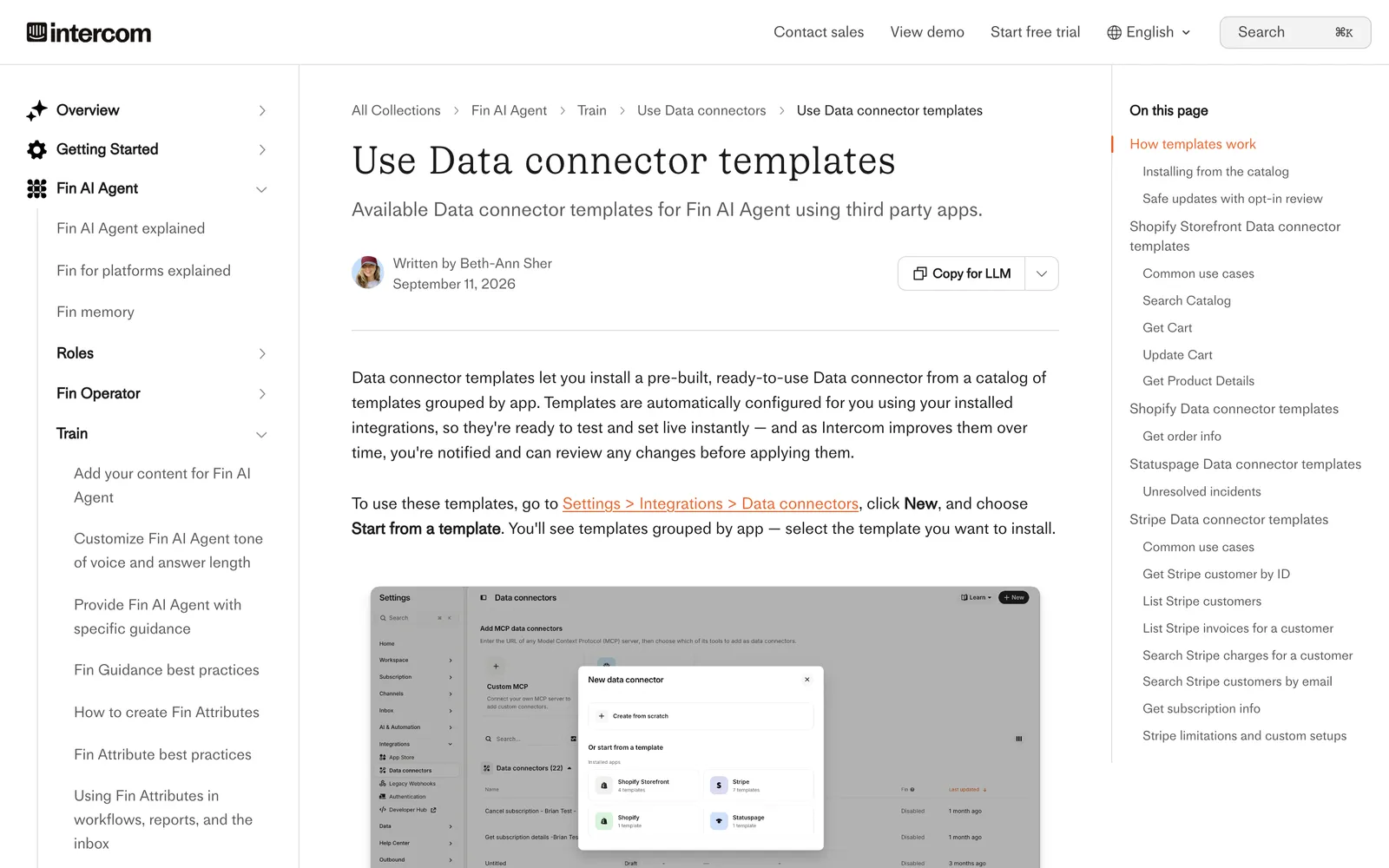
The store-actions question. Intercom documents five Shopify templates for Fin (11 September 2026): Search Catalog, Get Cart, Update Cart, Get Product Details and Get order info. Its compensation templates (23 September 2026) add a refund quote that “does not write to Shopify” and gift cards as store credit. Intercom pairs that quote with an existing Create Shopify Refund action, so Fin can confirm the amount with the customer and then issue the refund.
None of the templates cancels an order or changes an address; Intercom’s Procedures article says Fin connects to tools such as Shopify through data connectors or MCPs.
Your team can do more by hand. From the Shopify sidebar in the inbox, teammates refund line items or shipping, create replacement orders and issue gift cards, while order cancellation is “Not available”, so teammates use Shopify (help centre, October 2026).
The ownership question. Salesforce completed its acquisition of Fin, formerly Intercom, on 10 September 2026. That is a roadmap point to ask about, not a reason on its own.
Our view in one line: Intercom is built for SaaS support; Engaige is built for the store. So the split this guide follows is simple: keep Intercom and replace Fin, or move to another help desk.
What does Intercom still do well?
A lot. Intercom is a polished, widely adopted platform, and Fin is a capable agent. The inbox and Messenger are mature, and Fin has controls worth asking every alternative about: Procedures in natural language with a “Loop in teammate” approval step, simulations and batch tests, Fin’s thoughts in the inbox, and Fin Operator diffs you approve.
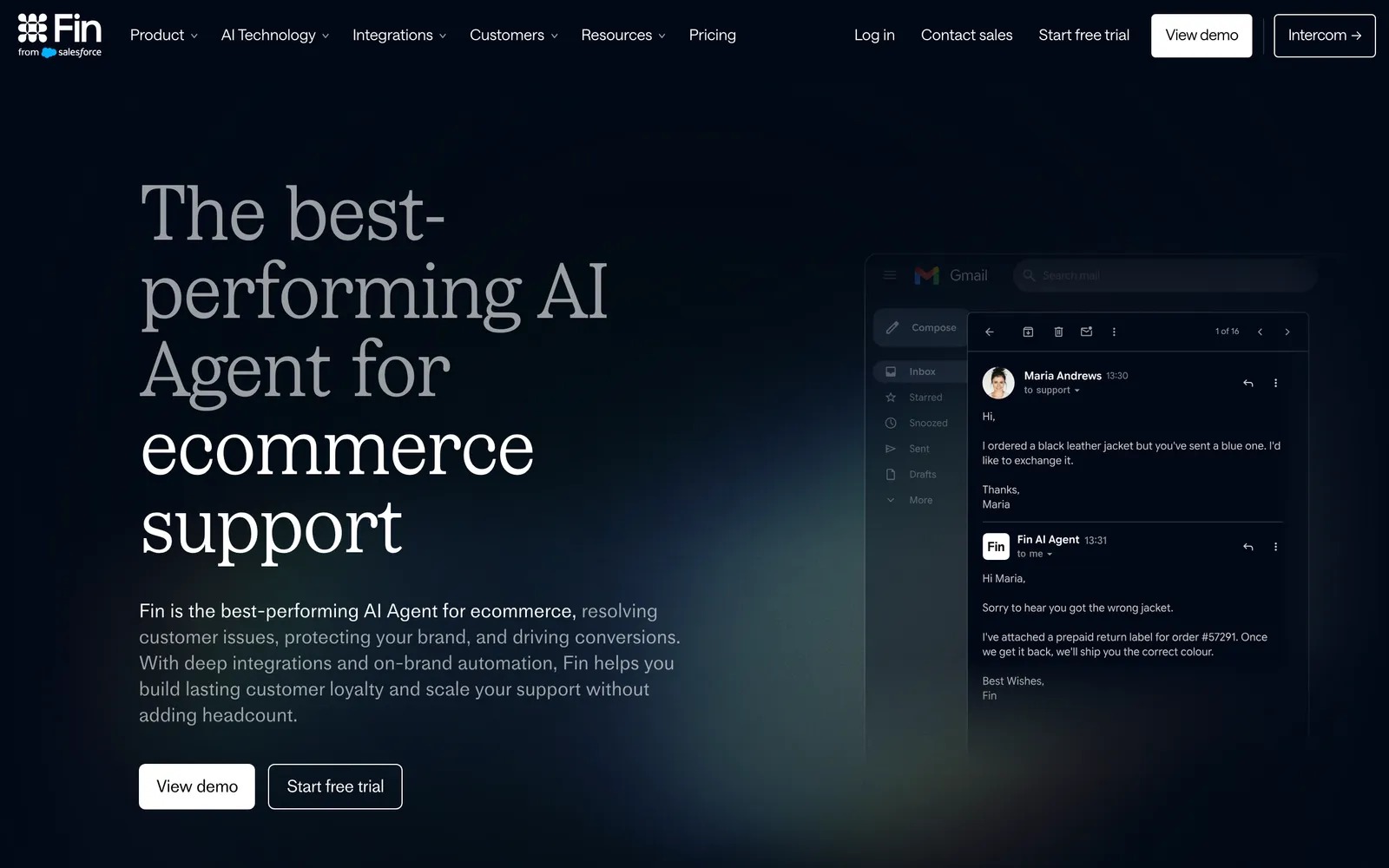
Fin’s homepage states an average resolution rate of 76% across 12,000+ customers (vendor-stated), and its e-commerce page markets refunds, cancellations and address changes. Whether that holds for your order tickets depends on which store actions you build.
Use the same test on every tool below, ours included: which named customer produced the number, over what period, and what counts as “resolved”?
How should you evaluate an Intercom alternative?
Five checks separate a real upgrade from a sideways move. The first decides whether you migrate at all, the next three test what the AI does with an order, and the last tests the bill. Ask each one in a demo, with your own tickets.
| # | Check | What to ask in a demo |
|---|---|---|
| 1 | Keep or move | Does it work inside Intercom, or need a migration of conversations, help articles and workflows? |
| 2 | Store actions | Can the AI itself refund, cancel, change an address or apply a discount, and are those actions shipped or built by your team? |
| 3 | Live data from several systems | Does one answer combine the order, the carrier event, the return and the subscription? |
| 4 | How it learns | Learns from what, and who approves the change before it goes live? |
| 5 | Cost per resolved ticket | What does a resolved ticket cost at today’s volume and at twice today’s volume? |
A practical shortcut for checks two and three: feed every candidate your three ugliest recent tickets, the WISMO case with a stuck parcel, the part-refund and the damaged item with a replacement. Whether it completes those, rather than deflecting them, predicts your real resolution rate better than any demo script.
What are the best Intercom alternatives?
The best Intercom alternatives in 2026 are Engaige if you want to keep Intercom and resolve store tickets end to end; Zendesk, Freshdesk or LiveChat for another general help desk; Gorgias or Richpanel for an e-commerce help desk; Help Scout or Front for an inbox-led team; HubSpot Service Hub or Kustomer for a CRM model; and Decagon as an AI platform for large teams.
Entries 1 and 11 work next to the Intercom you already run, so conversations, help articles and workflows stay where they are. Entries 2 to 10 replace the help desk itself.
1. Engaige: best for keeping Intercom and resolving store tickets end to end
- Best for: stores that like the Intercom inbox and want the AI to close refunds, returns and order changes end to end.
- Price as of October 2026: a flat monthly fee tied to your ticket volume.
- Keep or replace your help desk: keep Intercom.
- Verdict: no migration, several live store systems read in one answer, and an agent that learns from your team’s replies with your approval.
Engaige (that’s us) is the e-commerce AI support agent that works inside Intercom and replaces Fin, never the help desk, and Engaige AI configures and improves it from plain-language briefs. At MR MARVIS, a Shopify Plus brand handling over 120,000 questions a year, Engaige resolves over 60% of the conversations it’s involved in.
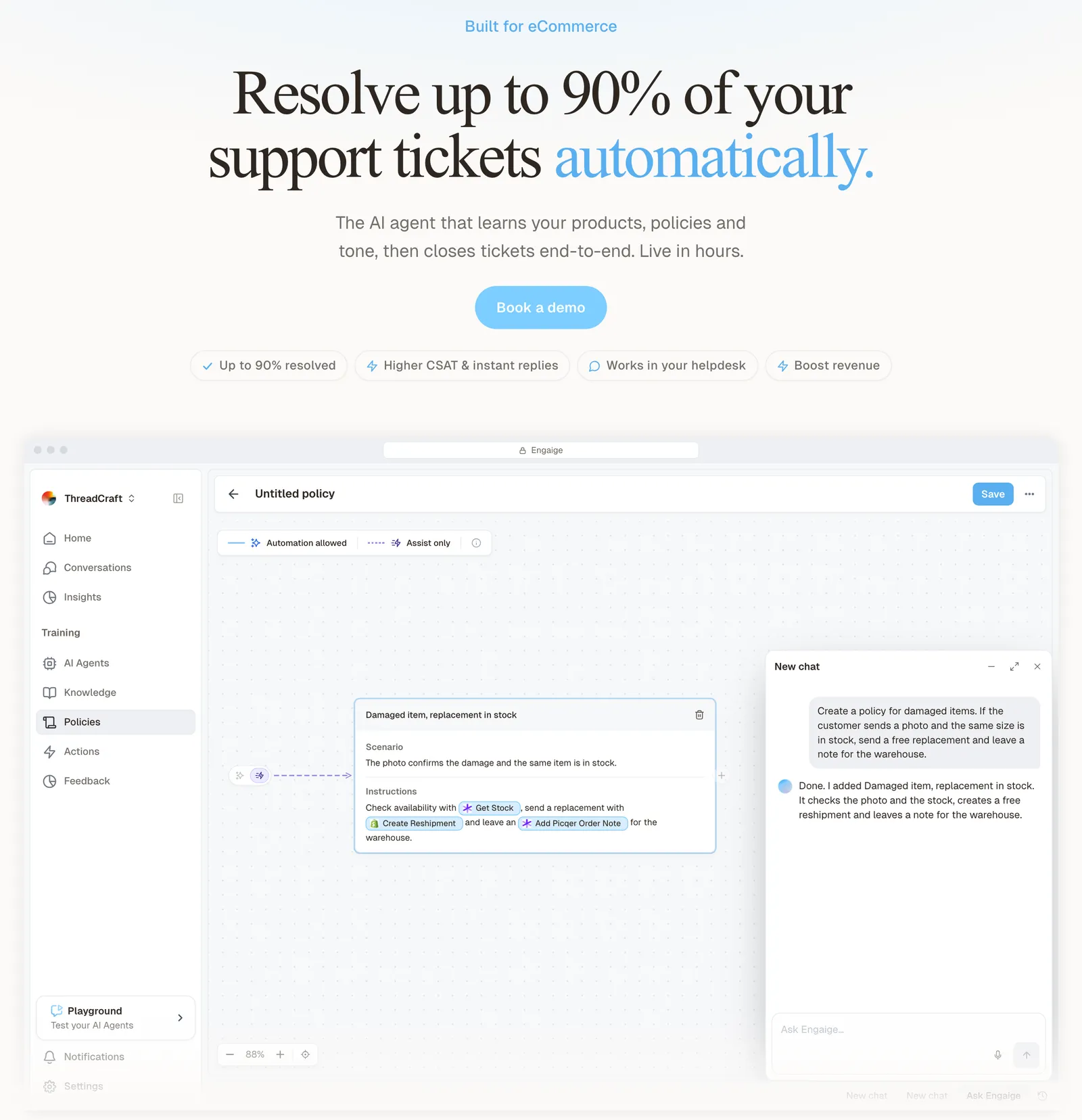
Keep Intercom, replace the AI. Engaige connects to your Intercom workspace (Intercom integration), so there is no migration of conversations, help articles or workflows, and you go live in Agent Assist within hours.
The difference with Fin is store depth. Engaige reads several live systems in one answer: the order, the carrier event, the return and the subscription. On Shopify it combines live Admin API data, pricing across markets and SKUs, inventory, orders and customers, with the marketing content from your storefront.
It takes the action itself, refunds, cancellations, address changes and discounts, as native actions you enable rather than data connectors you build, across 50+ native integrations with vetted, plug-and-play actions, and it connects to any system you run.
Hi, where is my order? It's been eight days and the tracking hasn't moved.

Shopify
Order 48219 · fulfilled

Picqer
Still processing Contradicts Shopify

DHL
Returned to depot · 3 delivery attempts
Settles it: the parcel is not with the customer
Reasoning…
Not deliverable. Reship to a confirmed address, booked in Picqer.
Suggested reply
Your parcel went back to the depot after three delivery attempts, so it will not arrive. I have booked a reshipment to the address you confirmed, arriving Thursday.
For an answer built from four systems, you want to know what each one said. Engaige shows the full reasoning and the sources for every answer and action in its dashboard, and if a ticket goes to your team in Intercom, the agent adds a short summary of that reasoning as an internal note.
Within the AI we can see the reasoning, and how it comes to a response. That shows us where information is missing or unclear, and helps us improve our workflow.

In Agent Assist, every reply your team sends is compared with what the agent suggested; that is one of the signals Engaige AI learns from, alongside conversations, your inputs, hand-offs and trends. It proposes changes to policies and behaviour with its reasoning, and you approve what goes live. Intercom’s Recommendations also compare failed Fin answers with your team’s replies to similar questions, and nothing goes live without your approval there either; the difference is that Engaige learns from every Agent Assist reply from day one.
Once a ticket type matches your team’s quality, you switch it to autonomous, and Engaige takes the action, replies to the customer and closes the ticket. Brands that move quickly reach autonomy in about a week, Engaige automates up to 90% of supported tickets, and autonomous from day one is also supported.
You set the limits. Policies can carry thresholds, such as sending refunds above a set amount to a person first, and each step runs Automated or in Agent Assist. You test policies in the Playground before they go live, for example by pasting in a past ticket. Engaige is text-first by design: email, chat, WhatsApp, SMS and social DMs, with no voice AI.
Otrium resolves 60% of its 120,000 annual tickets end to end, and HelloPrint automated 80% of its tickets with a 90% faster first response. Pricing is a flat monthly fee tied to your ticket volume, predictable as you scale. Our Intercom comparison sets the two side by side.
2. Zendesk: best for large multi-brand support teams
- Best for: large teams that need routing, QA and a wide app marketplace.
- Price as of October 2026: per-agent plans plus extra automated resolutions at $1.50 committed or $2.00 pay-as-you-go.
- Keep or replace your help desk: replace Intercom.
- Verdict: proven and broad; store actions run through action flows you configure.
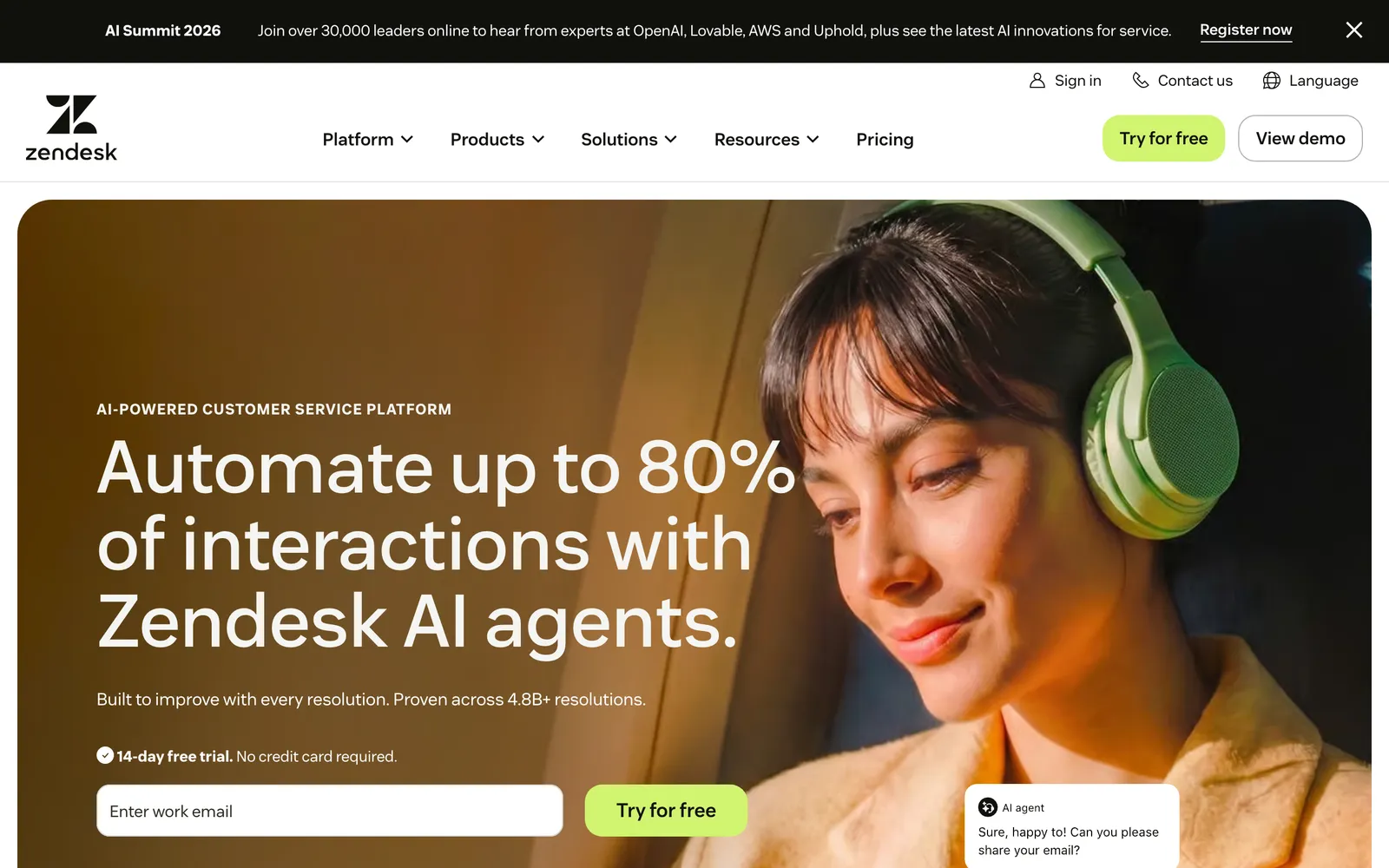
Zendesk is the proven, horizontal help desk that big support teams run on, and it states its AI agents “routinely resolve over 80% of interactions” (press release, vendor-stated). It completed its acquisition of Forethought on 26 March 2026, sells self-improving AI agents (vendor wording), and its AI agents run Shopify actions such as cancel and refund through action flows you configure.
It prices per agent, with automated resolutions on top: its US pricing page lists extra resolutions at $1.50 committed or $2.00 pay-as-you-go (October 2026). The catch for a store: the AI is bolted onto a horizontal platform, so the store actions are yours to set up. For the pair head to head, see Intercom vs Zendesk, and for the wider field, Zendesk alternatives.
3. Freshdesk: best for omnichannel support on per-agent plans
- Best for: teams that want email, chat, phone and social on per-agent plans.
- Price as of October 2026: $19, $55 or $89 per agent a month billed annually, plus $49 per 100 Freddy sessions after the first 500, which are free once per account.
- Keep or replace your help desk: replace Intercom.
- Verdict: broad channels and an AI agent that acts; store actions beyond the pre-built workflows are yours to build.
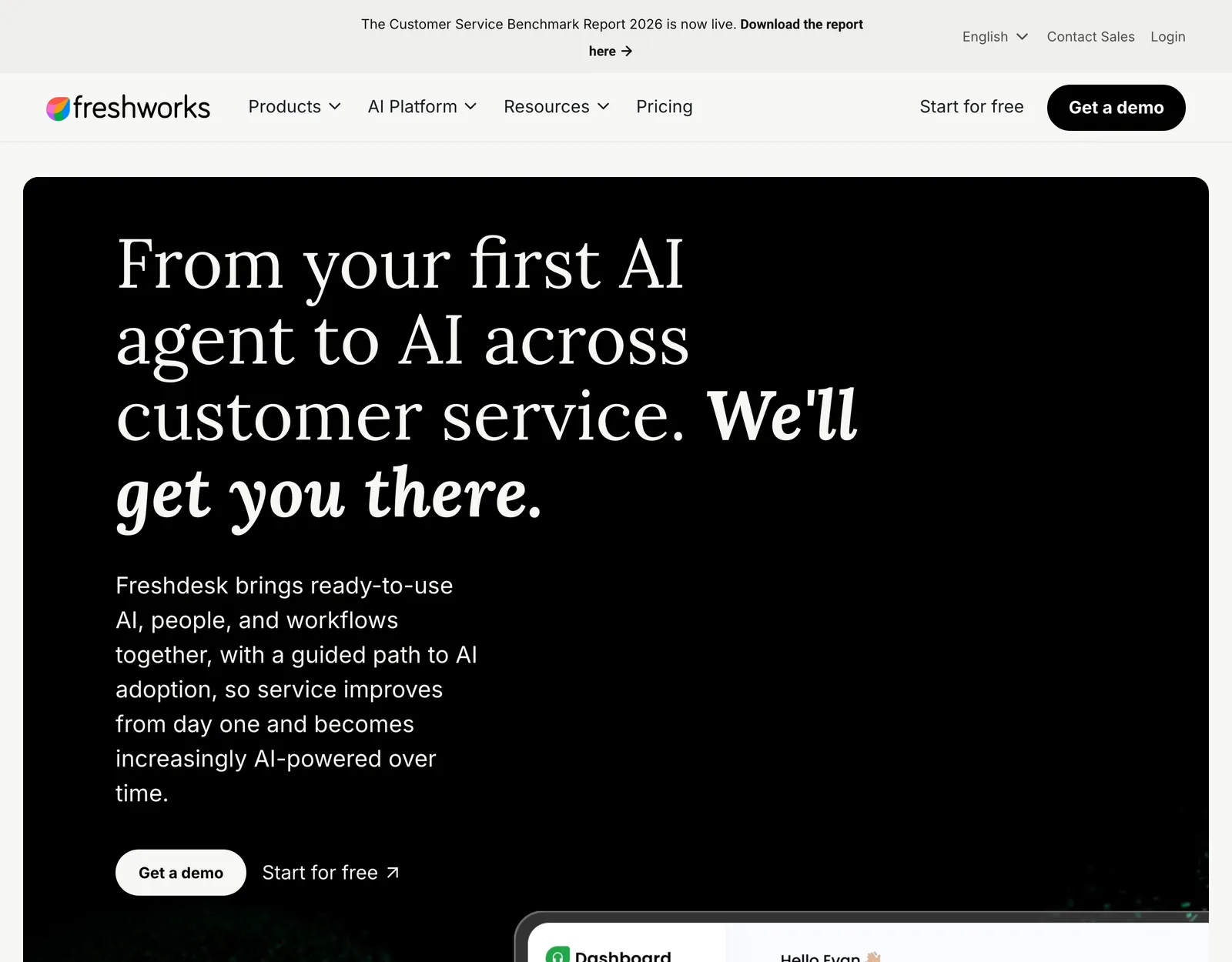
Freshdesk is Freshworks’ omnichannel help desk, with per-agent plans at $19, $55 and $89 a month billed annually (October 2026). Its Freddy AI Agent is on all three plans and comes pre-loaded with agentic workflows such as update subscription, cancel order and check stock availability, with integrations including Shopify and Stripe (October 2026).
Freshworks markets up to 80% resolution (vendor-stated) and names results too: iPostal1 reports 54% of queries resolved with AI (vendor-stated). The catch: Freddy is AI bolted onto horizontal ticketing, so store actions beyond the pre-built workflows are yours to build in AI Agent Studio. See Freshdesk alternatives.
4. LiveChat: best for chat-led stores that sell in the conversation
- Best for: stores whose support runs mostly through website chat and that want the chat to sell too.
- Price as of October 2026: $19 or $79 per user a month billed annually ($25 or $99 monthly), with 10 or 200 AI resolutions a month included and extra packs of 50 at $49.50; Enterprise on request.
- Keep or replace your help desk: replace Intercom.
- Verdict: a chat-first inbox with an AI agent that recommends products and adds them to the cart; order actions run through skills you connect.
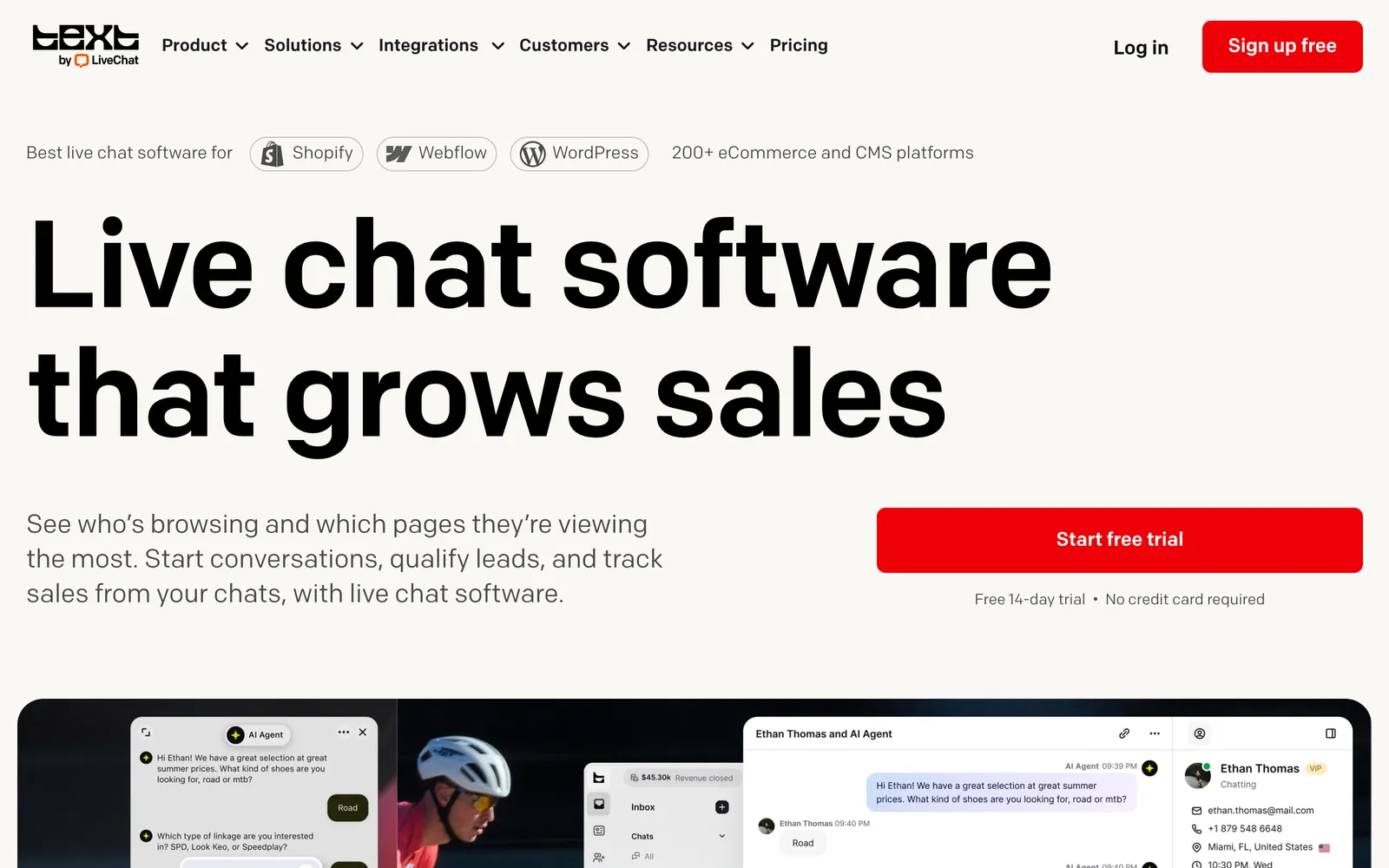
LiveChat is a live chat platform, and new customers now sign up for Text, which its pricing page calls “the next product from the team behind LiveChat”; existing LiveChat customers keep their plan. Every plan includes an inbox and ticketing system and an AI Agent, and an AI resolution counts when “the AI directly solved a customer question” (October 2026).
Its AI Agent answers from your website pages, help articles and files, and passes the full conversation to your team when a customer needs a person. With Shopify connected, it recommends products as cards and lets shoppers add them to the cart in the chat, and your team sees the shopper’s cart and order history. For refunds and account changes, the page points to Custom Skills that you connect through a webhook or API (October 2026).
5. Gorgias: best for a Shopify-first help desk
- Best for: Shopify stores that want a help desk built for e-commerce, with an AI that acts on orders.
- Price as of October 2026: $10 to $900 a month for 50 to 5,000 tickets on monthly billing, plus $0.90 per AI Agent interaction on annual plans or $1.00 on monthly plans.
- Keep or replace your help desk: replace Intercom.
- Verdict: strong e-commerce help desk with an acting AI; moving to it is a full help desk migration.
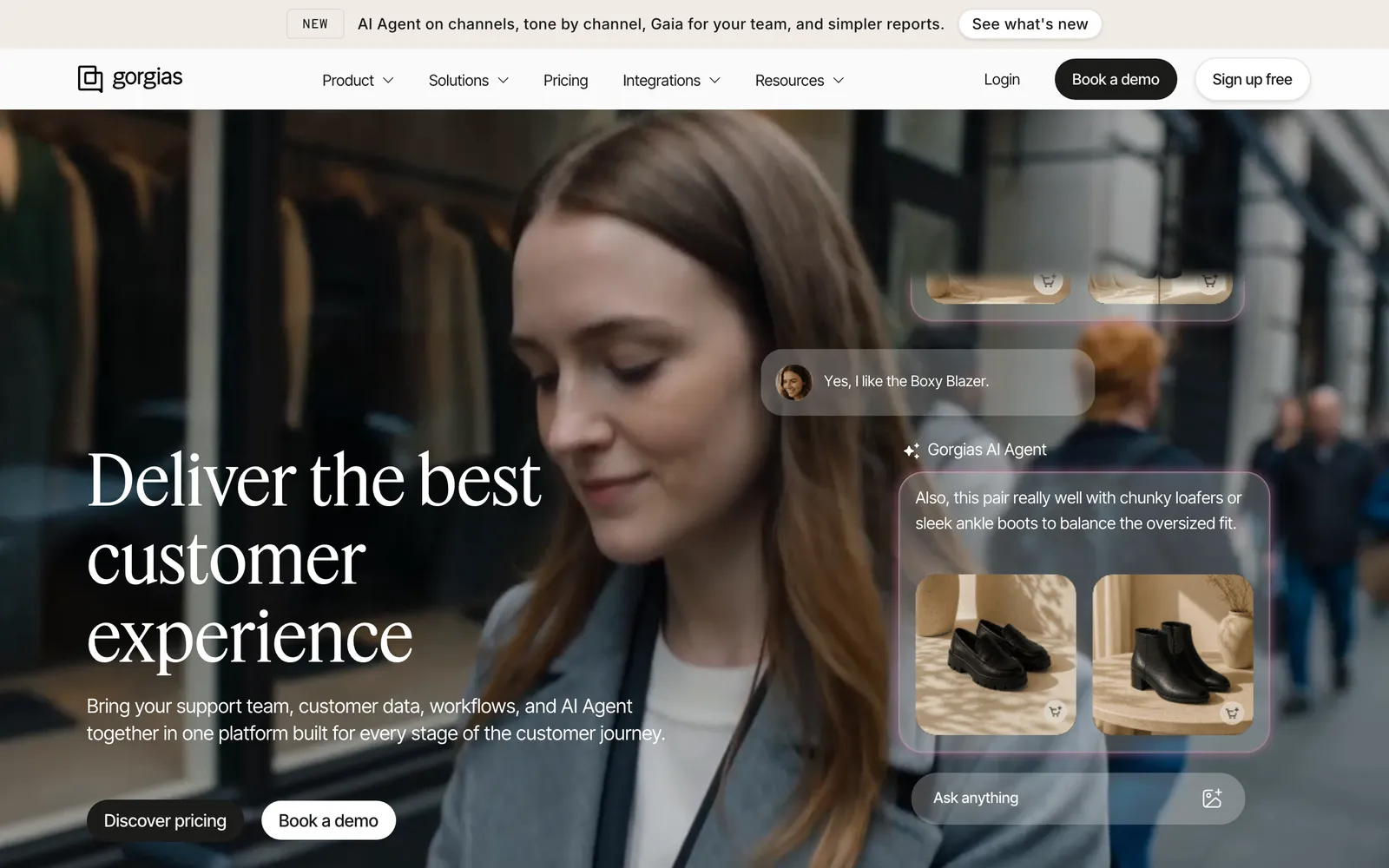
Gorgias is a Shopify-first help desk whose AI Agent takes Shopify actions, such as cancelling an order or editing a shipping address, with conditions on fields like fulfilment status (help centre). Its Gaia drafts changes to your AI Agent setup for you to approve, and its homepage promises “Automate 60% of support” (vendor-stated); its Orthofeet story reports 56% automation.
Its pricing page says the help desk is “never priced per agent” and charges per AI Agent interaction on top (October 2026). The catch: the AI is bolted onto a ticketing platform, so choosing Gorgias means moving help desk. For the pair head to head, see Intercom vs Gorgias, and for the wider field, Gorgias alternatives.
6. Richpanel: best for an e-commerce help desk with per-action approvals
- Best for: brands that want an e-commerce help desk where they choose which AI actions need approval.
- Price as of October 2026: $99 per seat a month on annual billing, plus about $0.20 per AI conversation and a $200 monthly AI minimum.
- Keep or replace your help desk: replace Intercom.
- Verdict: commerce AI with per-action approvals; moving to it is a full help desk migration.
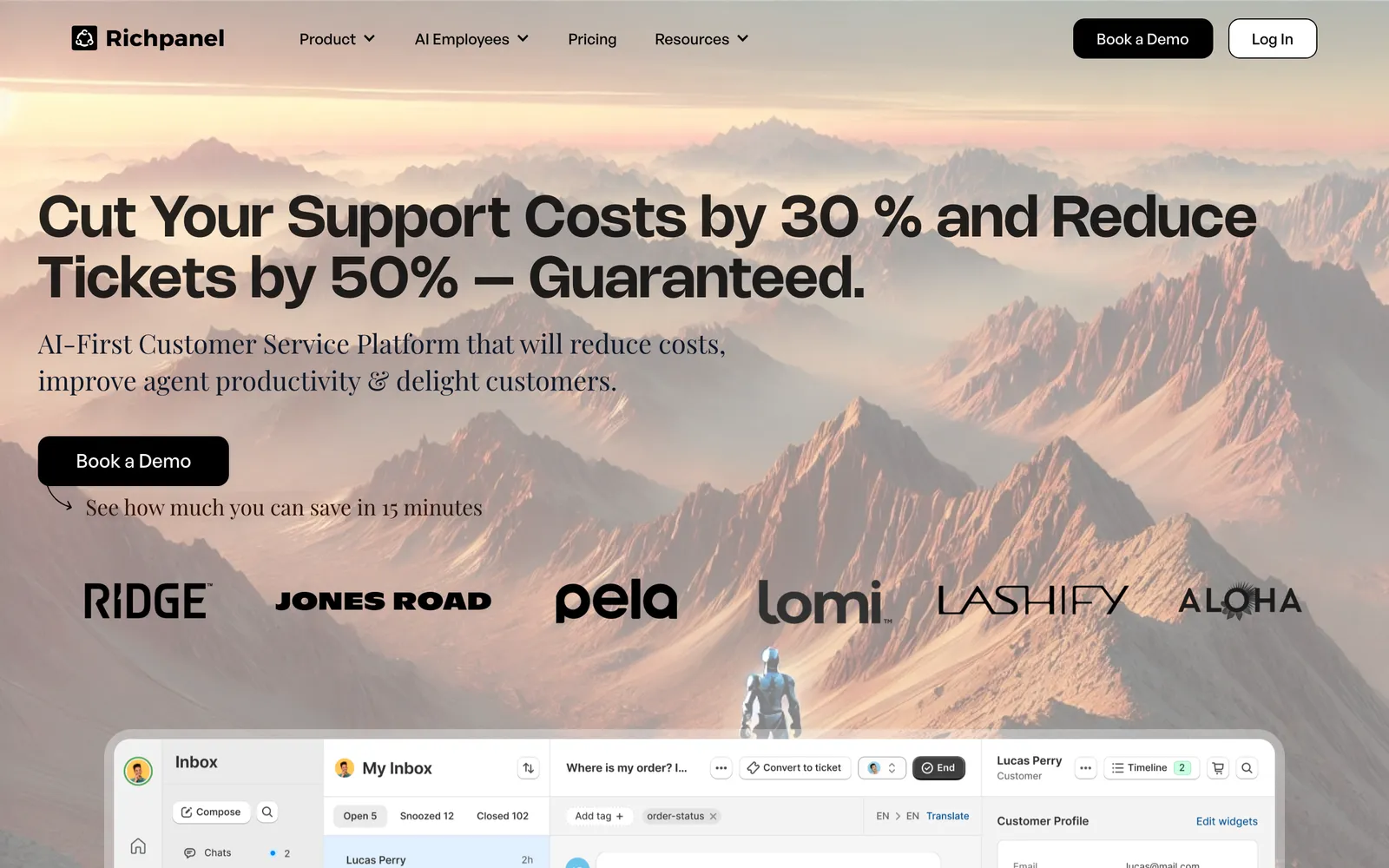
Richpanel is an e-commerce help desk whose AI actions run against Shopify, Recharge, Loop and Skio, and you choose which actions need approval first. A QA AI checks closed conversations, groups misses by cause and recommends fixes you approve. It markets high autonomous resolution, though those rates are not the norm for every brand.
Its pricing page lists $99 per seat a month on annual billing, with AI billed by credit at about $0.20 per AI conversation (October 2026). The catch: the deeper value needs full platform adoption, so it is a help desk migration. See Richpanel alternatives.
7. Help Scout: best for small, people-first teams
- Best for: small teams that want a simple shared inbox.
- Price as of October 2026: a free plan for 5 users; $25, $45 or $75 per user a month, plus $0.75 per AI resolution.
- Keep or replace your help desk: replace Intercom.
- Verdict: a well-loved inbox; the AI answers from knowledge, with app connections marked “coming soon”.
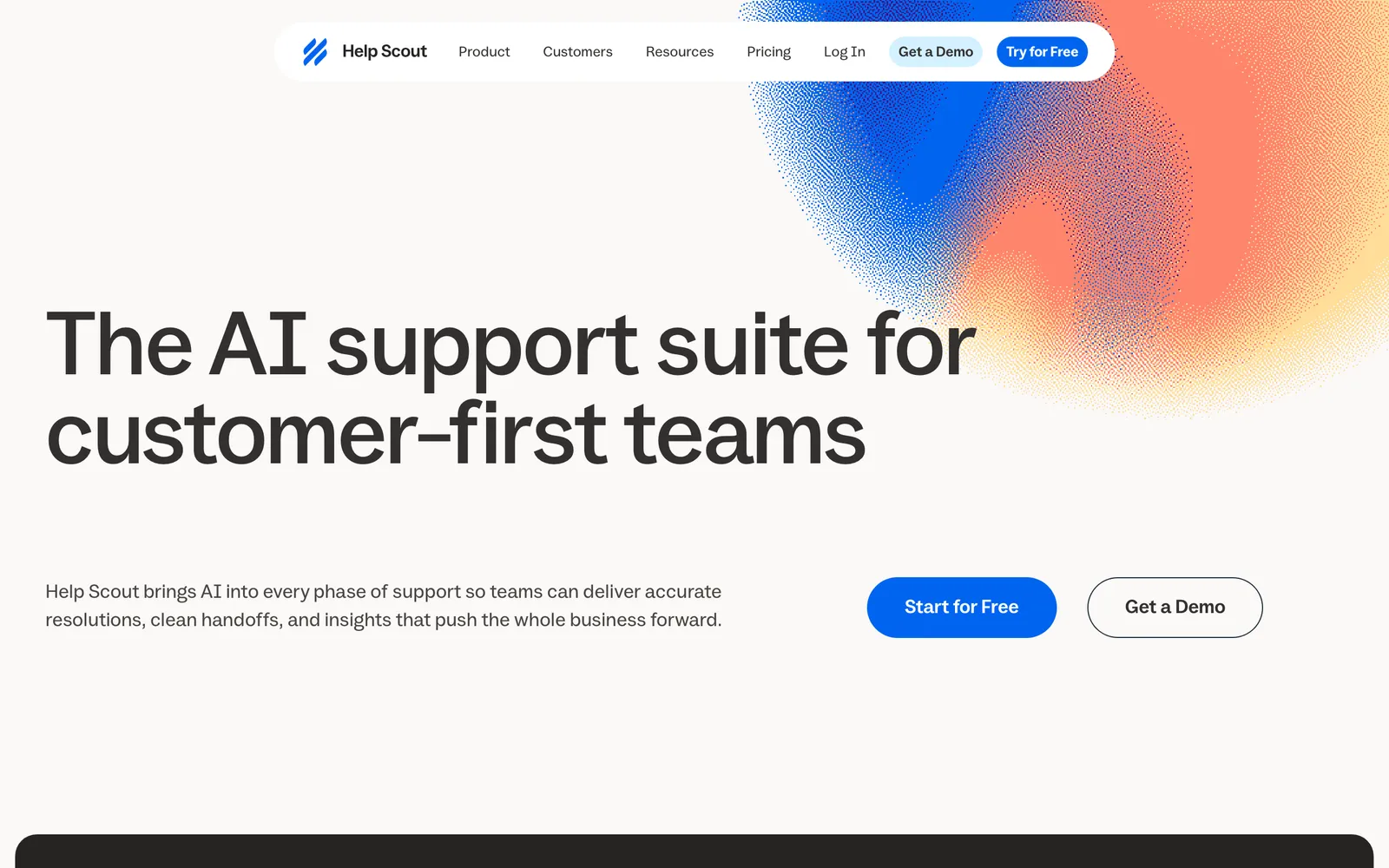
Help Scout is a people-first shared inbox for small and growing teams, with a free plan for 5 users and paid plans at $25, $45 and $75 per user a month (pricing, October 2026). Its AI agent, Scout, resolves 73% of requests on average, according to Help Scout (vendor-stated), at $0.75 per resolution.
For a store, check where actions live: human agents act on Shopify orders from the conversation sidebar, while Scout answers from your knowledge, with app connections marked “coming soon” as of October 2026. See Help Scout alternatives.
8. Front: best for collaborative operations inboxes
- Best for: teams that work in shared email across departments.
- Price as of October 2026: $25, $65 or $105 per seat a month billed annually, plus Autopilot from $0.05 per conversation.
- Keep or replace your help desk: replace Intercom.
- Verdict: a strong shared inbox that is open to external AI agents; confirm the Shopify actions you need.
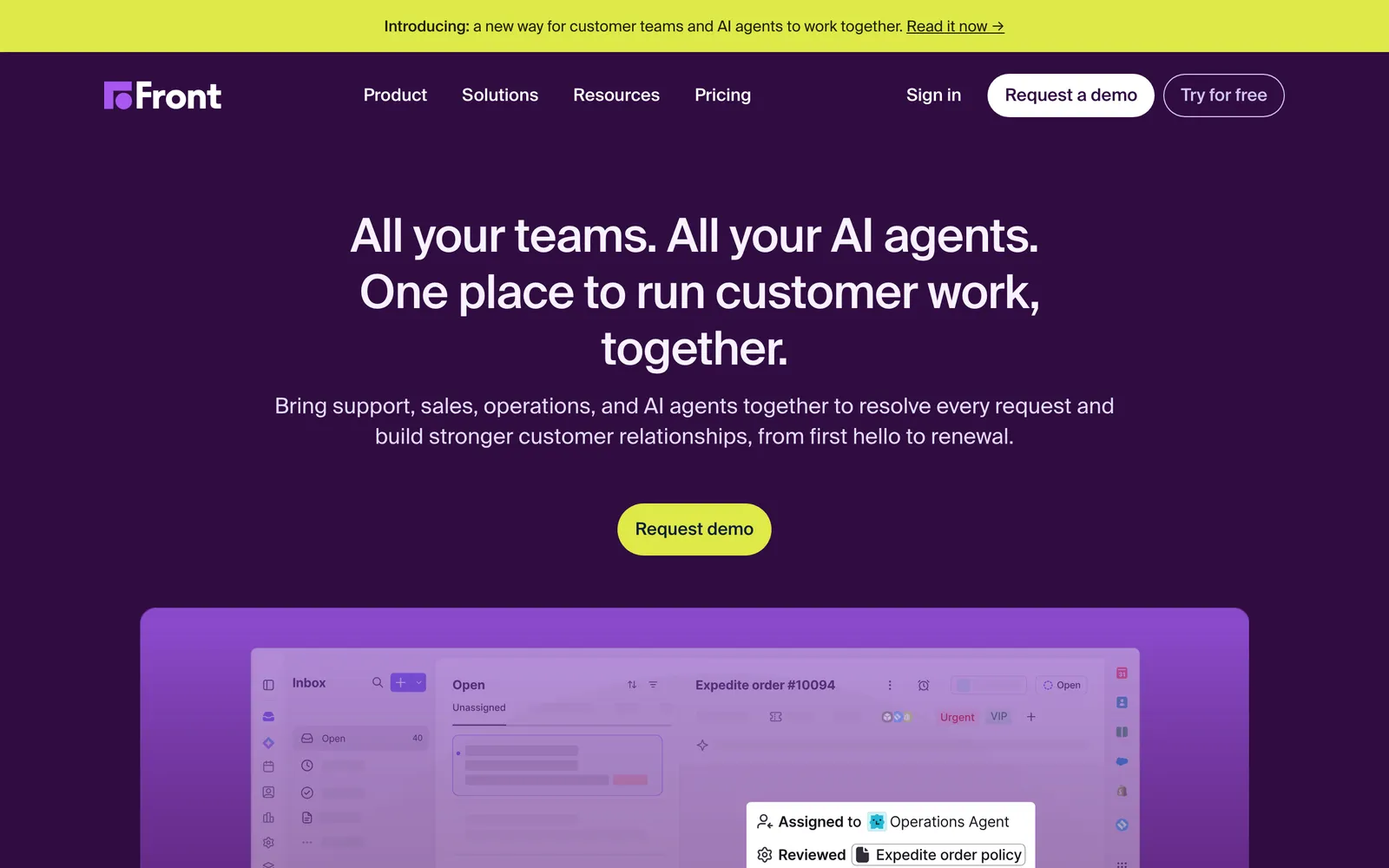
Front is a collaborative customer-operations inbox. Its Autopilot agent acts in your systems through Playbooks written in plain language, and Front says it “resolves up to 70% of requests” (Front, vendor-stated). Seats are $25, $65 or $105 a month billed annually (pricing), with Autopilot from $0.05 per conversation (October 2026).
Since 6 October 2026 you can bring an external AI agent into Front, so the inbox and the AI are separate choices. For a store, check depth: its Shopify integration is documented as displaying order data inside Front. See Front alternatives.
9. HubSpot Service Hub: best when HubSpot is already your CRM
- Best for: teams whose marketing and sales already run on HubSpot.
- Price as of October 2026: a free plan for up to 2 users; the Customer Agent runs on Professional or Enterprise seats and uses 50 HubSpot Credits per resolved conversation ($0.50 in HubSpot’s April 2026 announcement).
- Keep or replace your help desk: replace Intercom.
- Verdict: one customer record across teams; confirm the Shopify order actions before you move.
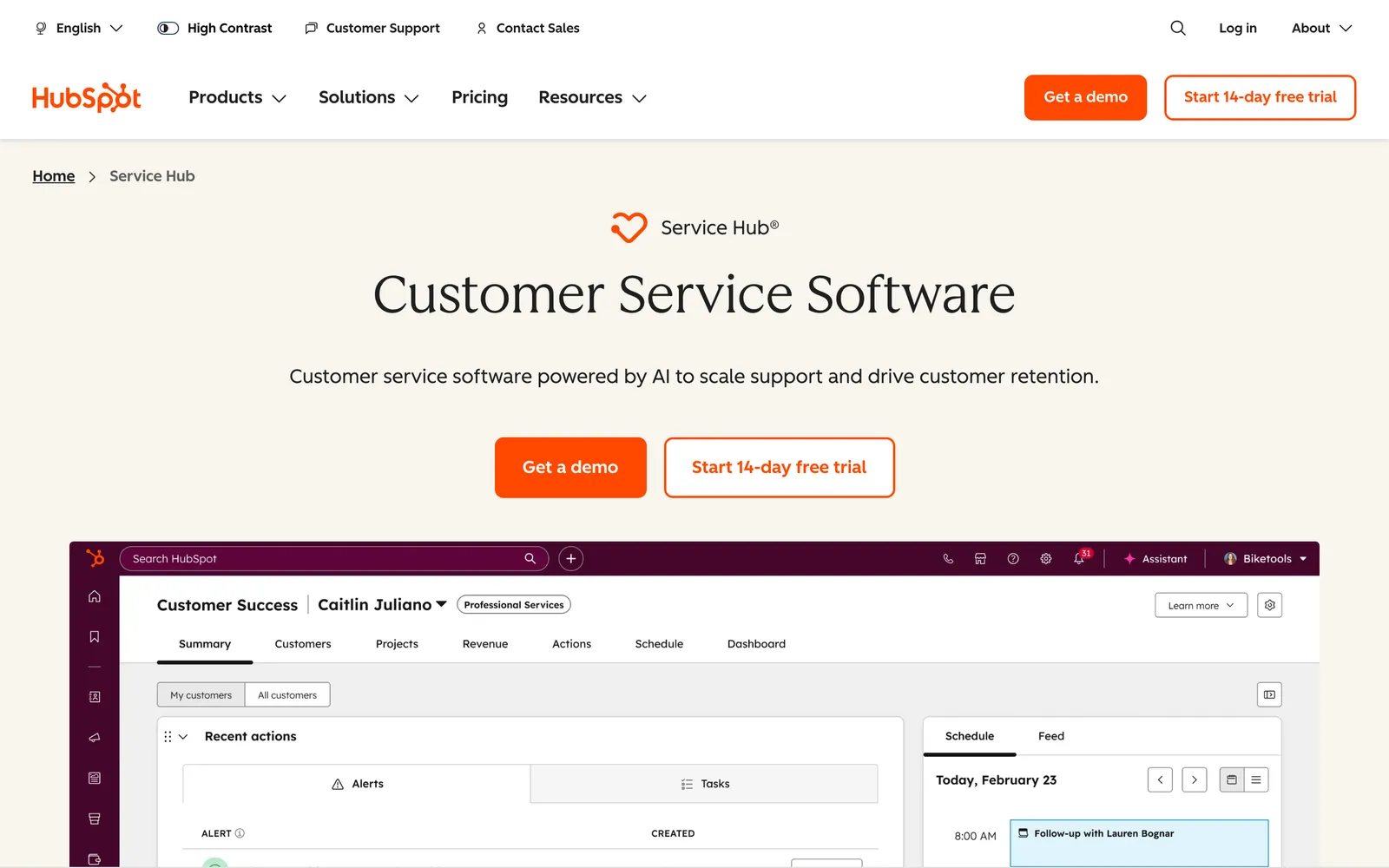
HubSpot Service Hub is the help desk on HubSpot’s CRM, so every ticket carries the full customer record from marketing and sales. Its pricing page lists a free plan for up to 2 users and funds the Customer Agent through HubSpot Credits (October 2026). Since 14 April 2026 the agent uses 50 credits per resolved conversation, which HubSpot’s announcement put at $0.50; HubSpot says it resolves 65% of conversations across more than 8,000 customers (HubSpot, vendor-stated).
It fits best when HubSpot is already your system of record. For a store, ask which Shopify actions the agent can take before you move; our HubSpot knowledge base guide covers what it answers from.
10. Kustomer: best for a single customer timeline
- Best for: brands whose problem is customer data spread across many tools.
- Price as of October 2026: no published prices; quote after an assessment.
- Keep or replace your help desk: replace Intercom.
- Verdict: a CRM model with AI across the timeline; its built-in Shopify tool reads only, and adopting it is a full migration.
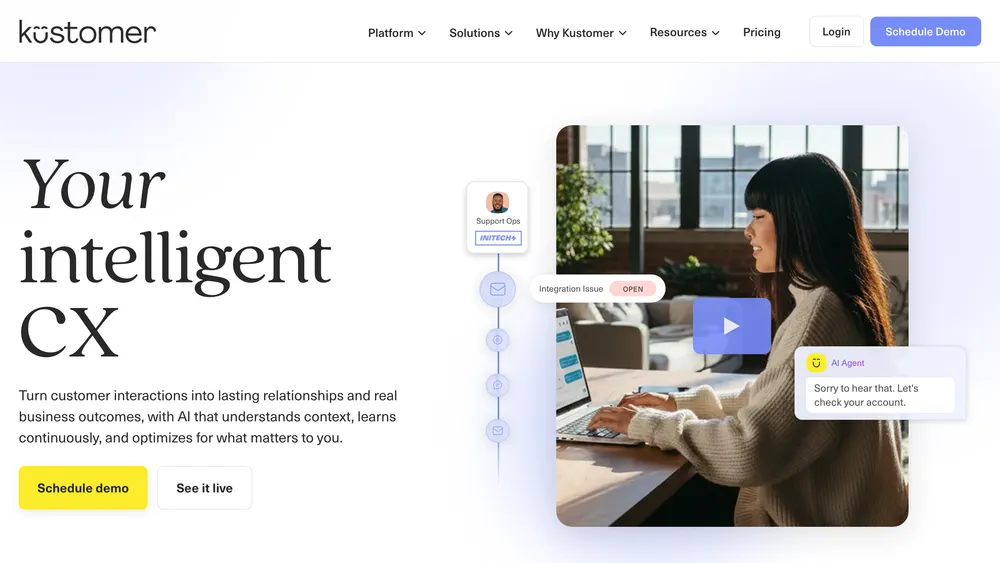
Kustomer replaces the help desk with a CRM model: order history, loyalty status and every conversation on one customer timeline, with AI agents that work across that data. It does not publish prices and builds a quote after an assessment (Kustomer, October 2026). Its AI’s built-in Shopify tool is documented as read-only, with writes built as custom tools (help centre, March 2026).
11. Decagon: best for enterprise teams building a custom AI programme
- Best for: large, cross-industry support organisations with a CX operations team to run the platform.
- Price as of October 2026: no published prices; sold through a demo.
- Keep or replace your help desk: keep Intercom; Decagon runs next to it.
- Verdict: a strong AI platform with a human-approved improvement loop; its integrations page names no commerce platform.
Decagon is an AI agent platform, not a help desk. Its integrations page names Intercom, Zendesk, Salesforce and Kustomer and promises to “connect seamlessly with your existing support stack”, and it names no commerce platform (October 2026). Its Duet Autopilot proposes fixes, tests each one, and needs human approval before production.
It is built for a heavier, different buyer than a scaling store, with procedures, simulations and QA programmes run by a dedicated team. See our Decagon guide. Sierra, the other enterprise AI platform, is in the table above as a row only; its Ghostwriter prepares improvements for review (25 March 2026), and Sierra states one healthcare customer went live seven weeks after kickoff (its own figure).
What does an Intercom alternative cost?
Two things: the licence model and the migration. Intercom charges help desk seats plus a fee per Fin outcome. Its pricing page lists Essential at $29 (shown at $19 for new customers), Advanced at $85 and Expert at $132 per seat a month on annual billing, with Fin at $0.99 per outcome on every plan (October 2026). Seat tables, what counts as a Fin outcome and worked examples by volume are in our Intercom pricing guide.
The alternatives use four models. Per outcome: Help Scout at $0.75, HubSpot at 50 credits ($0.50 as announced in April 2026) and Zendesk’s extra automated resolutions. Per conversation, session or AI interaction: Richpanel’s AI at about $0.20, Front’s Autopilot from $0.05, Freddy at $49 per 100 sessions after the first 500 and Gorgias at $0.90 to $1.00. Included allowances: LiveChat’s plans with 10 or 200 AI resolutions a month. Flat: Engaige, a monthly fee tied to your ticket volume. Kustomer and Decagon price by quote.
The honest comparison is total cost per resolved ticket: platform fee plus AI fee, divided by the tickets closed without a human. Each model suits a different volume and budgeting style, so none is wrong in itself. Run the number at today’s volume and at twice today’s volume, for every tool on your shortlist, Fin and ours included, then add the cost of leaving.
How hard is it to switch from Intercom?
It depends on the route. Replacing the AI doesn’t mean replacing your help desk: Engaige connects to the Intercom you run, so conversations, help articles and workflows stay put, and it is live in Agent Assist within hours. It can also start on a few ticket types you choose while Fin keeps handling the rest, so you compare both on your own tickets before switching over.
If you change help desk later, your Engaige setup comes with you: policies, actions and what Engaige AI has learned are reconnected on the new help desk, not rebuilt. Where a help desk migration is needed, Engaige helps with it, and your data stays yours to export.
If you do move away from Intercom, three steps make it smoother:
- Check the export early. Intercom’s conversation CSV export holds reporting metadata such as IDs, timestamps, attributes and metrics, and “Conversation/message content is not included”; full content comes through the Conversations API, and data is generally available for up to two years (help centre, October 2026).
- Rebuild, don’t copy. Workflows, Procedures, macros, help articles and integrations do not carry over one to one, so map each to the new tool and drop what you no longer use.
- Run in parallel. Keep Intercom live while the new help desk takes a share of traffic, then cut over channel by channel, ideally well before your renewal date.
If the reason you are leaving is the AI rather than the inbox, the lightest migration is none.
Which Intercom alternative fits your store?
Match the route to what sent you looking. If you like the Intercom inbox but want the AI to resolve order tickets, keep Intercom and replace Fin. If the inbox itself is the constraint, pick the help desk that fits how your team works.
| Your situation | Shortlist |
|---|---|
| Happy with the Intercom inbox, want the AI to resolve order tickets | Keep Intercom, add Engaige |
| Want to test a new AI next to Fin first | Engaige on chosen ticket types |
| Large multi-brand operation | Zendesk or Freshdesk |
| Most contacts arrive through website chat, and the chat should sell | LiveChat |
| Want a Shopify-first help desk | Gorgias or Richpanel |
| People-first small team | Help Scout |
| Collaborative operations inbox | Front |
| Marketing and sales already run on HubSpot | HubSpot Service Hub |
| Data spread across many tools | Kustomer |
| Enterprise team building a custom AI programme | Decagon or Sierra |
| Mostly SaaS onboarding and account questions | Outside our focus: Engaige is built for the store |
| Phone is a big share of contacts | A voice specialist, because Engaige is text-first by design |
Whichever route you take, pilot with your real ticket mix and measure end-to-end resolution, not deflection. For a wider shortlist of AI agents, see our AI agents guide. To see Engaige on your own Intercom tickets, book a demo.
Frequently asked questions
Who are Intercom’s main competitors?
As help desks: Zendesk, Freshdesk, LiveChat, Gorgias, Richpanel, Help Scout, Front, HubSpot Service Hub and Kustomer. As AI that works next to Intercom: Engaige, and Decagon and Sierra for enterprise teams. Which group matters depends on whether you want to replace the help desk or only the AI.
Can I keep Intercom and replace Fin?
Yes. Intercom stays your inbox, with its conversations, help articles and workflows, and Engaige takes over the AI work on store tickets. It can start on a few ticket types next to Fin, and that route needs no migration.
What is the best Intercom alternative for a Shopify store?
It depends on the route. Keep Intercom and add Engaige for native Shopify actions from live Admin API data, or move to Gorgias or Richpanel if the inbox itself is the problem. Run the five checks above on each candidate.
Does Fin take actions on Shopify orders?
Yes. Fin’s e-commerce page markets refunds, cancellations and address changes. Intercom documents Shopify templates that read orders, edit carts, quote refunds and issue gift cards, and pairs the refund quote with an existing Create Shopify Refund action that issues the refund. None of the documented templates cancels an order or changes an address, so those are data connectors you build (October 2026).
Is there a free Intercom alternative?
Help Scout has a free plan for 5 users and HubSpot Service Hub for up to 2 users, each with paid AI on top, and LiveChat offers a 14-day free trial (October 2026). For a store, the bigger cost is usually the tickets your team still handles, so compare total cost per resolved ticket.
Is there a cheaper alternative to Intercom?
It depends on your volume and what you count. Intercom charges $0.99 per Fin outcome on top of seats; per-outcome rates elsewhere include Help Scout at $0.75 and HubSpot at 50 credits ($0.50 as announced in April 2026), and LiveChat includes AI resolutions in its plans (October 2026). Compare total cost per resolved ticket, not the unit price.
Do I have to migrate to switch away from Intercom?
Only if you move help desk, which means conversations, help articles and workflows, and the CSV export leaves out message content. Replacing only the AI keeps everything in Intercom.
How is Engaige priced?
Engaige is a flat monthly fee tied to your ticket volume, predictable as you scale.