The best Front alternatives depend on what you are replacing. To swap the inbox, compare Gorgias, HubSpot Service Hub, Intercom, Zendesk, Freshdesk, Kustomer and Help Scout. To keep Front and replace only its AI, connect an e-commerce agent such as Engaige. Front itself answers “No” to “Do I have to use Front’s AI agent?”
This guide is for a store’s support lead weighing that choice. Front facts are as of October 2026, from its public pages, and Front’s figures are labelled vendor-stated. It sits alongside our e-commerce helpdesk guide, which explains what a store needs from a help desk in the first place.
Why do teams look for Front alternatives in 2026?
An online store’s support lead usually looks past Front for one of two reasons: a different inbox, or a different AI layer. The second does not require leaving Front, because since 6 October 2026 Front lets you bring your own AI agent. So “keep the inbox, replace the AI” is now a real option beside switching platforms.
Front is built for many kinds of customer work. Its homepage names Tech, Financial Services, Logistics, Manufacturing, Professional Services and Travel as industries, and lists no e-commerce industry (October 2026). Read that as horizontal rather than e-commerce-specialised, not as a weakness.
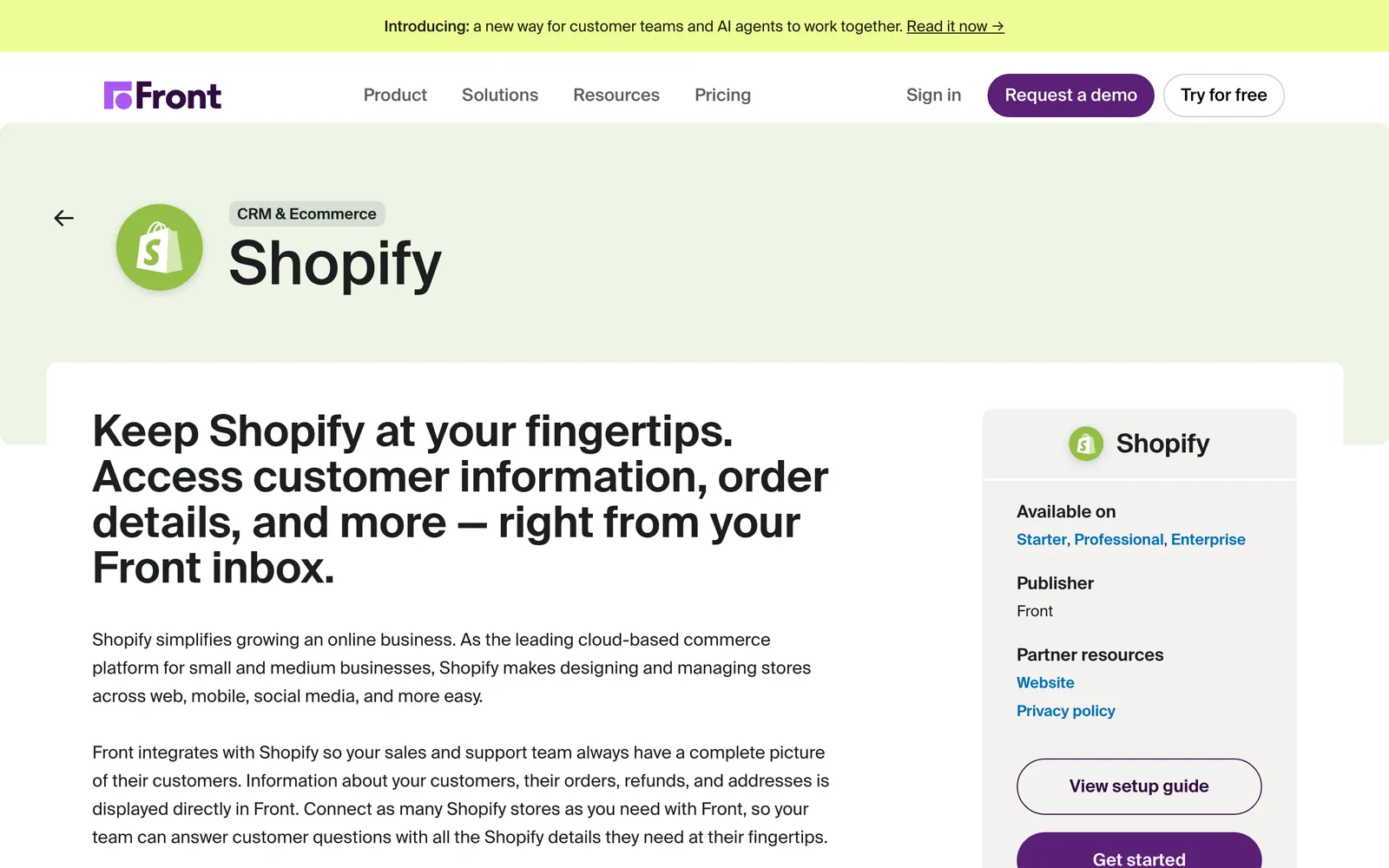
For a store, most tickets are order work: refunds, cancellations, address changes and discounts. Front’s Shopify integration is documented as displaying customer, order, refund and address information in Front, across as many stores as you connect. The page does not describe refunding or cancelling from Front.
Autopilot’s page describes actions “in your systems” without naming e-commerce ones. Treat that as documented, not as a limit, and ask in a demo.
What does Front do well?
Front is a well-regarded collaborative inbox. Autopilot acts with Playbooks and step visibility, and since 6 October 2026 External Agents lets you bring another AI agent. For many stores the question is the order-handling layer, not the inbox.
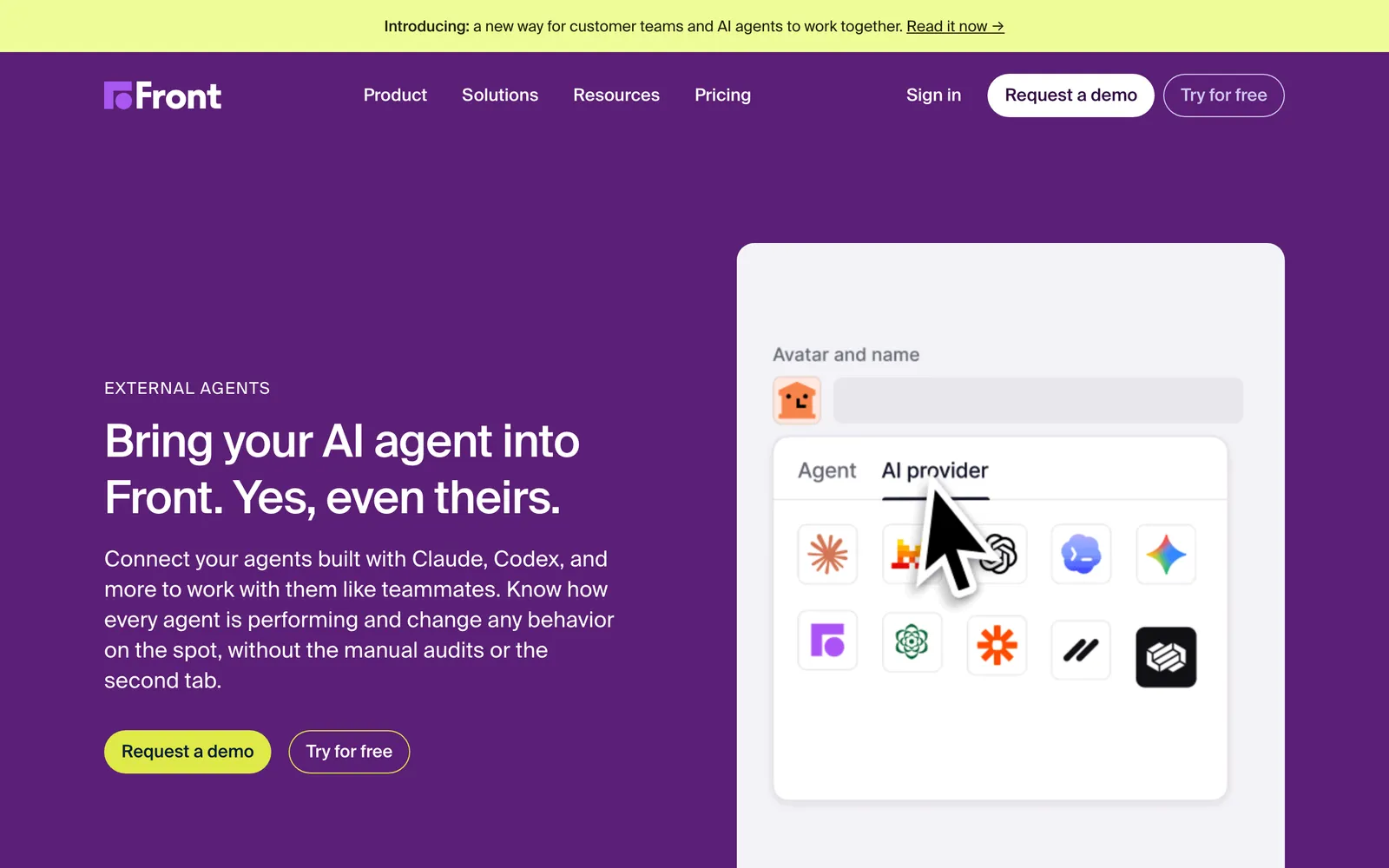
Front says over 9,300 businesses trust it and that Autopilot resolves up to 70% of requests (vendor-stated, October 2026). Per its Autopilot page, Autopilot takes action in your systems, so do not read it as a drafting tool only. It runs Playbooks: processes you describe once in plain language, with you defining when it acts, what it may do and when it escalates.
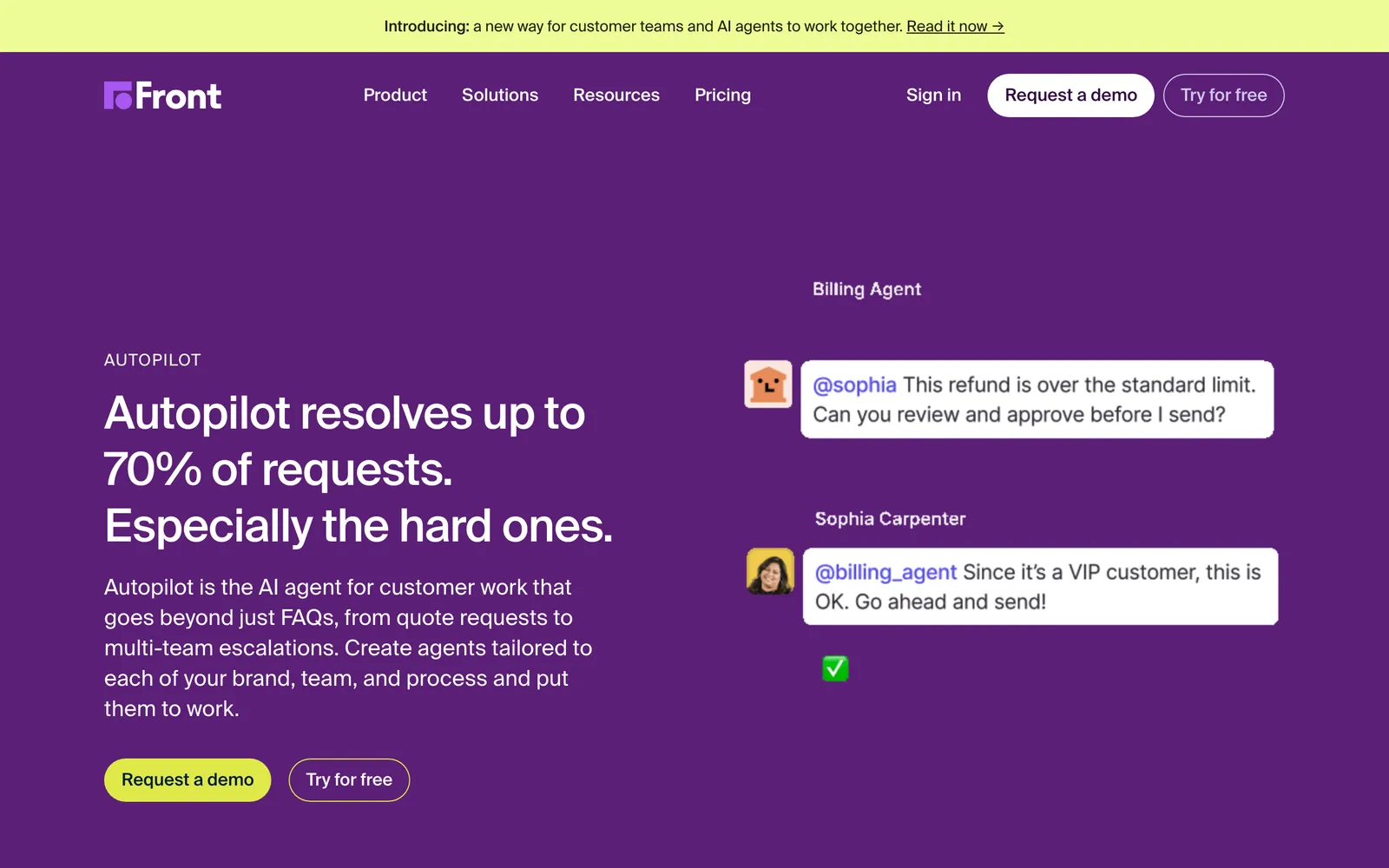
External Agents, launched on 6 October 2026, lets you connect agents built elsewhere. Front’s page says “Bring your AI agent into Front. Yes, even theirs.” Agents built with Claude, Codex, Decagon, Sierra and more can be assigned and @mentioned on tickets, and Front’s launch post describes Compass, which reviews every conversation Autopilot handles (October 2026).
To “Do I have to use Front’s AI agent?”, Front answers “No”. You can connect a preferred external agent and route each workflow to whichever agent performs best for it.
How should you evaluate a Front alternative?
Test any alternative on five checks, starting with whether you need a new inbox at all. Vendors change their products often, so each linked guide holds the current detail. Use the table as questions for your own demo with your own tickets, rather than as a scorecard.
| # | Check | What to ask | Why it matters for a store |
|---|---|---|---|
| 1 | Inbox or AI? | Do you need to leave Front, or only change the AI layer? | Front accepts external agents, so the inbox may not be the problem. |
| 2 | Ready-made e-commerce actions | Are refunds, cancellations, address changes and discounts switched on, or built by your team with Playbooks? | Most store tickets are order work, so check which actions come ready-made and which you build. |
| 3 | Control per step | Can each step run Automated or in Agent Assist, with thresholds such as refunds above a set amount going to a person first? | Refunds and discounts cost money, so you want a person where the risk is. |
| 4 | How it improves | Hand-written Playbooks, or an AI that learns from your team’s replies and proposes changes you approve? | A policy that never changes decays as your catalogue and rules do. |
| 5 | Shopify depth | Does it display order data, or read live Admin API data plus storefront content and act on it? | An answer about price, stock or an order is only as good as the data behind it. |
Check 1 decides whether you migrate. Checks 2 to 5 decide whether the AI resolves tickets or only sits beside them.
What are the best Front alternatives?
The best Front alternatives split into three groups. Keep Front and replace only the AI (Engaige). Move to an e-commerce help desk, Gorgias. Or move to another help desk with built-in AI: HubSpot Service Hub, Intercom, Zendesk, Freshdesk, Kustomer or Help Scout. Each has its own guide for detail.
Keep Front, replace the AI: Engaige (that’s us)
Engaige is the AI support agent that works inside the helpdesk your conversations land in, here Front. It replaces Front’s built-in AI, not the Front inbox, and Engaige AI configures and improves the agent. Engaige connects to Front through its Front integration and replaces the AI layer, so you keep Front as your inbox. At Otrium, Engaige resolves 60% of 120,000 annual tickets end to end.
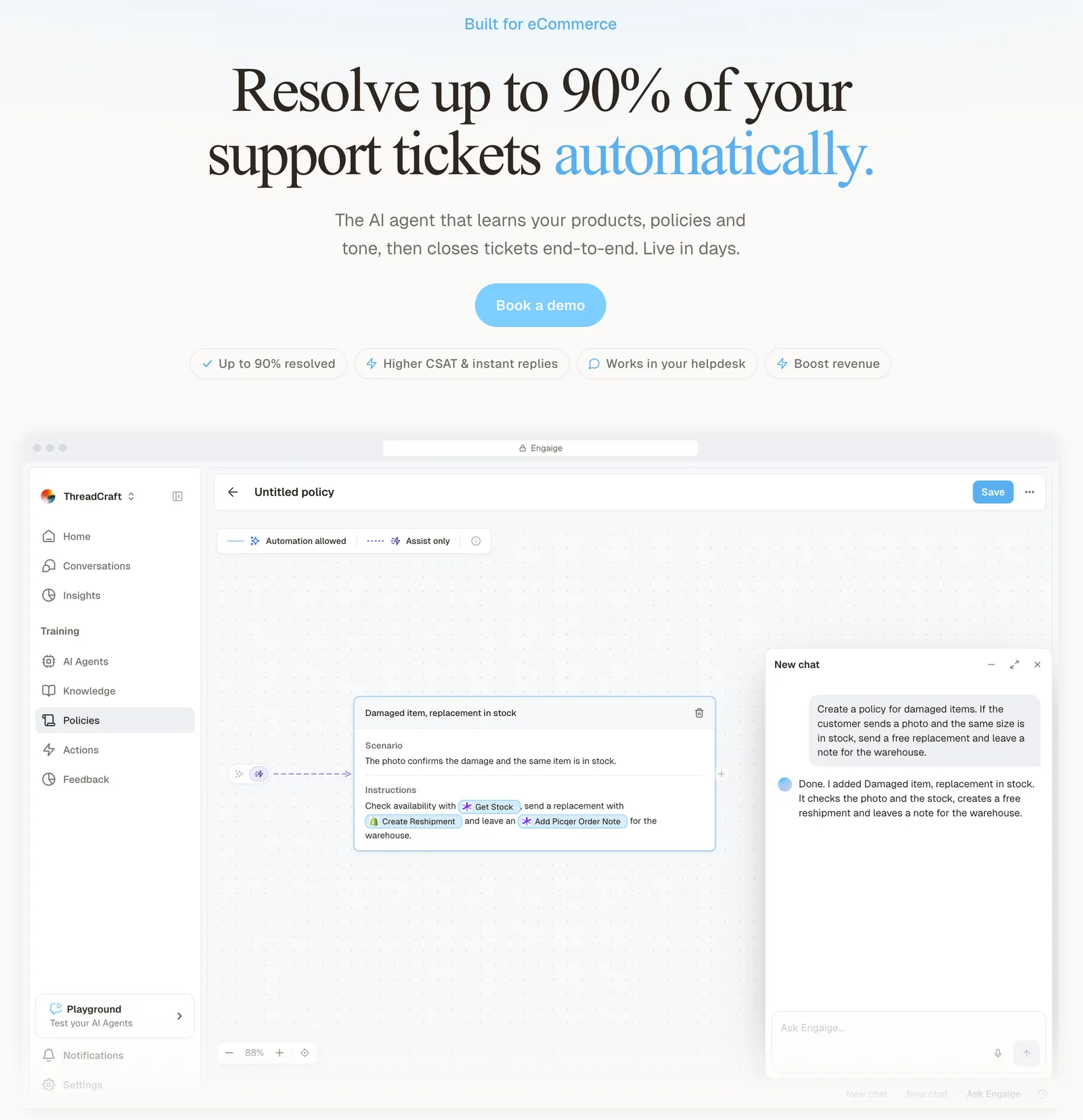
Engaige resolves tickets rather than suggesting: it takes the action in your systems (a refund, a cancellation, an address change), replies to the customer and closes the ticket.
The difference is control and ready-made actions. Engaige runs on 50+ native integrations whose vetted, plug-and-play actions (refunds, cancellations, address changes, discounts) you switch on rather than build. Front’s Playbooks are processes your team writes. Front’s Shopify integration is documented as displaying order data; Engaige is deepest on Shopify, combining live Admin API data with your storefront content.
You set what the agent may do alone. A policy is a set of plain-language steps, and each step runs Automated, where the agent acts on its own, or in Agent Assist, where it drafts for your team. You add thresholds, such as sending refunds above a set amount to a person first.
Scenario
The customer asks about a delivery address.
Instructions
Read the order with Get order , then take the branch that matches.
 Get order
Scenario
The order has not been picked yet.
Instructions
Move it with Change picqer shipping address .
 Change picqer shipping address
Scenario
The parcel has already left the warehouse.
Instructions
Say it cannot be redirected, then offer Process refund .
That is the control Otrium describes.
Engaige offered control, flexibility, and the ability to really incorporate AI in a more human way.

Open any conversation in Engaige and you see the full reasoning behind every answer and action. When the agent hands a ticket to your team, it leaves a summary of its reasoning as an internal note in the ticket. At MR MARVIS (Shopify Plus, over 120,000 questions a year), the team uses that reasoning to see where information is missing or unclear.
Engaige AI also improves the agent. In Agent Assist, every reply your team sends is compared with the agent’s suggestion, one of several signals Engaige AI learns from. It proposes what to change in a policy, with its reasoning, and you approve what goes live. You do not rewrite Playbooks by hand.
You go live in Agent Assist in hours. Most brands go fully autonomous in about a week; starting autonomous from day one is also supported. After go-live, HelloPrint has 80% of its tickets automated and a 90% faster first response.
Engaige proved to be invaluable. Their hands-on support during the implementation phase resulted in significant improvements to our automated resolution rate and CSAT.

Move to an e-commerce help desk
If the inbox itself is the problem and you want a help desk built around Shopify, this is the common destination.
Move to another help desk
For a help desk that serves many industries, these are the common destinations. Each line is a pointer, with detail on the page that owns it. If you mainly want live chat on your storefront, see our guide to Shopify live chat.
How do the alternatives compare at a glance?
The split is between replacing the inbox and replacing the AI layer. The table sorts each option by what it is and whether you keep Front. Vendors change their products often, so each linked guide holds the current detail.
| Option | Type | Keeps Front? | Read more |
|---|---|---|---|
| Engaige | AI agent for e-commerce support, works inside Front | Yes | Front integration |
| Gorgias | E-commerce help desk with built-in AI Agent | No | Gorgias guide |
| HubSpot Service Hub | CRM with built-in help desk and AI agent | No | HubSpot guide |
| Intercom | Support platform with the Fin AI agent | No | Intercom comparison |
| Zendesk | Help desk with built-in AI | No | Zendesk guide |
| Freshdesk | Help desk with Freddy AI | No | Freshdesk guide |
| Kustomer | Service platform with built-in AI | No | Kustomer integration |
| Help Scout | Shared-inbox help desk with built-in AI | No | Help Scout guide |
What does a Front alternative cost?
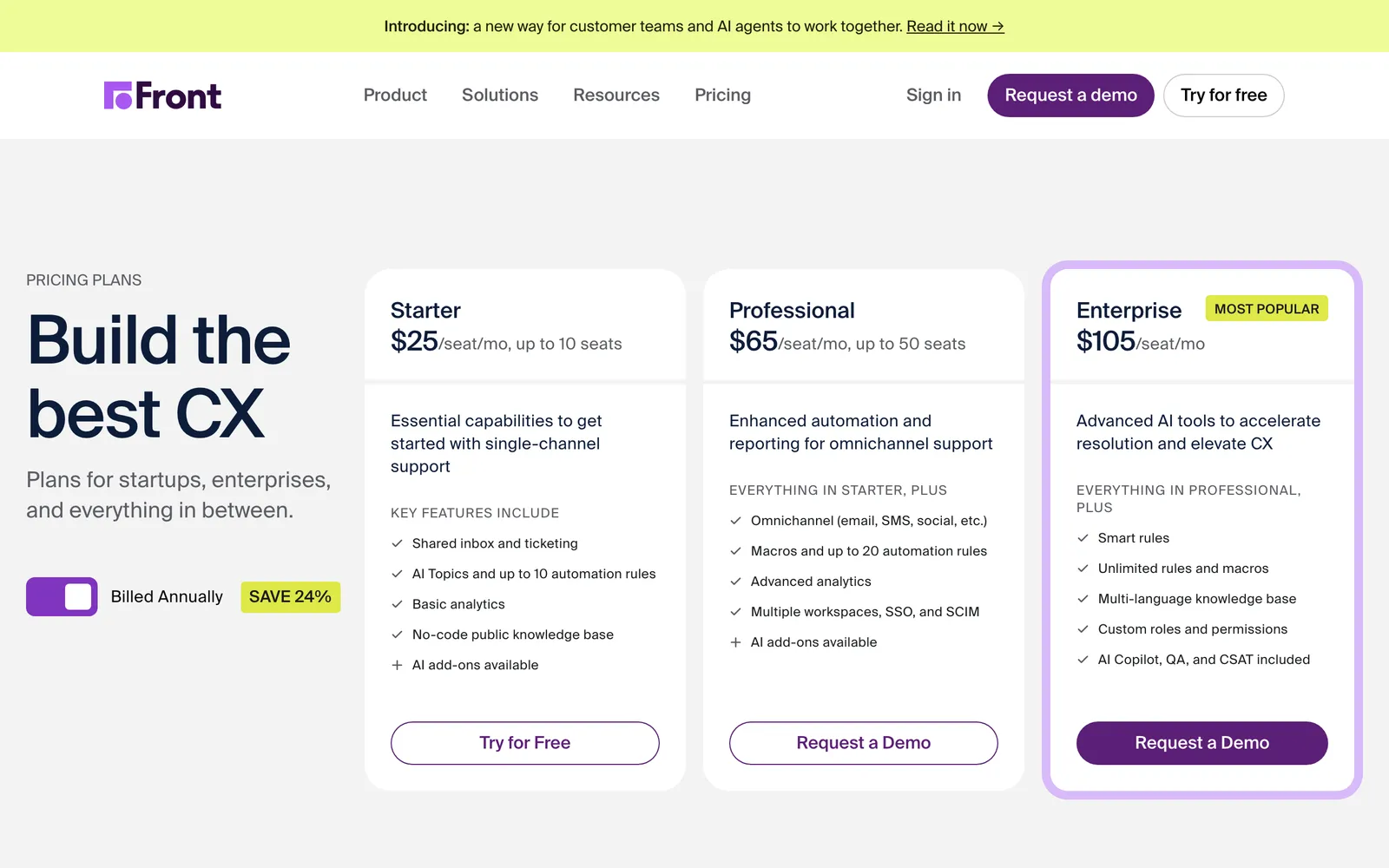
Front lists its plans per seat and Autopilot per conversation (vendor-stated, October 2026, billed annually). On its pricing page, Starter is $25, Professional $65 and Enterprise $105 per seat per month. Autopilot starts at $0.05 per conversation, and Copilot is $20 per seat per month on Starter and Professional, included in Enterprise.
Engaige is priced flat to your ticket volume, predictable as you scale. For the other vendors, prices sit on their linked guides, not here.
Which Front alternative fits your store?
Match the alternative to what sent you looking. If you like Front’s inbox and want the AI to handle order work, keep Front and replace the AI. If the inbox is the constraint, pick the help desk that matches how your team works.
- You like Front’s inbox and want the AI to handle order work: keep Front and add Engaige. To see it on your own tickets, book a demo.
- You want a help desk built around Shopify from the ground up: Gorgias.
- Your team already runs on HubSpot CRM: HubSpot Service Hub.
- Small team wanting a simple shared inbox: Help Scout.
- Large ticketing operation across many brands or channels: Zendesk.
Frequently asked questions
What is the best Front alternative for an online store?
It depends on what you are replacing. If the inbox works, keep Front and replace only the AI with an e-commerce agent such as Engaige. If the inbox is the problem, compare Gorgias, HubSpot Service Hub, Intercom, Zendesk, Freshdesk, Kustomer and Help Scout against the five checks above.
Can I keep Front and use a different AI agent?
Yes. Front answers “No” to “Do I have to use Front’s AI agent?”, and since 6 October 2026 its External Agents feature lets you connect agents built elsewhere.
Does Front integrate with Shopify?
Yes. Front’s Shopify integration is documented as showing customer, order, refund and address information inside Front, and it supports multiple stores. The documentation does not mention refunding, cancelling or editing orders from Front (October 2026).
How much does Front cost?
Front lists Starter at $25, Professional at $65 and Enterprise at $105 per seat per month billed annually, with Autopilot from $0.05 per conversation (vendor-stated, October 2026). Check the current pricing page, because plans and add-ons change.
Do I have to migrate my conversations to switch the AI in Front?
No. You keep Front as your inbox, so your conversations stay where they are and only the AI layer changes. If you decide the inbox is the problem instead, each alternative above has its own guide for what a move involves.