The best Decagon alternatives for an e-commerce brand in 2026 are Engaige, Intercom Fin, Sierra, Ada, Siena and Yuma, which run on top of the help desk you already use, as Decagon does, or the AI built into Zendesk, Gorgias, Kustomer and Richpanel if you would rather run one platform. Decagon AI competitors split the same two ways; which fits depends on your ticket mix and who runs the agent.
How do Decagon AI competitors compare at a glance?
Prices in US dollars as published on the vendors’ own sites on 26 October 2026, except Zendesk’s resolution fees, which come from its US pricing page as checked on 21 October 2026 (zendesk.com now redirects us to a local site); figures are vendor-stated unless marked.
| # | Tool | What it is | Your help desk | Headline figure (vendor-stated) | Price (October 2026) |
|---|---|---|---|---|---|
| Decagon (baseline) | AI agent platform for voice, chat and email | Runs alongside it; names Zendesk, Intercom, Salesforce, Kustomer | Chime: 70% chat and voice resolution | No published prices | |
| 1 | Engaige | E-commerce AI support agent, text channels | Keep it: Zendesk, Gorgias, Intercom, Kustomer and more | MR MARVIS 60%+, Otrium 60%, HelloPrint 80% (case studies) | Flat monthly fee by ticket volume |
| 2 | Intercom Fin | AI agent that also runs on other help desks | Keep it, or move to Intercom | 76% average across 12,000+ customers | $0.99 per outcome, 50 a month minimum |
| 3 | Sierra | Enterprise conversational AI platform | Runs alongside it | No figure on its homepage | Outcome-based; no published prices |
| 4 | Ada | Enterprise agentic CX platform | Runs alongside it; hands off to Gorgias, Kustomer, Zendesk | 84% automated resolution | No published prices |
| 5 | Siena | AI CX platform for consumer brands | Keep it, or use the one Siena includes | Named 36% to 80% | $750 a month + $0.90 per automated ticket |
| 6 | Yuma | AI agents for e-commerce | Keep it: Gorgias, Zendesk, Kustomer and more | Up to 89% | Full resolutions only; from $14,400 a year |
| 7 | Zendesk AI agents | Help desk with built-in AI, Forethought included | Zendesk | Up to 80% of interactions | Per agent + $1.50 to $2.00 per extra resolution |
| 8 | Gorgias AI Agent | E-commerce help desk with built-in AI | Gorgias | 60% headline; Orthofeet 56% | $10 to $900 a month + $0.90 to $1.00 per AI interaction |
| 9 | Kustomer | CRM-based service platform with AI agents | Kustomer | No public rate | No published prices |
| 10 | Richpanel | E-commerce help desk with built-in AI | Richpanel | High rates marketed | $99 per seat + about $0.20 per AI conversation |
This guide is for the support lead at an online store who has Decagon on a shortlist, or runs it today. If you first want Decagon itself explained, read our Decagon guide. A fair word on our own row: our numbers are named case studies you can open, MR MARVIS, Otrium and HelloPrint, and every vendor figure in this table, ours included, deserves the same questions.
Why do teams look for Decagon alternatives?
Rarely because Decagon lacks capability. For an e-commerce brand, three questions come up: who the platform is built for, how deep it goes into the store, and who on your side does the work of running it.
The buyer question. Decagon sells to large consumer and tech brands across financial services, travel, health, technology, retail, telecoms and media. Its tooling (experiments, golden test sets, always-on QA) is aimed at teams with a CX operations function. A scaling online store may simply be a different buyer.
The depth question. Decagon’s integrations page names help desks, CRMs, knowledge bases and contact-centre tools, and no commerce platform (October 2026); a 2025 Decagon retail post says its agents integrate with platforms like Shopify. It has direct-to-consumer customers such as Oura and Curology, so ask how it reaches your order, return and subscription systems.
The operating question. Decagon’s AOP page describes procedures that combine “the flexibility of natural language with the reliability of code”, and its own post says engineers add code-level controls for critical operations. Ask every vendor who on your team will change the agent, and how.
What does Decagon still do well?
A lot. Decagon is an AI agent platform for voice, chat and email, built on natural-language Agent Operating Procedures (AOPs). It runs alongside your help desk, CRM and contact centre rather than replacing them.

Its improvement loop is real and visible. Duet Autopilot reads production conversations, proposes a fix, validates it against the original conversation and a golden test set, and shows the exact diff; Decagon’s Autopilot post (9 June 2026) states that every change “requires human approval before it reaches production”. Trace View shows which steps ran per turn, and simulations and Watchtower test and monitor behaviour.
Its proof is large-brand: the Decagon homepage names Chime at 70% chat and voice resolution, Duolingo at an 80% deflection rate and Curology at a 65% reduction in costs, all vendor-stated. Voice is a core channel, which suits contact-centre-heavy brands.
How should you evaluate a Decagon alternative?
Six checks separate a better fit from a sideways move. Ask each one in a demo, with your own tickets.
| # | Check | What to ask in a demo |
|---|---|---|
| 1 | Time to value | How long until it handles real tickets, and until a ticket type runs on its own? |
| 2 | Who runs it | Does your support team change the agent in plain language, or do engineers own part of the logic? |
| 3 | Store actions | Can it complete the refund, cancellation or address change itself, and are those actions shipped or built by your team? |
| 4 | Live data from several systems | Does one answer combine the order, the carrier event, the return and the subscription? |
| 5 | How it learns | Learns from what, from when, and who approves the change before it goes live? |
| 6 | Cost per resolved ticket | What does a resolved ticket cost at today’s volume and at twice today’s volume? |
A practical shortcut for checks three and four: give every candidate three of your hardest recent tickets, a WISMO case with a stuck parcel, a part-refund and a damaged item that needs a replacement. Whether it completes those, rather than handing them over, predicts your real resolution rate better than a scripted demo.
What are the best Decagon alternatives?
The best Decagon alternatives in 2026 are Engaige, Intercom Fin, Sierra, Ada, Siena and Yuma if you want an agent on top of the help desk you run, and Zendesk AI agents, Gorgias AI Agent, Kustomer or Richpanel if you would rather have the AI built into your help desk.
Entries 1 to 6 work alongside or inside your current help desk, like Decagon, so tickets, macros and history stay where they are. Entries 7 to 10 are help desks with their own AI: the natural pick if you already run that help desk, a migration if you do not.
1. Engaige: best for e-commerce brands that want to be live in hours
- Best for: scaling online stores whose queue is mostly orders, returns, subscriptions and product questions.
- Price as of October 2026: a flat monthly fee tied to your ticket volume.
- Keep or replace your help desk: keep it.
- Verdict: live in Agent Assist within hours, set up and tuned by Engaige AI in plain language, and deep on the store systems a brand runs.
Engaige (that’s us) is the e-commerce AI support agent that works inside the help desk you already run and replaces its AI, never the help desk itself. Engaige AI configures and improves it from plain-language briefs. At Otrium, Engaige resolves 60% of 120,000 annual tickets end to end.
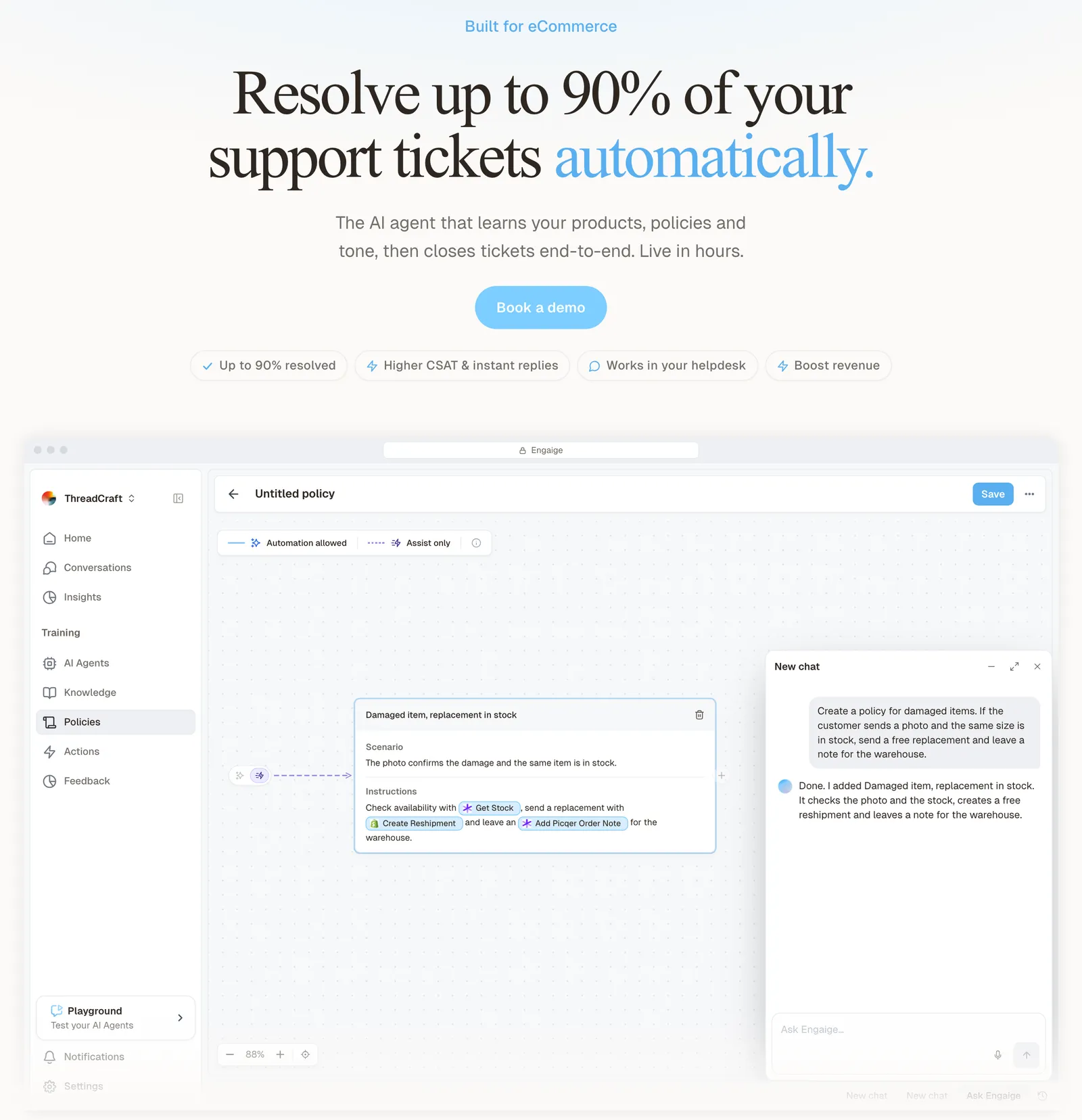
The first difference with Decagon is speed for a scaling brand. Engaige connects to the help desk you run, including Zendesk, Intercom, Salesforce and Kustomer, all four named on Decagon’s integrations page too. You go live in Agent Assist within hours, and most brands are autonomous in about a week, one ticket type at a time.
The second is who does the work. You brief Engaige AI in plain language, and it drafts your first policies from the integrations you enable and tunes them for you, so your support team runs the agent without a CX operations programme or code-level controls to maintain.
The third is depth on the store. On Shopify, Engaige combines live Admin API data, pricing across markets and SKUs, inventory, orders and customers, with the marketing content from your storefront (Shopify integration). It runs on 50+ native integrations with vetted, plug-and-play actions (refunds, cancellations, address changes and discounts), covers WooCommerce, Magento and BigCommerce, and connects to any system you run.
On learning, Decagon is strong too: Duet Autopilot proposes changes a human approves. The difference is the mechanism. In Agent Assist, every reply your team sends is compared with what the agent suggested, from day one; that is one of the signals Engaige AI learns from, alongside conversations, hand-offs and trends. It proposes changes with its reasoning, and you approve what goes live.
You set the limits. Policies can carry thresholds, such as sending refunds above a set amount to a person first, and each step runs Automated or in Agent Assist. You test policies in the Playground before they go live, for example by pasting in a past ticket. Full reasoning for every answer and action sits in the Engaige dashboard, and a hand-over leaves a reasoning summary as an internal note in the ticket.
Engaige offered control, flexibility, and the ability to really incorporate AI in a more human way.

At MR MARVIS, Engaige resolves over 60% of the conversations it’s involved in, and HelloPrint automated 80% of support.
2. Intercom Fin: best for a mix of store and account questions
- Best for: teams whose queue is as much account and product questions as orders.
- Price as of October 2026: $0.99 per outcome, with a 50-outcome monthly minimum.
- Keep or replace your help desk: keep it on a supported help desk, or move to Intercom.
- Verdict: a capable horizontal agent with self-serve pricing; store actions beyond its Shopify templates are connectors you build.
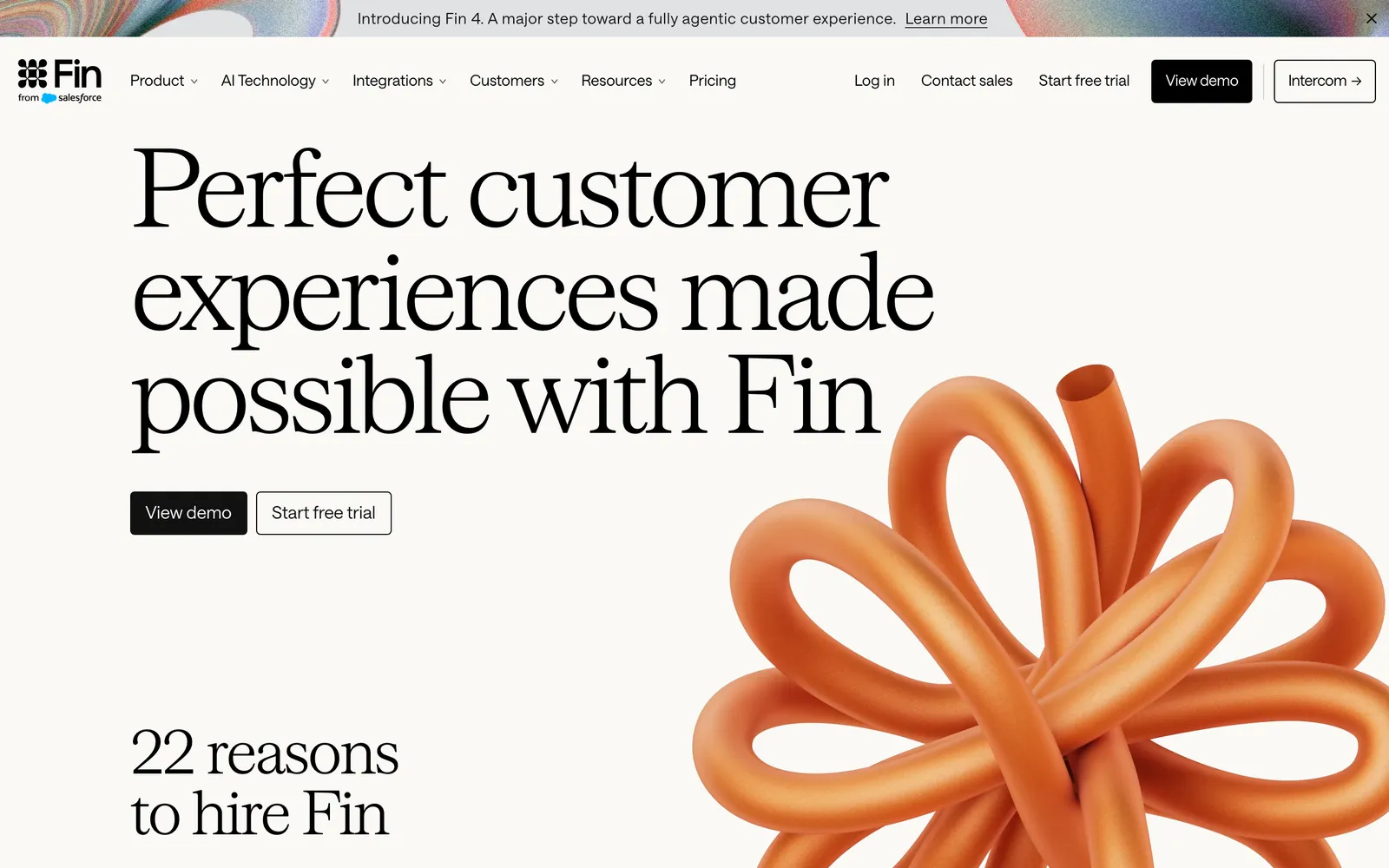
Fin is Intercom’s AI agent, and it runs on help desks other than Intercom’s own: its pricing page lists Salesforce, HubSpot, Front, Freshworks and Gorgias among others, at $0.99 per outcome with a 50-outcome monthly minimum (October 2026). It states a 76% average resolution rate across 12,000+ customers (vendor-stated) and lists voice among its channels.
Fin acts through Procedures written in natural language, with a “Loop in teammate” step that pauses for human approval, and Fin Operator proposes changes as reviewable diffs. The catch for a store: Intercom documents Shopify templates for order info and cart updates, so other store actions are connectors you build. Our Fin guide covers the product, and our Intercom comparison sets it next to Engaige.
3. Sierra: best for the largest enterprises on many channels
- Best for: very large brands that want one agent across chat, SMS, WhatsApp, email, voice and ChatGPT.
- Price as of October 2026: outcome-based; no published prices.
- Keep or replace your help desk: runs alongside it.
- Verdict: the leading enterprise name in conversational AI, open about how its agents behave; a heavier, different buyer from a scaling online store.
Sierra is the closest like-for-like Decagon competitor: a cross-industry conversational AI platform for large enterprises. Agents follow Journeys written in natural language, Agent Traces show each decision and tool call, and Ghostwriter analyses real interactions and prepares validated changes for your team to review. Its homepage says you “only pay for the value Sierra delivers with outcome-based pricing”, with no rates published (October 2026).
Its retail logos include Gap Inc. and Wayfair. For a scaling store, check the project shape: Sierra itself cites a major healthcare customer going live seven weeks after kickoff, and we found no Shopify connector on sierra.ai, while its retail page names no commerce-platform integration (October 2026). Our agent ranking scores Sierra and Decagon side by side.
4. Ada: best for global enterprises with many languages
- Best for: large service organisations that run AI agents across voice, messaging and email in many languages.
- Price as of October 2026: no published prices; quoted after a demo.
- Keep or replace your help desk: runs alongside it.
- Verdict: mature and large-scale, with recognisable e-commerce customers; built for teams that run AI management as an in-house discipline.
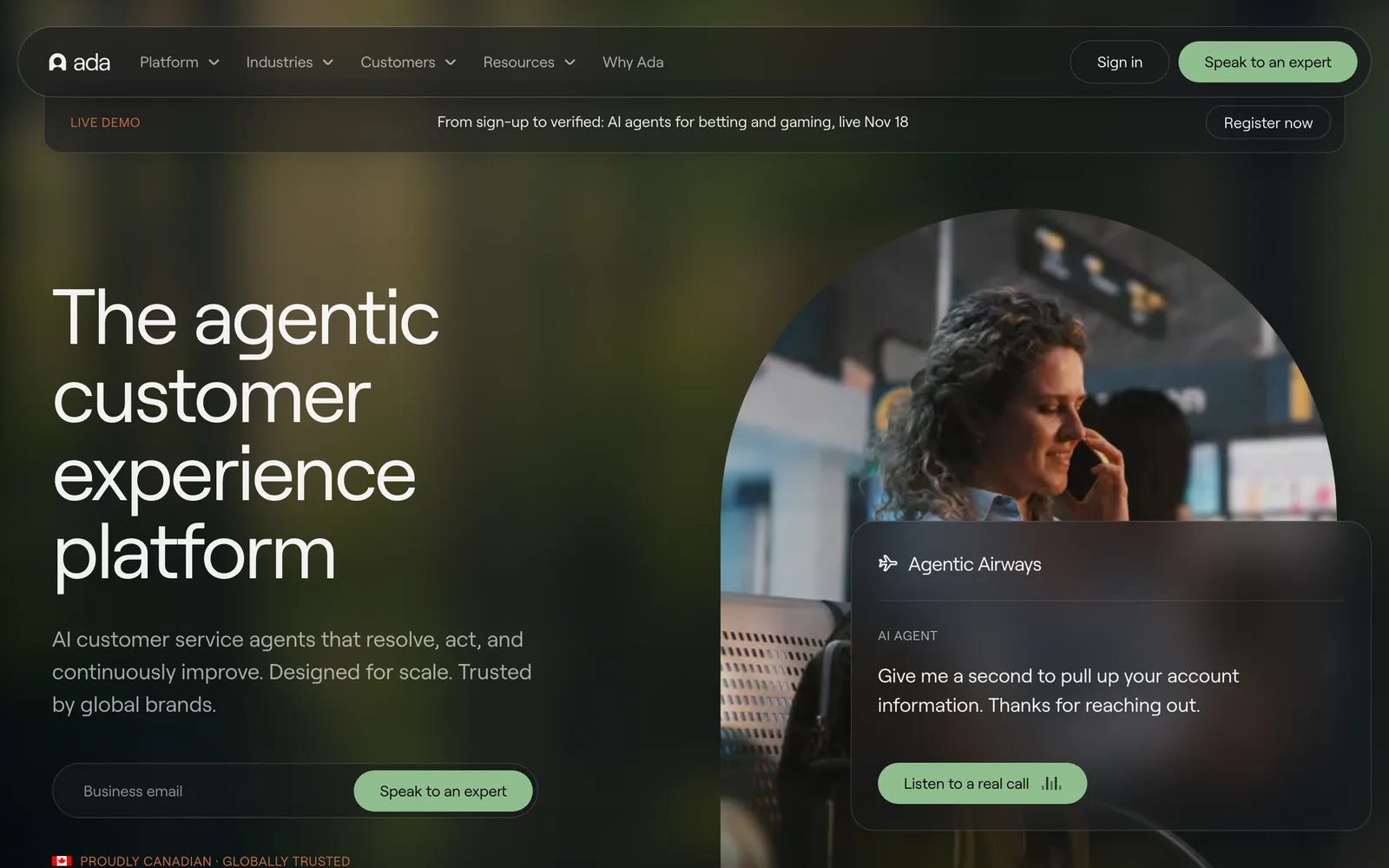
Ada is an agentic customer-experience platform, founded in 2016, that runs alongside your help desk and hands off to Gorgias, Kustomer, Zendesk and others. Its homepage states an 84% automated resolution rate (vendor-stated), and its e-commerce customers include IPSY, iHerb and Simba Sleep. A reasoning log shows the knowledge searches, actions and processes behind each answer.
Ada recommends that enterprises treat AI agent management as a core competency they build in-house, and coaching on past conversations is applied automatically. For a store, check depth: its integrations page lists no commerce platform, while its e-commerce page says it integrates with Shopify (October 2026). See our Ada comparison.
5. Siena: best for consumer brands that want actions in one flow
- Best for: consumer brands that want refunds, labels and replacements handled in a single flow.
- Price as of October 2026: $750 a month plus $0.90 per automated ticket.
- Keep or replace your help desk: keep it, or use the help desk Siena now includes.
- Verdict: an e-commerce specialist with strong DTC proof; we found no approval step for the changes it learns.
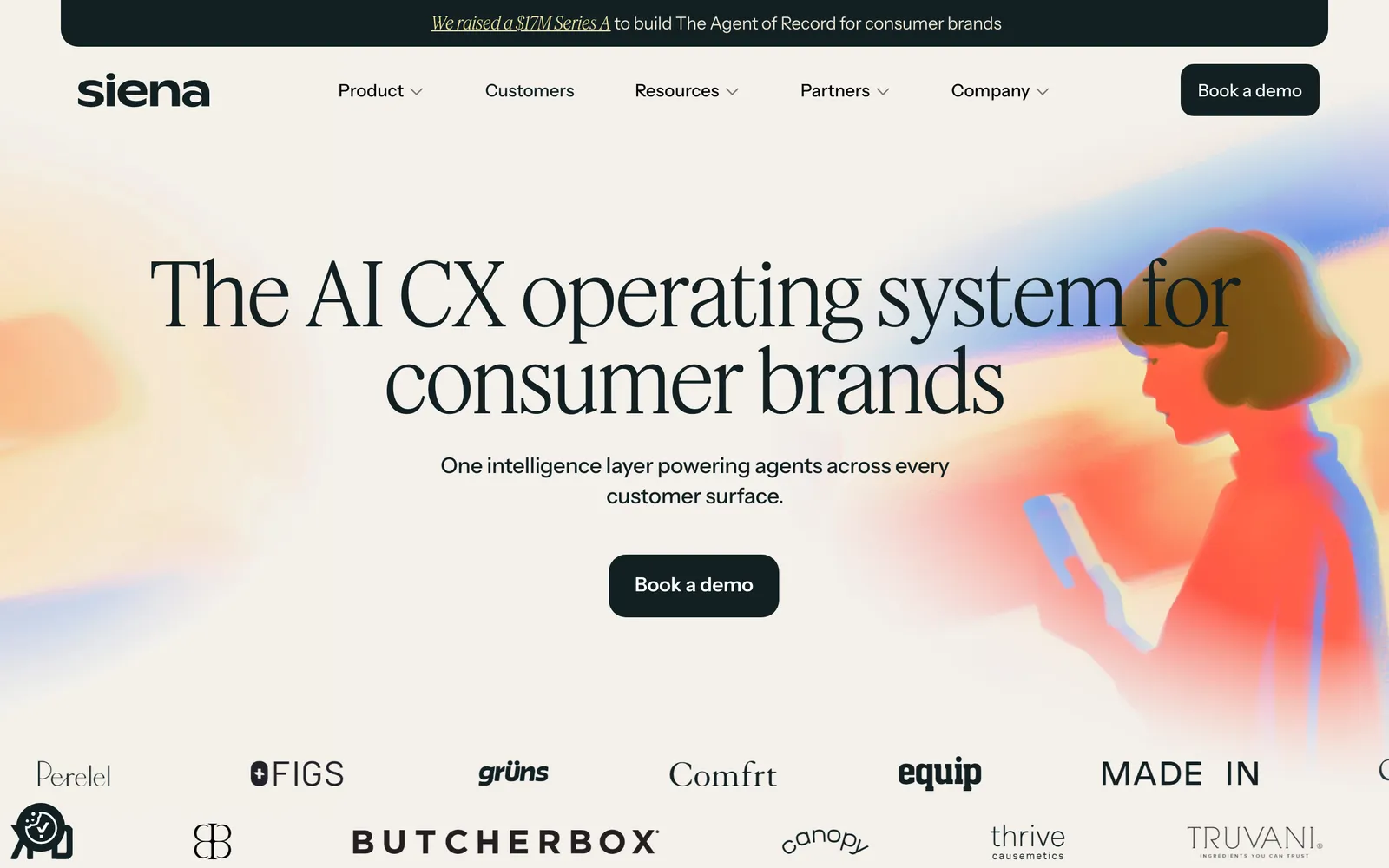
Siena is an e-commerce AI platform with agents for support, shopping, social and reviews that act, issuing refunds, generating labels and sending replacements in a single flow. It runs on existing help desks, and since its October 2026 Series A it says “the help desk is included”. Its customers page names automation rates from over 36% (Canopy) to 80% (Bad Birdie, True Sea Moss), vendor-stated.
Pricing is a $750 monthly platform fee plus $0.90 per automated ticket, per its pricing page (October 2026). The difference with Engaige is how each improves: we found no Siena description of an approval step for the changes it learns, while Engaige AI proposes each change with its reasoning for you to approve. Our Siena guide goes further.
6. Yuma: best for paying only for full resolutions
- Best for: e-commerce brands that want outcome-based billing on a yearly commitment.
- Price as of October 2026: from $14,400 a year for 12,000 resolutions (illustrative bundles).
- Keep or replace your help desk: keep it.
- Verdict: acts inside your help desk and now answers phone calls too; it learns from your team’s edits automatically, with no review step described.
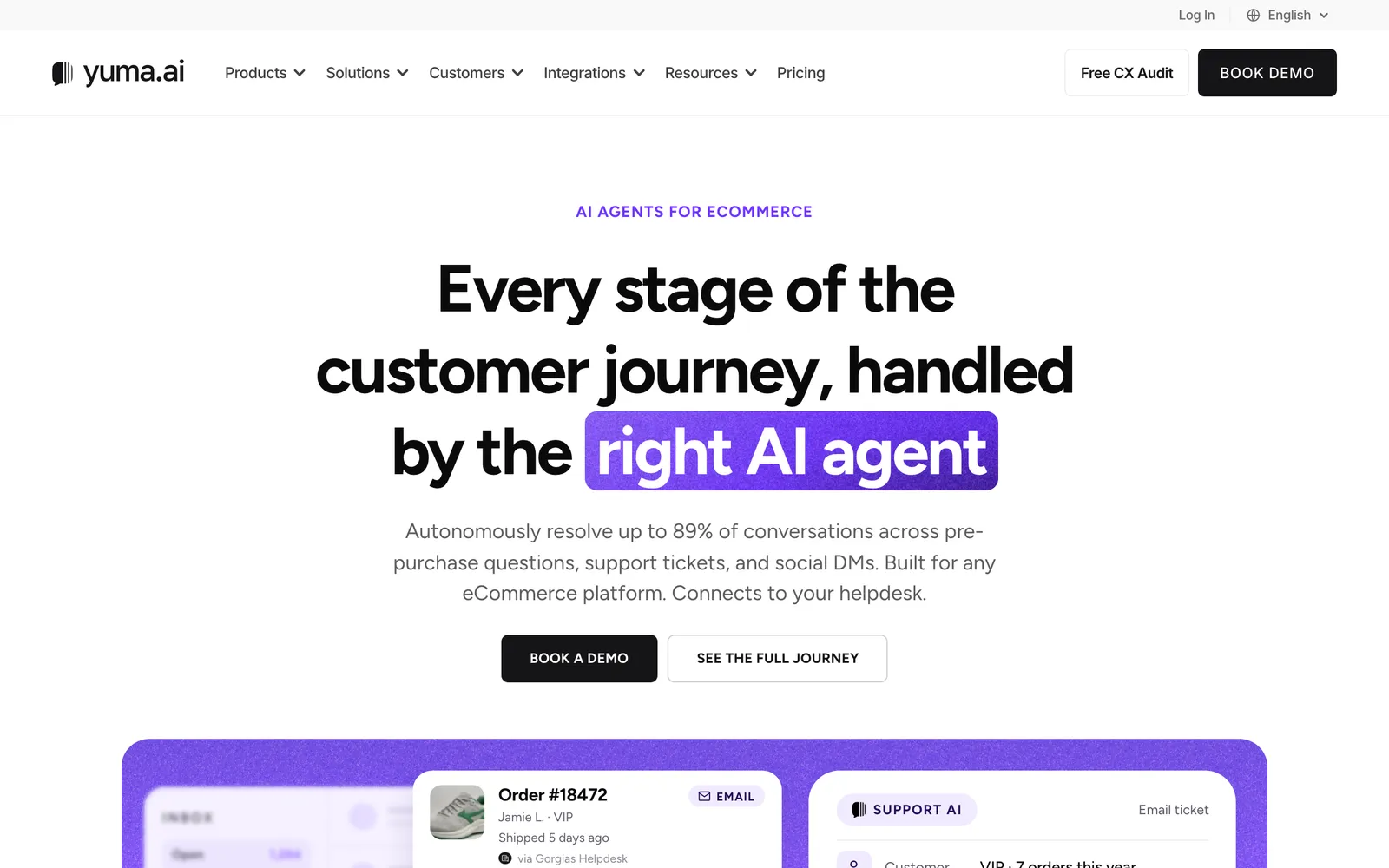
Yuma is an AI agent for e-commerce brands that installs on top of your help desk, with Gorgias, Zendesk, Kustomer and Front among those its FAQ lists, and takes actions such as refunds, reships and subscription edits. Its homepage claims “up to 89%” autonomous resolution (vendor-stated), and it launched voice in the third quarter of 2026.
Its pricing page bills only for full resolutions, with illustrative annual bundles from $14,400 for 12,000 resolutions on a 12-month commitment (October 2026). The difference with Engaige is how each learns: Yuma absorbs your team’s edits into future replies automatically, while Engaige AI proposes each change with its reasoning for you to approve. See our Yuma guide.
7. Zendesk AI agents: best if you run Zendesk and want one vendor
- Best for: large teams already on Zendesk that want routing, QA and AI from one vendor.
- Price as of October 2026: per-agent plans, with an allowance of automated resolutions and extra ones at $1.50 committed or $2.00 pay as you go.
- Keep or replace your help desk: keep Zendesk; for anyone else, a migration.
- Verdict: proven and broad, with self-improving agents since Forethought; store actions run through action flows you configure.
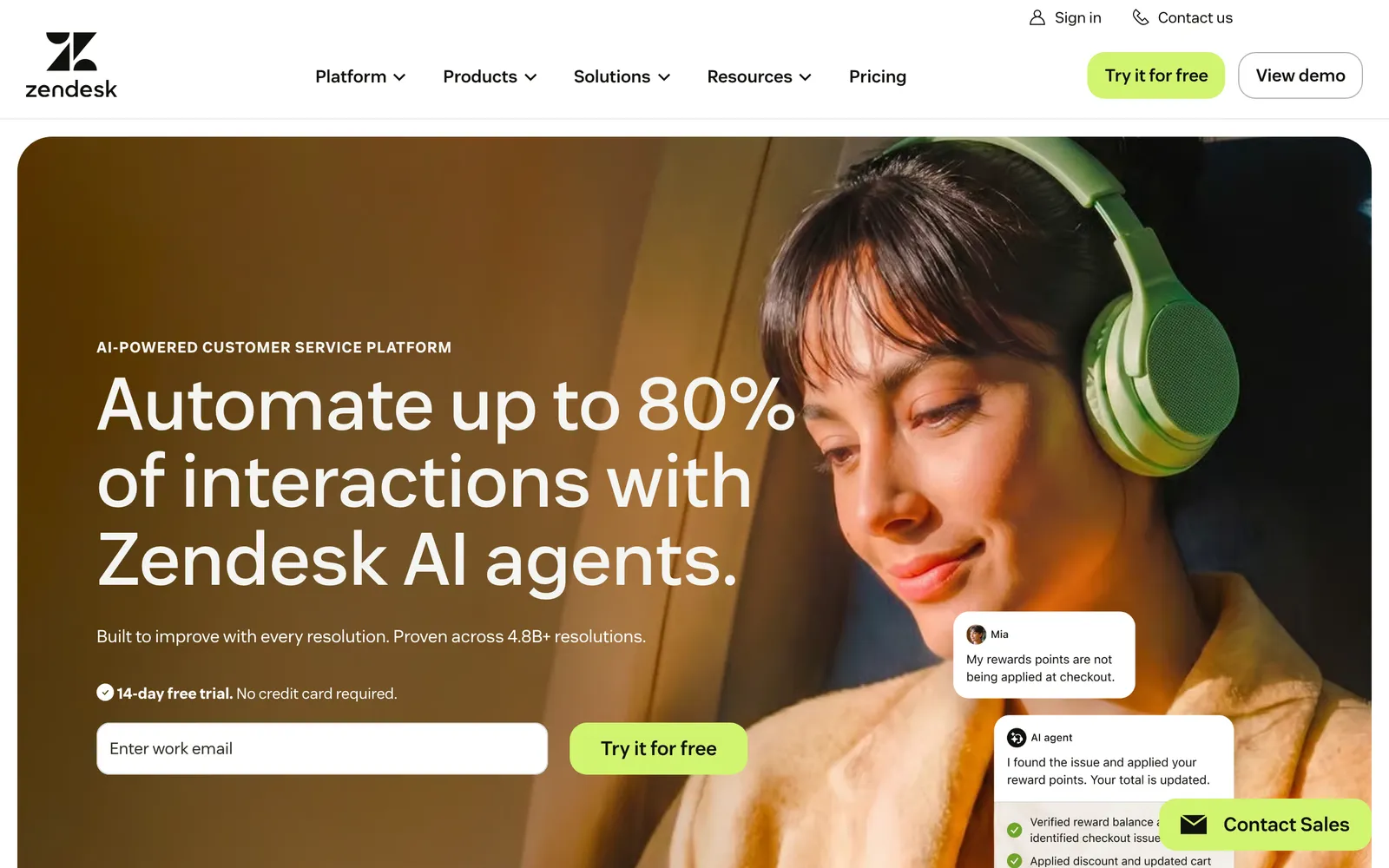
Decagon names Zendesk among its integrations, so many teams weighing Decagon run Zendesk already, and the built-in AI is the obvious comparison. Zendesk completed its Forethought acquisition in March 2026; its AI agents now run action flows, logs show the plan, reasoning and knowledge sources, and weekly AI-drafted procedures wait for you to publish them.
AI agents are included in every Suite and Support plan with an allowance of automated resolutions; extra ones cost $1.50 committed or $2.00 pay as you go (October 2026). The catch for a store: the AI is bolted onto a horizontal help desk. Keep Zendesk and replace the AI with our Zendesk integration; our Zendesk AI guide and Zendesk comparison go deeper.
8. Gorgias AI Agent: best for Shopify stores that want one platform
- Best for: Shopify brands that want the help desk and its AI from one e-commerce vendor.
- Price as of October 2026: help desk plans from $10 to $900 a month on monthly billing, plus $0.90 per automated interaction on annual plans or $1.00 monthly.
- Keep or replace your help desk: keep Gorgias; for anyone else, a migration.
- Verdict: a strong Shopify-first help desk whose AI takes real store actions; check how far it reaches beyond Shopify into returns, subscriptions and carriers.
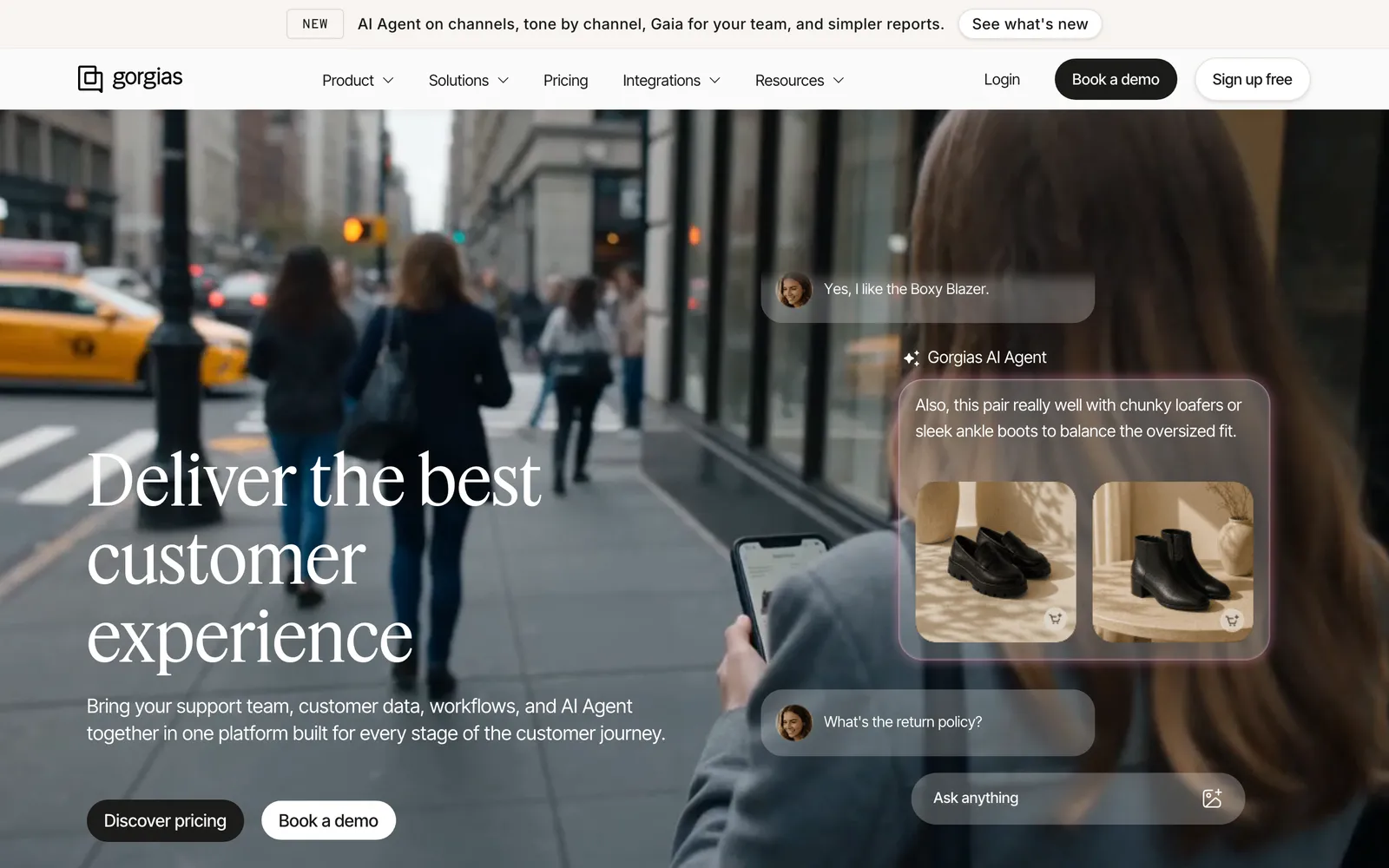
Gorgias is the Shopify-first help desk, and its AI Agent takes real Shopify actions, such as cancelling an order or editing a shipping address, with conditions you set. A summary of its reasoning sits under every AI message, and Gaia drafts changes to the AI setup for you to approve. The Gorgias homepage promises “Automate 60% of support”, and its Orthofeet story reports 56% in under two months (vendor-stated).
Its pricing page lists plans from $10 to $900 a month on monthly billing and $0.90 per automated interaction on annual plans (October 2026). To keep Gorgias and widen what the AI reads and does, see our Gorgias integration and our guide to Gorgias’s AI.
9. Kustomer: best for a single customer timeline
- Best for: brands whose problem is customer data spread across many tools.
- Price as of October 2026: no published prices; quote after an assessment.
- Keep or replace your help desk: keep Kustomer; for anyone else, a migration.
- Verdict: a CRM model with a well-articulated AI control story; its built-in Shopify tool reads only.

Kustomer puts order history, loyalty status and every conversation on one customer timeline, with AI agents working across that data, guardrails, evaluations built from real conversations and observability of tool calls. Decagon also names Kustomer among its integrations. Kustomer does not publish prices and builds a quote after an assessment (pricing, October 2026).
For a store, check the write actions: Kustomer documents its AI’s built-in Shopify tool as read-only, with writes built as custom tools (help centre, March 2026). To keep Kustomer and add native store actions, see our Kustomer integration.
10. Richpanel: best for moving to another e-commerce help desk
- Best for: e-commerce teams that want to move to a help desk with commerce AI built in.
- Price as of October 2026: $99 per seat a month on annual billing, plus about $0.20 per AI conversation and a $200 monthly AI minimum.
- Keep or replace your help desk: keep Richpanel; for anyone else, a migration.
- Verdict: commerce AI with per-action approvals; moving to it is a full help desk migration.

Richpanel is an e-commerce help desk whose AI resolves tickets with your tools, for example holding a Shopify shipment or saving a subscription in Recharge, and you choose which actions need approval first. A QA AI reviews closed conversations and recommends fixes you approve. It markets high autonomous resolution, though those rates are not the norm for every brand.
Its pricing page lists $99 per seat a month on annual billing ($119 monthly), about $0.20 per AI conversation and a $200 monthly AI minimum (October 2026). If you already run Richpanel, our Richpanel integration keeps it and replaces the AI; the Richpanel comparison sets the two side by side.
What does a Decagon alternative cost?
Start with Decagon itself: it publishes no rates. A Decagon pricing article (December 2024) describes two models, a fixed rate per incoming conversation, which it says most customers choose, or a higher rate per fully resolved conversation with escalations not charged. Any price you see quoted elsewhere is a third-party estimate, so ask Decagon for a quote at your volume.
The alternatives use four models. Per outcome or resolution: Intercom Fin at $0.99, Siena at $0.90 on top of a $750 platform fee, Yuma in annual bundles, Zendesk’s extra automated resolutions at $1.50 to $2.00, Gorgias at $0.90 to $1.00 per automated interaction, and Sierra on outcomes at rates it does not publish. Per conversation: Richpanel’s AI at about $0.20. Flat: Engaige, a monthly fee tied to your ticket volume. Ada and Kustomer price by quote.
The honest comparison is total cost per resolved ticket: platform fee plus AI fee, divided by the tickets closed without a person. Each model suits a different volume and budgeting style, so none is wrong in itself. Run the number at today’s volume and at twice today’s volume, for every tool on your shortlist, ours included.
How hard is it to switch from Decagon?
Easier than most switches, because Decagon runs alongside your help desk rather than replacing it. Replacing the AI doesn’t mean replacing your help desk: Engaige connects to the one you run, so tickets, macros and history stay put, and it is live in Agent Assist within hours.
It can also start on a few ticket types you choose while your current AI keeps handling the rest, so you compare both on your own tickets before switching over. If you change help desk later, your Engaige setup comes with you: policies, actions and what Engaige AI has learned are reconnected on the new help desk, not rebuilt. Where a help desk migration is needed, Engaige helps with it, and your data stays yours to export.
Three steps make any move smoother:
- Write down what the agent does today. List the procedures, actions and hand-over rules your current agent runs, so each one is rebuilt on purpose rather than lost.
- Run in parallel. Give the new agent a few ticket types first and compare resolution and quality on your own tickets.
- Cut over by ticket type. Move the rest once each type meets your quality bar, and plan it well before your contract renewal date.
If the alternative you pick is a help desk with its own AI (entries 7 to 10), add the help desk migration itself: exporting tickets, rebuilding macros and rules, and running both in parallel before you cut over.
Which Decagon alternative fits your store?
Match the shortlist to what sent you looking. If Decagon’s model fits but you want something built for a store, look at the e-commerce agents; if you want the same enterprise shape, look at the enterprise platforms.
| Your situation | Shortlist |
|---|---|
| Scaling online store, want to be live in hours inside your help desk | Engaige |
| Heavy order, return and subscription volume | Engaige, Siena, Yuma |
| Support team should run the agent without engineers | Engaige |
| Mixed store, account and product questions | Intercom Fin, Engaige |
| Very large enterprise, many channels including voice | Sierra, Ada |
| Want to pay only for full resolutions | Yuma |
| Already on Zendesk, Gorgias, Kustomer or Richpanel and want one vendor | That help desk’s own AI, or Engaige on top |
| Phone is a big share of your support | A voice specialist, Sierra, Ada or Yuma |
Whichever you shortlist, pilot with your real ticket mix and measure end-to-end resolution, not deflection. For a scored view of the wider field, see our agent ranking.
Frequently asked questions
Who are Decagon’s main competitors?
Sierra and Ada are the closest enterprise competitors; Intercom Fin is the horizontal agent most often compared. For e-commerce brands, Engaige, Siena and Yuma are the specialist agents that run on top of your help desk, and Zendesk, Gorgias, Kustomer and Richpanel offer AI built into their own help desks.
What is the best Decagon alternative for an e-commerce brand?
It depends on your mix and who runs the agent. For a scaling online store that wants to be live in hours inside its current help desk, with the support team running it in plain language and real store actions, Engaige fits. Siena and Yuma are other e-commerce specialists; Sierra and Ada suit very large enterprises.
How does Decagon compare with Sierra?
Both are cross-industry AI agent platforms for large enterprises, with voice. Decagon builds agents from AOPs and improves them with Duet Autopilot, whose changes a human approves; Sierra uses Journeys and Ghostwriter, which prepares changes for review. Sierra prices on outcomes; Decagon describes per-conversation and per-resolution models. Neither publishes rates (October 2026).
How much does Decagon cost?
Decagon publishes no prices. It describes a fixed rate per conversation, which it says most customers choose, or a higher rate per resolved conversation with escalations not charged. Ask for a quote at your volume and compare total cost per resolved ticket.
Can I replace Decagon without changing my help desk?
Yes. Decagon runs alongside your help desk, and so do Engaige, Intercom Fin, Sierra, Ada, Siena and Yuma. Engaige connects to Zendesk, Intercom, Salesforce and Kustomer, among others, and can start on chosen ticket types next to your current AI.
Does Engaige handle voice like Decagon?
No. Engaige is text-first by design: email, chat, WhatsApp, SMS and social DMs, no voice AI. A live call gives an AI seconds to reason; text gives it time to read the order, check your policy and act, so resolution quality is higher.
How is Engaige priced?
Engaige is a flat monthly fee tied to your ticket volume, predictable as you scale.