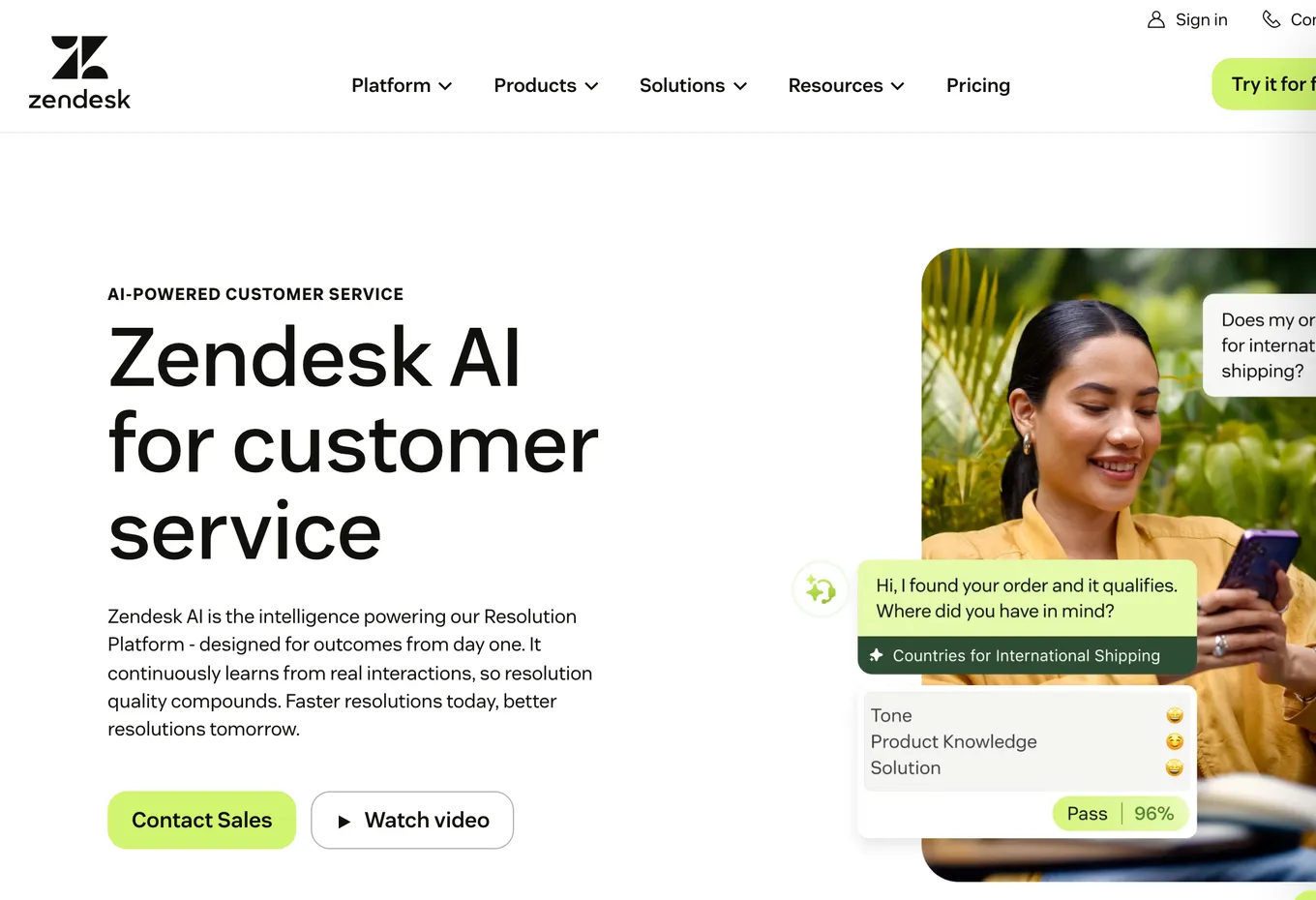
Zendesk AI is the AI layer of Zendesk’s help desk, which Zendesk calls “the intelligence powering our Resolution Platform”. It has four parts: AI agents that answer customers, Copilot that assists your human agents, a knowledge layer the AI reads, and quality assurance that scores conversations. Since March 2026 the AI agents include Forethought, which Zendesk bought.
This guide covers what each part does, what it costs and where an online store needs more than Zendesk ships. Facts are as of October 2026, from Zendesk’s own pages. For how Zendesk works for a store as a whole, start at our Zendesk hub.
What is Zendesk AI?
Zendesk AI is the set of AI products Zendesk sells on top of its ticketing: AI agents, Copilot, Knowledge and quality assurance, plus voice AI for contact centres. Zendesk markets it as one platform that “continuously learns from real interactions”. You buy it with a Zendesk plan, and the AI agents are billed per automated resolution.
Zendesk’s AI page groups the products under one heading, the Resolution Platform. The table maps each part to its job.
| Part of Zendesk AI | What it does | Who it serves |
|---|---|---|
| AI agents | Answer and resolve customer requests on messaging, email and voice | Your customers |
| Forethought AI Agents by Zendesk | Self-improving agents that also run on other service platforms | Your customers |
| Copilot | Suggests replies and actions, follows procedures you write, admin copilot for setup | Your human agents and admins |
| Knowledge | Help centre content, generative search and Knowledge builder | The AI and your customers |
| Quality assurance | Scores human and AI agent conversations | Your team leads |
| Voice | AI on calls in the contact centre | Your phone queue |
What are Zendesk AI agents?
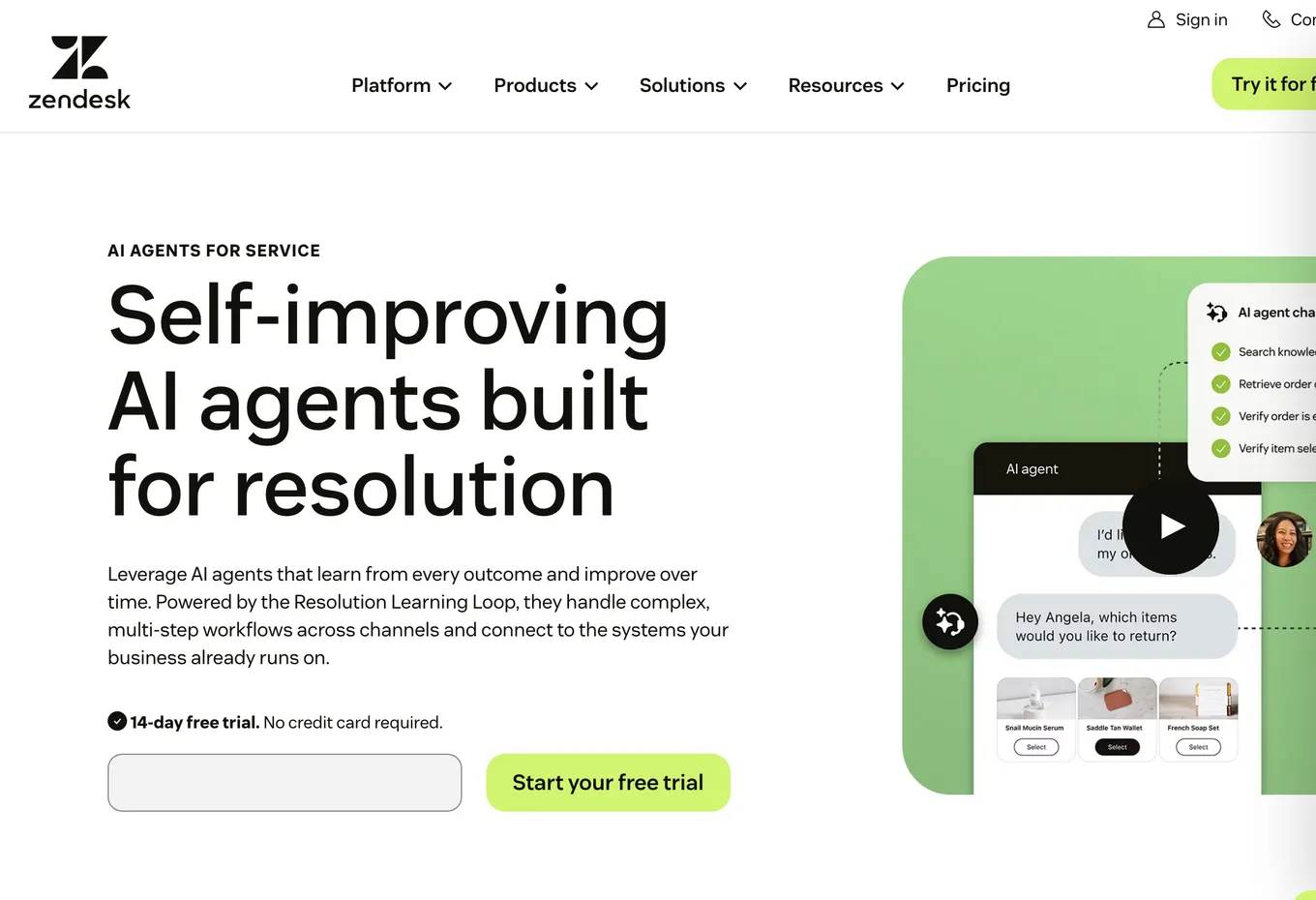
Zendesk AI agents are the customer-facing part: bots that answer and act on messaging, email and voice. Zendesk’s About AI agents page calls them “AI-powered chatbots”, and its AI agents page is headed “Self-improving AI agents built for resolution”, powered by what it calls the Resolution Learning Loop.
You give an agent knowledge sources, use cases and procedures written in plain language, then connect it to other systems. Since a rollout from 13 May to 12 June 2026, Zendesk says “all custom actions are available in AI agents”, and action flows can be invoked when they use the Run on demand trigger.
Zendesk’s FAQ says its AI agents work across “social, web, mobile, voice and email channels” and markets “up to 80% automation” with its services offer. That is Zendesk’s own figure, across all industries.
Two older products sit behind the current agents. The included Essential level is no longer available from 10 December 2026, covered in our AI essentials guide. Answer Bot and the bot builder are older still; our Zendesk chatbot guide explains what replaced them.
What did Zendesk buy with Forethought?
Zendesk bought Forethought, an AI agent company for customer support, to add self-improving AI agents to its platform. It announced the deal on 11 March 2026 and completed it on 26 March 2026. The product is now sold as “Forethought AI Agents by Zendesk”.
Zendesk says these agents run on chat, email and voice and “work seamlessly within Zendesk and across any platform”. Its chief executive, Tom Eggemeier, is quoted in the completion release: “No one but Zendesk is delivering self-improving AI agents like ours”. That is Zendesk’s claim.
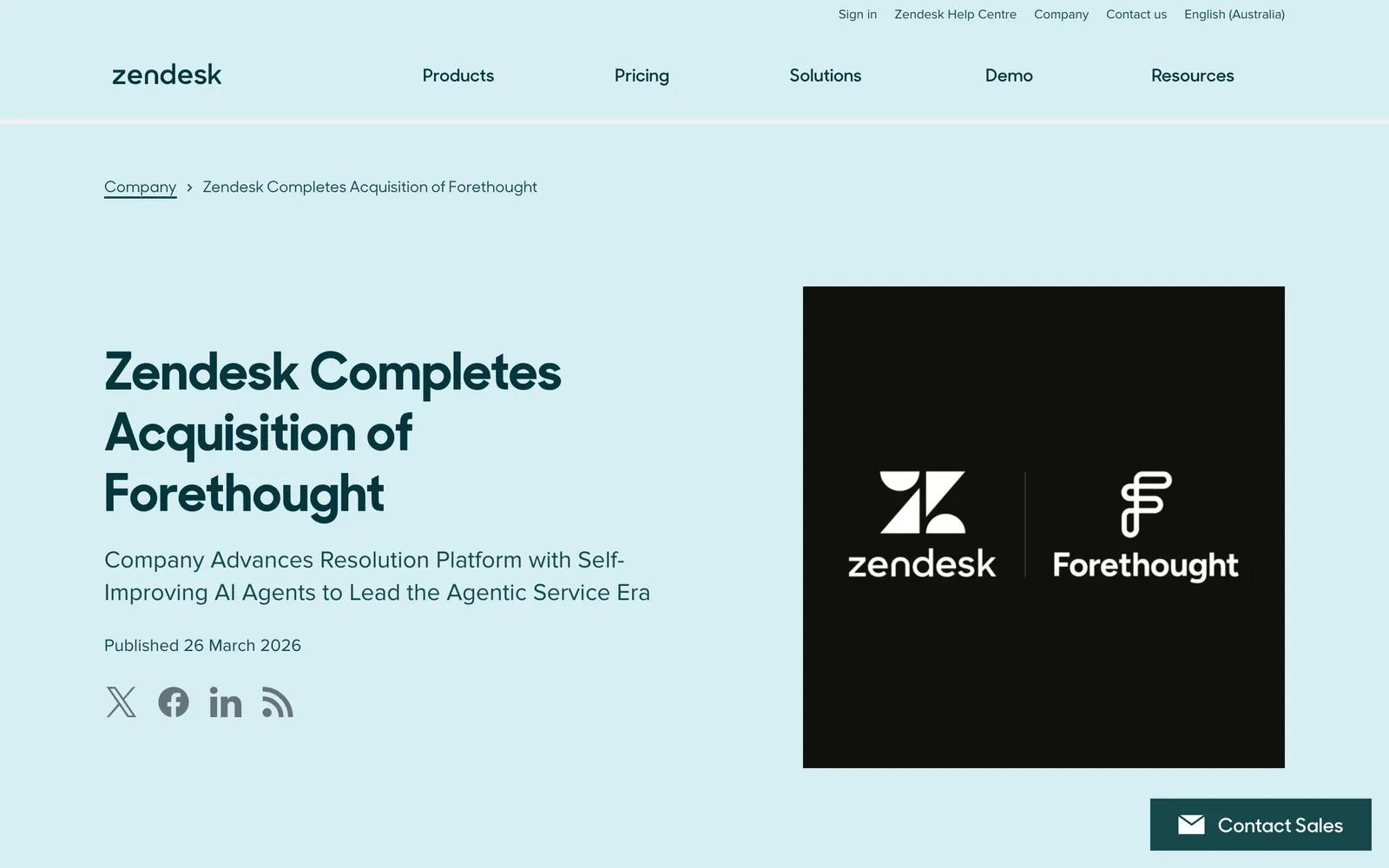
Forethought’s own site lists a support AI suite: agents for resolution (Solve), ticket triage (Triage) and knowledge-gap discovery (Discover), plus quality assurance and an agent copilot. Its site now carries the banner “Forethought is now part of Zendesk”. For how Forethought compared with Ada before the deal, see our Forethought comparison.
What is Zendesk Copilot?
Zendesk Copilot is the AI for your human agents and admins, not for customers. Its auto assist follows procedures you write in natural language and suggests replies and actions, and Zendesk says Copilot “can take actions in third-party systems such as Shopify”. It is an add-on at $50 per agent per month, billed yearly.
In auto assist, each action is marked pre-approved, so it runs, or agent-approved, so a person confirms it. Zendesk advises that “actions that write data, such as an action that refunds an order, should be marked as agent-approved”. Our Zendesk Copilot guide covers procedures, admin copilot and plans.
Copilot is also where Zendesk’s learning shows most clearly. Zendesk documents AI-generated procedure drafts built from your common issues, solved tickets from the last 30 days and knowledge articles. You edit each draft and publish it before auto assist uses it.
What is the Zendesk Resolution Platform?
The Resolution Platform is Zendesk’s name for its whole service suite with AI built through it: ticketing, AI agents, Copilot, Knowledge, quality assurance, voice and workforce management. Zendesk AI is the layer that powers it. The Resolution Learning Loop is Zendesk’s term for how outcomes feed back into the agents.
Zendesk’s March announcement says “The Resolution Learning Loop enables continuous improvement by learning directly from every customer conversation.” On its AI agents page, Zendesk says the agents “identify gaps, detect failing procedures and refine knowledge and workflows based on outcomes”.
For a store, the useful question is not whether the AI learns. Zendesk says it does. The question is what it learns from, and whether you see and approve each change before it reaches customers.
What are the Zendesk AI features?
Zendesk AI features are spread across plans, so the plan you are on decides what you can use. Zendesk’s pricing page marks each AI feature by plan: AI agents for email and Action Builder on every plan, AI agents on messaging from Suite Team, admin copilot from Suite Professional, and intelligent triage and auto assist in Suite Enterprise with Copilot.
| Feature | What it does | Plan on zendesk.com/pricing (October 2026) |
|---|---|---|
| AI agents | Answer and act for customers | Email on every plan; messaging from Suite Team (Support Team needs messaging) |
| Knowledge base | Help centre the AI answers from | Suite Team and up |
| Action Builder | Builds the actions and flows AI can run | Every plan: up to 40,000 actions a month on Support Team and Suite Team, 100,000 on Suite Professional |
| Admin copilot | Helps admins find and fix setup issues | Suite Professional and up |
| Writing tools | Rewrites and expands agent replies | Suite Professional, 5 uses per agent per month, pooled |
| Intelligent triage | Predicts intent, sentiment and language | Suite Enterprise + Copilot |
| Auto assist | Suggests replies and actions to agents | Copilot add-on |
| Generative AI for voice | AI on calls | Suite Enterprise + Copilot |
Two features deserve their own guide: intelligent triage for routing, and the AI knowledge setup that every agent answers from.
What does Zendesk AI cost?
Zendesk AI costs a plan per agent plus automated resolutions. AI agents are included in every Suite and Support plan, “with pricing based on the successful outcomes they deliver”. Each plan includes an allowance of automated resolutions; extra ones cost $1.50 committed or $2.00 pay as you go, and Copilot is a $50 add-on, as of October 2026 on Zendesk’s pricing page.
Since 18 May 2026 only a verified resolution counts against the allowance, per Zendesk’s resolution tiers. For every plan price, the resolution tiers and worked examples at 1,000 to 10,000 tickets a month, see our guide to Zendesk pricing.
What does Zendesk AI do well?
Zendesk AI does well what Zendesk has always done well: it gives big, multi-team service operations one vendor for ticketing, channels, AI and reporting. Its agents show their working, Copilot learns procedures from your solved tickets, quality assurance is built in, and voice is covered.
- Visible reasoning. Zendesk’s conversation logs show a Plan field, “the AI agent’s reasoning in determining how to resolve the user’s issue”, plus the procedure step, the resources used and every integration call.
- Learning you publish. Procedure drafts come from your solved tickets and wait for you to publish them.
- One platform. Ticketing, AI agents, Copilot, QA and voice share one admin, which suits a large team.
- Retail proof. On its AI page Zendesk cites Fortnum & Mason, the London retailer, at a 90% drop in live chat processing time; that is Zendesk’s figure.
Zendesk is a proven ticketing foundation trusted by big teams. Our view: Zendesk doesn’t think in orders, returns or subscriptions. It wasn’t built to, and that is where a store feels the gap.
Where does an online store need more than Zendesk AI?
A store needs store actions: changing an order, refunding it, updating an address, pausing a subscription, then closing the ticket. Zendesk documents Shopify lookups, cancellations and refunds for Copilot, which it advises a person approves, while AI agents act through custom actions and flows your team builds and maintains.
| Store job | What Zendesk documents (October 2026) | What a store needs |
|---|---|---|
| Where is my order (WISMO) | AI agents call an API integration or action you build | Live order and carrier status in the answer |
| Refund or cancellation | Copilot Shopify actions, advised as agent-approved | The agent acts within your policy and closes the ticket |
| Address change | No standard Shopify action listed | Edit the order before it ships |
| Discount or goodwill | No standard Shopify action listed | A code within the limits you set |
| Subscription change | Build it through custom actions | Skip, pause or swap in your subscription app |
| Product advice | Answers from knowledge articles | Live catalogue, stock and price per market |
Two caveats sit in Zendesk’s own docs. Auto-assist “actions don’t work on AI agent tickets” (Zendesk), so Copilot’s Shopify actions help a human, not the bot. And an AI agent only receives “the outputs passed by the last step” of a flow (Zendesk), so each flow is designed around what the agent needs.
None of this stops a store from building order work on Zendesk. It means the order logic lives in flows and procedures you write, test and maintain, on a platform built for every industry. Our view: that is the bolt-on pattern, AI added onto ticketing, where the store logic reaches only as far as the flows you configured. For order status questions, see our WISMO use case.
How does Engaige work inside Zendesk?
Engaige (that’s us) is the e-commerce-native AI support agent that plugs into the Zendesk you already run and replaces only its AI layer: keep your helpdesk, replace the AI. Engaige AI, the part you talk to in plain language, configures the agent, shows which policy it used and learns from your team. MR MARVIS, on Shopify Plus, handles over 120,000 questions a year with Engaige, resolving over 60% of the conversations it’s involved in.
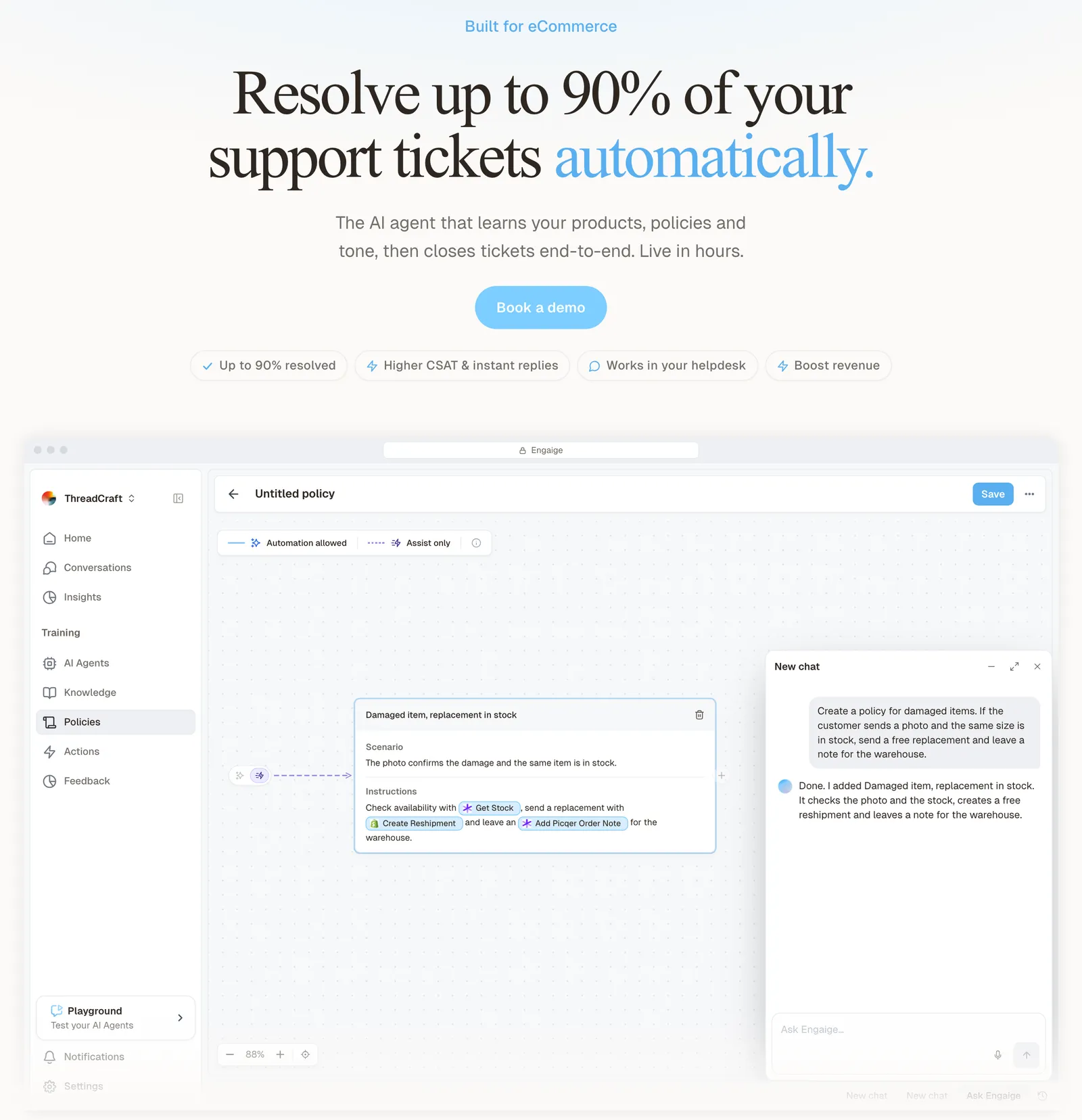
Keep Zendesk, no migration. Engaige works in the Zendesk agent workspace on your existing tickets, macros and history. It can take chosen ticket types while Zendesk’s AI agent keeps the rest, so you compare both on your own tickets before you switch. The Zendesk integration has the setup.
Store actions, built for e-commerce. Engaige reasons in the order lifecycle: WISMO, refunds and returns, cancellations, address changes, discounts and subscription changes. It takes the action in the connected system, replies to the customer and closes the ticket in Zendesk. On Shopify it combines live Admin API data, pricing across markets and SKUs, inventory, orders and customers, with the marketing content from your storefront.
Learns from your team’s normal work. You go live in Agent Assist in hours. Every reply your team sends is compared with what the agent suggested, one of the signals Engaige AI learns from, next to the conversations, your inputs, hand-offs and emerging trends. Engaige AI proposes each change with its reasoning, and you approve it. Zendesk drafts procedures from solved tickets; Engaige learns from your team’s replies from day one.
Reasoning and control. Open any conversation in Engaige and you see the full reasoning behind every answer and action. At a hand-over, the agent leaves a reasoning summary as an internal note in the Zendesk ticket. You decide per step whether the agent acts alone or drafts for your team, and you can set thresholds, such as sending refunds above a set amount to a person first.
Within the AI we can see the reasoning, and how it comes to a response. That shows us where information is missing or unclear, and helps us improve our workflow.

Ticket types go autonomous one at a time, most brands in about a week, up to 90% of supported tickets; autonomous from day one is also supported. Otrium resolves 60% of its 120,000 annual tickets end to end. Engaige is text-first by design: email, chat, WhatsApp, SMS and social DMs, no voice AI. Engaige is built for resolution, not enterprise overhead.
If you are weighing a move away from Zendesk altogether, our Zendesk alternatives guide covers the wider field and Gorgias vs Zendesk weighs the two help desks, while the Zendesk comparison sets Engaige and Zendesk’s AI side by side.
Frequently asked questions
Is Zendesk AI included in every plan?
Zendesk AI agents are included in every Suite and Support plan, priced on automated resolutions with an allowance per agent. Copilot is a paid add-on, and features such as admin copilot and intelligent triage depend on your plan.
Is Zendesk AI the same as Forethought?
Forethought is now part of Zendesk AI. Zendesk completed the acquisition on 26 March 2026 and sells Forethought AI Agents by Zendesk, which it says run inside Zendesk and on other service platforms.
What is the difference between Zendesk AI agents and Copilot?
AI agents talk to your customers on messaging, email and voice. Copilot helps your human agents and admins: it suggests replies and actions, follows your procedures and drafts new procedures for you to publish.
What does a Zendesk automated resolution cost?
Each plan includes an allowance, 5 or 10 per agent per month on the listed plans. Extra automated resolutions cost $1.50 committed or $2.00 pay as you go, as of October 2026. Assisted escalations and contained resolutions do not count against the allowance.
Does Zendesk AI work with Shopify?
Yes, with work on your side. Copilot’s auto assist can look up, cancel and refund Shopify orders, and Zendesk advises agent approval for refunds. AI agents reach Shopify through custom actions, flows or API integrations you configure.
Do I have to leave Zendesk to use a different AI agent?
No. Engaige plugs into the Zendesk you run and replaces only the AI layer, with no migration. It can take chosen ticket types next to Zendesk’s AI agent, so you compare both on your own tickets.
How is Engaige different from Zendesk AI?
Engaige is built for e-commerce: it takes store actions such as refunds, cancellations and address changes itself and closes the ticket. Engaige AI learns from your team’s replies in Agent Assist, and you approve every change before it goes live.