
The Zendesk chatbot is Zendesk’s AI agent: an AI-powered bot that answers customers on messaging, email and voice from your help centre, and runs procedures and API actions you configure. It succeeds Answer Bot, comes with every Suite and Support plan, and from 10 December 2026 the legacy and Essential bots are no longer available.
This guide is for an online store already on Zendesk. It explains what the bot is, what happened to Answer Bot, how Zendesk counts a resolution and whether the bot can take a Shopify refund. For the wider Zendesk picture, start with our guide to Zendesk e-commerce.
What is the Zendesk chatbot?
The Zendesk chatbot is what Zendesk calls an AI agent. Zendesk defines AI agents as “AI-powered chatbots that interact with your customers on messaging, email (including API and web form), and voice channels” (Zendesk docs). They are available on all Suite plans and on Support Team, Professional and Enterprise.
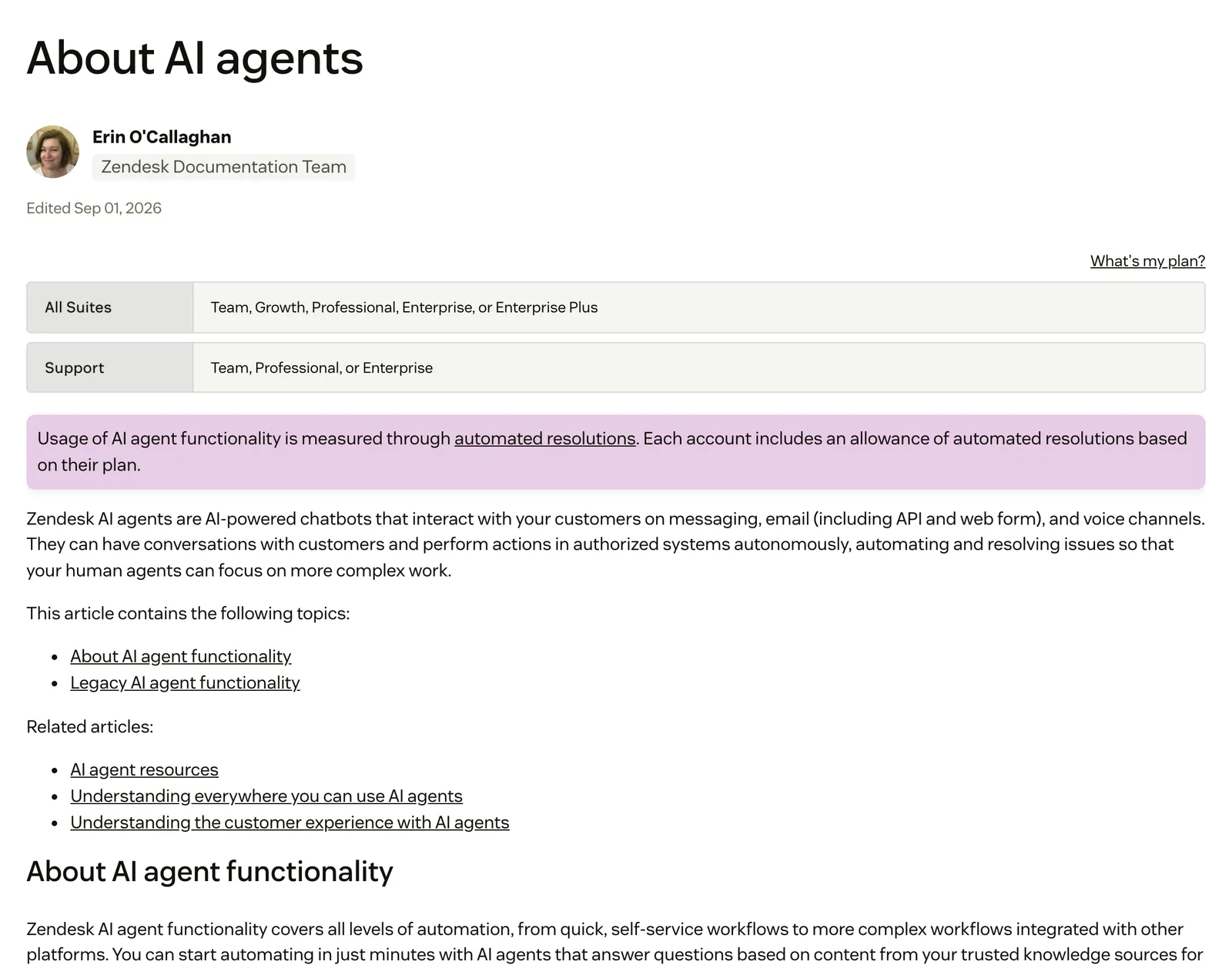
Zendesk’s FAQ says AI agents come with every Suite and Support subscription. The same documentation says they go beyond knowledge answers to “generative procedures, scripted dialogues, authorized actions, and API integrations”, and can act in authorised systems autonomously.
Searches for “Zendesk chat bot”, “Zendesk chatbots” and “Answer Bot” all land on this product family. Zendesk completed its Forethought acquisition in March 2026 and markets self-improving agents that “learn from every outcome” (Zendesk). It also claims the agents resolve up to 80% of interactions (claim), which is Zendesk’s figure. Your own rate depends on how many tickets need an order action rather than an answer.
What types of Zendesk chatbot are there?
Zendesk lists three chatbot options: its built-in AI agents, a do-it-yourself bot on Sunshine Conversations Web Messenger, and third-party bots brought into the same conversation. The first is included in your plan, the second needs a separate licence, and the third is the documented route to running a different AI agent inside Zendesk.
| Type | Who builds it | Licence | What it handles |
|---|---|---|---|
| Built-in AI agents | You configure it in Zendesk | Included in Suite and Support plans | Knowledge answers, plus procedures and API actions you set up |
| DIY on Sunshine Conversations | Your developers | Separate Sunshine Conversations licence | Whatever you code on Web Messenger |
| Third-party bots | The vendor | Vendor’s own | Whatever the vendor’s agent does, in the same conversation |
Source: Zendesk docs. Zendesk’s wording is that you can “bring your Zendesk and third-party chatbots together into a single, continuous conversation”.
Auto assist, part of Zendesk Copilot, is a different thing: it helps your human agents rather than talking to customers.
One trap if you still run live chat. Zendesk documents that Chat Conversations API bots are “prevented from being invoked” once messaging is enabled, and recommends moving them to Sunshine Conversations APIs (Zendesk).
What happened to Zendesk Answer Bot?
Answer Bot was Zendesk’s earlier bot. It used machine learning to answer simple support enquiries with help centre articles, and it has been replaced by AI agents. Its resolutions are being replaced by automated resolutions, and the old bot builder, answers and intents are legacy, with Zendesk’s end date set at 10 December 2026.
Zendesk’s description of the original: it “uses machine learning to respond to customer questions with content from your knowledge base” (Zendesk). Counting was narrow. A resolution was counted when an end user took an action on a suggested article, such as “Yes, close my request”. Messaging Web Widget resolutions did not count, and every 100 API requests equalled one resolution (Zendesk).
Old name to current status, all from Zendesk docs:
| Old name | Legacy since | Status |
|---|---|---|
| Autoreplies with articles | 31 July 2025 | No longer available 10 December 2026 |
| Bot builder, answers, intents | 2 February 2025 | No longer available 10 December 2026 |
| AI agents Essential | 11 May 2026 | No longer available 10 December 2026 |
| Zero-training AI agents | 11 May 2026 | Legacy; cannot be created |
Can you use a different AI agent inside Zendesk?
Yes. Zendesk documents third-party bots as a chatbot option, brought into the same conversation as its own agents, so the built-in AI agent is not the only choice. Engaige runs inside the Zendesk agent workspace on your existing tickets, replaces only the AI layer and needs no migration.
When do legacy and Essential Zendesk bots stop working?
Plan for 10 December 2026. Zendesk’s About AI agents page says AI agents Essential, bot builder, answers, intents and autoreplies with articles will no longer be available on that date. A separate removal notice lists automatic migration in 2027 without naming a shut-off date, so treat 10 December as the deadline to plan around.
The timeline across Zendesk’s pages:
| Date | What happens |
|---|---|
| 30 March 2026 | Essential and Advanced split removed; advanced features included across Suite and Support plans |
| 18 May 2026 | Automated resolution tiers introduced |
| 25 May to 12 June 2026 | Rollout to new, trial and existing accounts |
| 23 June 2026 | Removal notice published |
| 31 August 2026 | Legacy experience in maintenance mode, critical bug fixes only |
| 10 December 2026 | Features “will no longer be available”, per About AI agents |
| January 2027 | Unmigrated Essential agents migrated “with some exceptions” |
| Early February 2027 | Unmigrated legacy agents migrated “with some exceptions” |
Sources: Zendesk docs, the announcement and the removal notice. The notice does not apply to customers who bought the AI agents Advanced add-on.
Check what carries over: Zendesk says unmigrated agents are migrated for you with some exceptions, so review your agents before the date. It is also a natural decision point for which AI should sit inside Zendesk.
September 2026Our Agent SOP leverages triggers & automations driven by tags Essentials adds to the tickets. This tagging behavior doesn’t carry forward to the Agentic AI replacement, so I’m in working on updating the triggers & automations associated with our Agent SOP for the new platform. · Zendesk CommunityHow does Zendesk count an AI agent resolution?
Zendesk has counted automated resolutions in three tiers since 18 May 2026. Assisted escalation and Contained resolution do not count against your allowance. Verified resolution means the agent successfully resolved the interaction. Conversations that fail verification by a large language model count as Contained (Zendesk).
The three tiers, as Zendesk describes them:
- Assisted escalation: the AI contributed and a human resolved it.
- Contained resolution: handled without the customer asking for more help.
- Verified resolution: the AI agent successfully resolved it, as judged by the LLM.
Verification runs when the conversation ends. For email, that is 72 hours after the first email. For messaging, 2 hours after the first message by default, extendable to 72 hours. For voice, at hang-up. So the figure in your report is a judged transcript, not a ticket status. When you measure your real automation rate, read Verified separately from Contained.
Is the Zendesk chatbot included in my plan?
Yes, in the sense that AI agents come with every Suite and Support plan. Usage is the variable. On zendesk.nl, checked 13 October 2026 with annual billing, Support Team is EUR 19, Suite Team EUR 55 and Suite Professional EUR 115 per agent per month (Zendesk). Support Team and Suite Team include 5 automated resolutions per agent per month, Suite Professional 10. On Suite plans, extra resolutions are EUR 1.50 committed or EUR 2.00 pay-as-you-go.
Can the Zendesk chatbot process Shopify refunds and cancellations?
Zendesk documents that its AI agent can act through actions and API integrations you specify and maintain. Out of the box it answers from knowledge: if you create no use cases, the agent “forms responses using only the content of your connected knowledge sources” (Zendesk). Order work is something you build.
Zendesk’s Shopify page puts “order refunds and cancellations” in the human agent’s sidebar app, while its bots answer common questions such as return policies and hand off to a live agent (Zendesk). Auto assist can suggest Shopify order lookups, cancellations and refunds, which the agent accepts in the Agent Workspace (Zendesk).
These are the store jobs, each something you configure with actions or API integrations you specify (Zendesk docs):
- Where is my order: an action that reads the order. See WISMO.
- Refunds and returns: an action plus your policy rules. See refunds.
- Cancellations and address changes: an action that writes to the store.
Zendesk documents use cases, generative procedures and API integrations as the pieces you configure; with no use cases the agent answers from knowledge only. Email agents cannot use dialogues and must use generative procedures instead.
How do you evaluate a chatbot for Zendesk?
Judge a chatbot for Zendesk on what it does for a store, not on a feature list. Check whether it reads live order data, acts under rules you set per step, shows why it answered, learns in a way you can see and approve, and stays inside Zendesk so you do not migrate. Then check time to first value and the channels you use.
| Criterion | Question to ask |
|---|---|
| Live order data | Does it read orders, returns and subscriptions, or only articles? |
| Control | Can you set what it may do alone, step by step? |
| Transparency | Does every answer show why, with the source? |
| Learning loop | Can you see what it learned and approve each change? |
| Fit with Zendesk | Does it work on your existing tickets, with no re-platforming? |
| Time to first value | How long until it handles real tickets? |
| Channels | Which channels does it cover, and do they match yours (email, chat, WhatsApp, social, phone)? |
For the full matrix, read our chatbot guide and the BigCommerce view. If you are weighing the help desk itself, see Gorgias comparison. For the difference between a bot and an agent, see agent guide. The agent’s answers come from your knowledge, so our knowledge base guide matters too.
Does a Zendesk chatbot replace your support team?
No. Exceptions, judgement calls and sensitive cases stay with people, and Zendesk itself counts Assisted escalations as a separate tier because a human finishes those. What changes is the mix: the bot takes the repetitive tickets, and your team spends its time on the ones that need a decision.
Which cases stay with a person is your call: with a policy-governed agent you can route a sensitive refund or a high-value damage claim to your team while routine claims resolve on their own. When one escalates, the internal notes your team leaves and the SLA clocks on that ticket decide how smoothly it is picked up.
Where does Engaige fit?
Engaige (that’s us) isn’t a bot Zendesk ships. It’s the AI support agent you put inside Zendesk in place of the built-in bot, while Zendesk stays your help desk and nothing is migrated: keep your helpdesk, replace the AI. Behind it is Engaige AI, which learns from your conversations and inputs, configures your support agent and shows which policies it used.

The difference that matters here is control. Zendesk’s agent acts through procedures and API actions you build and maintain. With Engaige, policies set how the agent reasons, which process it follows and when it may act, per step. You decide where a person checks first and where the agent may go ahead alone, and you can change it as your confidence grows.
Scenario
The customer asks about a delivery address.
Instructions
Read the order with Get order , then take the branch that matches.
 Get order
 Scenario
The order has not been picked yet.
Instructions
Move it with Change picqer shipping address .
 Change picqer shipping address
 Scenario
The parcel has already left the warehouse.
Instructions
Say it cannot be redirected, then offer Process refund .
Otrium’s agent resolves 60% of 120,000 annual tickets end to end, and Otrium chose Engaige for control, flexibility and an AI that feels more human. See the Otrium story for the detail. MR MARVIS handles over 120,000 questions a year and resolves over 60% of the conversations it is involved in.
Engaige offered control, flexibility, and the ability to really incorporate AI in a more human way.

Before the 10 December decision point, you can go live in Agent Assist in hours, with the agent drafting replies inside Zendesk. Engaige AI compares what your team said with what the agent suggested, learns from the difference and improves itself under your supervision: you approve the changes. That lets you see real answers on your own tickets before you decide what replaces the Essential bot. Every answer and action shows why, with the source.
Ticket types then switch to autonomous one at a time, most brands in about a week, up to 90% of supported tickets. Inside Zendesk, the action happens in your store first (Shopify, WooCommerce, Magento, BigCommerce or a custom system), then Engaige replies and closes the ticket. On Shopify it reads the Admin API plus your storefront content.
Engaige is a flat monthly fee tied to your ticket volume, predictable as you scale, so you know your cost per ticket before you decide and can set it against what a person costs per ticket; our ROI guide shows the sum.
Engaige is text-first by design: email, chat, WhatsApp, SMS and social DMs, no voice AI. A live call gives an AI seconds to reason; text gives it time to read the order, check your policy and act, so resolution quality is higher. If phone is a big share of your mix, a voice specialist is the honest answer.
With the 10 December 2026 date coming, this is the moment to choose which AI sits inside Zendesk. See the Zendesk comparison or the Zendesk integration page.
Frequently asked questions
Does Zendesk have a chat bot?
Yes. Zendesk calls its chatbot an AI agent. It answers customers on messaging, email and voice from your help centre, and can run procedures and API actions you configure. It is included with every Suite and Support plan, and a Sunshine Conversations bot or a third-party bot are the other documented options.
What happened to Zendesk Answer Bot?
Answer Bot, which answered simple enquiries with help centre articles, has been replaced by AI agents. Its resolutions are being replaced by automated resolutions, and bot builder, answers and intents are legacy. Zendesk’s About AI agents page says they are no longer available from 10 December 2026.
Is the Zendesk chatbot included in my plan?
AI agents come with every Suite and Support subscription. Zendesk bills automated resolutions beyond the included allowance. On zendesk.nl, checked 13 October 2026, Suite Team and Support Team include 5 per agent per month and Suite Professional 10, with extras at EUR 1.50 committed or EUR 2.00 pay-as-you-go on Suite plans.
When do legacy Zendesk bots stop working?
Plan for 10 December 2026, the date Zendesk’s About AI agents page gives for Essential agents, bot builder and autoreplies with articles. A separate notice lists automatic migration in January and February 2027, with exceptions and no shut-off date.
How does Zendesk count an AI agent resolution?
In three tiers. Assisted escalation and Contained resolution do not count against the allowance. Verified means the agent resolved it, and an LLM checks that when the conversation ends. Email windows are 72 hours, messaging 2 hours by default and voice ends at hang-up.
Can the Zendesk chatbot process Shopify refunds and cancellations?
Zendesk documents actions and API integrations you specify and maintain, and its Shopify page puts refunds and cancellations in the agent’s sidebar app. Engaige instead takes the action in your store under policies you set, then replies and closes the ticket in Zendesk.
Can I use a different AI agent inside Zendesk?
Yes. Zendesk documents third-party bots as one of its chatbot options. Engaige runs inside the Zendesk agent workspace on your existing tickets, replaces only the AI layer and needs no migration.
Does a chatbot replace my support team?
No. Exceptions and judgement calls stay with people, and Zendesk counts Assisted escalations as their own tier. The bot takes repetitive tickets so your team can focus on those that need a decision.







