Running a BigCommerce store comes with countless support tickets, from shipping delays to return requests and product questions. As your store grows, your support team can’t keep up. That’s where an AI customer support tool for BigCommerce comes in.
In this list, we break down the top 7 AI agents and support chatbots for BigCommerce so you can pick the best solution for your business. It is the BigCommerce drill-down of our wider guide to best AI chatbots; platform-agnostic tools live there. On Shopify instead? That roster lives in the Shopify edition. One of the seven (Engaige) is ours, so we show our working: the methodology below applies to us too. For the platform-agnostic shortlist across every helpdesk, see our guide to the best AI agents.
BigCommerce sits in the open-SaaS middle ground: hosted like Shopify, API-open like WooCommerce. That openness cuts both ways. Several big-name AI agents that act deeply on Shopify do not act here at all. Gorgias’s documentation states its AI Agent “is not supported on stores that use BigCommerce, Magento or WooCommerce”. So the decisive question on this page: who genuinely acts through the BigCommerce API?
How is this list created?
This list is generated based on the BigCommerce integration each tool publishes. The inclusion rule: a tool must offer a genuine BigCommerce integration, as a marketplace app or a documented API connection, and a tool that does not publish one is left out, by name.
Integration depth, how far that integration lets the AI act, then carries the joint-heaviest weight in the six-criterion matrix that orders this list.
One test for every number you’ll see, ours included: which named customer produced it, over what period, and what does the vendor count as “resolved”? A rate with none of those attached is a marketing figure, not a benchmark. Resolution figures below are vendor-stated unless noted, and how well a vendor substantiates its own claims counts toward its transparency score.
There is a fourth test, and it is a buyer’s test rather than a reading test: ask every vendor, us included, to execute a refund or cancellation in a sandbox on your store before you sign. Five minutes of watching that happen settles more than any integration page.
The exclusion note, because the rule only means something if it bites:
- Yuma announced a BigCommerce integration in 2024, but it is not currently published: its current integrations page omits BigCommerce and the marketplace app listing no longer resolves.
- Siena publishes commerce integrations for Shopify and Fulfil only, per its integrations page.
- Intercom (Fin): for Fin for Ecommerce, its documentation states “Shopify is the only supported ecommerce provider”, and Intercom’s app store lists no BigCommerce app.
- Richpanel recently shipped a BigCommerce integration, but its own release note describes it as sync: “sync your orders and shipments… complete customer visibility”. Read-level today, so it sits in this note rather than the ranking.
- eDesk publishes a BigCommerce integration that flows messages and orders into the helpdesk, but the “directly refund and cancel” wording we found appears only in a search snippet we could not verify on the live page, so we leave it out rather than rank it on an unverified capability.
What should you look for in a BigCommerce AI agent or support chatbot?
Four things decide whether an AI customer support tool for BigCommerce actually removes tickets from your queue: a deep connection to your BigCommerce store and helpdesk, the ability to take actions rather than suggest replies, training on your own policies, and context-awareness across order history. On BigCommerce specifically, add a fifth check: whether “integration” means the AI acts, your agents get buttons, or data merely syncs.
Deep BigCommerce & helpdesk integrations
A great AI agent connects directly to your BigCommerce store and helpdesk so it can pull order details automatically and update tickets in real time. For example, when a customer asks “Where’s my order?”, the agent can instantly check BigCommerce for tracking info and share it, no manual lookup required.
But it’s not just about fetching a tracking link. Many WISMO (Where Is My Order) tickets come in because the shipping status is confusing or incorrect. By using real-time order and tracking data, an AI agent can clarify these issues on the spot, reduce unnecessary back-and-forth, and give customers accurate, reassuring answers right away.
Breadth versus depth: two different questions
Integration breadth is easy to count, which is why vendors lead with it: eDesk states on its integrations page that it “natively connects with over 300+ marketplace, web store and social channels”, and Yuma lists 60+ on its integrations page (both vendor-stated). Counts answer the question “can we start?”: will the tool plug into the stack you already run.
Depth answers the question that matters in month six: do the hard tickets still get resolved? Breadth plus launch speed gets you started; depth is what still resolves refunds and cancellations when the course gets hard. If a connection you need is not there yet, we build it on demand and you are live in about a week.
Ability to take actions (not just suggest replies)
Unlike simple chatbots that only suggest text, the best AI agents can actually take actions in your BigCommerce store, like processing refunds, cancelling orders, or updating order status. This matters because customers asking about their order often don’t just want information, they want a problem resolved.
One caveat on every rate below, ours included: a resolution rate only means something by ticket complexity. The easy bulk (order status, returns, address changes) is table stakes that any modern AI clears; the hard middle (partial refunds, complex returns, judgement calls) is the real test. We set out how to read a resolution rate in our e-commerce guide.
Imagine a customer who wants to cancel an order they just placed: the AI can handle the cancellation immediately, before it ships. Or if a shipment is stuck or lost, the agent can process a refund without your team stepping in. On BigCommerce, read the vendor’s integration page closely: “take actions” sometimes means buttons for your human agents, not the AI acting on its own. This list never blurs the two.
Trained on your business policies
Your AI agent should understand your unique return windows, shipping rules, and discount policies so it always gives accurate, on-brand responses. If you have a 30-day return policy on shoes but final sale on accessories, the AI should know not to promise a refund where it isn’t allowed. Policy training avoids misunderstandings, reduces escalations, and keeps answers consistent.
Context-aware: sees orders, history, and knows your tone of voice
A context-aware AI agent doesn’t just see the latest message, it has visibility into the customer’s entire order history and past support interactions. If someone writes in about a missing item, it can check their recent orders, see that part of the shipment went separately, and respond with the tracking link for the rest.
It’s not just about knowing the facts, it’s about delivering answers in a tone that feels human, friendly, and aligned with how your support team would naturally respond.
Proven ROI through reasoning, ticket deflection & resolution
One of the biggest benefits of a strong AI agent is its ability to deflect and resolve the repetitive tickets that take up most of your team’s time, like “Where’s my order?” or “How do I return this?”. But ROI isn’t just about automation, it’s about reasoning: understanding what your customer is really asking, applying your policies and context, and choosing the right next step automatically.
Operators are equally blunt about what happens when that control is missing. From r/ecommerce, two weeks before this guide was published:
May 2026 Reddit We just changed our CS platform (again) because the service we signed with had an AI agent you couldn’t turn off. We knew about the AI agent, we did not know it wasn’t optional. It gave our wrong answers and everyone hated it so the second our contract ended we got out. · r/ecommerce View on RedditWhat’s the difference between a chatbot and an AI agent for a BigCommerce store?
A chatbot answers questions from scripts or FAQs and hands anything real to your team. An AI agent connects to your BigCommerce store and acts: it reads the order, applies your policy, and executes the refund or cancellation itself. On BigCommerce there is also a third pattern in between, and vendors rarely advertise which one they are.
A basic chatbot is usually rule-based or keyword-triggered
It follows simple scripts to answer FAQs like “What are your opening hours?” or “Do you ship internationally?”. These bots can’t understand customer context or take meaningful action in your BigCommerce store. If a customer asks to cancel an order, the chatbot typically says: “Please wait for an agent.”
Pros and cons:
- Cheap and easy to set up
- Good for very simple FAQs
- Can’t access BigCommerce data or perform actions
- Often frustrate customers with dead ends (“Please email us”)
An agent-side integration gives your humans buttons, not your AI autonomy
This is the BigCommerce-specific middle tier. Helpdesks like Gorgias and Re:amaze publish real BigCommerce order actions (create, duplicate, refund, cancel), but they are performed by your human agents inside the helpdesk. The data and controls are genuinely deep; the labour is still yours. It speeds agents up rather than removing tickets from the queue.
Pros and cons:
- Real order actions without leaving the helpdesk
- Human judgement on every sensitive action
- Every action still consumes agent time
- The AI layer, where one exists, drafts or suggests rather than resolves
An AI agent is designed to automate support tasks, not just answer questions
It connects directly to your BigCommerce store through the API, so it can check real-time order data, process refunds, cancel orders, or update subscriptions on its own. If a customer messages “Can I cancel order #1234?”, the AI agent can check if it’s unfulfilled and cancel it immediately, updating the customer without any human intervention.
Pros and cons:
- Can handle real support tasks end-to-end
- Personalised responses with real order data
- Reduces workload for your team by solving issues automatically
- Slightly more complex to implement (needs integrations and training)
When evaluating the tools on this list, you’ll see all three patterns marketed under the same “AI support” banner. The entries below say plainly which tier each tool occupies, in the vendor’s own words wherever possible.
How deep does each tool act inside BigCommerce?
Here is the qualifying axis in one picture. Depth measures how far each tool’s integration lets the AI act in your store, from reading order data (shallow) to executing refunds, cancellations and subscription changes through the API (deep), and it maps to the use cases that clear a queue: WISMO, refunds and returns and subscriptions.
On BigCommerce the best supplier overall is Engaige, the API-acting agent that pairs the full needed-action set with named, openable resolution outcomes. Minimal documents the same action set and so ties Engaige on this one axis, documented depth, but trails on proven resolution and on the weighted total.
One principle sits under the whole ranking: vendor resolution rates do not transfer across platforms. A rate earned on Shopify says little about BigCommerce, and integration depth here determines what is achievable on your store; Gorgias’s 60% (vendor-stated) belonging to Shopify, covered below, is the proof. Depth is not the number of integrations a vendor lists; it is how far the AI can act per integration. The score matrix further down formalises that ordering, weighting depth first.
Depth measures how far the AI can act per the vendor’s own documentation or claim, not the number of integrations. A tool is credited only on what it documents or claims: Tidio’s Lyro action depth is unpublished here (action docs not published), and eDesk’s refund wording is unverified, so neither is ranked on it. Gorgias and Re:amaze reach their score through agent-side actions a human triggers; Engaige leads on AI-executed actions through the BigCommerce API, with Minimal matching it on documented depth alone. Source: public documentation + our own analysis, June 2026.
The list: top 7 AI agents and support chatbots for BigCommerce (2026)
Alright, enough with the theory. It’s time to take a closer look at the different AI agents and support chatbots. The entries follow the weighted ranking from the score matrix further down. What exactly does each tool do inside BigCommerce, which of the three tiers does it occupy, and what’s the best use case for each? Let’s find out below.
1. Engaige
letsengaige.com (that’s us!)
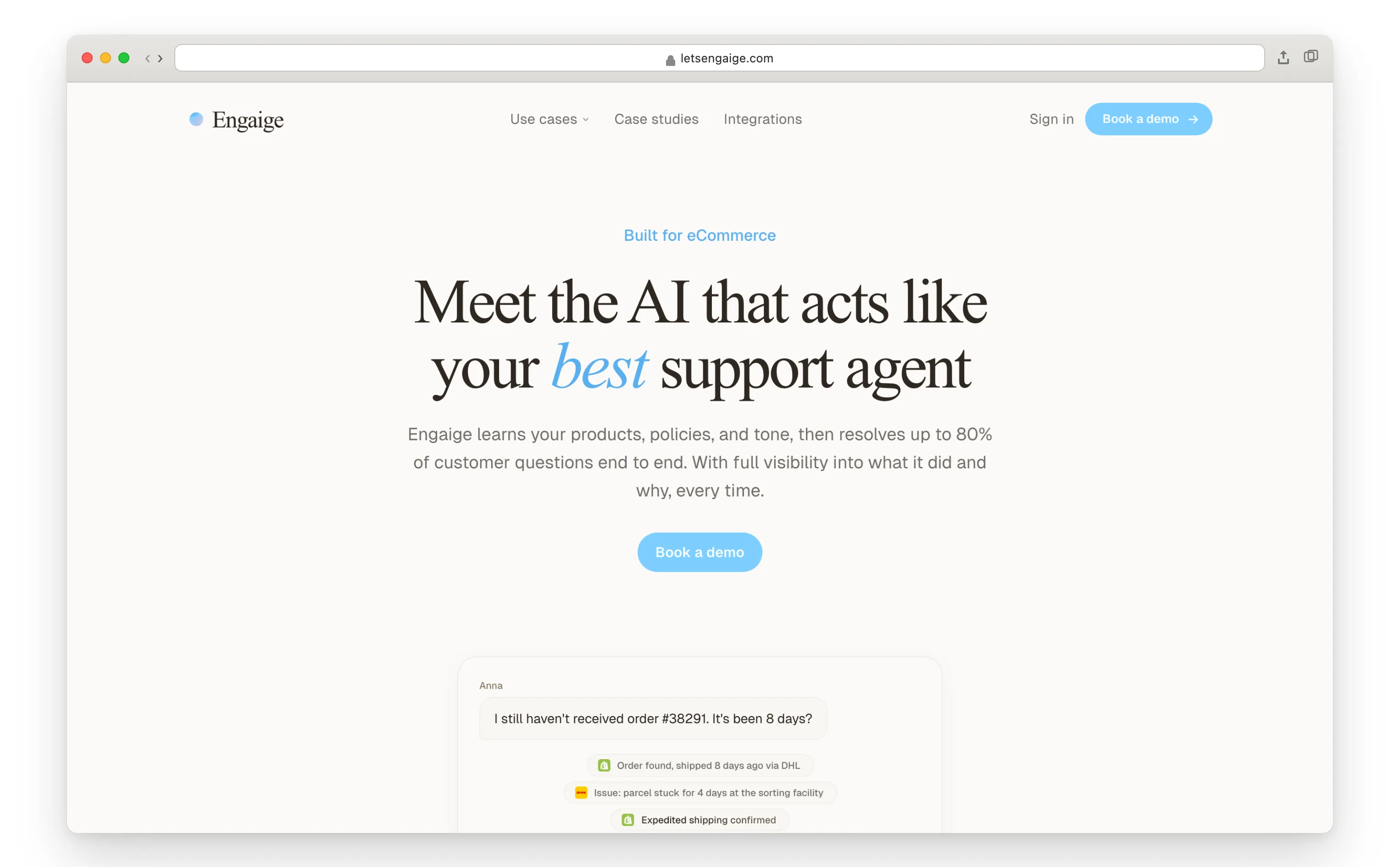
Engaige is a continuously improving AI agent for customer service, built for e-commerce support teams in industries like fashion, beauty, and electronics. On BigCommerce it connects through the documented API and resolves tickets end to end: it reads the order, applies your policies, and executes the refund, cancellation or subscription change itself.
That is the full action set a support ticket needs, which ties any vendor documenting the same depth (Minimal does), and it is our claim, so apply the same scepticism to it as to every other vendor’s on this list. The integration is listed on our integrations page. If a connection you need is not there yet, we build it on demand and you are live in about a week.
The verified outcomes, with the case studies open for inspection: Otrium resolves 60% of 120,000 annual tickets autonomously, and HelloPrint automated 80% of support, cut first-response time by 90%, and shrank its team from 100 to 28. The “up to 90%” we state is our ceiling at the deepest integrations, the same kind of vendor-stated ceiling you should challenge every supplier on.
The honest beat, and it is about the ceiling rather than the launch: you go live in Agent Assist within hours, not months, and resolution compounds from there.
The engine is a self-improvement loop, not a setup wizard: from day one it learns from your team’s normal work. What your team sends compared with what the agent suggested is one of its training signals, and Engaige AI proposes changes to policies and behaviour with its reasoning, which you approve in plain language. We found no competitor that publicly describes learning from that everyday gap with changes a human approves.
The full reasoning for every answer and action sits in the Engaige dashboard, and at a hand-over the agent leaves a reasoning summary as an internal note on the ticket. Policies support thresholds and a per-step choice between Automated and Agent Assist, and you test them in the Playground before launch.
Once a ticket type has learned enough, you switch it to autonomous (most brands get there in about a week), and it keeps learning there too, surfacing emerging trends and the cases where it hands a ticket back to a human. From there it keeps climbing toward up to 90% of supported tickets, our ceiling at the deepest integrations.
Inside BigCommerce it can: read orders, customers and products in real time through the documented API; process refunds and cancellations per your policy; handle subscription changes; automate shipping, returns and order enquiries end to end.
The catch: our named outcomes (Otrium, HelloPrint) are e-commerce deployments, not BigCommerce case studies, so hold us to the sandbox test like everyone else here, and budget for an initial training phase.
Key features:
- Self-improving AI: learns from your team’s replies in Agent Assist, then from live outcomes and hand-offs once autonomous
- AI agent trained on your company’s policies, in plain language (no prompt engineers)
- Acts through the documented BigCommerce API: refunds, cancellations, subscription changes
- AI agent integrated with your product catalogue
- Automates conversations via email, chat and social
- You can test and preview your AI agent outputs before they go live
Pros
- Resolves the repetitive middle end to end: named outcomes of 60% (Otrium) and 80% (HelloPrint), with up to 90% as our stated ceiling
- Full control and transparency over AI behaviour
- A flat monthly fee tied to your ticket volume, predictable as you scale
Cons
- Reaches its highest resolution ceiling over a few weeks of policy training, not on day one, though you go live within hours
Best for: BigCommerce stores in fashion, beauty and consumer electronics looking to scale customer service with deep automation.
Engaige offered control, flexibility, and the ability to really incorporate AI in a more human way.

Engaige proved to be invaluable. Their hands-on support during the implementation phase resulted in significant improvements to our automated resolution rate and CSAT.

2. eesel
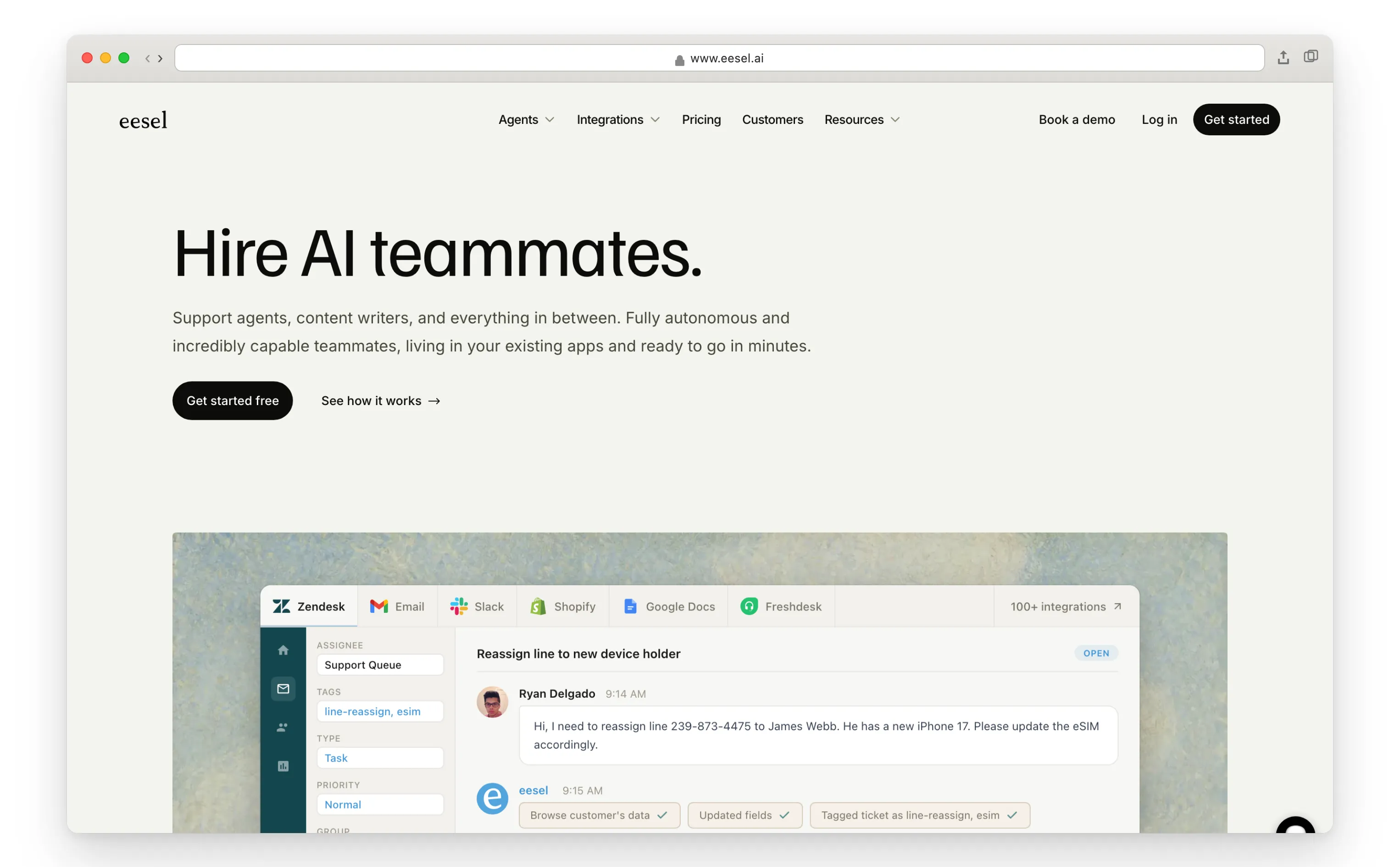
eesel is an AI agent that connects to BigCommerce via API and, per its BigCommerce page, syncs your catalogue, customer groups, orders and policies so it can answer with live store data (vendor-stated). On the action side, its published BigCommerce capability is handling return requests, in semi-automatic and autonomous modes. Pricing is unusually clean: $0.40 per chat session with no platform fee (vendor-stated).
Inside BigCommerce it can: sync catalogue, customer groups, orders and policies; answer order and product questions from live data; handle return requests semi-automatically or autonomously.
The catch: the published BigCommerce action list stops at returns. We could not verify refund execution on its BigCommerce integration page, so if refunds matter, ask eesel to demonstrate that on your store before you commit.
Key features:
- API-based BigCommerce integration with catalogue, order and policy sync
- Return requests handled in semi-automatic or autonomous mode
- Per-session pricing: $0.40 per chat session, no platform fee (vendor-stated)
- Lightweight footprint that layers on your existing helpdesk and channels
Pros
- Published, predictable per-session pricing with no platform fee
- AI-executed (not agent-side) handling of return requests
- Easy to pilot without replatforming your support stack
Cons
- Published BigCommerce actions cover returns; deeper order actions are not documented on its integration page
- No published BigCommerce resolution rate or named BigCommerce customer outcome
Best for: Teams that want AI-executed returns handling at a transparent per-session price.
3. Tidio
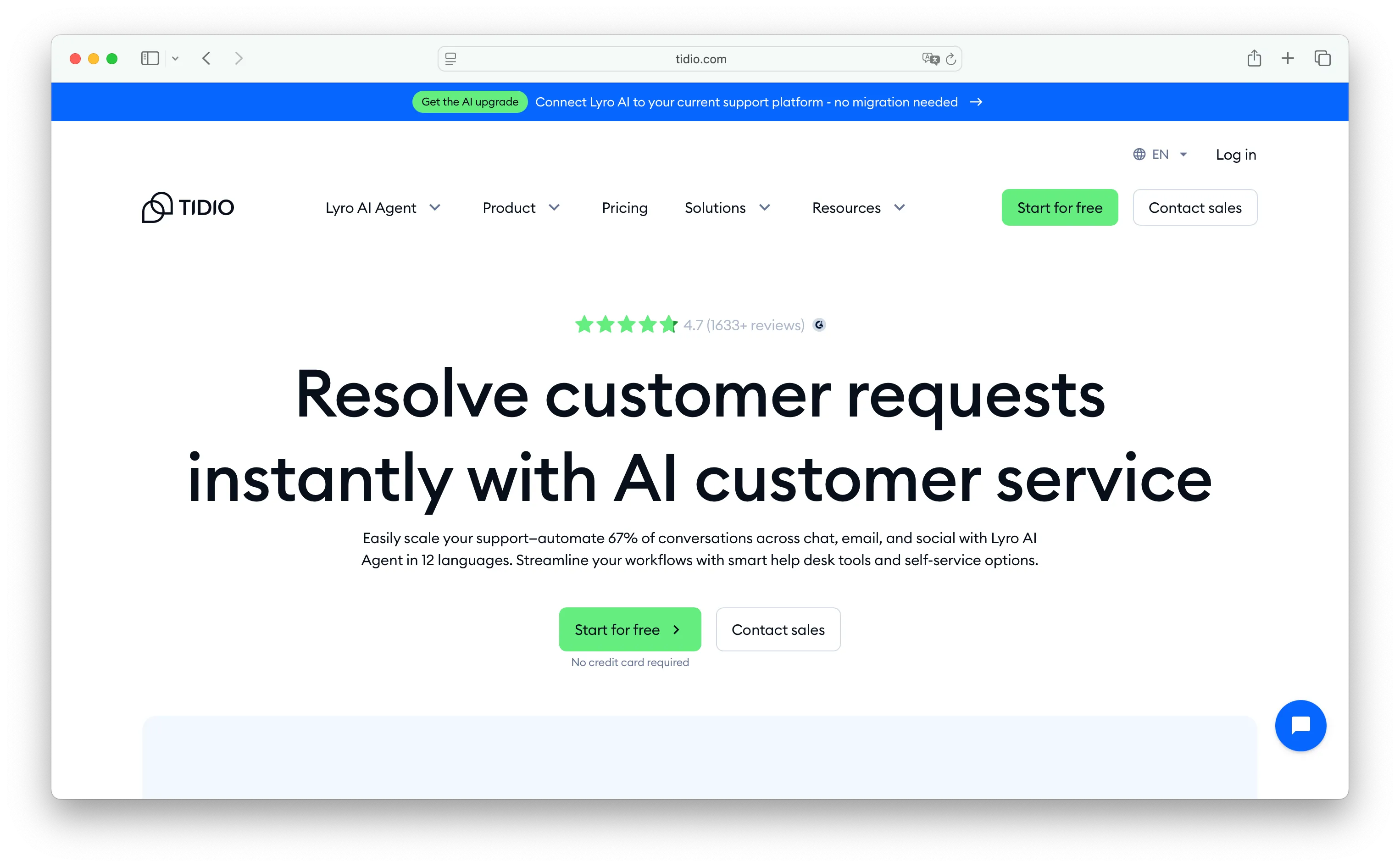
Tidio is the SMB entry: live chat plus its AI agent Lyro, installed via the BigCommerce marketplace app. Tidio states its customers average a 75% resolution rate with Lyro (vendor-stated, platform-wide, checked October 2026), with Lyro sold as a monthly add-on by conversation volume. It is the fastest route on this list to a working chat widget with AI answering.
Inside BigCommerce it can: install from the marketplace app; answer FAQ and product questions through Lyro across chat, email and social. How far Lyro acts on BigCommerce orders specifically is not published.
The catch: Lyro’s BigCommerce action depth is unpublished, so we scored it conservatively. Treat order actions as unverified until you test them on your own store.
Key features:
- Quick installation via the BigCommerce marketplace app
- Customisable website chat widget to match branding
- Omnichannel inbox for managing chat, email, and social
- Lyro AI for multilingual FAQ answering
Pros
- Easy to set up, fast time-to-value
- Combines live chat and AI chatbot in one platform
- Publishes a headline resolution rate (75%, vendor-stated) you can hold it to
Cons
- BigCommerce-specific action depth is not published
- Lyro is strongest on FAQs; commerce actions are newer and integration-dependent
Best for: SMBs needing a simple AI chatbot on BigCommerce without deep automation.
4. Minimal
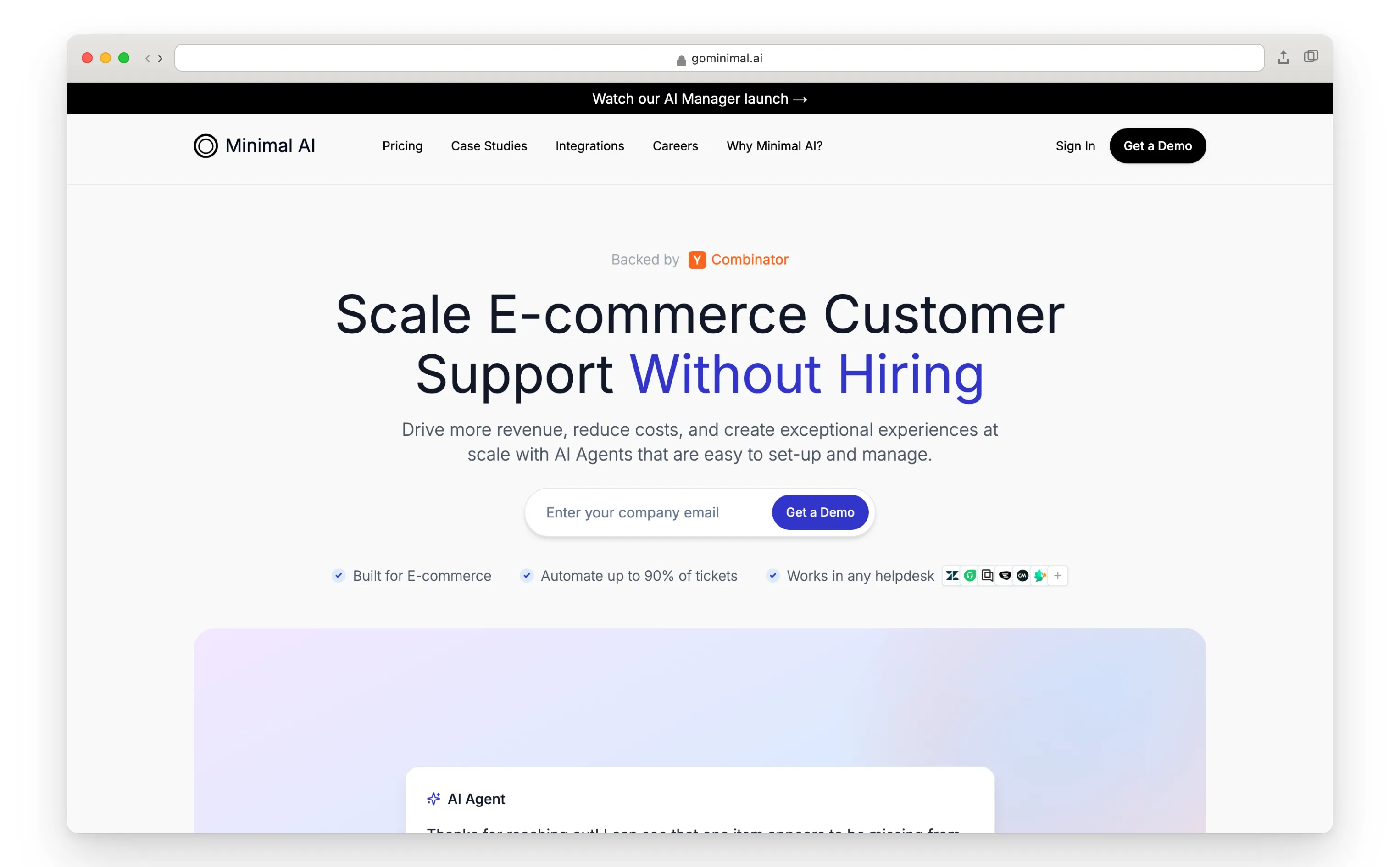
Minimal states on its BigCommerce page that its agent “connects to the BigCommerce API and takes real actions” (vendor-stated): refunds through the Orders V3 API with line-item precision, order status updates, shipments, customer info, inventory checks and order creation. On documentation, that is an AI-executed action list in the same depth band we document, rather than agent-side buttons. Documentation is where the parity ends.
On the documented-depth axis both list the full needed-action set, so the scores meet there. They part on everything that proves it: we publish named outcomes (Otrium, HelloPrint) and Minimal does not, which is why it trails us on resolution and on the weighted total.
Inside BigCommerce it can: process refunds via Orders V3 with line-item precision; update order status; manage shipments; read customer info and inventory; create orders.
The catch: the depth is documentation-verified, not outcome-verified. Minimal publishes no named BigCommerce customer outcomes, which is exactly what holds it back in the matrix below.
Key features:
- AI-executed actions through the BigCommerce Orders V3 API
- Line-item precision on refunds
- Order creation and shipment handling, not just lookups
- Detailed per-platform integration documentation
Pros
- A documented action list as deep as any on this page
- Acts through the API rather than handing buttons to agents
- Publishes its action depth in concrete, checkable terms
Cons
- No public pricing, so budget predictability is a quote away
- No published resolution rate or named BigCommerce customer outcome
Best for: Stores that want deep, API-executed order actions and are willing to go through a quote process.
5. Gorgias
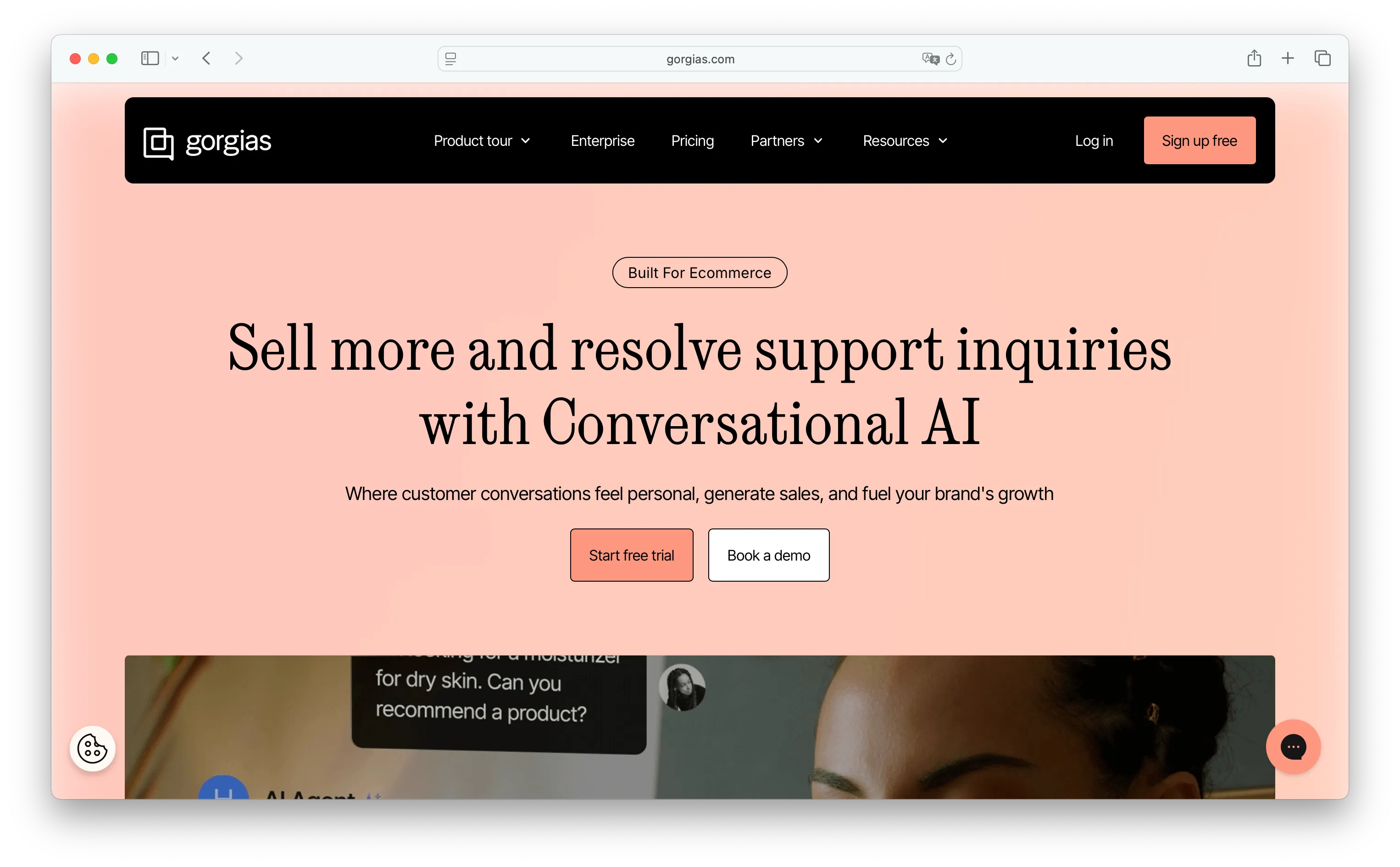
Gorgias is the e-commerce helpdesk most teams arrive at from Shopify comparisons, and on BigCommerce the offer is different. Its BigCommerce integration, built with partner Blueant Solutions, lets agents “create, duplicate, and refund BigCommerce orders within Gorgias” (vendor-stated). The AI layer is the limit: Gorgias’s documentation states its AI Agent “is not supported on stores that use BigCommerce, Magento or WooCommerce”.
For context, the “60% of inquiries resolved instantly” headline on its AI Agent page (vendor-stated) belongs to Shopify, where the AI Agent runs. On BigCommerce, what you are buying is a strong multichannel helpdesk with real agent-side order controls.
Inside BigCommerce it can: let your human agents create, duplicate and refund BigCommerce orders inside the helpdesk; centralise email, chat and social in one inbox.
The catch: every order action here is agent-side: a human clicks the button. The autonomous AI Agent that defines Gorgias on Shopify is not part of its BigCommerce offer, per its own documentation.
Key features:
- Agent-side BigCommerce order actions: create, duplicate, refund (partner-built integration)
- Multichannel inbox combining email, chat, and social in one platform
- Robust macros for agent productivity and consistent responses
- Documentation that states its platform limits plainly
Pros
- Real BigCommerce order controls without leaving the helpdesk
- Strong helpdesk features and ecosystem
- Unusually clear docs about what is and isn’t supported
Cons
- AI Agent not offered on BigCommerce stores, per Gorgias’s own documentation
- Agent-side actions still consume human time on every ticket
Best for: BigCommerce teams that want a polished helpdesk with agent-side order actions and don’t need autonomous AI resolution yet.
6. Re:amaze
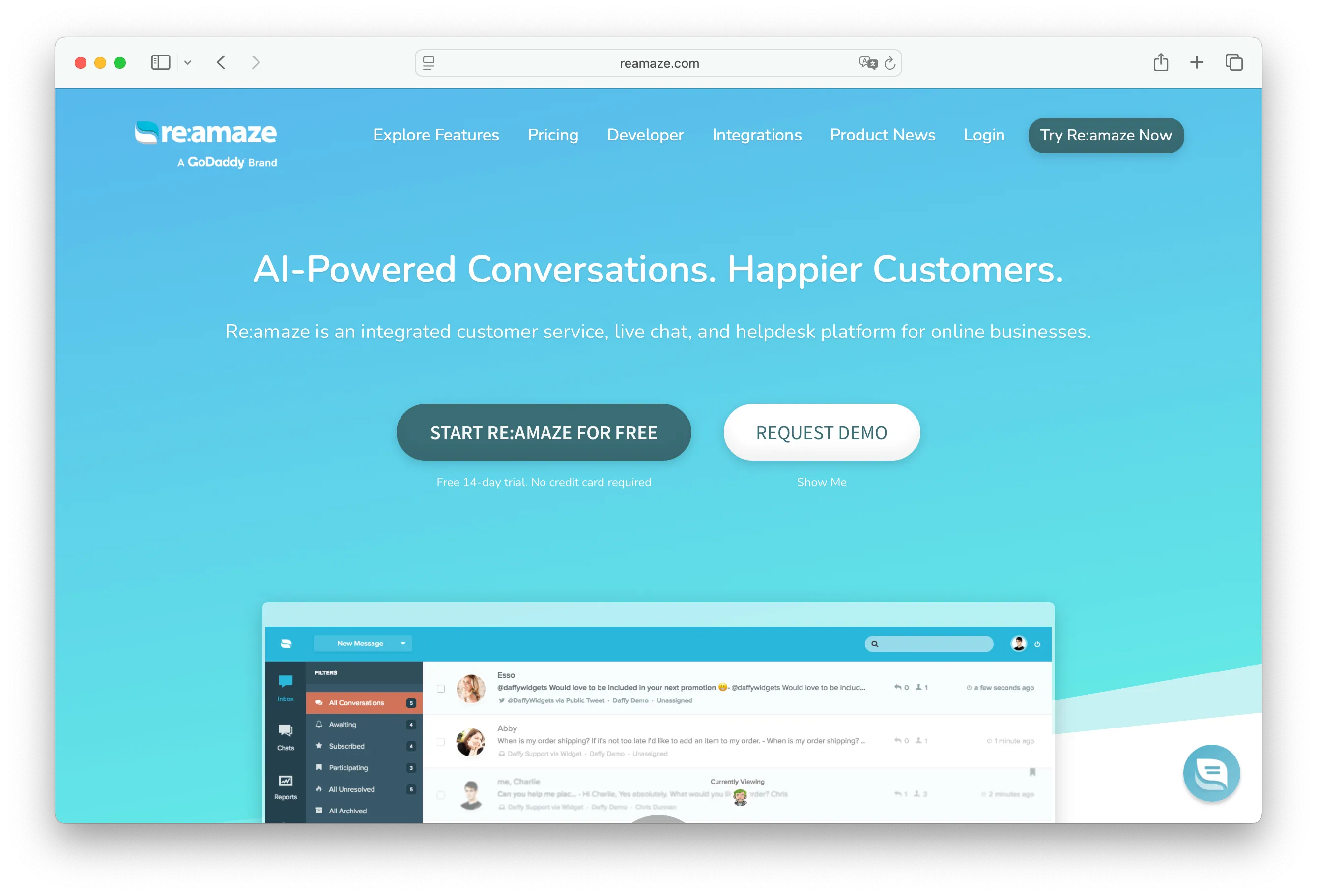
Re:amaze is a multichannel helpdesk whose BigCommerce integration page is unusually concrete: it lists the “ability to refund each order” and the “ability to cancel each order”, with orders, items and fulfilments shown alongside conversations (vendor-stated). Those controls are agent-side, and its AI assists by drafting replies rather than resolving autonomously.
Inside BigCommerce it can: show orders, items and fulfilments next to each conversation; let agents refund and cancel each order; draft replies with AI assist.
The catch: like Gorgias, the refund and cancel buttons belong to your agents. The AI drafts; humans execute. Good for agent speed, not for removing tickets from the queue.
Key features:
- Unified inbox across email, live chat, social and SMS
- Per-order refund and cancel actions for agents, in the conversation view
- Order, item and fulfilment data shown alongside each ticket
- AI drafting assistance for faster agent replies
Pros
- The clearest agent-side action list of any helpdesk on this page
- Multichannel inbox to handle every support channel in one place
- Order context in the conversation cuts lookup time
Cons
- AI is assistive, not action-based: most issues still need a human
- Focuses on agent productivity, not autonomous resolution
Best for: Teams that want AI-assisted agents with real per-order controls across many channels, not full automation.
7. Zipchat
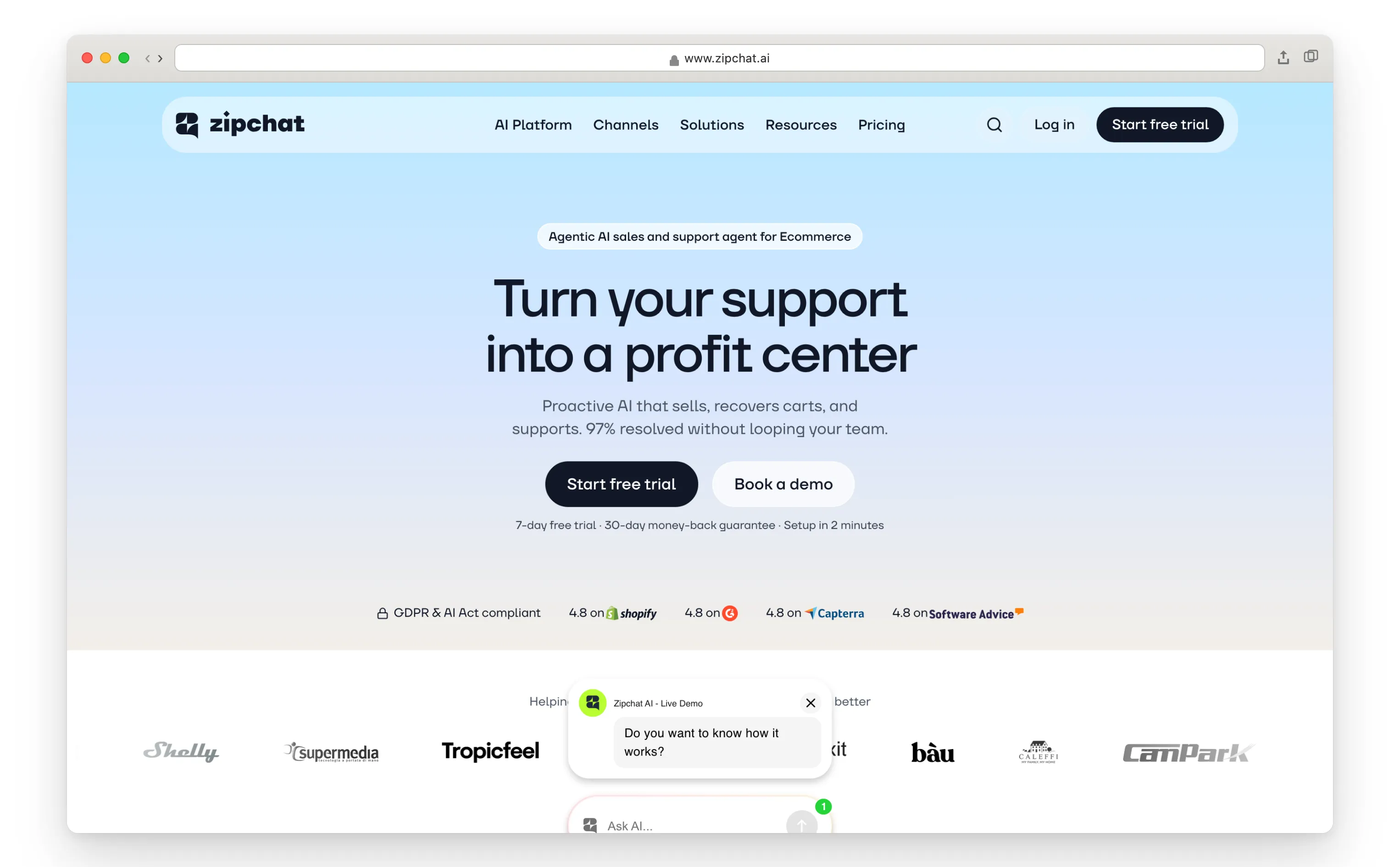
Zipchat is the budget baseline of this list, and the baseline matters here: BigCommerce ships no native chat app, so there is no free Shopify-Inbox equivalent to try first (we checked the marketplace, June 2026). Zipchat starts from $49 per month (vendor-stated), installs via Script Manager, queries the orders endpoint, and supports custom tools for coupons and refunds.
Inside BigCommerce it can: install through Script Manager; query the orders endpoint for order data; run custom-built tools for coupons and refunds that you configure.
The catch: out of the box it reads order data. The coupon and refund “custom tools” are things you configure and build, not a published end-to-end action list, so depth depends on your own setup work.
Key features:
- Entry pricing from $49/month (vendor-stated)
- Script Manager install, no replatforming
- Orders endpoint queries for live order data
- Custom tools for coupons and refunds
Pros
- Cheapest published entry point on this list
- Fast to install on a BigCommerce storefront
- Extensible through custom tools if you invest the setup time
Cons
- Action depth depends on custom tools you build yourself
- No published resolution rate or named BigCommerce customer outcome
Best for: Small BigCommerce stores that want an affordable chat-plus-AI baseline before investing in deep automation.
Comparison of the best AI agents and support chatbots for BigCommerce stores
On BigCommerce, two tools document AI-executed actions through the API: Engaige and Minimal. Two helpdesks, Gorgias and Re:amaze, give human agents real order buttons. eesel executes returns at a per-session price, while Tidio and Zipchat are fast, shallow chat layers. The table below maps each tool to its tier and its key limitation.
| Tool | Best for | Inside BigCommerce it can | Automation level | Key limitation |
|---|---|---|---|---|
| Engaige | Automating support at scale | Read orders/customers/products via API; refunds, cancellations, subscription changes | End-to-end resolution (named 60-80%, up to 90% ceiling) | Initial policy-training phase |
| eesel | AI-executed returns at per-session pricing | Sync catalogue/customer groups/orders/policies; handle returns | Semi-auto/autonomous on returns | Refund execution not documented on its BigCommerce page |
| Tidio | Fast, affordable SMB setup | Marketplace app; Lyro FAQ and product answers | 75% vendor-stated (platform-wide) | BigCommerce action depth unpublished |
| Minimal | Deep documented API actions (ties Engaige) | Refunds via Orders V3 (line-item), status, shipments, create orders | AI-executed (no published rate) | Flat per-ticket pricing public, but no named BigCommerce outcomes |
| Gorgias | Helpdesk with agent-side order controls | Agents create, duplicate, refund orders | Agent-side; AI Agent not on BigCommerce (their docs) | A human clicks every action |
| Re:amaze | Multichannel agent assist | Agents refund and cancel each order; order data in chat | Agent-side + AI drafting | AI does not execute actions |
| Zipchat | Budget chat baseline | Script Manager install; orders endpoint; custom tools | Read + custom-built actions | Depth depends on what you build |
How do they score side by side?
Engaige leads the weighted matrix at 4.85 out of 5, with Minimal (3.7) next, then eesel (3.3) and Tidio (3.2), Gorgias on 3.1, Re:amaze on 2.9 and Zipchat on 2.6. Scores are 1-5 per criterion, multiplied by weight, summed and rounded to one decimal, sorted highest first.
The ranking is not a single rule. A tool’s resolution ceiling is roughly its action depth times its integration breadth, with depth the heavier multiplier, which is why depth and resolution carry the joint-heaviest weight at 25% each. Engaige leads, with Minimal level on the documented-depth axis at 5; what then moves their totals apart is substantiation under the other criteria, where Engaige comes out the stronger supplier.
The criteria and weights match our e-commerce comparison, but every criterion is scored for a BigCommerce deployment specifically, pricing and configurability included, so a vendor’s scores can differ across our platform guides and totals are not 1:1 comparable. Based on public information and our own research, June 2026.
Our claims, pricing and configurability are the same on every platform; time-to-value is scored per platform, so our row can shift by a cell between guides, and competitor rows move because theirs differ. We are Engaige, so hold our own row to the same test: the scores credit named outcomes you can open over homepage claims, and substantiation counts toward transparency.
| Tool | BigCommerce depth (25%) | Resolution (25%) | Pricing (15%) | Transparency (15%) | Time-to-value (10%) | Config (10%) | Weighted |
|---|---|---|---|---|---|---|---|
| Engaige | 5 | 5 | 5 | 4 | 5 | 5 | 4.85 |
| Minimal | 5 | 3 | 4 | 3 | 3 | 3 | 3.7 |
| eesel | 3 | 3 | 4 | 3 | 4 | 3 | 3.3 |
| Tidio | 2 | 3 | 4 | 3 | 5 | 4 | 3.2 |
| Gorgias | 3 | 2 | 3 | 4 | 4 | 4 | 3.1 |
| Re:amaze | 3 | 2 | 3 | 3 | 4 | 3 | 2.9 |
| Zipchat | 2 | 2 | 4 | 2 | 4 | 3 | 2.6 |
A fair word on the table. Minimal matches us on the documented-depth axis at 5, with a documented action list as long as ours, and its flat, public per-ticket pricing scores well on predictability too. But Engaige still leads overall: what separates us is substantiation, and Minimal trails us on proven resolution and on the weighted total.
And eesel’s published per-session price is more transparent than any quote. Gorgias’s transparency score credits documentation honest enough to say what isn’t supported. Engaige’s lead does not come from out-acting the field on paper; it comes from named outcomes you can open, flat pricing, and plain-language configurability.
Hold our numbers to the same test as everyone else’s. Our named, verifiable outcomes are Otrium (60% of 120,000 annual tickets) and HelloPrint (80%), each a full case study you can open. The “up to 90%” on our homepage is our ceiling at the deepest integrations: the same kind of vendor-stated ceiling you should challenge every supplier on, us included.
Verdict per criterion
No tool wins on everything, and Engaige is the best supplier overall. Engaige leads on depth with Minimal matching it on the documented axis only, Engaige takes resolution on named outcomes, the published pricing models take predictability, Gorgias earns transparency credit for honest docs, Engaige and Tidio top time-to-value, and the plain-language tools win configurability. Per criterion, the picture looks like this.
- BigCommerce-native action depth. Led by Engaige, with Minimal matching its documented action set on this axis; both execute through the API rather than handing buttons to agents. Gorgias and Re:amaze go deep too, but agent-side: real buttons, human fingers.
- Resolution level. Won by Engaige on named, openable outcomes (60% and 80%). Tidio publishes a platform-wide 75% (vendor-stated); eesel and Minimal act but publish no BigCommerce rates; Gorgias and Re:amaze keep a human in the loop here.
- Pricing predictability. Shared by the published flat and usage models: Engaige’s flat monthly fee, Minimal’s flat per-ticket pricing, eesel’s $0.40 per session with no platform fee, Zipchat’s from-$49 entry, Tidio’s tiers. The cost that decides it is per resolved ticket, not the sticker price: a ticket the AI does not resolve is handled again by a human, so Engaige’s named 60-80% outcomes carry the criterion.
- Transparency and control. Engaige leads on preview and visible decisions backed by open case studies; Gorgias earns credit for docs that state platform limits plainly; Minimal documents depth but not outcomes.
- Time-to-value. Led by Engaige and Tidio. Tidio is live in minutes via the marketplace app and the light installs (Zipchat via Script Manager) start fast too; Engaige matches them through Engaige AI, live within hours in plain language, and unlike a plug-and-play start it keeps climbing to a higher ceiling, the ramp-up we explain in the e-commerce guide.
- Configurability. Won by the plain-language tools (Engaige, Tidio) a CX team can run without a developer; Zipchat’s custom tools are powerful but need build work.
What does an AI agent for BigCommerce cost?
AI support on BigCommerce is priced four ways: per session (eesel, $0.40 per chat, no platform fee), tiered subscriptions (Zipchat from $49/month; Tidio plans with a Lyro add-on sized by conversation volume), flat monthly tied to a ticket volume (Engaige), or helpdesk plans the AI sits on top of (Gorgias, Re:amaze). Minimal publishes flat per-ticket pricing (from €489/mo), though not a BigCommerce-specific rate.
| Tool | Pricing model | What to watch |
|---|---|---|
| Engaige | Flat monthly fee tied to a ticket volume | Predictable as volume grows; ramp-up weeks first |
| eesel | $0.40 per chat session, no platform fee (vendor-stated) | Bill scales linearly with conversation volume |
| Tidio | Tiered plans; Lyro add-on sized by conversation volume (vendor-stated) | Choose the add-on tier that fits your conversation volume |
| Minimal | Flat per-ticket, public | Public tiered pricing from €489/mo; no BigCommerce-specific rate |
| Gorgias | Ticket-volume helpdesk plan; AI Agent per-resolution fees apply on Shopify, where the AI Agent runs | On BigCommerce you are buying the helpdesk plan, not resolutions |
| Re:amaze | Plan-based helpdesk pricing; current tiers on its pricing page | Per-seat vs per-tier split as your team grows |
| Zipchat | From $49/month (vendor-stated) | Custom action tools cost setup time, not licence fees |
The two-layer anatomy to watch: if the tool is also your helpdesk, you pay for the helpdesk before any AI. On BigCommerce that layer is the whole Gorgias and Re:amaze bill, because the autonomous AI layer either isn’t offered here (Gorgias, per its docs) or is drafting-assist (Re:amaze). The honest comparison across all seven is total cost per resolved ticket, not the headline per-unit price.
FAQs about AI agents and support chatbots for BigCommerce
The questions BigCommerce store owners ask most before choosing a tool, answered with the same sourcing rules as the rest of this guide.
Does BigCommerce have a built-in AI chatbot for customer support?
No. BigCommerce ships no native chat app, so there is no free equivalent of Shopify Inbox to try first (we checked the marketplace, June 2026). Every option is a third-party app or API integration, which is why the budget slot on this list is a paid one: Zipchat, from $49 per month (vendor-stated).
Can Gorgias’s AI Agent run on a BigCommerce store?
Per Gorgias’s own documentation, its AI Agent “is not supported on stores that use BigCommerce, Magento or WooCommerce”. Its BigCommerce integration, built with partner Blueant Solutions, gives your human agents the ability to create, duplicate and refund orders inside the helpdesk. That is agent-side tooling, not autonomous AI resolution.
What is the difference between a chatbot, an agent-side integration and an AI agent on BigCommerce?
A chatbot answers scripted FAQs and escalates everything real. An agent-side integration (Gorgias, Re:amaze) gives your human agents order buttons such as refund and cancel inside the helpdesk, so actions are real but manual. An AI agent (Engaige, Minimal, eesel on returns) executes actions itself through the BigCommerce API, under your policies.
How many tickets can an AI agent resolve for a BigCommerce store?
The vendor-stated figures on this list span Tidio’s platform-wide 75% average and Engaige’s named outcomes of 60% (Otrium) and 80% (HelloPrint), with “up to 90%” as a stated ceiling. Treat every headline rate as a ceiling, not a guarantee, and pilot on your own ticket mix, asking each vendor which named customer produced their number.
What does an AI agent for BigCommerce cost?
Four models: per chat session (eesel, $0.40 with no platform fee), tiered subscriptions (Zipchat from $49/month; Tidio plans plus a Lyro add-on by conversation volume), flat monthly tied to ticket volume (Engaige), or helpdesk plans that agent-side actions ride on (Gorgias, Re:amaze). Minimal is flat per-ticket and public. Compare tools on total cost per resolved ticket, not the per-unit headline: a ticket the AI does not resolve is handled again by a human, which is the real cost.