AI customer service is worth it for a small ecommerce team when repetitive questions fill the inbox and the team is close to its limit. The value is not a smaller team. It is capacity, faster replies, cover in the evenings and at peaks, and time for work that earns money. With a quiet inbox, it is too early.
This guide is for an online store with one or two people on support who are staying. It sits under our explainer on AI agents in customer service.
Is AI customer service worth it for a small ecommerce team?
Yes, when three things are true: a large share of your tickets are the same few questions, the one or two people who answer them are near capacity or keep being pulled off other work, and evenings, weekends or peaks go unanswered. Not yet, when one person clears the inbox comfortably.
This is a common doubt, not an edge case. Buyers regularly ask us whether they are too small for an AI support agent, or what the value is when they do not plan to cut staff or already run lean.
The doubt is fair, because most business cases count agents saved. A team of one or two has no fraction of a job to save, so the case has to rest on something else.
Where does the value come from if you are not cutting staff?
From four places: capacity, so the store can grow without the team growing at the same pace; response time; cover outside working hours and at peaks; and time back for work that earns money. None of them needs a smaller team, and keeping your staff is what most companies do.
A Gartner survey of 321 service leaders in October 2025 found that 55% kept staffing stable while handling more volume, and 20% had cut headcount because of AI (Call Centre Helper, 2025). In Gorgias platform data from March 2026, 23.5% of brands reduced their team after switching on its AI agent, so roughly three in four did not (Gorgias, 2026). That headcount analysis only covers teams of three or more, so teams of one or two are not in it.
- Capacity: among Gorgias brands that grew ticket volume by at least 20% in a year and had 60% or more automation, ticket volume grew 143% year on year while human hours grew 6%. It is Gorgias data on its own merchants, so it shows a direction, not a promise.
- Speed: in the same data, median first response time halved after brands enabled the agent. Our response time guide has the benchmarks.
- Evenings and weekends: 53% of pre-purchase questions arrive outside business hours, and the median human first response to those questions stretches from 2.2 hours in business hours to about 15 after hours (Gorgias, 2026). Ticket types an autonomous agent handles do not wait for the morning.
- Peaks: a team of two cannot add hours for a sale week, so the queue grows instead. An agent’s capacity stretches with the volume (peak season).
- Time back: in a small store the person on support also packs, buys stock or runs the marketing. Every repeat question the agent handles is time for that work, or for pre-sale product advice.
What to measure on your own tickets for each lever:
| Lever | What changes for a team of one or two | What to measure on your own tickets |
|---|---|---|
| Capacity | Volume can grow without the next hire being urgent | Tickets handled per person-hour |
| Speed | Repeat questions get an answer without waiting for a person | First response time, by hour of arrival |
| Cover | Evenings, weekends and sale weeks are answered | Share of tickets arriving outside working hours, and how long they wait |
| Time back | Hours return to the other jobs the same person does | Hours a week spent on the same ten questions |
How many support tickets do you need before an AI agent pays off?
An AI agent can help a store of any size, but we see the gain from about 1,000 tickets a month. Beyond that, payback depends on three things: the share of tickets that repeat, your volume set against the vendor’s fee, and how close the team is to its limit. Published thresholds differ because each one rests on an assumed price, handling time and automation rate.
A published rule from another vendor lands in the same range. As of November 2026, melibo, a German vendor, puts the point where a fully automated agent pays off at around 1,200 tickets a month, based on an hourly rate of €45, six minutes a ticket and 40% automation. At €55 an hour, the same page lowers it to 900 to 1,000 (melibo, 2026).
A better first test is the repeat rate. Fin’s rule of thumb looks at how much of the inbox comes down to the same ten or so questions: above roughly half, it says automating costs less whatever the volume; below a quarter, it does not (Fin, 2026). Fin itself calls this a rule of thumb, and its data come from early-stage software companies, not stores.
To find your own number, tag two to four weeks of tickets by type, count the repeats and time them, then use the formula in our ROI guide; its worked example gives one break-even point on stated assumptions, and yours will move with your own inputs. Payback also depends on the share the agent really resolves, which our guide to resolution rate explains.
When is it too early for an AI agent?
It is too early when one person clears the inbox inside working hours with time to spare, when few questions repeat, or when there is no help desk and no written policy yet. Cheaper fixes come first then, and the agent can wait until the signals change.
| Signal | Too early | Ready |
|---|---|---|
| Inbox | Cleared daily with time to spare | Backlog after weekends and peaks |
| Questions | Mostly one-offs or bespoke advice | The same handful every day |
| Tooling | A shared mailbox | A help desk in place |
| Policies | Decided case by case | Written down for returns, late parcels and cancellations |
| Hours | Few contacts outside working hours | Many arrive in the evening and at weekends |
| Growth | Flat | The next support hire is on the table |
If you are in the left column, start with a clear FAQ, saved replies and tracking emails, and a help desk once more than one person answers. Our guide to help desk software covers that choice, and ticket reporting shows how to measure ticket types.
In money terms, an AI agent’s fee is usually tied to a ticket volume or charged per resolved ticket. Far below the volume a plan is built for, the cost per ticket is high, so ask every vendor how the fee relates to your volume.
Mix matters as much as volume. If most contacts are bespoke, technical or business-to-business, an agent works better as a drafting assistant than as an autonomous front door; see replace or augment. And if phone is a large share of your contacts, a text-first agent covers less of your load. Look again when volume grows faster than the team, or when you start writing the advert for the next support hire.
Is an AI agent better value than hiring another support person?
They solve different problems. A hire adds judgement and a fixed block of hours. An AI agent adds capacity on the repeat questions at every hour and stretches at peaks. When the extra work is mostly repeat questions, the agent comes first and the next hire becomes a choice, not a rescue.
| Part-time hire | Outsourced or freelance agent | AI agent | |
|---|---|---|---|
| Hours covered | Fixed shifts | Agreed hours | Every hour |
| Sale weeks and peaks | Same hours, longer queue | Extra hours by arrangement | Stretches with volume |
| Exceptions and upset customers | Strong | Depends on the briefing | Handed to a person |
| What it needs from you | Training and management | Briefing and quality checks | Written policies and someone who approves changes |
A hire only helps weeks after you decide: recruiting, training and getting a new colleague up to speed all come first, so the decision has to be made before the queue grows (Fin, 2026). To be fair to people: part-time or outsourced staff can be the better deal for a quiet inbox, and our posts on BPO vs AI and outsourcing customer care compare the costs. What they cannot give is evenings, peaks and the same answer every time.
Hire for judgement, not for the same twenty questions. A hire is due when the work left for people gets harder, more cases carry risk, and everyone is tied up answering with no room to improve anything. Fin’s guide lists the same signs (Fin, 2026).
What can an AI agent take off a team of one or two?
The repeat questions with a rule behind them: where is my order, returns and refunds, address changes and cancellations before shipping, and product questions. Complaints, disputes and one-off exceptions stay with your people, who now have the time for them.
Reading and acting are different things. An agent that reads the live order and the carrier’s tracking can answer an order-status question properly (WISMO). One that can also act changes the order, starts the return or issues the refund (refunds and returns).
An agent that only drafts is still useful: in a study of 5,179 support agents, an AI assistant raised issues resolved per hour by 14% on average and by 34% for novices (NBER, 2023). The larger gain comes once the agent can act.
If order tracking is not your main load, count what repeats among the harder tickets. Damaged or missing items follow a rule too (damaged items).
The agent works across the tools you already use: a help desk such as Gorgias or Zendesk, carriers such as PostNL or DHL, and returns tools such as Loop Returns or Returnless.
Can a small team run an AI agent without an AI specialist?
Yes, when the agent is run in plain language and proposes its own improvements. It needs an owner, not a specialist: someone who writes down the policies you would give a new colleague, approves proposed changes and reads the tickets it hands over.
In a normal week the owner does three things:
- Write or adjust a policy in plain language when a rule changes, such as a new returns window.
- Review and approve the changes the agent proposes before they go live.
- Read the handed-over tickets, which show where a rule is missing or unclear.
The work is deciding policy, which a small team already does case by case. What the agent may do alone and where a person checks first is covered in our guardrails guide.
How does a small team start with an AI agent?
Small and supervised. Measure your ticket types, pick one repeat type and let the agent draft while a person sends. Switch that type to autonomous once the drafts match what you would have sent, then take the next type.
This order suits a team of one or two, which cannot afford a bad week with customers: in draft mode nothing reaches a customer without a person. The full sequence is in our implementation guide.
Where does Engaige fit?
Engaige (that’s us) is the e-commerce-native AI support agent that works inside the help desk you already run. Keep your helpdesk. Replace the AI. Behind it is Engaige AI, which learns from your conversations and inputs and configures your support agent. Otrium has 60% of 120,000 annual tickets resolved end to end with Engaige.
With Engaige, we are able to automatically resolve 60% of the 120,000 support tickets that we receive annually.

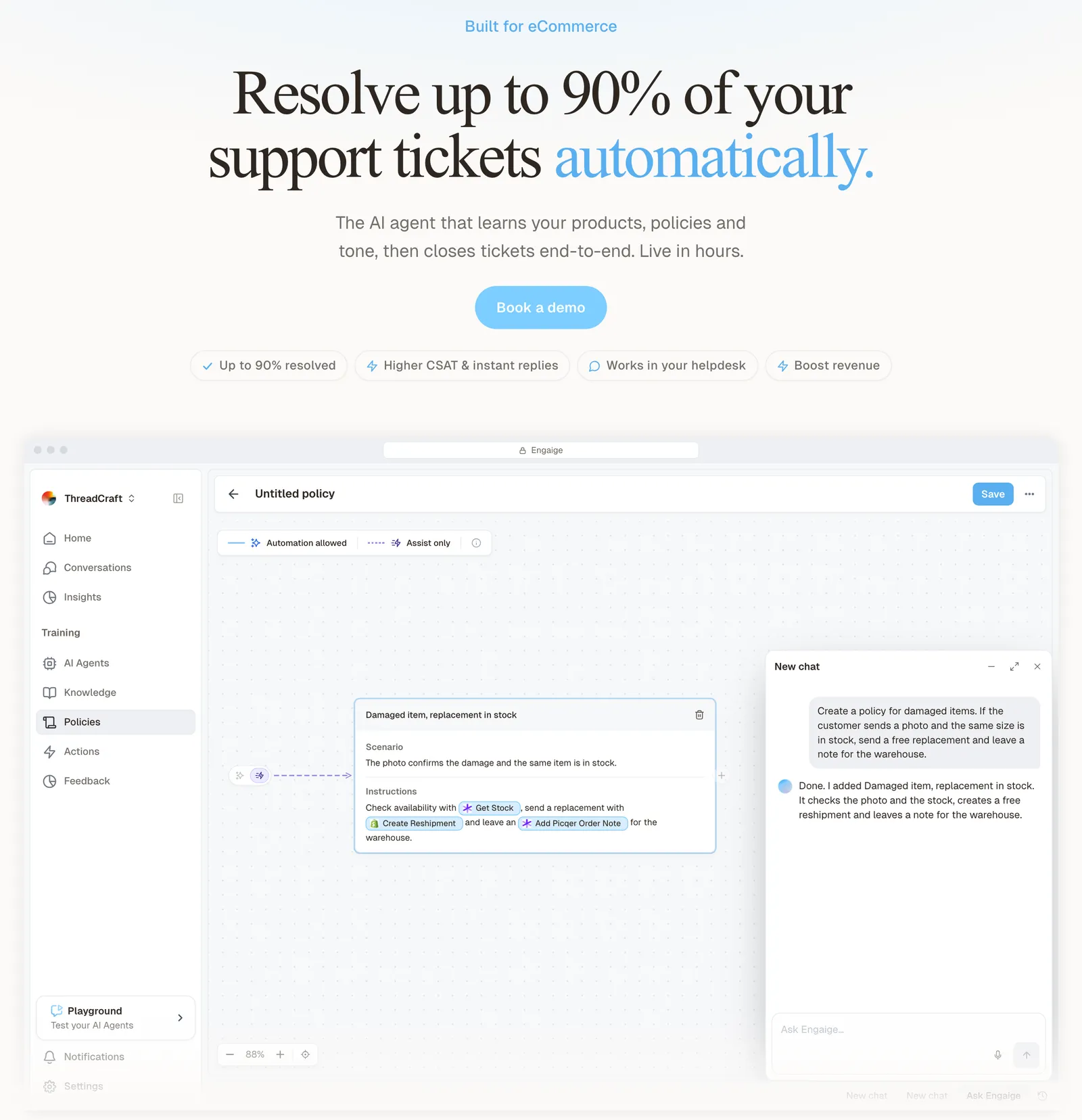
A small team can start in Agent Assist, the lowest-risk path: you go live in hours and Engaige drafts replies for your team, so they work faster from day one. No ticket closes without a person. Brands that are ready can also launch autonomous from day one. Every reply your team sends is compared with what the agent suggested; that is one of the signals Engaige AI learns from.
You do not need a specialist. Engaige AI drafts your first set of policies, and you change the agent’s behaviour by briefing Engaige AI in plain language, without prompt engineers. It shows the improvements it proposes with its reasoning, and you approve what goes live. Test every policy in the Playground before it goes live, including real past tickets you paste in.

Hello Potential New Client
What would you like to get done today?
Could you analyse this week's conversations and show me some automation opportunities?
Ask Engaige…
Searched and found 4 contact reasons · 2.4s
Your agent resolved 426 of 512 conversations. 86 were handed over, and one contact reason accounts for most of them.
Searched and found 1 policy · 1.6s
Delivery status hands over whenever tracking is older than 24 hours, which is 40 of those 46.
Editing Delivery status · 1.9s
Done. It now handles stale tracking itself. Those 40 a week stay with your agent.
What were the reasons for handover, and how can we improve?
Fix it.
Reply…
You decide per policy step whether the agent acts on its own or drafts for your team, and you can set thresholds, such as sending refunds above a certain amount to a person first. Ticket types then switch to autonomous one at a time, and on those Engaige takes the action, replies and closes the ticket. Most brands are autonomous in about a week.
Engaige is built for scaling direct-to-consumer and ecommerce brands. We can help a store of any size; the gain shows from about 1,000 tickets a month. Above that, the fit depends on the kind of business and the signals above. Every customer gets a dedicated Slack channel, and pricing is flat and volume-based. Book a demo to see it on your own tickets.
Frequently asked questions
Is my store too small for an AI support agent?
Team size is not the test. We can help a store of any size, but the gain shows from about 1,000 tickets a month. Beyond that, look at how many tickets repeat, whether the inbox is cleared inside working hours and what arrives in the evening. If one person copes comfortably, wait and fix the basics first.
What is the point of an AI agent if I am not cutting staff?
Four things. Capacity: the store grows without the next hire being urgent. Speed: repeat questions are answered without waiting for a person. Cover: evening and weekend questions do not wait until morning. Time back: hours return to the other work the same person does.
Can an AI agent replace hiring a part-time support person?
It can postpone or change that hire when the extra work is repeat questions. It does not replace judgement. A hire gives you fixed hours and strength on exceptions; an agent gives you every hour and room at peaks.
Does an AI agent still pay off if my support person also does other jobs?
Yes, that is where the time-back argument is strongest: every repeat question the agent handles is time for the other job. The gain is hours, not headcount, so measure the hours a week that go to repeat questions before and after.