Peak season is the stretch where demand outruns your support team: Black Friday and Cyber Monday, the gifting weeks, the January returns wave and the WISMO surge that follows every delivery promise. This guide covers which tickets to automate first, how to set escalation paths, and how to get an AI agent peak-ready so you scale without exhausting your people. For the demand and operations side, see our guide to seasonality.
Why is peak season so hard on support teams?
Peak season is hard because volume scales faster than a human team can. Support tickets typically run 20% to 50% of order volume, so a Black Friday that doubles sales doubles the inbox with it. In 2026, WISMO and returns dominate that inbox, and most of those tickets are repetitive. The work that drains agents is not the difficult case; it is answering the same order-status question hundreds of times a day while queues grow.
During a peak, many teams slide into the same cycle:
- Agents handle only urgent or angry customers
- Work becomes reactive instead of proactive
- Knowledge work is replaced by copy-pasting from tools
- SLAs slip
- Senior agents feel stuck in low-value tasks
It is not complexity that drains your team. It is the repetition.
Why do traditional methods struggle at peak?
Most e-commerce support processes are built for an average week, not an extreme peak. When volume spikes, teams reach for longer hours or temporary staff. Both have hard limits, and both put the heaviest load on the people least able to absorb it. One operator summed up why leaning on a single dedicated person breaks at peak:
June 2026 Reddit the issue is consistency. one person gets sick, goes on holiday, has a bad day, and suddenly support drops. also the cost per call when you factor in salary, benefits, downtime between calls is higher than it looks. · r/ecommerce View on RedditBelow is how the load lands on a human-only team across a typical peak.
| Ticket type | Share of peak volume | Effort per ticket | Drains the team? |
|---|---|---|---|
| WISMO / order status | High | Low, but constant | Yes, through sheer repetition |
| Returns and exchanges | High | Low to medium | Yes, repetitive and rule-heavy |
| Address and order changes | Medium | Low | Yes, interrupts deeper work |
| Sensitive complaints | Low | High | No, this is the work worth keeping |
| Bulk or VIP issues | Low | High | No, needs human judgement |
How does manual handling pressure the team?
When every ticket needs a human to read, understand and respond, busy periods quickly become exhausting. Manually checking SKUs across marketplaces or verifying international shipping statuses can take hours per agent per day. That leaves no time for the complex cases that actually need a person, so quality slips exactly when customers are most anxious.
Why does repetitive work cause burnout?
During a peak, agents answer the same questions on repeat: order status, returns, address changes. The repetition reduces focus and morale, and the tricky, high-value complaints pile up unresolved. With long queues, the focus shifts from doing good work to just finishing the day. Agents skip breaks and feel constant pressure, and burnout follows, not from lack of skill but from an unsustainable workload.
Which tickets should you automate first?
Automate the high-volume, low-judgement tickets first, because they cause the most repetition and the least satisfaction to handle. WISMO, returns, address changes and simple policy questions are the fastest wins. Returns matter especially here: retailers expect holiday returns to run 17% higher than their annual rate, so the January wave lands right after the December surge. An AI agent resolves these end to end, checking order status, issuing return labels and applying your rules, while the team keeps the cases that need empathy and judgement.
The split below shows where the line usually sits.
| Automate first (repetitive) | Keep human (judgement) |
|---|---|
| WISMO and order-status questions | Sensitive or emotional complaints |
| Returns, exchanges and refund status | Goodwill and policy exceptions |
| Address and order changes | Bulk and VIP order issues |
| Cut-off, delivery and resend queries | Complex multi-order disputes |
| Simple policy and FAQ answers | Anything outside approved flows |
What happens to product advice at peak?
Peak is not only WISMO and returns. Gifting season drives a surge in product-advice questions: sizing, fit and “will this suit them?”. These feel like they need a human, but they arrive in high volume, and getting them wrong feeds the January returns wave. In fashion especially, the cost is real:
July 2025 Reddit One of the biggest issues I see in fashion ecommerce is how much returns, especially from sizing, eat into margins. · r/ecommerce View on RedditAn AI agent that reads your catalogue can give fit comparisons and product advice around the clock, so more shoppers buy the right item the first time. MR MARVIS, a menswear brand with a large, growing range, found this was one of its strongest AI use cases, not its weakest.
One thing that impresses me every day is the quality of the product recommendations.

How do AI agents help you scale support?
AI customer service agents do not replace your team. They remove the work that drains it. By taking the repetitive layer off the team’s plate, an AI agent eases the mental load and helps prevent burnout before it starts, so your people spend their energy where it counts.
A well-implemented AI agent can:
- Retrieve live order information through your systems
- Understand your policies and business rules
- Process returns, exchanges or cancellations when allowed
- Handle multilingual conversations
- Spot errors or risky situations in orders or input
- Escalate to a human when a case falls outside approved flows
What does team load look like before and after AI?
The clearest way to see the benefit is to compare a human-only peak with one where an AI agent owns the repetitive layer. The shift is less about headcount and more about what each agent spends the day doing. We put numbers on that shift in the ROI breakdown.
| Measure | Human-only peak | With an AI agent |
|---|---|---|
| Repetitive tickets (WISMO, returns) | Handled by agents | Resolved by AI end to end |
| Agent focus | Survival mode, queue clearing | Complex, high-value cases |
| First response time | Stretches as volume climbs | Seconds, around the clock |
| Overtime and temp staff | Routinely needed | Rarely needed |
| Burnout risk | High | Lower, repetition removed |
How do you keep escalation clear?
Uncertainty creates stress, so define exactly when and how the AI escalates to a human and make sure full context travels with the ticket. A clear handover means agents never wonder whether a case is theirs, and customers never repeat themselves. Protect the work that needs judgement, empathy and creative problem-solving, such as gift-delivery complaints, important customer requests and complex returns.
How do you prepare for peak season?
Prepare before the first busy week, not during it. Test your systems, workflows and staffing in advance, and with AI, run real-case simulations starting with low-risk scenarios before expanding. Five practical moves keep the team protected as volume climbs.
1. Protect your team’s energy first
Identify which tickets genuinely need human judgement and which are repetitive or low-value. Encourage regular breaks, rotate shifts fairly and avoid piling high-pressure tasks on the same people.
2. Automate the repetitive tasks
Start with high-volume, low-value tickets: WISMO questions, returns, address changes and simple policy queries. An AI agent can handle these end to end, checking order statuses, issuing return labels and applying rules automatically.
3. Define clear AI-to-human handovers
Make it clear exactly when and how AI escalates tickets to humans, and ensure all context is passed along so the customer never has to repeat themselves.
4. Keep human work human
Protect the work that requires judgement, empathy and creative problem-solving. Examples include gift-delivery complaints, important customer requests and complex returns.
5. Prepare before the peak
Test systems, workflows and staffing before the first busy period begins. With AI, run real-case simulations and start with low-risk scenarios, expanding gradually as confidence grows.
How did Otrium scale support with an AI agent?
Otrium, an online fashion marketplace, faced large volumes of repetitive questions about orders, returns and refunds. They built an AI customer service agent named Oliver with Engaige to absorb that repetitive layer.
With Engaige, we are able to automatically resolve 60% of the 120,000 support tickets that we receive annually.

Oliver answers WISMO queries instantly, explains return rules across brands and markets, shares refund statuses, and hands complex cases to human agents with full context. Resolving the majority of yearly tickets gave the team breathing room to focus on high-value cases and reduced stress during peaks.
What do support teams gain from AI agents?
Introducing an AI customer service agent the right way brings:
- Fewer repetitive queries: WISMO, returns and policy checks are handled automatically
- More time for complex cases: agents focus on issues requiring judgement and empathy
- Energy for training and quality checks: with repetitive tasks removed, teams have bandwidth to improve
- Smoother handovers: AI keeps track of context, so agents don’t waste time retracing steps
Where does Engaige fit at peak times?
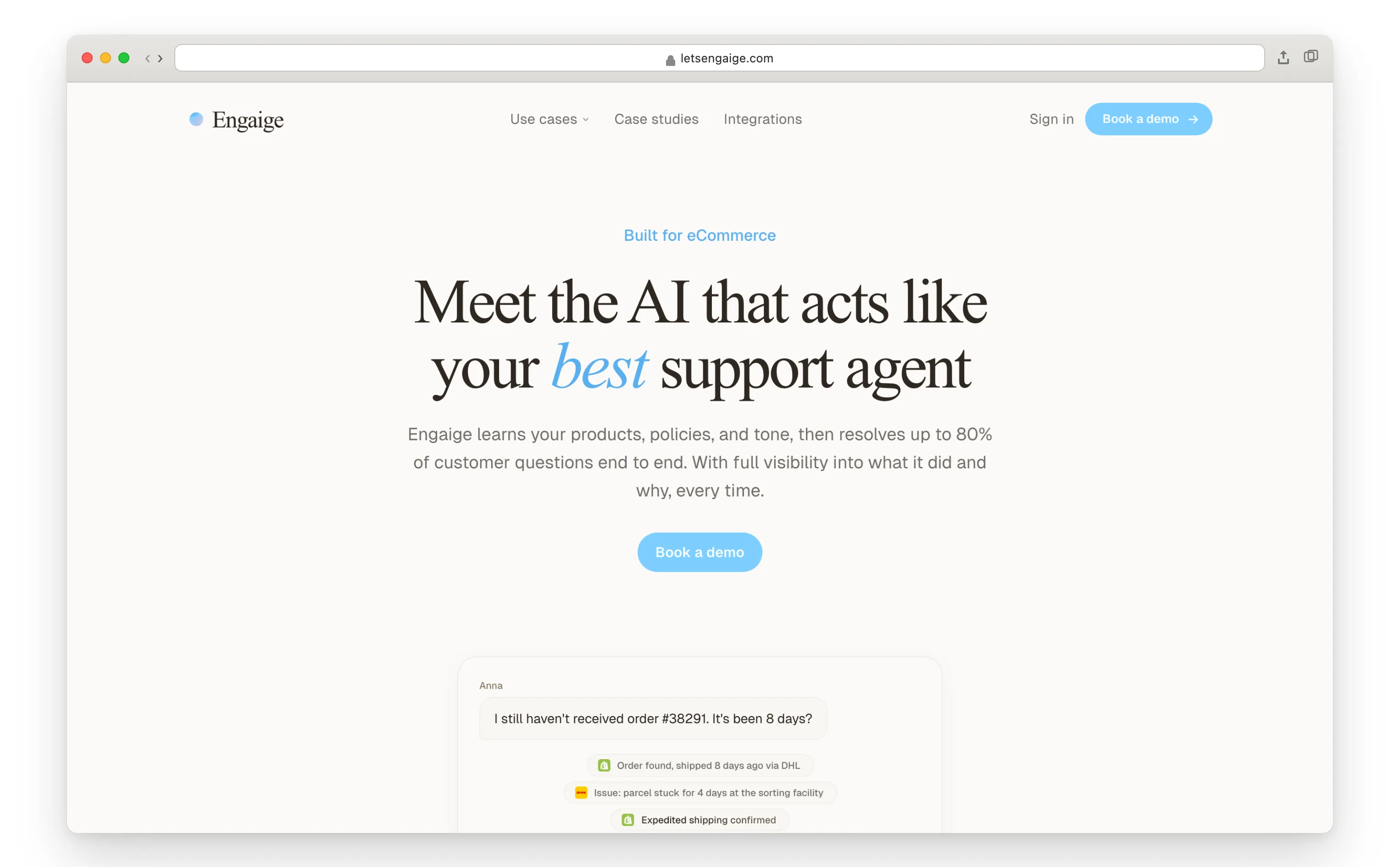
Engaige’s AI agent suits e-commerce brands in fashion, beauty and consumer electronics because it is designed around how support teams actually operate. You define what the agent is allowed to do. It uses your knowledge base, policies, order data and API endpoints, follows your workflows, and escalates to your team when human judgement is needed.
Across the brands Engaige works with, outcomes include:
- Teams feel lighter because the repetitive layer is gone
- Customers get faster, clearer answers
- Support becomes scalable and easier to manage, even in peak season
FAQs about scaling support without burning out your team
How can AI agents handle complex customer queries?
AI agents are designed to follow clear logic and policies. When a query requires judgement, negotiation or deeper empathy, the agent routes it to a human with full context included.
Will automation reduce the need for human agents?
Support automation reduces repetitive work, not human work. Most teams use AI to slow down hiring needs while removing the stress-inducing workload from the people they already have.
How do we train AI to understand our e-commerce processes?
With Engaige you train your AI customer service agent on your policies, workflows, order data and API endpoints. During implementation you test the agent weekly against real cases, refine behaviour and add guardrails.
Will AI agents sound robotic or hurt our brand tone?
With Engaige, you stay in control of tone of voice. The AI agent matches your brand guidelines so customers feel like they are talking to your team.
Are AI agents reliable enough during critical peak moments?
Yes. When you launch ahead of peak season, you let the AI agent handle only low-risk cases first, then expand as confidence grows.
How does automation help prevent burnout in support teams?
AI agents take over repetitive, high-volume tasks. By removing this constant mental load, your team gets more time for meaningful conversations and higher-impact work, reducing stress and fatigue.
Can AI reduce the pressure during seasonal peaks or unexpected spikes?
Yes. During high-volume periods, AI agents pick up the extra volume of repetitive queries so your team doesn’t face unmanageable queues or extended shifts.
Will implementing AI create extra workload for my support team?
Not with Engaige. Setup focuses on existing policies and workflows while the AI handles repetitive tasks your agents would otherwise perform, reducing fatigue rather than adding burden.