Seasonality used to be predictable. You prepared for Q4, staffed up, stocked up and braced for impact. That world is gone. In 2026, e-commerce brands face constant demand spikes driven by TikTok trends, micro-holidays, influencer moments, payday cycles and flash sales. Every spike hits your operations at once: inventory, forecasting, support and delivery expectations are all under pressure at the same time.
This guide breaks down why seasonality is now a year-round challenge, how an AI agent helps you stay ahead of unpredictable peaks, the practical steps to implement it, and how Engaige supports your Shopify store through its busiest periods.
What is e-commerce seasonality in 2026?
E-commerce seasonality is the pattern of demand peaks and troughs across the year. It used to mean one Q4 spike: US shoppers spent over $241 billion online across the 2024 holiday season, and Cyber Monday alone hit $13.3 billion, its biggest online shopping day ever (both figures from Adobe Analytics). In 2026, peaks are also more frequent and harder to predict, arriving as waves rather than a single curve.
Prime Day, payday cycles, gifting moments, micro-trends and TikTok-driven surges now scatter demand across the calendar. Each wave creates operational stress at the same time, so the old “staff up once for the holiday season” playbook no longer fits how shoppers actually buy.
Peak triggers and their support impact
Different triggers hit your operations in different ways. The table below maps the most common ones to the support load they create, so you can see why a single seasonal plan rarely holds.
| Peak trigger | Typical timing | Support impact |
|---|---|---|
| Black Friday / Cyber Monday | Q4 | Highest WISMO volume, returns wave in January |
| Payday cycles | Monthly | Recurring order and delivery spikes |
| TikTok / influencer surge | Unpredictable | Sudden stock and sizing questions on one SKU |
| Flash sales and bundles | Ad hoc | Checkout, pricing and availability queries |
| Micro-holidays and gifting | Year-round | Delivery-date and cut-off questions |
Why does demand feel so unpredictable now?
Traffic doesn’t grow in a straight line anymore. It jumps. Promotions, social trends, influencer content, weather and competitor activity can all create sudden demand spikes. Traditional forecasting methods, which mostly look backward, can’t keep up. The result is simple: you either run out of stock or you sit on too much of it.
What does seasonality do to stock and margins?
Stockouts lose you sales and overstock eats your margins. Both are symptoms of the same problem: forecasting that only reacts after the fact. Brands can’t afford to guess their way through seasonal swings. Even a small forecasting error compounds fast when you are juggling hundreds of SKUs across multiple sales channels.
Why does peak season overload customer service?
The moment demand rises, your support inbox fills up. WISMO (“where is my order”) questions can jump from 10% to 25% of contacts in normal months to over 50% at peak. Product availability, sizing questions, delivery options and returns stack on top, and customers want answers now. Queues slow, response times stretch and shoppers bounce. It is not that your team isn’t doing enough; no human team can scale at the speed of seasonal demand.
How does fragmented omnichannel hurt the experience?
Shoppers move between ads, TikTok, your store, email, social DMs and support widgets without thinking. They expect a consistent experience wherever they show up. When your systems aren’t in sync, customers get different answers depending on where they ask. That is a fast way to lose trust and the sale.
Why don’t manual fixes scale?
- Hiring seasonal support reps
- Building more macro
- Creating yet another spreadsheet
- Manually updating product messages
These fixes work for a moment, but they don’t scale. When every peak season becomes a scramble, you’re stuck reacting instead of operating with confidence.
How does the support mix shift across a peak?
The volume rises at peak, but so does the type of question, and that is what catches teams out. On the Black Friday ramp, order status and shipping questions dominate. Through December, delivery-deadline anxiety takes over. Then, weeks later, a returns and refunds wave lands. Planning for one flat “peak” misses that each phase needs different answers.
| Phase of the peak | When it hits | Tickets that dominate |
|---|---|---|
| The ramp | Around Black Friday and Cyber Monday | Order status, WISMO, shipping cut-offs, promo and price questions |
| The gifting window | December | ”Will it arrive in time?”, delivery-deadline anxiety, gift options, address changes |
| The returns wave | Late December into January | Returns, refunds, exchanges, wrong-item claims |
| The quiet stretch | Summer, for many verticals | Lower volume, shifting toward product advice and sizing |
Support load tracks order volume closely: customer-service tickets typically run 20% to 50% of order volume, so a Black Friday that doubles orders can double the inbox with it. One operator described the mix during a rush:
February 2026 Reddit pre-holiday setup has to start sept at latest for nov peaks. Automation needs order status handling since thats like 50-60% of tickets during rushes plus return policy stuff. · r/EntrepreneurRideAlong View on RedditThe returns wave is the part most teams underestimate. Shoppers sent back $890 billion of goods in 2024, about 16.9% of everything sold, and retailers expect holiday returns to run around 17% higher than their annual rate. January, not November, is when refund and exchange tickets peak, long after the seasonal temps have gone home.
How can an AI agent tackle seasonal challenges?
An AI agent gives you what a human team cannot have during a peak: unlimited capacity and real-time decision-making. Instead of throwing more people and spreadsheets at the problem, you let the agent resolve the repeatable work and the constant “what’s happening right now?” questions, end to end, while your team handles the cases that need judgement.
The split below shows what a well-built agent absorbs at peak and what stays human. Drawing the line early is the difference between a calm peak season and a scramble.
| What an AI agent absorbs at peak | What stays human |
|---|---|
| WISMO and order-status questions | Angry or sensitive complaints |
| Delivery, cut-off and resend queries | Goodwill and refund exceptions |
| Returns, exchanges and refund status | Bulk or VIP order issues |
| Product, sizing and availability advice | Complex multi-order disputes |
| Subscription edits and address changes | Cases outside approved policy |
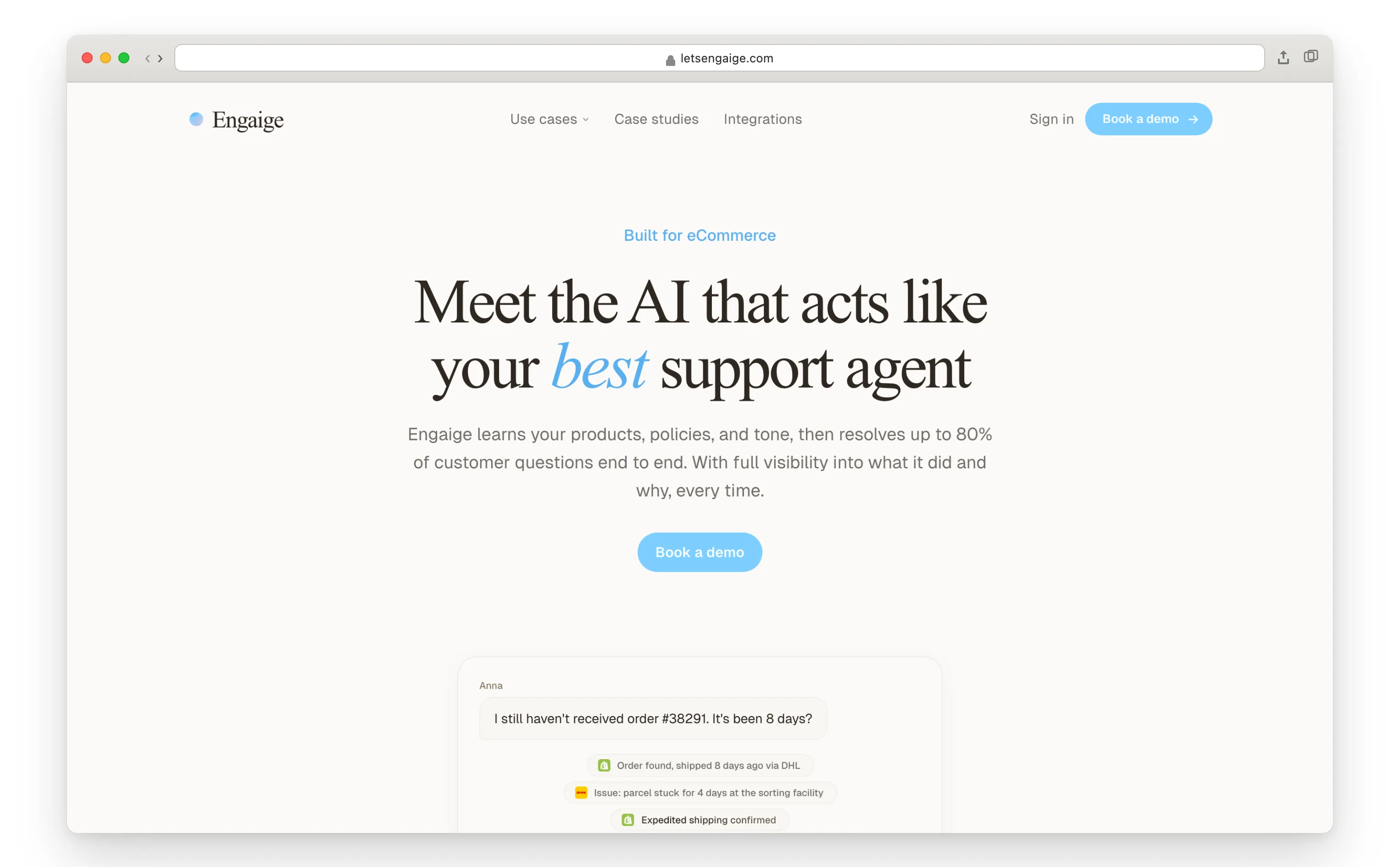
Engaige is an AI customer service agent built for exactly this in e-commerce. It learns your products, policies and tone, then resolves up to 90% of customer questions end to end, with full visibility into what it did and why. During a peak, the repetitive seasonal volume is handled the moment it lands, not left in a queue for a temp hired three weeks earlier.
Here are the main ways an AI agent helps your team during seasonal peaks.
Predictive demand and inventory management
Most teams look at last year’s numbers and “add a bit on top.” That’s guesswork. An AI agent can go much further by connecting to your store and reading the signals that actually drive demand.
For example, it can:
- Learn seasonality patterns per SKU (not just at category level)
- Factor in promotions, discounts, and campaigns you’re planning
- Pick up behaviour shifts in real time (certain sizes selling out faster, new products taking off, etc.)
In a Shopify context, that means your AI isn’t just answering questions. It’s feeding smarter decisions into the rest of your stack: what to restock, what to push harder and which products are at risk of going out of stock during the next peak.
You still decide the strategy. The AI gives you a clearer picture so you’re not flying blind.
Real-time customer support and WISMO resolution
Seasonality hurts the most in your inbox, and the good news is that a big chunk of those tickets are repeatable. Order status, delivery questions, returns and product information can mostly be resolved end to end, instead of the agent just drafting a reply for a human to send.
A strong e-commerce AI agent should be able to:
- Read live order and shipment data
- Apply your specific policies (refunds, resends, cut-off times)
- Give a clear answer in seconds, without touching your human queue
That is especially powerful for WISMO (“Where is my order?”) tickets. Instead of sending a tracking link, an AI agent can interpret what is happening with the shipment, explain it in plain language and act when needed, for example triggering a resend when something is clearly stuck. Your team then focuses on the few cases that need human judgement. As one operator put it, the hard part is not showing a tracking number, it is knowing which orders need action before the ticket ever arrives:
May 2026 Reddit WISMO is rarely a tracking problem, it's an exception-management problem. Most teams can show a shipment status, but they don't know which orders are at risk, which delays need action, and which customers should be updated before the ticket hits support. · r/shopify_geeks View on RedditOtrium, an online fashion marketplace, scaled its support this way by using Engaige to automate the repetitive tickets.
With Engaige, we are able to automatically resolve 60% of the 120,000 support tickets that we receive annually.

That frees the CX team to focus on complex queries while delivering faster, more consistent support.
Dynamic pricing and personalised marketing
During peak season, demand moves too fast for static pricing and “set-and-forget” campaigns.
An AI agent can help by:
- Spotting products that are underperforming or overperforming against your baseline
- Highlighting SKUs where a price change, bundle, or promotion would actually make sense
- Feeding smarter segments into your email, SMS, and on-site campaigns
Think of it as a layer that constantly asks: “Given what’s happening right now, who should we talk to, about which product, and with which message?”
You still control discounts and margin thresholds. The AI just does the heavy lifting of matching the right offer to the right shoppers at the right time.
Automated cart recovery and proactive engagement
Seasonal traffic is expensive. Letting it leave without buying is even more expensive.
An AI agent can help you:
- Intercept hesitating shoppers on your product or checkout pages with useful, human-like help (sizing, materials, delivery dates, alternatives)
- Follow up on abandoned carts with emails or messages that actually address the reason they left, not just “Here’s 10% off”
- Nudge customers towards in-stock alternatives when their first choice is sold out
Instead of generic nudges, you get context-aware product advice: the AI knows what the shopper was looking at, where they dropped off and what similar customers ended up buying.
Integrated omnichannel operations
One of the trickiest parts about seasonality is that it hits all of your channels all at once.
But if your chat says one thing, email says another and your Instagram DMs are ignored, customers feel it instantly. An AI agent built for e-commerce plugs into all these channels and gives consistent, policy-proof answers everywhere.
For a Shopify brand, that typically looks like:
- Same AI agent active on live chat, email, WhatsApp, Instagram, etc.
- Same logic and guardrails applied across every channel
- Same view of order data, product info, and policies
So when peak season hits, you’re not fighting fires in 5 different inboxes. You have one brain handling the majority of questions and one team supervising the edge cases.
How do you implement AI for seasonality management?
You implement it in seven steps, starting well before your next peak. Rolling out AI for seasonality is not about buying another tool. It is about setting the right foundations so your agent learns your business, products and customers. These steps help you avoid the common pitfalls and get real impact fast, especially on Shopify with recurring peaks.
1. Onboard before the peak (it takes days, not months)
You do not need months of lead time, but you do need to be live before the rush. With Engaige, onboarding runs on a clear ramp: connect your store and map your top use cases on day one, soft launch in Agent Assist mode around day five, and reach 60% or more of tickets resolved autonomously by day thirty. HelloPrint had its system fully operational within two weeks.
The work in those first weeks is mostly setup, and it is what carries you through the peak:
- Connect your store so the agent reads live order, shipment and catalogue data
- Set your policies for refunds, resends, exchanges and subscription changes
- Define guardrails: what the agent resolves on its own and what it escalates
- Soft launch in Agent Assist, then expand to autonomous handling as trust builds
Start the week of Black Friday and you miss this ramp. Begin a month or two out and the agent is at full autonomous handling exactly when volume spikes.
2. Audit data and touchpoints
AI can only be as accurate as the data it receives. Before peak season, map out:
- Which systems hold your order data
- Where customers commonly reach out (chat, email, IG DMs, WhatsApp, etc.)
- Gaps in product information that confuse customers
- Inconsistencies in your policies or FAQs
This audit gives your AI agent a clean foundation. Engaige, for example, pulls directly from your store and central systems so it works with verified, up-to-date information every time.
3. Select the right AI agent
Not all AI tools handle seasonality well. Generic chatbots can answer FAQs, but they won’t resolve real e-commerce workflows and that’s what makes the difference during busy periods.
Look for an AI agent that can:
- Pull real-time data from Shopify
- Read order + carrier data
- Act on behalf of your team (refunds, resends, subscription edits)
- Maintain your brand tone consistently
- Handle multi-channel support
If the AI can only “suggest replies,” your team will still drown during peaks. And if you’re feeling overwhelmed with the options out there, check out our curated list of the best AI agents for customer service.
4. Train and customise
Your AI agent isn’t plug-and-play. It learns best from examples, policies, and specific situations from your store.
To speed up training:
- Upload your policies and FAQs
- Provide examples of your writing style
- Define guardrails (what the AI can and cannot do)
- Teach it how to respond to your most common seasonal questions
And importantly: test safely. Engaige offers a full sandbox where you can run real-world questions before going live so you always stay in control.
5. Set proactive triggers
Seasonality isn’t just about reacting to a higher influx of orders. The way to make it through these peaks and actually come out on the other side is to correctly anticipate and prepare for it.
Your AI agent can automatically trigger:
- WISMO alerts when orders are delayed
- Product recommendations when certain SKUs start trending
- Cart recovery flows tailored to the shopper’s behaviour
- Alternative product suggestions when an item goes out of stock
Proactive engagement is where AI goes beyond saving you costs and actually starts creating revenue. We put numbers on both in the ROI guide.
6. Maintain data quality and oversight
Even the best AI needs regular calibration.
Before and during peak periods, check:
- Product descriptions (are they outdated?)
- Stock levels (do SKUs have adequate metadata?)
- Updated refund and return rules
- Carrier performance changes
Engaige can also show you where answers could be improved, which cases are strong and which need refinement. This makes ongoing optimisation much easier.
7. Scale and refine
Once your AI is live and resolving tickets daily, improvement becomes a rhythm.
Review:
- Which cases it resolves well
- Which ones still need human intervention
- Which customer objections repeat
- Where new automations can be added
As confidence grows, many brands scale from agent assist to fully autonomous handling of specific topics. Engaige lets you choose which workflows to hand over and when so automation grows with your comfort level.
Where does Engaige fit for seasonal e-commerce support?
Engaige sits across your support channels as a fully trained agent, resolving the repetitive seasonal volume so your team handles only the cases that need a person. It runs on your real Shopify data, policies and tone, which means consistent answers whether demand is flat or spiking.
Engaige takes the pressure off your team during peak season by acting like a fully trained support agent that never slows down. Our AI agent resolves the bulk of your repetitive tickets automatically, from WISMO to refunds, resends, product questions and subscription edits. It does this using your real Shopify data, your policies and your tone of voice. So instead of drowning in seasonal volume, your team stays focused on the few conversations that truly need a human touch.
Because Engaige works across all your channels and retrains itself regularly, it keeps your support consistent, accurate and fast even as demand spikes. So when seasonality hits, Engaige gives your CX team something it’s never had before: predictable, scalable customer service that grows with your brand.
FAQs about managing e-commerce seasonality with AI
What is e-commerce seasonality?
E-commerce seasonality refers to predictable (and increasingly unpredictable) spikes in customer demand throughout the year like Black Friday, back-to-school, gifting moments, payday cycles or TikTok-driven trends. These peaks affect everything from inventory planning to customer support volume, and they’re now happening more frequently than ever.
How does AI improve customer service during busy seasons?
AI helps by taking over the repetitive, high-volume questions that normally slow your team down. Think order status, delivery timelines, returns, product information, subscription changes and more. A strong AI agent reads real Shopify data, applies your policies and responds instantly. That means shorter queues, faster answers and a support team that can focus on complex cases instead of drowning in routine requests.
What is WISMO and how does an AI agent handle it?
WISMO (“Where is my order?”) is usually the number-one support question during and immediately after peak periods. An AI agent can pull live order and carrier data, interpret what is happening (delay, exception, transit issues) and give customers a clear explanation with no human input needed. If an order is clearly lost or stuck, the AI can even trigger the next step, like issuing a resend.
Can AI agents help with omnichannel shopping?
Yes. A well-trained AI agent gives customers the same accurate, policy-aligned answer whether they message you via chat, email, Instagram, WhatsApp or anywhere else. It connects your data and your rules across channels, so your support stays consistent even when shoppers jump between touchpoints.
Is it difficult to implement an AI agent for e-commerce teams?
Not anymore. Modern AI agents (like Engaige) integrate directly with Shopify and popular support tools, learn your tone, absorb your policies and start resolving tickets in mere days. You don’t need technical skills to get started, and you stay in control of what the AI can or can’t do.
How quickly can an AI agent improve seasonal performance?
Most brands see impact within the first week: fewer WISMO tickets, faster replies, clearer customer communication and a support inbox that feels manageable again. As the AI learns your products, policies and edge cases, its accuracy and resolution rate improve week after week, long before your next seasonal spike hits.