AI customer service guardrails are the rules and checks that keep an AI support agent inside your policy. The agent reads live order data before it answers, follows a written policy for each ticket type, takes only the actions you have allowed, hands sensitive cases to a person, and shows its reasoning so you can check every answer.
This guide is for an online store weighing an AI agent for its help desk. It goes deeper than our guide to AI agents in customer service.
What are AI customer service guardrails?
Guardrails are limits that sit outside the conversation, in permissions and thresholds, so a persuasive customer cannot talk the agent into an action it has no permission for. The main ones are live data before every answer, a written policy per ticket type, a permission per action, amount thresholds, hand-off rules, visible reasoning and testing before go-live. How to stop the AI from promising or doing something that is not allowed is one of the questions buyers ask us most.
An agent that only answers can say something wrong. One that refunds, cancels or changes an address can also do something wrong, which is the step from chatbot to AI agent. What those actions look like in practice is in our guide to returns and cancellations.
| Guardrail | What it stops | Where it lives |
|---|---|---|
| Live data before the answer | Promises the order state does not allow | Connection to store and carrier |
| Written policy per ticket type | Improvised rules | Policy |
| Permission per action and step | Unwanted refunds, cancellations and changes | Policy step |
| Thresholds | Large amounts going out unchecked | Policy step |
| Hand-off rules | Guessing on sensitive or unclear cases | Policy |
| Visible reasoning | Wrong answers nobody can explain | Conversation view |
| Testing before go-live | Mistakes a customer finds first | Test environment |
Our view: an instruction in a prompt is a request, a guardrail is a limit. No setup rules out errors: Anthropic’s documentation says its techniques reduce made-up answers without removing them completely (Anthropic, 2026). Guardrails decide what a mistake can cost.
How do you stop an AI agent from making wrong promises?
Let the agent promise only what the live order data and your policy both allow, and let it confirm an action only after the action has happened.
The classic case is a cancellation when the order is already with the warehouse. On a platform such as Shopify, a partially fulfilled order can no longer be cancelled, and with an outside fulfilment service the cancellation may have to happen there first (Shopify, 2026). Reassurance works the same way: check the status at a carrier such as DHL or PostNL before saying all is well.
In Moffatt v. Air Canada, a Canadian tribunal held the airline responsible for a refund promise its chatbot made against the airline’s own policy, and ordered it to pay about 800 Canadian dollars (Canadian tribunal, 2024). In Medallia’s survey, 42% of consumers find human errors more forgivable than AI errors and 7% the opposite (Medallia, 2026).
So write three things into the policy: the cut-off (until which order state a change is still possible), what the agent offers after it, and that nothing is confirmed before the action has run.
How do you control which actions an AI agent can take?
Decide per action, and per step in a policy, whether the agent acts on its own, drafts for a person or stays out, then add amount thresholds on top. OWASP traces what it calls excessive agency to too much functionality, too many permissions or too much autonomy. It recommends that a person approves high-impact actions and that connected systems enforce the limits, not the model (OWASP, 2025).
An example split to adapt:
| Action | Agent acts alone | Agent drafts, person approves | Stays with a person |
|---|---|---|---|
| Share tracking status | Yes | ||
| Change an address before the cut-off | Yes | ||
| Cancel an unfulfilled order | Yes | ||
| Refund below your threshold | Yes | ||
| Refund above your threshold | Yes | ||
| Goodwill credit or discount | Yes | ||
| Write to another back-office system | Yes |
In Engaige, a policy is a branching set of plain-language steps, and each step has its own mode: Automated or Agent Assist. You can set thresholds, such as sending refunds above a certain amount to a person first. If refunds and returns must stay with your team, keep that step on Agent Assist: the agent drafts, a person approves.
Scenario
The customer asks about a delivery address.
Instructions
Read the order with Get order , then take the branch that matches.
 Get order
Scenario
The order has not been picked yet.
Instructions
Move it with Change picqer shipping address .
 Change picqer shipping address
Scenario
The parcel has already left the warehouse.
Instructions
Say it cannot be redirected, then offer Process refund .
In Agent Assist, no ticket closes without a person, and you switch ticket types to autonomous one at a time. Who writes the policies, and in which order, is in our implementation guide.
Engaige offered control, flexibility, and the ability to really incorporate AI in a more human way.

How do you stop an AI agent from hallucinating?
Make the agent answer from your own data and policies instead of general model knowledge, let it say it does not know, and send what it does not know to a person. Anthropic documents the first two (Anthropic, 2026).
Three situations, each with its own guardrail:
- It invents a policy or a discount: give that ticket type a written policy.
- It answers one question two ways: steps and conditions keep the path the same, even when the wording differs.
- It contradicts your help articles: keep one source of truth and check which source it used.
When no policy covers a question, the right behaviour is a hand-off that makes the gap visible. Health claims, liability and legal letters need a rule that sends them to a person, not better wording.
How do you see why an AI agent gave an answer?
Every answer and action should come with its reasoning: what the agent read, which policy it applied and why it replied or acted as it did.
Visible reasoning turns “the AI was wrong” into a cause you can fix: missing information, an unclear policy or a missing connection. In Engaige you open any conversation and see the full reasoning behind every answer and action.
Within the AI we can see the reasoning, and how it comes to a response. That shows us where information is missing or unclear, and helps us improve our workflow.

When should an AI agent hand over to a human?
An AI agent should hand over to a human whenever a written rule says so, not when the model judges it: an angry customer, a legal or health topic, an amount above your threshold, or a question without a policy. Write those situations down, and have the agent pass on the context so the customer does not repeat the story. Common triggers:
- An angry customer, a legal threat, or a health or liability topic.
- An amount above your threshold.
- Evidence the agent cannot judge, such as a photo for damaged items of high value.
- No policy for the question, or the customer asks for a person.
In Twilio’s survey, 63% want an easy way to reach a person at any time and 78% have tried to bypass an AI agent (Twilio, 2026). Medallia finds 68% comfortable with only AI for an order status, against 27% for a formal complaint (Medallia, 2026).
Customers also try to talk an agent into a bigger refund, and OWASP says it is unclear whether any fool-proof prevention for prompt injection exists (OWASP, 2025), so the limit belongs in the permission and the threshold, not in the conversation.
In Engaige, the agent leaves a summary of its reasoning as an internal note in the help desk ticket at a hand-over. See also escalation triggers and what to keep human.
How do you test an AI agent before it goes live?
Test every policy on the awkward cases before a customer meets them. Many teams then let the agent draft next to the team first; the order is covered in our implementation guide. Anthropic recommends extensive testing in a sandbox, together with guardrails (Anthropic, 2024).
Start with a change request after the cut-off, two issues in one message, a customer pushing for an exception, and the same question asked twice in different words.
In Engaige you test policies in the Playground by playing the customer, and you can paste in a real past ticket. What share to expect afterwards is covered under resolution rate.
Can an AI agent keep your tone of voice?
Yes, an AI agent can keep your tone of voice, because tone can be written down as rules: formal or informal address, sentence length, the phrases your brand prefers and the ones it avoids. A brand voice gets damaged by the content of an answer more often than by its style.
A confident wrong answer hurts your brand more than a robotic one: an on-brand sentence about the wrong return window is still a complaint. Fin says the same in its own guide (Fin, 2026).
On Shopify, Engaige indexes your storefront’s marketing content and brand voice next to the commerce data and any documents you add, so the agent answers from your real data, on-brand.
Will customers notice they are talking to AI?
Most customers cannot tell from the text alone that they are talking to AI, but hiding it is the wrong goal. Tell customers it is AI, make the answer specific to their order and keep a person within reach.
- Twilio: 75% think they can tell via text; when tested, 90% could not (Twilio, 2025).
- Twilio: 76% want the agent to identify itself at the start. 81% of brands say theirs does; 22% of consumers agree (Twilio, 2026).
The EU AI Act requires that systems interacting directly with people are designed so people are informed they are dealing with AI, unless that is obvious. Article 50 has applied since 2 August 2026 (AI Act, 2024). In one small peer-reviewed study from before today’s language models, disclosing the chatbot made no significant difference in the experiment, and in the interviews users said helpfulness and a friendly tone mattered more (Springer, 2024).
Our view: customers mind an agent that does not know their order or offers no way out far more than the fact that it is AI. Staying personal means people keep the conversations where they add value. See where a human team keeps winning, and our guide for a small team.
Where does Engaige fit?
Engaige (that’s us) is the e-commerce AI support agent inside the help desk you already run. Keep your helpdesk. Replace the AI. The guardrails above are how it works: a mode and thresholds per policy step, full reasoning for every answer and action, Playground testing, and a start in Agent Assist or autonomous from day one.
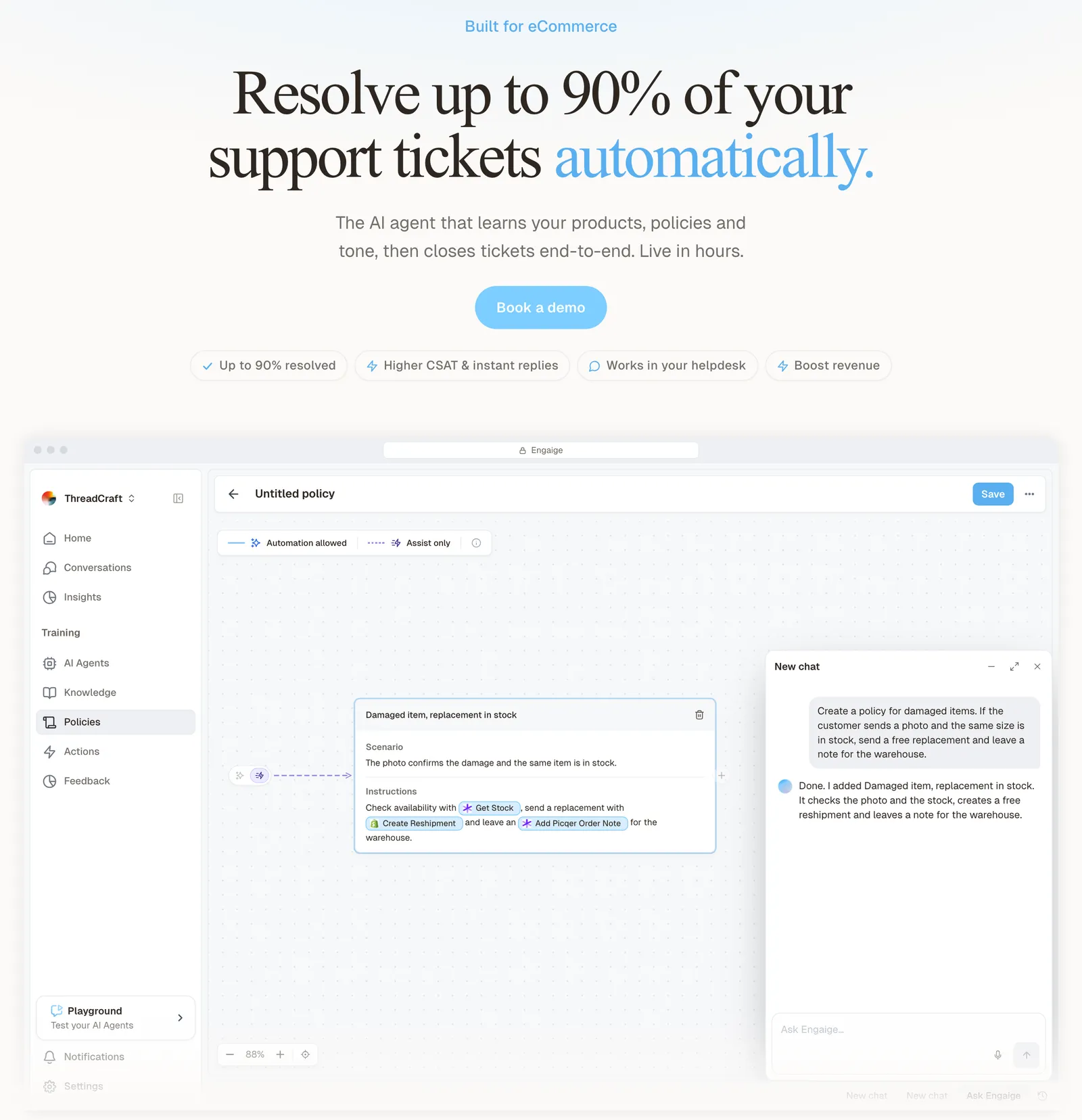
What keeps the guardrails current is Engaige AI. In Agent Assist, every reply your team sends is compared with what the agent suggested, one of the signals it learns from. Once ticket types run autonomously, it surfaces emerging trends and the tickets the agent handed back to a person. From those it proposes policy changes with their reasoning, and you approve what goes live. Nothing changes behind your back.
Otrium and MR MARVIS, quoted above, both use Engaige.
Frequently asked questions
Can an AI agent issue refunds without a person checking?
Only where you allow it: in Engaige, each policy step is set to Automated or Agent Assist, and an amount threshold can send larger refunds to a person first.
What does an AI agent do when it has no policy for a question?
It should hand over to a person, and the gap should become visible. In Engaige, tickets the agent hands back are surfaced, and Engaige AI proposes policy changes that you approve.
Does AI make customer service less personal?
Not if people keep the conversations where they add value and the agent’s answers are specific to the order. You set that line per ticket type and step.
Do you have to tell customers they are talking to AI?
The EU AI Act requires that people are informed they are interacting with AI, unless that is obvious, and most customers want to know. This is not legal advice.
Do AI customer service guardrails work in the help desk we already use?
Yes. Engaige runs inside the help desk your team already uses, and the hand-over note lands in the ticket.