The best AI agents for Zendesk in 2026, scored for an online store, are Engaige (4.60 out of 5), Fin (4.45) and Siena AI (4.35), then Zendesk’s own AI agents (4.10), melibo (3.90), Decagon (3.75) and Ada (3.15). For most stores the deciding question is whether the agent takes the store action itself; if phone is a big share of your tickets, choose a voice-capable agent.
We make Engaige, so read our own score with that in mind: the criteria, the weights and the fact behind every score are on this page, so you can reweight it for your team. Vendor facts come from each vendor’s own pages, checked on 9 November 2026, and any resolution figure is vendor-stated. We scored a selection of the agents online stores shortlist most often, and only those whose own pages document Zendesk support.
New to the built-in option? Our Zendesk AI guide explains AI agents, Copilot and Forethought. For the field beyond Zendesk, see our full ranking, and for everything Zendesk for a store, the Zendesk hub.
Which AI agents are best for Zendesk in 2026?
The table gives the ranking at a glance. The e-commerce specialists lead on store work, Fin leads the horizontal platforms, and Decagon and Ada are capable platforms built for large, cross-industry service teams.
| Rank | AI agent | How it works with Zendesk | Store actions, as documented (November 2026) | Best for | Score |
|---|---|---|---|---|---|
| 1 | Engaige | Works inside the Zendesk agent workspace on your existing tickets | Refunds, cancellations, address changes, discounts and subscription changes; Shopify Admin API plus storefront | Online stores that keep Zendesk and want the agent to learn from their team | 4.60 |
| 2 | Fin | Runs as an AI support agent within Zendesk messaging and tickets | Cancellations, refunds and address changes through data connectors | Teams that want Fin’s procedures, and voice, on top of Zendesk | 4.45 |
| 3 | Siena AI | Connects to your Zendesk account and automates its channels | Address updates, labels, refunds, replacements, subscription skip, pause and swap | Consumer brands that want several agents (support, shopping, social) | 4.35 |
| 4 | Zendesk AI agents (incl. Forethought) | Built into Zendesk | Custom actions and flows you build; Copilot can look up, cancel and refund Shopify orders for your team | Teams that want one vendor and build their own flows | 4.10 |
| 5 | melibo | AI agents in Zendesk with reply and action suggestions in the ticket | Cancellations, address changes and return labels (vendor-stated); refunds suggested for one-click approval | Shops in Germany, Austria and Switzerland on the German e-commerce stack | 3.90 |
| 6 | Decagon | Handles email through Zendesk, with handoffs | Acts in connected systems; its integrations page names no commerce platform | Large consumer brands across industries | 3.75 |
| 7 | Ada | Runs in its own channels and hands off into Zendesk | Business-system tools you switch on; its integrations page lists no commerce platform | Enterprise service teams with a heavy voice share | 3.15 |
When is Zendesk’s own AI enough?
Zendesk’s own AI is enough when most of your tickets are questions answered from your help centre, you want one vendor for ticketing, AI and voice, and you have people who build and maintain actions and flows. It falls short for a store when the ticket needs an order changed in Shopify and closed, and nobody has built that flow yet.
Zendesk has made its AI agents far more capable in 2026. Since the action builder rollout, “all custom actions are available in AI agents”, and action flows with the Run on demand trigger can be invoked by an AI agent (Zendesk). Since buying Forethought, Zendesk says its Forethought AI Agents “work seamlessly within Zendesk and across any platform” (Zendesk).
Keep Zendesk’s AI if these are true for you:
- Knowledge questions dominate. Delivery times, sizing and returns policy, answered from articles.
- You want one vendor. Ticketing, AI agents, Copilot, quality assurance and voice share one admin.
- You build your own flows. Someone owns the custom actions, API calls and action flows, and keeps them working.
- Your team takes the store actions. Copilot can “look up a Shopify order, cancel and refund an entire Shopify order, or refund selected items” (Zendesk), and Zendesk advises that actions that write data “should be marked as agent-approved”.
The order work is where the effort sits. For Shopify order status on its AI agents, Zendesk’s help centre says to “Develop a custom script that makes an API request”, adding that the steps differ with the AI agents Advanced add-on and that its early-access Custom Agents programme can take action on e-commerce work (Zendesk). Our Zendesk AI guide covers those limits in detail.
That is the case for a dedicated AI agent on top: keep Zendesk, replace the AI. Our Shopify guide covers what the Zendesk and Shopify connection gives you, and the Zendesk chatbot guide covers the 10 December 2026 cut-off for older bots.
How do you choose an AI agent for Zendesk?
Score each agent on six weighted criteria: e-commerce actions (20%), self-improvement (20%), help desk fit (20%), control (15%), time to live (15%) and channel coverage (10%). Store actions decide which tickets disappear today; the learning loop decides how many disappear six months from now.
| # | Criterion | Weight | 5 means | Lower scores |
|---|---|---|---|---|
| 1 | E-commerce actions | 20% | Store write actions (refund, cancellation, address change) documented as built in | 4: writes through connectors you configure, or vendor-stated with refunds only suggested. 3: you build the actions, or no commerce platform is named |
| 2 | Self-improvement | 20% | Your team’s everyday replies are a training signal from day one, improvements are proposed with their reasoning, and a person approves what goes live | 4: the AI proposes changes a person reviews, learning mainly from its own conversations. 3: no documented approval step. 2: coaching written by a person or applied automatically |
| 3 | Help desk fit | 20% | Documented on your existing help desk tickets and on its messaging or chat, with no migration | 4: documented on tickets or email only. 3: runs in its own channels and hands off into Zendesk |
| 4 | Control | 15% | Per-step or per-action approval, or a per-type choice between suggesting and acting | 4: behaviour set in procedures or switched-on tools, without a documented per-action approval |
| 5 | Time to live | 15% | Live in minutes or hours, with no flows to build | 4: setup that calls for technical roles. 3: flows you build yourself, or a multi-week ramp |
| 6 | Channel coverage | 10% | The vendor sells an AI voice agent | 4: voice announced but no product page. 3: text only |
Action-taking is close to table stakes among the leaders, so self-improvement, the learning loop you can see and steer, carries equal weight. Most of these agents also show the reasoning behind each answer in some form, so we treat reasoning as table stakes and did not score it separately. Pricing is left out: the models differ too much (per resolution, per ticket, flat fee) to score fairly. Our Zendesk marketplace guide covers how third-party apps are found and installed.
How do the best AI agents for Zendesk compare?
The best AI agents for Zendesk fall into three groups: e-commerce specialists that sit on top of Zendesk (Engaige, Siena AI, melibo), Zendesk’s own AI agents, and horizontal platforms that also connect to Zendesk (Fin, Decagon, Ada). Entries are in ranked order, with facts as of November 2026.
1. Engaige (that’s us): 4.60
Engaige is the e-commerce-native AI support agent that works inside the Zendesk you already run and replaces only its AI layer. It takes the store action, replies and closes the ticket. Engaige AI, the part you talk to in plain language, configures the agent and learns from your team. MR MARVIS handles over 120,000 questions a year with Engaige.
It scores 5 on store actions, self-improvement, control and time to live (live in Agent Assist in hours). It takes a 4 on help desk fit, because we score only what is documented for Zendesk tickets, and a 3 on channel coverage: Engaige is text-first by design, with no voice AI. The detail is in the Engaige section below.
2. Fin: 4.45
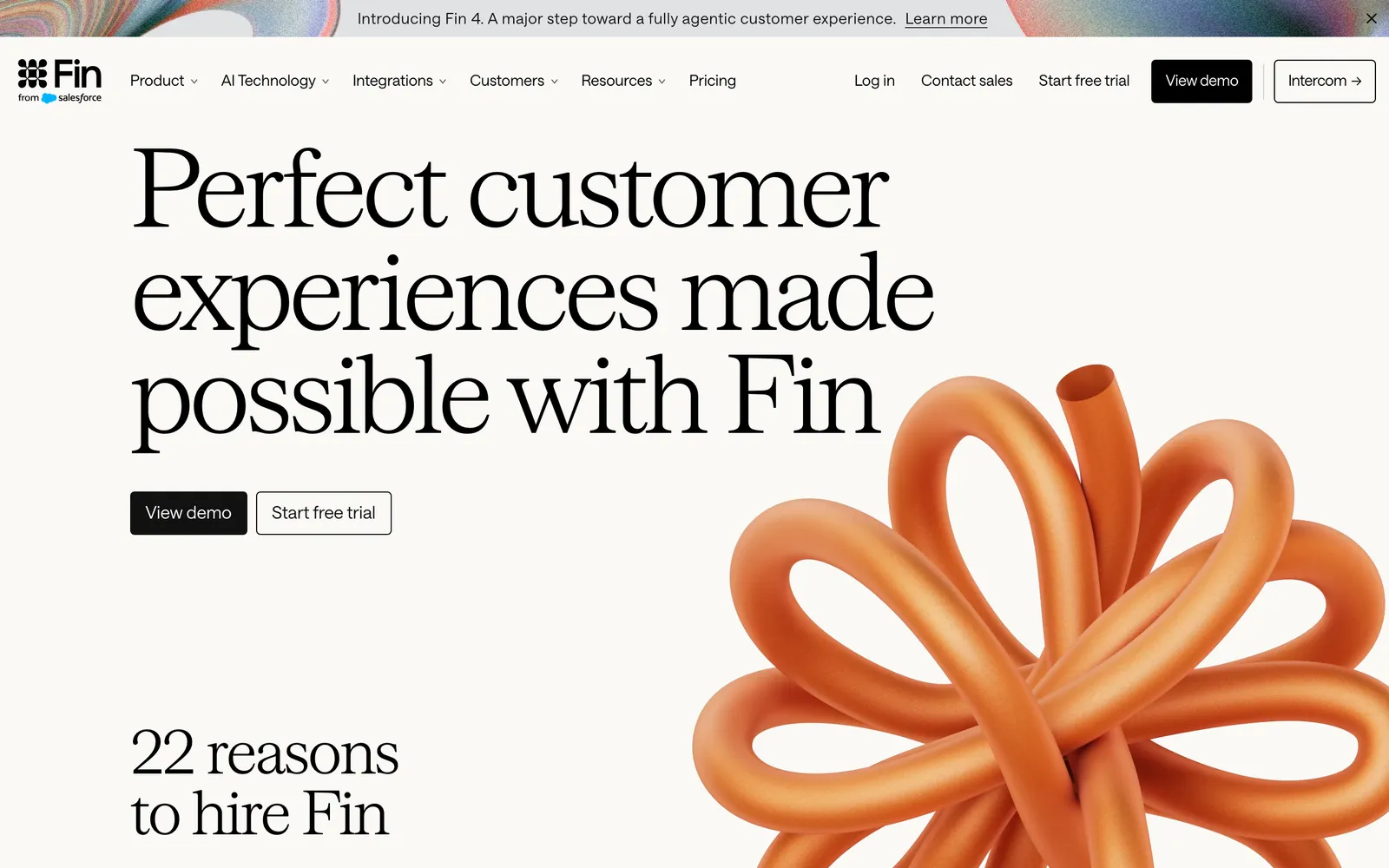
Fin, Intercom’s AI agent, also runs on Zendesk: Fin’s help centre says “Fin AI Agent acts as an AI-powered support agent within Zendesk”, deployed on Zendesk Messaging and Zendesk tickets, so help desk fit scores 5 (Fin). The same guide states a 76% average resolution rate; that is Fin’s figure.
Store actions score 4: Fin’s e-commerce page says it can “process partial or full cancellations, and issue refunds automatically”, once you “Connect Fin to your systems” through “no-code data connectors” (Fin). Control scores 5: a “Loop in teammate / agent” step pauses a Procedure to “request a teammate’s input or approval before Fin continues” (Intercom).
Self-improvement scores 4: content recommendations scan unresolved Fin conversations and “compare them to human replies”, and “Nothing goes live without your explicit approval first” (Fin). Time to live scores 4, because the setup guide lists a technical leader to manage the integration, and Fin Voice covers calls. Intercom is built for SaaS support; Engaige is built for the store. Our Fin guide has more.
3. Siena AI: 4.35
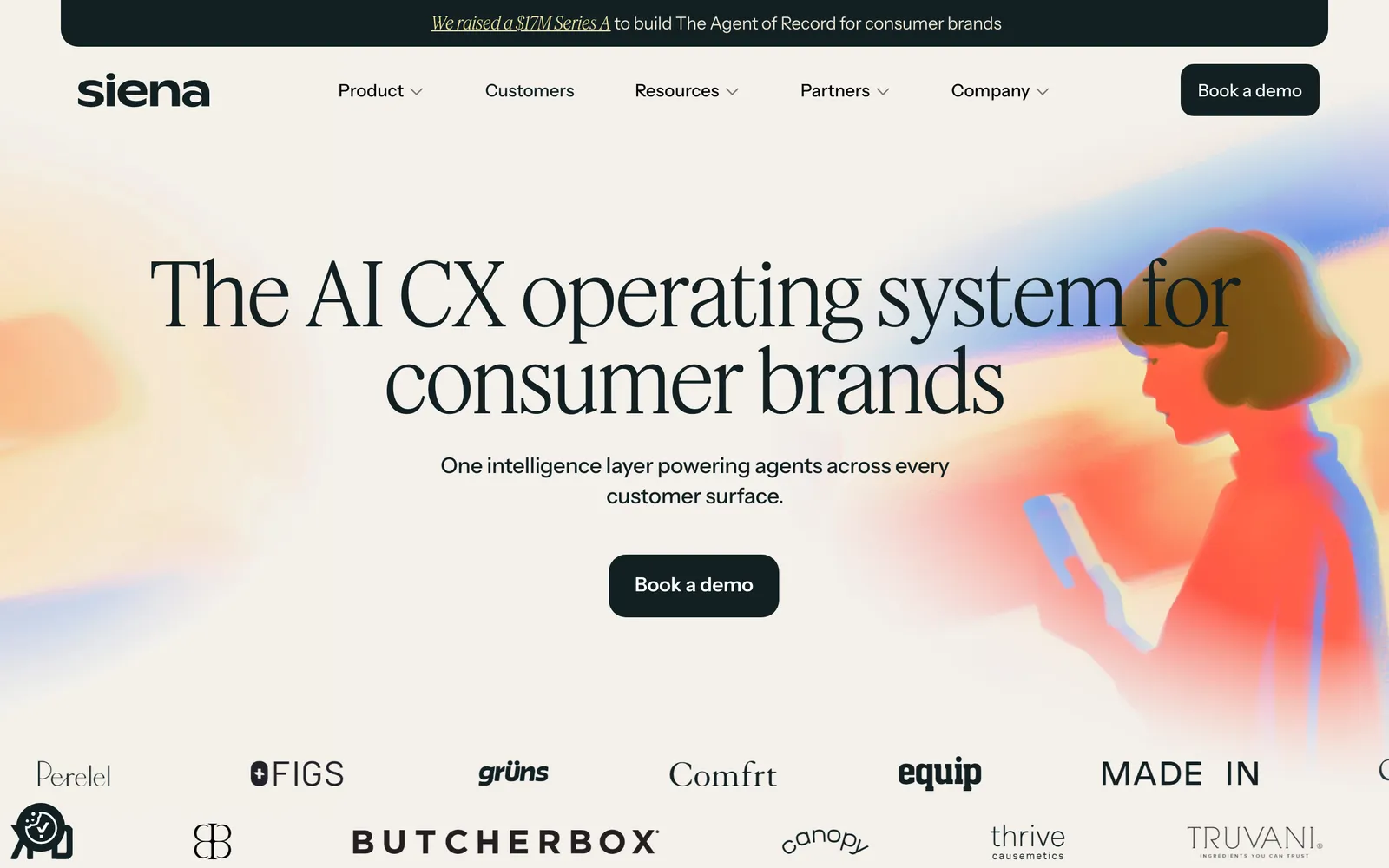
Siena AI is an e-commerce specialist that lets you “Connect your Zendesk account to Siena in minutes”, automating “email, SMS, WhatsApp, Instagram, Facebook, Twitter, chat, and web channels” while Siena “creates all necessary webhooks and resources” (Siena). That earns 5 on help desk fit and on time to live. It handles “updating addresses, generating labels, issuing refunds, and sending replacements in a single flow”, so store actions score 5 (Siena).
Control scores 4: its procedures are “plain language workflows for the agent to follow” (Siena), and the Siena pages linked here describe no per-action approval step. Self-improvement scores 3, because those pages describe no approval step for learned changes. Siena says it has added voice after its social and shopping agents (Siena), but has no voice product page, so channels score 4. Our Siena guide covers the rest.
4. Zendesk AI agents (incl. Forethought): 4.10
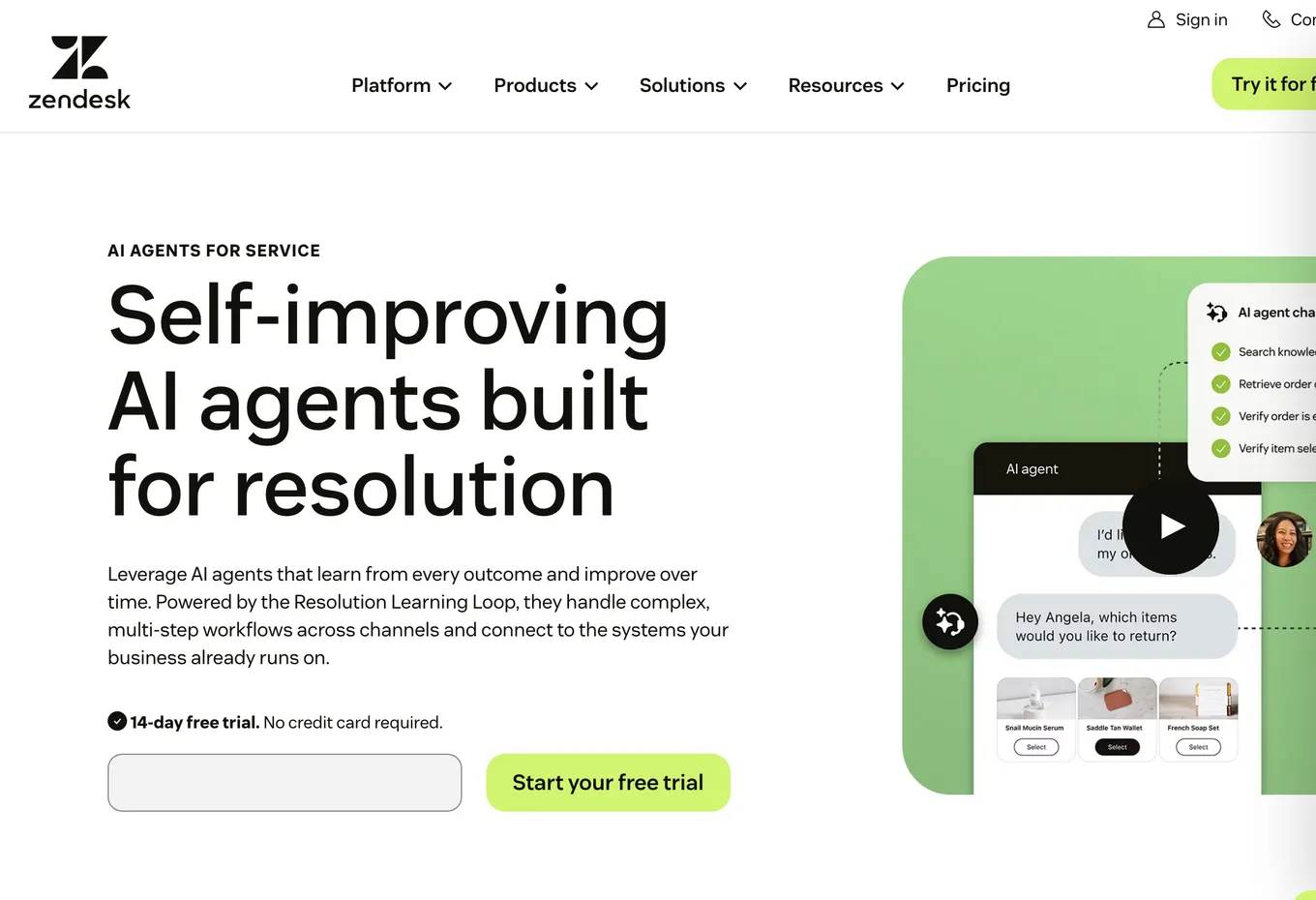
Zendesk’s own AI agents are the baseline: already part of your Zendesk, nothing to install, and voice is covered. Conversation logs show a Plan field, “The AI agent’s reasoning in determining how to resolve the user’s issue” (Zendesk). Zendesk is a proven ticketing foundation trusted by big teams.
Self-improvement scores 4: Zendesk sells “Self-improving AI agents built for resolution”, powered by its Resolution Learning Loop (Zendesk), and its Copilot procedure drafts “must be published by you” (Zendesk). Control scores 5, for the per-action “agent-approved” marking quoted above. Store actions and time to live score 3, because the AI agent’s order work runs through actions and flows you build. Our view: that is AI bolted onto horizontal ticketing. The Zendesk comparison sets it against Engaige.
5. melibo: 3.90
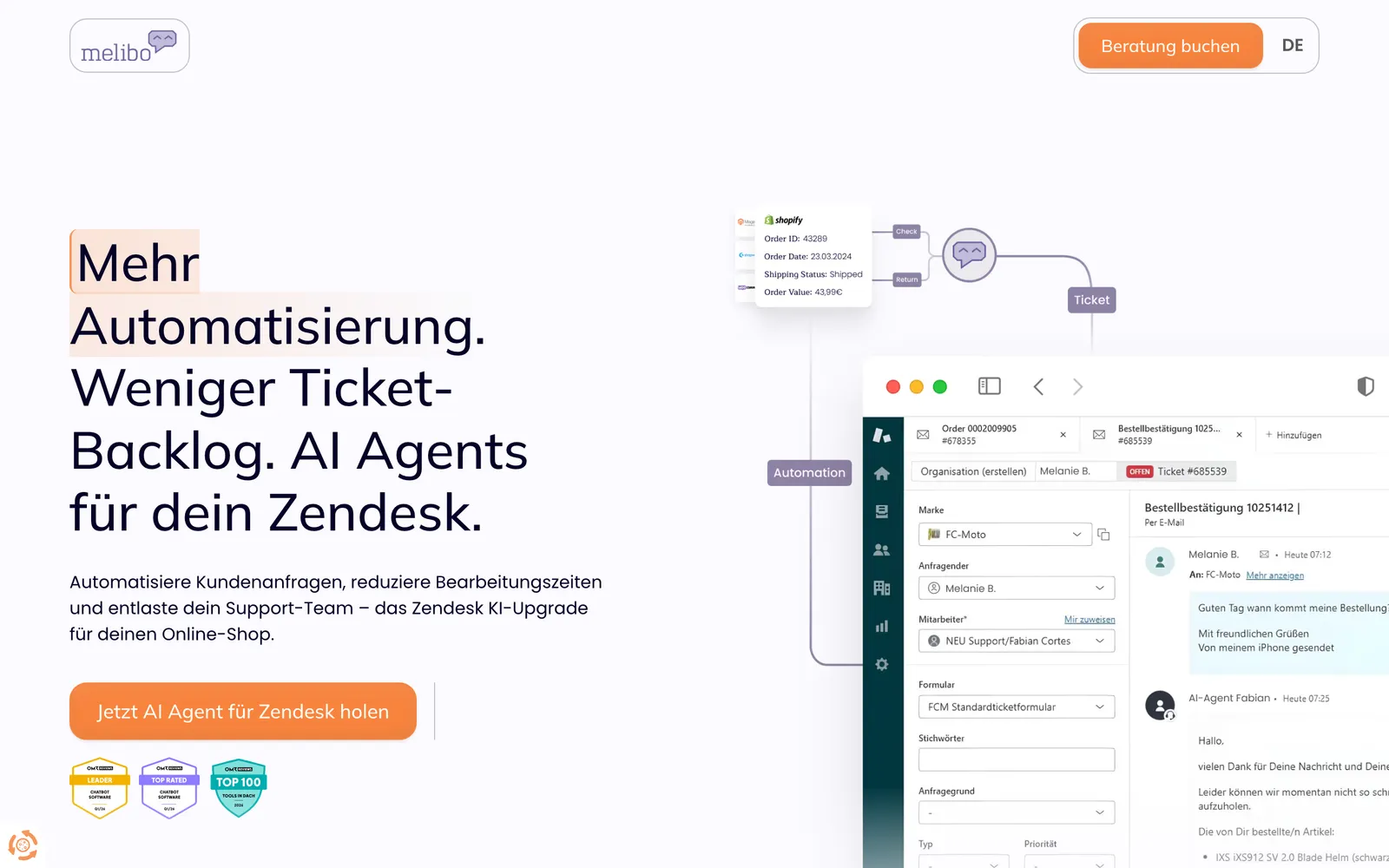
melibo is a German AI agent for online shops that sells “AI Agents für dein Zendesk”, with deep connectors to the German e-commerce stack. In Zendesk it drafts replies and can send emails and close tickets once a request is solved, so help desk fit scores 4 (melibo). Its Action Assist suggests cancellation, address change or refund for your team to confirm in one click (melibo); write actions are vendor-stated, so store actions score 4.
Control scores 5: you choose per request type whether an action is a suggestion your team confirms or runs fully automatically (melibo). Self-improvement scores 4: its feature list offers “Trainingsvorschläge der KI”, AI training suggestions, and your team rates each AI answer in the ticket.
For the first four weeks the AI only drafts, and melibo states an average ramp-up of 30 business days to go-live, its own figure, so time to live scores 3. Its channel list (web chat, app, Messenger, WhatsApp, ticket and email) has no voice, so channels score 3.
6. Decagon: 3.75
Decagon is a strong, well-funded AI agent platform for large consumer brands. Its integrations page says your agent can “handle email inquiries through Zendesk and Intercom, with smooth handoffs when needed” (Decagon), so help desk fit scores 4 on that documented email use. The page names help desks and CRMs but no commerce platform, so store actions score 3, and it covers “chat, email, and voice channels”, so channels score 5.
Its agents run on Agent Operating Procedures that “Combine the flexibility of natural language with the reliability of code” (Decagon): control scores 4 (behaviour set in procedures, no per-action approval described there) and time to live 3 (part of the setup is code). Self-improvement scores 4: Duet Autopilot proposes updates with “exact diffs”, under “human approvals for proposed updates” (Decagon). The enterprise platforms are built for a heavier, different buyer. See our Decagon guide.
7. Ada: 3.15
Ada, founded in 2016, is a mature enterprise platform with strong voice, so channels score 5. It works with Zendesk from the outside in: “Ada integrates with Zendesk in several ways to support live agent and ticket-based handoffs” (Ada), so help desk fit scores 3. Its integrations page lists help desks and airline systems but no commerce platform (Ada), so store actions score 3.
Control scores 4: of its action tools Ada says “You author them, turn them on, and govern what the agent can touch”, and “Each stays off until you turn it on” (Ada). Self-improvement scores 2: “Coaching on past conversations is automatically applied to future interactions”. Time to live scores 3, because Ada advises enterprises to “treat AI agent management as a core competency, one they build and own in-house”, which suits a large service organisation more than a scaling store team.
How do the scores add up?
Scores run from 1 to 5 per criterion, from vendor pages checked on 9 November 2026. Engaige concedes channel coverage and help desk fit.
| AI agent | E-commerce actions (20%) | Self-improvement (20%) | Help desk fit (20%) | Control (15%) | Time to live (15%) | Channels (10%) | Weighted |
|---|---|---|---|---|---|---|---|
| Engaige | 5 | 5 | 4 | 5 | 5 | 3 | 4.60 |
| Fin | 4 | 4 | 5 | 5 | 4 | 5 | 4.45 |
| Siena AI | 5 | 3 | 5 | 4 | 5 | 4 | 4.35 |
| Zendesk AI agents | 3 | 4 | 5 | 5 | 3 | 5 | 4.10 |
| melibo | 4 | 4 | 4 | 5 | 3 | 3 | 3.90 |
| Decagon | 3 | 4 | 4 | 4 | 3 | 5 | 3.75 |
| Ada | 3 | 2 | 3 | 4 | 3 | 5 | 3.15 |
The total is the weighted sum: actions × 0.20 + self-improvement × 0.20 + help desk fit × 0.20 + control × 0.15 + time to live × 0.15 + channels × 0.10. For Engaige that is 1.00 + 1.00 + 0.80 + 0.75 + 0.75 + 0.30 = 4.60; for Fin, 0.80 + 0.80 + 1.00 + 0.75 + 0.60 + 0.50 = 4.45.
Reweight it for your mix. If phone is a big share of your tickets, channel coverage deserves more weight and the voice-capable agents move up. If you have developers who own Zendesk flows, Zendesk’s own AI agents close much of the gap on store actions.
Where does Engaige fit?
Engaige isn’t a help desk and doesn’t replace Zendesk: it’s the AI support agent that works inside the Zendesk agent workspace, on your existing tickets and macros, and Engaige AI, the part you brief in plain language, configures and improves it. Keep your helpdesk, replace the AI. There is no migration, and the Zendesk integration page shows what it does in the ticket.
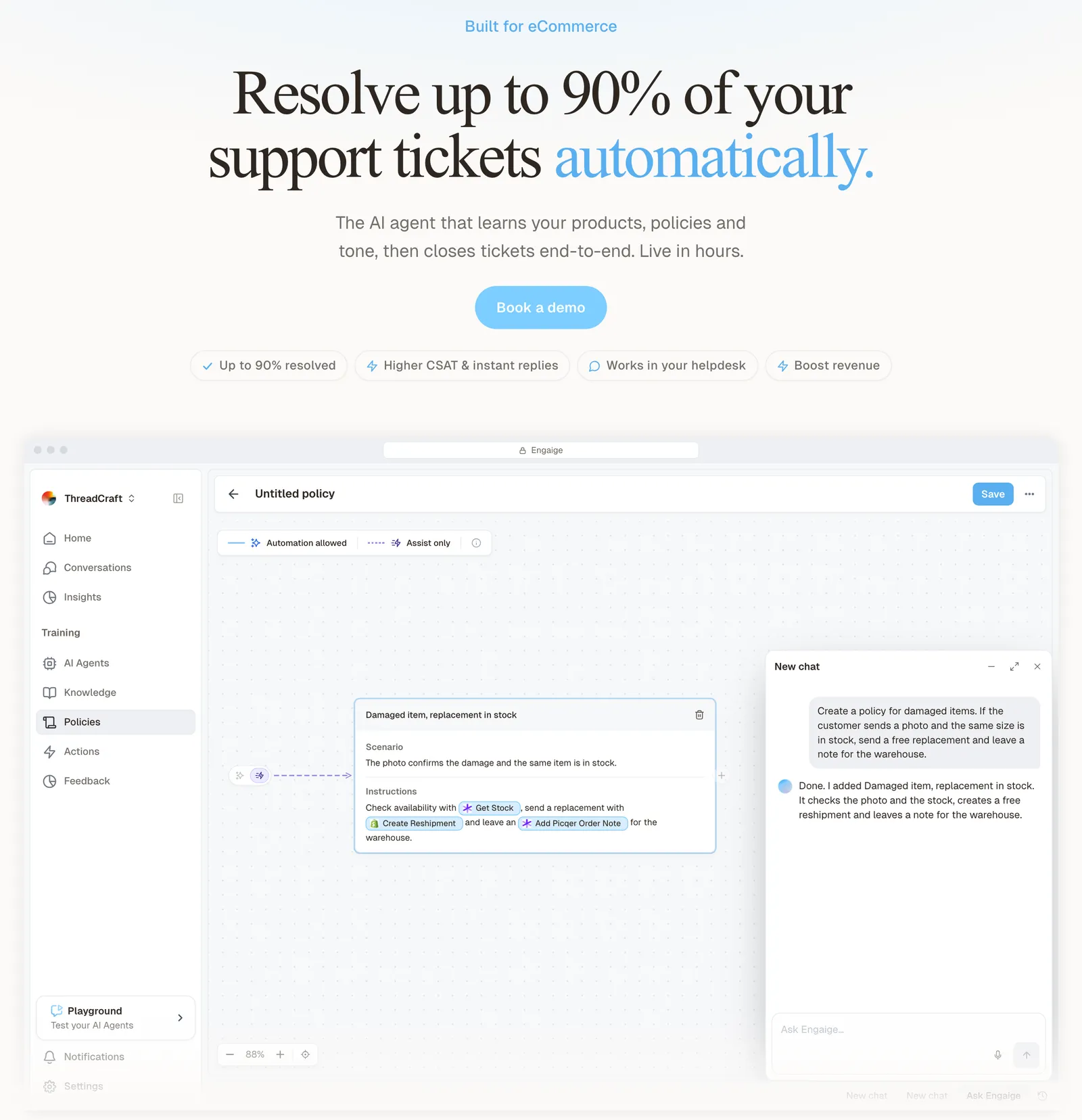
Store actions, built for e-commerce. Engaige reasons in the order lifecycle: where is my order, returns and refunds, cancellations, address changes, discounts and subscription changes. It takes the action in the connected system, replies and closes the ticket in Zendesk. On Shopify it combines live Admin API data, pricing across markets and SKUs, inventory, orders and customers, with the marketing content from your storefront. See the Shopify integration.
It learns from your team’s normal work. You go live in Agent Assist in hours. Every reply your team sends is compared with what the agent suggested, one of the signals Engaige AI learns from, next to the conversations, your inputs, hand-offs and emerging trends. Engaige AI proposes each change to a policy with its reasoning, and you approve it before it goes live.

Hello Potential New Client
What would you like to get done today?
Could you analyse this week's conversations and show me some automation opportunities?
Ask Engaige…
Searched and found 4 contact reasons · 2.4s
Your agent resolved 426 of 512 conversations. 86 were handed over, and one contact reason accounts for most of them.
Searched and found 1 policy · 1.6s
Delivery status hands over whenever tracking is older than 24 hours, which is 40 of those 46.
Editing Delivery status · 1.9s
Done. It now handles stale tracking itself. Those 40 a week stay with your agent.
What were the reasons for handover, and how can we improve?
Fix it.
Reply…
Others on this list learn from people too: Fin’s recommendations compare unresolved Fin conversations with human replies, and melibo says its agent “lernt, wie dein Team antwortet” (melibo). Engaige’s mechanism is comparing every drafted reply with the one your team sent, from day one. It keeps learning once a ticket type is autonomous, from live outcomes, emerging trends and hand-offs.
Reasoning and control. Open any conversation in Engaige and you see the full reasoning behind every answer and action. At a hand-over, the agent leaves a reasoning summary as an internal note in the Zendesk ticket. You decide per step whether the agent acts alone or drafts for your team, and you can set thresholds, such as sending refunds above a set amount to a person first.
Ticket types go autonomous one at a time, most brands in about a week, up to 90% of supported tickets; autonomous from day one is also supported. Otrium resolves 60% of its 120,000 annual tickets end to end, and MR MARVIS handles over 120,000 questions a year with Engaige.
With Engaige, we are able to automatically resolve 60% of the 120,000 support tickets that we receive annually.

Engaige is text-first by design: email, chat, WhatsApp, SMS and social DMs, no voice AI. A live call gives an AI seconds to reason; text gives it time to read the order, check your policy and act. If phone is a big share of your mix, a voice specialist is the honest answer. Engaige is built for resolution, not enterprise overhead.
Frequently asked questions
What is the best AI agent for Zendesk?
For an online store, Engaige scores highest on our matrix at 4.60, ahead of Fin (4.45) and Siena AI (4.35). It works inside Zendesk with no migration, takes store actions such as refunds and address changes, and learns from your team’s replies with you approving every change.
Do I need a third-party AI agent if I already have Zendesk AI?
Not always. Zendesk’s own AI agents are enough when most tickets are answered from your help centre and you build and maintain your own actions and flows. A dedicated agent earns its place when store actions such as refunds, cancellations and address changes should run end to end without building each flow yourself.
Which AI agent for Zendesk goes live fastest?
Engaige goes live in Agent Assist in hours, and Siena says you can connect Zendesk in minutes. melibo states an average ramp-up of 30 business days, and Zendesk’s own AI agents need the actions and flows you build for store work.
Which AI agents for Zendesk need developers?
Zendesk’s own AI agents reach Shopify through custom actions, flows or scripts your team builds, and Decagon’s procedures combine natural language with code. Engaige and Siena connect to Zendesk without building flows, and Fin’s setup guide lists a technical leader for the integration.
Can I run two AI agents in Zendesk at the same time?
Yes. Engaige can take chosen ticket types while Zendesk’s own AI agent keeps the rest, so you compare both on your own tickets before you switch.
Which AI agents for Zendesk handle phone calls?
Zendesk, Fin, Decagon and Ada sell AI voice agents, and Siena says it has added voice. Engaige is text-first by design: email, chat, WhatsApp, SMS and social DMs.