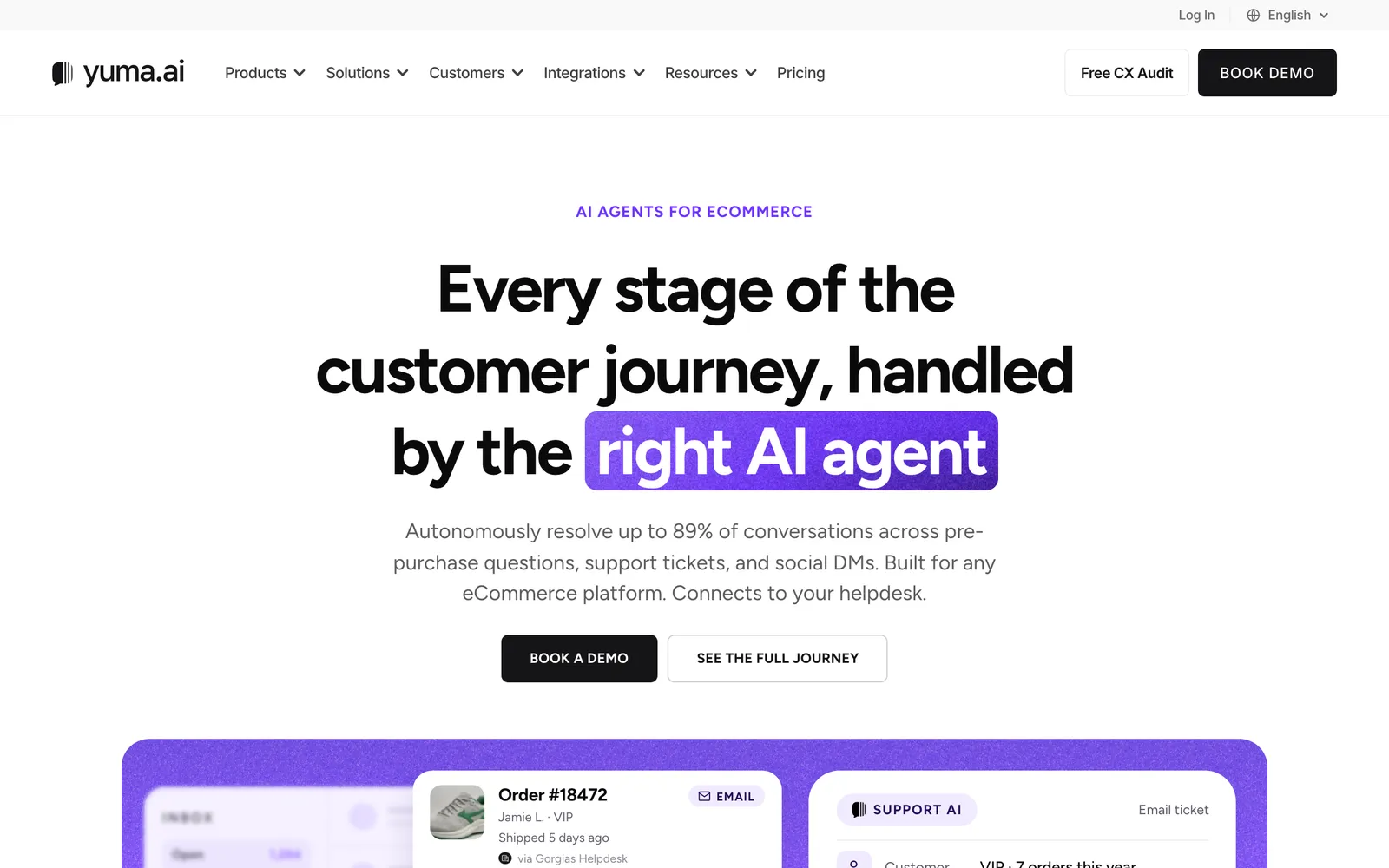
Yuma AI is an AI agent platform for e-commerce brands, built by Boston-based Yuma (yuma.ai). Its agents work inside the help desk a brand already runs, such as Gorgias or Zendesk, read live order data and take actions like refunds, reships and subscription changes. Brands pay only for tickets the AI fully resolves. It is not the city in Arizona.
This page covers Yuma only, with facts from Yuma’s own pages as of October 2026. For a scored view of the category, see our agent ranking.
What is Yuma AI?
Yuma AI is AI customer experience software for e-commerce. On its about page, Yuma describes it as software whose agents resolve support, sales, social, chat and voice conversations end to end, inside the help desk brands already use. Its homepage promises to “autonomously resolve up to 89% of conversations” and says it is built for any e-commerce platform.
If the term is new to you, our guide to AI agents explains what an agent does that a scripted chatbot does not. Yuma belongs in that group: it acts in your store systems rather than only suggesting answers.
Who is behind Yuma AI?
Yuma was founded by Guillaume Luccisano, its chief executive and a three-time Y Combinator founder. In November 2022 he launched one of the first generative AI support apps on the Gorgias App Store, and merchant demand turned it into Yuma. Yuma gives 2022 as its founding year; its YC profile lists it as founded in 2023, in the Winter 2023 batch.
Yuma’s about page says it raised $5M in 2024 from Y Combinator, Gradient Ventures, Pioneer Fund, Altman Capital and more than 50 angel investors. It reports around 30 people across Boston, Barcelona and remote, and more than 140 e-commerce brands as customers.
| Yuma AI at a glance | As of October 2026 (per Yuma) |
|---|---|
| Company and site | Yuma AI, yuma.ai |
| Founder | Guillaume Luccisano, founder and CEO |
| Headquarters | Boston, with a second office in Barcelona |
| Founded | 2022, per Yuma; 2023 (Winter 2023 batch), per Y Combinator |
| Funding | $5M raised in 2024 |
| Customers | 140+ e-commerce brands in North America and Europe |
| Products | Support AI, Sales AI, Social AI, Chat AI, Voice AI |
| Pricing model | Pay only for tickets the AI fully resolves |
What does Yuma AI do for e-commerce support?
Yuma runs five agent products on one shared knowledge base, brand voice and set of guardrails. Support AI handles the inbox: where-is-my-order questions, returns, exchanges, refunds and order changes, escalating only the conversations that need a person. The table lists each product as Yuma describes it on its about page.
| Product | What Yuma says it does |
|---|---|
| Support AI | Resolves WISMO, returns, exchanges, refunds and order changes end to end |
| Sales AI | A shopping assistant for Shopify storefronts that answers product questions and recovers abandoned carts |
| Social AI | Replies to comments, DMs and mentions on Instagram, Facebook, TikTok and more |
| Chat AI | A live chat widget for any storefront, installed in minutes |
| Voice AI | Answers the support line around the clock and takes backend actions mid-call |
| Ask Yuma | Build automations, diagnose issues and get reports in plain English |
| Web Actions | Completes tasks in a real browser on sites with no API, such as carrier portals |
Since Yuma 2.0, announced on 28 September 2026, one written Handbook runs every channel. Its Yuma 2.0 post describes brand pages, playbooks and procedures that you manage in plain language. Our WISMO use case shows the same core job on our side.
Which help desks and platforms does Yuma work with?
Yuma installs on top of your help desk, with no migration. Its FAQ lists Gorgias, Zendesk, Kustomer, Front, Salesforce Service Cloud, Gladly, Re:amaze, Sprinklr and Zoho Desk. On the commerce side it names Shopify, BigCommerce, WooCommerce, Magento 2 and Adobe Commerce, plus subscription, returns and shipping tools.
Its integrations page says your macros, tags and routing keep working, and that refunds, reships, cancellations and subscription skips happen “within the limits you set”. The same FAQ says a dedicated account manager configures your agents: “There’s no DIY setup”, and Yuma’s team handles it at no extra cost.
If you run Gorgias, our comparison of Gorgias and Yuma weighs the built-in AI against a layered one. See our Gorgias integration for how Engaige connects to the same help desk.
Does Yuma handle phone calls?
Yes. Yuma launched Voice AI in the third quarter of 2026, per its about page. Its voice page says the agent answers your support number, verifies the caller and makes the change in Shopify or your subscription tool before the call ends, using the same Handbook as email and chat.
Yuma provisions US and UK numbers directly; in the EU you bring your own number and Yuma routes it. When a call needs a person, it lands in Gorgias, Zendesk or Kustomer. For other options on the phone, see our guide to voice AI.
Which brands use Yuma, and what do they report?
Yuma names brands such as Glossier, Petlibro, FINN, Clove, Javvy Coffee, Tediber, EvryJewels, MFI Medical, CABAIA and UnBonMaillot. Each figure below comes from Yuma’s own case study pages as of October 2026, so treat it as vendor-stated.
| Customer | Result (vendor-stated) | Source |
|---|---|---|
| EvryJewels (jewellery) | 89% of tickets fully automated; 150,000 tickets in a single month (December 2023) | case study |
| Clove (footwear) | 70% of tickets fully automated; 3x ROI in three months | case study |
| MyVariations (consumer tech) | 62% of tickets fully automated; first response from 7 hours to 2 | case study |
The spread is useful. The same vendor reports 89% at one brand and 62% at another, so your own ticket mix decides where you land. Ask any vendor how it defines the percentage and over which tickets.
How much does Yuma AI cost?
Yuma uses outcome-based pricing: you pay only for full resolutions. Its pricing page defines one as a ticket Yuma handled from start to finish with no human involved, counted once per ticket. Conversations and escalations are not charged, and there is no implementation fee.
The page publishes three plans. Yuma labels the figures illustrative annual prices with a 12-month commitment, and sizes the exact bundle to your forecast.
| Plan | Illustrative price | Resolutions a year | Approx. per resolution |
|---|---|---|---|
| Starter | $14,400 a year | 12,000 | $1.20 |
| Growth | $40,000 a year | about 48,000 | $0.83 |
| Scale | $90,000 a year | about 120,000 | $0.75 |
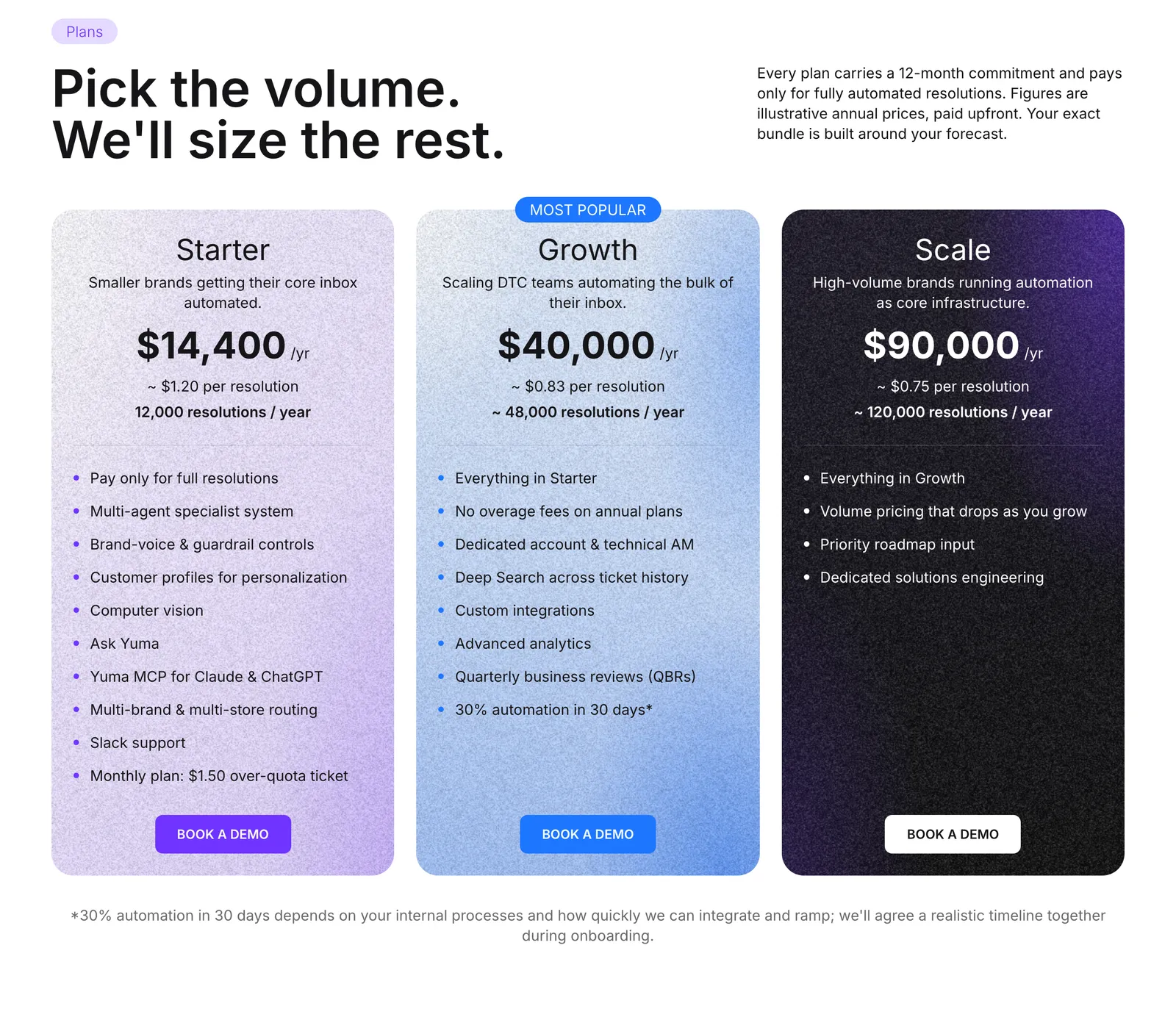
On annual plans, usage pauses when you reach your bundle. On monthly plans, extra full resolutions cost $1.50 each. Every contract starts with a free 30-day trial on real tickets, per Yuma’s about page.
How does Yuma learn after go-live?
Yuma learns in two ways, per its FAQ. When a person on your team edits or overrides an AI draft, “Yuma absorbs that correction into future replies”. Its engineering team also ships model improvements weekly. The FAQ does not describe a review step for the corrections it absorbs from edits.
Handbook changes work differently. Ask Yuma writes Handbook pages from your SOPs or tickets, and “every change lands as a draft” until you publish it. Each playbook carries its own tests, rerun as simulated conversations when something changes. You can roll a new playbook out to 10% of matching conversations, with the rest kept as drafts for your team.
Where the Handbook is silent, Yuma hands the conversation to a person and logs the gap as an open question. Its FAQ adds that Hard Limits cap refunds and coupon values, and that every reply and action is logged. Yuma’s account team also reviews results and adds new intents and workflows over time.
Where does Engaige fit?
Engaige (that’s us) is the AI support agent for e-commerce brands. It works inside your help desk, and Engaige AI configures and improves it. MR MARVIS, a Shopify Plus brand, handles over 120,000 questions a year with Engaige, resolving over 60% of the conversations it’s involved in.
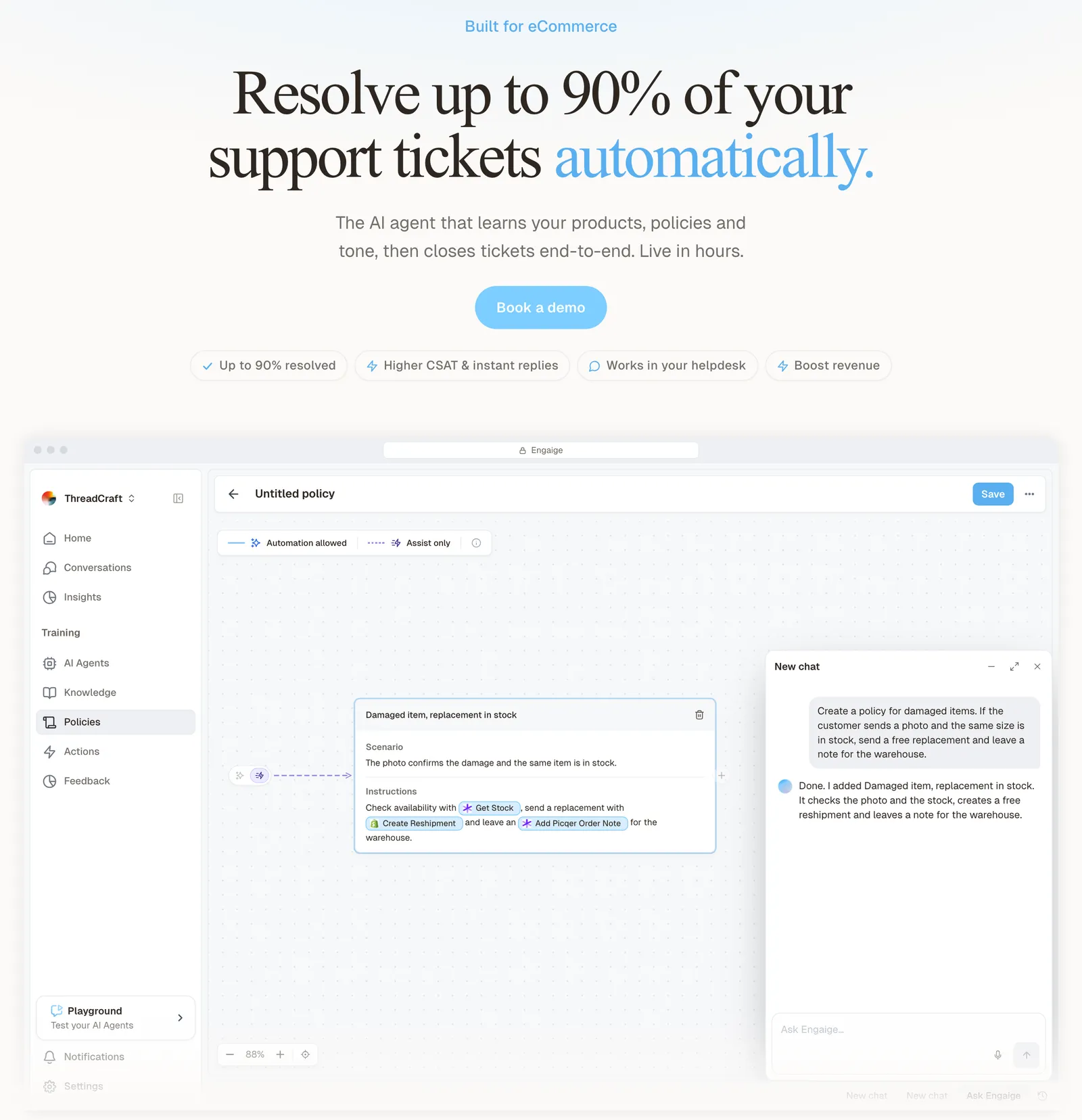
Yuma does real work for e-commerce brands and takes actions in the help desk. Same category; our angle is who approves what the agent learns. Engaige is live in Agent Assist in hours. Every reply your team sends is compared with what the agent suggested, one signal next to the conversations, your inputs, hand-offs and emerging trends. Engaige AI proposes each change with its reasoning, and you approve it before it goes live.

Hello Potential New Client
What would you like to get done today?
Could you analyse this week's conversations and show me some automation opportunities?
Ask Engaige…
Searched and found 4 contact reasons · 2.4s
Your agent resolved 426 of 512 conversations. 86 were handed over, and one contact reason accounts for most of them.
Searched and found 1 policy · 1.6s
Delivery status hands over whenever tracking is older than 24 hours, which is 40 of those 46.
Editing Delivery status · 1.9s
Done. It now handles stale tracking itself. Those 40 a week stay with your agent.
What were the reasons for handover, and how can we improve?
Fix it.
Reply…
Once a ticket type is autonomous, Engaige resolves it end to end: it takes the action in your store systems, replies to the customer and closes the ticket. It keeps learning in that mode too, from hand-offs and emerging trends, under the same approval.
You decide per step whether the agent acts on its own or drafts for your team, and you can set thresholds, such as sending refunds above a certain amount to a person first. Open any conversation in Engaige and you see the full reasoning behind every answer and action.
Engaige offered control, flexibility, and the ability to really incorporate AI in a more human way.

On Shopify, Engaige combines live Admin API data, pricing across markets and SKUs, inventory, orders and customers, with the marketing content from your storefront, so several live systems are read in one answer. It also runs on WooCommerce, Magento, BigCommerce and custom systems. See the Shopify integration.
Otrium, a fashion marketplace, resolves 60% of its 120,000 annual tickets end to end.
Replacing the AI does not mean replacing your help desk. Engaige connects to the one you run and can start on a few ticket types next to your current AI, so you compare both on your own tickets. For a broader list, see our Yuma alternatives, or Siena AI for another e-commerce agent.
Frequently asked questions
Is Yuma AI a help desk?
No. Yuma is an AI layer that installs on top of a help desk such as Gorgias, Zendesk, Kustomer or Front, with no migration. Engaige also works inside your help desk, so the choice is about how the agent learns, not about your inbox.
Does Yuma only work with Shopify?
No. Yuma names Shopify, BigCommerce, WooCommerce, Magento 2 and Adobe Commerce, and its homepage says it is built for any e-commerce platform. Its Sales AI shopping assistant is described for Shopify storefronts.
Who founded Yuma AI?
Guillaume Luccisano, its founder and chief executive, launched it on the Gorgias App Store in November 2022. Yuma was in Y Combinator’s Winter 2023 batch and says it raised $5M in 2024.
How does Yuma AI pricing work?
You pay only for tickets the AI fully resolves, with no charge for conversations or escalations. Yuma publishes illustrative annual plans of $14,400, $40,000 and $90,000, each with a 12-month commitment and a free 30-day trial.
Does Yuma learn from my team?
Yes. Its FAQ says Yuma absorbs corrections into future replies when your team edits or overrides an AI draft, with no review step described. Handbook changes arrive as drafts that you publish.
How is Engaige different from Yuma AI?
Same category; our angle is approval. In Agent Assist, Engaige AI learns from your team’s replies among other signals and proposes each change with its reasoning, and you approve it before it goes live. You also set per-step control and thresholds.
Does Engaige do voice like Yuma?
No. Engaige is text-first by design: email, chat, WhatsApp, SMS and social DMs, no voice AI. A live call gives an AI seconds to reason; text gives it time to read the order, check your policy and act. Yuma offers Voice AI on the phone.