Intercom vs Zendesk is a choice between a messaging-first help desk and a ticketing-first one. Intercom, now Fin, builds its help desk around the Messenger and the Fin AI agent. Zendesk builds around tickets across email, messaging and voice, with AI agents and Copilot. For a store, the deciding question is which one resolves order tickets, and whether you need to switch at all.
This comparison is for the support lead or founder of an online store who runs one of the two, or is choosing between them. Every vendor fact below comes from Fin’s, Intercom’s, Zendesk’s and Salesforce’s own pages, read in October 2026, so treat it as vendor-stated.
| Intercom (Fin) | Zendesk | |
|---|---|---|
| Built around | The Messenger and a shared inbox, with Fin built in | Tickets across email, messaging, voice and the help centre |
| AI for customers | Fin AI agent with Procedures | AI agents, plus Forethought AI agents |
| AI for your team | Copilot | Copilot (auto assist) |
| Vendor-stated AI result | 76% average resolution rate across 12,000+ businesses | 80% automation rate in a customer story on its AI agents page |
| AI pricing | $0.99 per outcome | Allowance included, then $1.50 committed or $2.00 pay-as-you-go per automated resolution |
| Shopify, as documented | Get order info, plus cart and catalogue templates | Order look-up, cancel and refund actions in Copilot’s auto assist; AI agents through action flows you build |
| Owner | Salesforce, since 10 September 2026 | Zendesk, which owns Forethought since 26 March 2026 |
Sources: Fin, Intercom pricing, Zendesk pricing and the pages cited below, read on 26 October 2026.
What are Intercom and Zendesk?
Intercom and Zendesk are customer service help desks: a shared inbox, ticketing, a help centre and live chat, each with a built-in AI agent. Intercom renamed itself Fin in 2026 and is now part of Salesforce; its help desk keeps the Intercom name. Zendesk is an independent help desk suite that bought Forethought, an AI agent company, in March 2026.
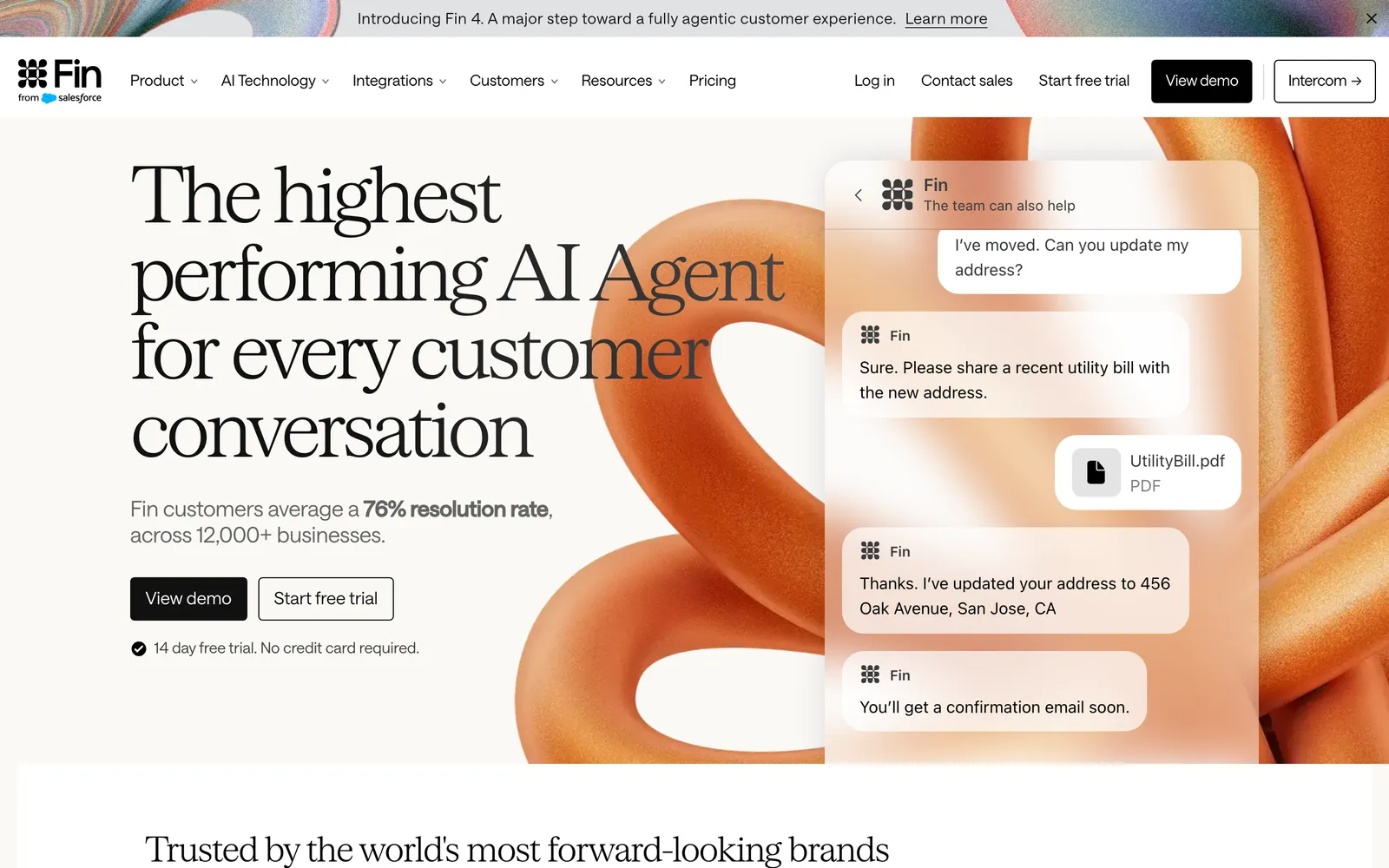
Fin’s homepage, captured on 26 October 2026, leads with “The highest performing AI Agent for every customer conversation” and the line that Fin customers average a 76% resolution rate across 12,000+ businesses. Both are vendor claims. The Fin logo carries a “from Salesforce” mark, and an Intercom link sits in the top navigation.
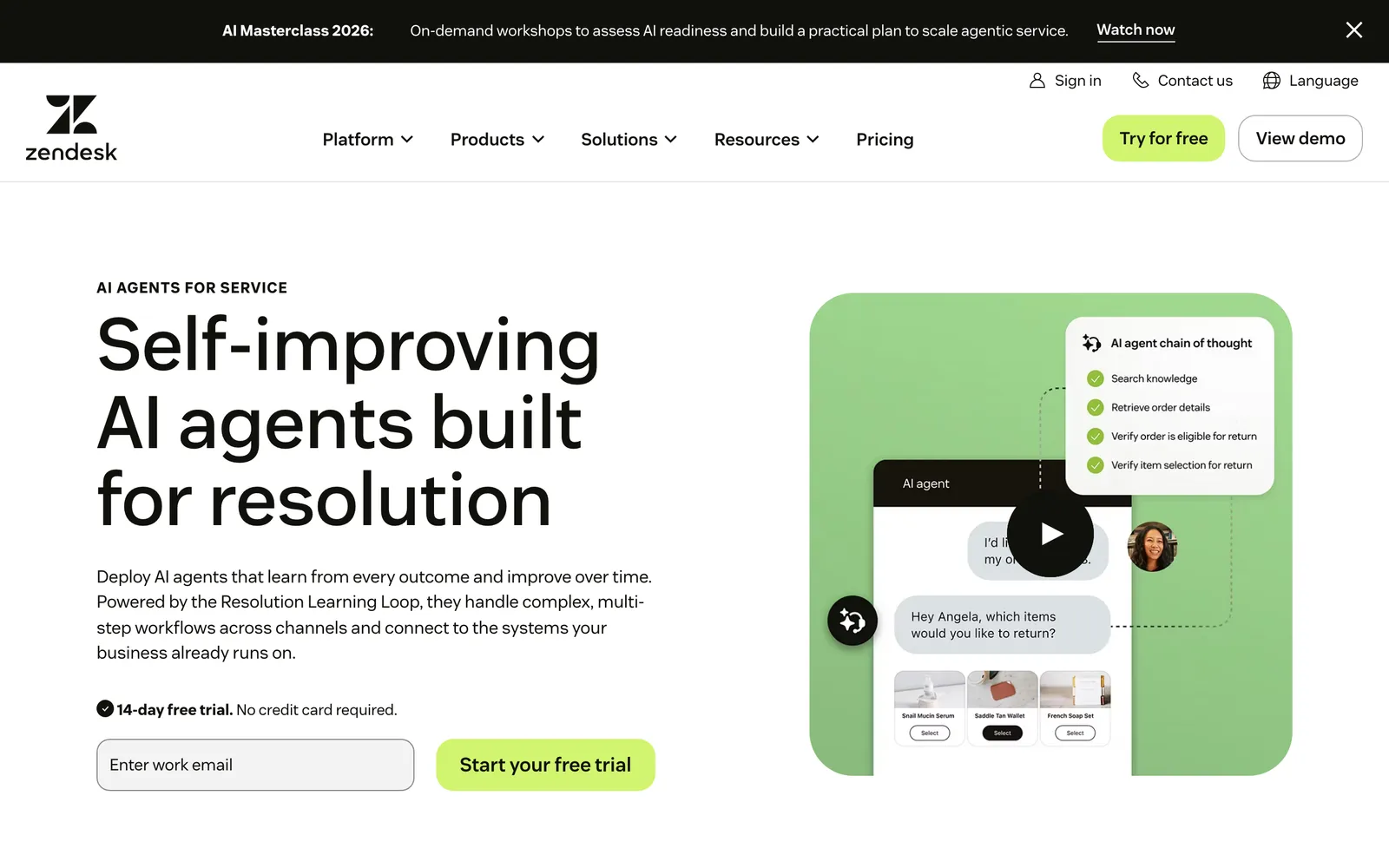
Zendesk’s AI agents page, captured the same day, is headed “Self-improving AI agents built for resolution”. It says the agents “learn from every outcome” through its Resolution Learning Loop, and shows a chain of thought that retrieves order details and checks return eligibility.
Who owns Intercom and Zendesk now?
Salesforce completed its acquisition of Fin, formerly Intercom, on 10 September 2026, and says Fin will “continue to serve its customers” as part of its AI Labs. Our Intercom guide explains the rename and what Fin is today.
Zendesk completed its acquisition of Forethought on 26 March 2026. Its pricing page now describes Forethought AI agents as self-improving agents that work in Zendesk or “on any platform”. Our Zendesk hub covers what that means for a store on Zendesk.
What is each built for?
Intercom is built for conversations that start in chat: a Messenger on your site or in your app, with Fin answering first and your team in the same inbox. It grew up in software support. Zendesk is built for high-volume ticketing across channels, voice included, with routing, triage and reporting for larger, multi-team operations.
That history shows in the products. Intercom leads with the Messenger and Fin, and its own comparison page argues that Fin and the help desk are “built as one platform”. Zendesk leads with omnichannel routing, skills-based routing, an IVR phone tree on Suite Professional and a large app marketplace.
For a store, both are general-purpose help desks. Neither is organised around the order lifecycle: where an order is, whether it can still be changed, whether a return is inside the window. That logic lives in Shopify and the apps around it, so in either help desk the AI reaches it through integrations you configure.
Where does each fall short?
For a store, Intercom falls short on documented commerce depth: its Shopify templates read orders and manage carts, and refunds or cancellations are built as your own data connectors. Zendesk falls short in the same place: its ready-made Shopify actions are documented for Copilot’s auto assist, the layer for your agents, while its AI agents reach Shopify through action flows you build.
Intercom. Fin is a capable agent, with Procedures, a “Loop in teammate” approval step and “Fin’s thoughts” showing its reasoning in the Inbox. Its centre of gravity is SaaS support, so store logic is something you assemble. Intercom’s templates article, dated 11 September 2026, lists one Shopify order template, Get order info, next to four cart and catalogue templates.
Zendesk. Zendesk’s AI agents log a plan with their reasoning and can run action flows, rolled out to all Suite and Support plans between May and June 2026, per its announcement. The AI is horizontal, added onto a ticketing platform built for every industry. Zendesk doesn’t think in orders, returns or subscriptions by default; you connect that knowledge yourself.
How do Intercom and Zendesk compare?
Intercom and Zendesk compare closely on AI capability and differ on shape. Both AI agents take actions, show their reasoning and propose improvements a person approves. Intercom bundles Fin into a Messenger-first help desk; Zendesk sells a broader ticketing suite with voice. On Shopify, both document a handful of order actions you set up.
| Criterion | Intercom (Fin) | Zendesk |
|---|---|---|
| Main channel | Messenger and in-app chat, plus email and others | Email, messaging, live chat and voice |
| AI agent actions | Procedures with data connectors and MCPs | Custom actions and action flows |
| Human approval before an action | ”Loop in teammate” step in a Procedure | Copilot actions marked pre-approved or agent-approved |
| Reasoning you can read | ”Fin’s thoughts” in the Inbox | A “Plan” field in AI agent conversation logs |
| AI-proposed improvements | Recommendations compare failed Fin answers with human replies; nothing goes live without approval | Up to three AI-drafted procedures per brand a week from solved tickets, which you publish |
| Testing | Batch tests and simulations | Test widget and a conversation simulator (early access) |
| AI on another help desk | Fin works on Zendesk, Salesforce, HubSpot and Freshdesk | Forethought AI agents work on any platform |
Sources: Intercom’s Recommendations, approvals and Fin’s thoughts articles; Zendesk’s conversation logs, actions and AI-generated procedures articles, read in October 2026.
How does each handle Shopify orders?
Intercom’s templates article lists Get order info, which returns order status, items, shipping address and tracking, plus Search Catalog, Get Cart, Update Cart and Get Product Details. Fin’s e-commerce page says Fin can “process partial or full cancellations, and issue refunds automatically”, which you build as data connectors inside Procedures.
Zendesk’s actions article lists standard Shopify actions for auto assist, the Copilot layer that works alongside your agents: look up an order, cancel and refund an entire order, and refund selected items. There it advises that write actions be “marked as agent-approved so that an agent can validate the action before it’s executed”, with refunds as the example.
Zendesk’s AI agents for customers use custom actions and action flows instead, which can call Shopify once you build them. Our Shopify integration guide covers the Zendesk set-up.
| Store question | Intercom (Fin), as documented | Zendesk auto assist, as documented |
|---|---|---|
| Where is my order? | Get order info template | Look up a Shopify order |
| Cancel my order | Built as a data connector in a Procedure | Cancel and refund an entire order |
| Refund one item | Built as a data connector in a Procedure | Refund selected items |
| Change my address | Claimed on Fin’s e-commerce page; built as a data connector | No address action listed |
| Change my cart or find a product | Get Cart, Update Cart, Search Catalog, Get Product Details | Not listed |
Sources: Intercom’s templates article and Zendesk’s actions article, read on 26 October 2026.
What do Intercom and Zendesk cost?
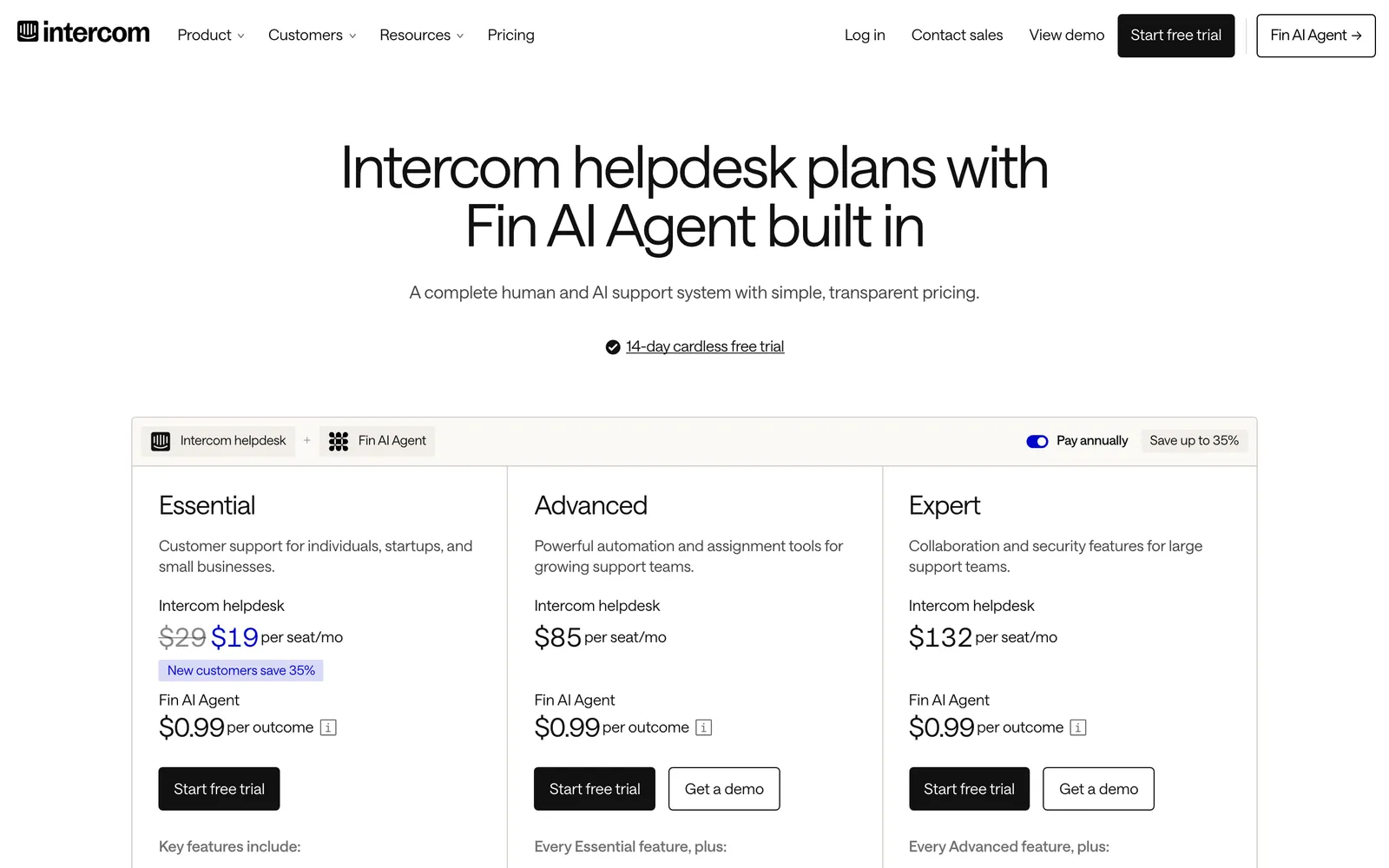
Both charge per seat for the help desk and per result for the AI. As of October 2026, Intercom seats run from $29 ($19 for new customers) to $132 a month on annual billing, and Fin costs $0.99 per outcome. Zendesk runs from $19 to $115 per agent a month on annual billing, with automated resolutions included up to an allowance.
| Cost layer | Intercom (Fin) | Zendesk |
|---|---|---|
| Entry help desk seat (annual) | Essential $29 per seat a month, $19 for new customers | Support Team $19 per agent a month ($25 monthly) |
| Main tiers (annual) | Advanced $85, Expert $132 per seat a month | Suite Team $55, Suite Professional $115 per agent a month ($69 and $149 monthly) |
| AI agent | $0.99 per outcome, one outcome per conversation | 5 or 10 automated resolutions per agent a month included, up to 10,000 a year |
| Extra AI volume | Same $0.99 per outcome | $1.50 per automated resolution committed, $2.00 pay-as-you-go |
| AI on another help desk | Fin at $0.99 per outcome, 50 outcomes a month minimum | Forethought AI agents via sales |
| Agent assistant | Copilot add-on, $29 per agent a month ($35 monthly) | Copilot add-on, $50 per agent a month, paid yearly |
Prices from Intercom, Fin and Zendesk pricing pages in US dollars, read on 26 October 2026. Suite Enterprise is sold through Zendesk’s sales team.
Both models scale with the AI’s results, so forecast from your ticket mix, not only your seat count. Ask each vendor what counts as a billable outcome or resolution for your store’s most common tickets before you compare totals. Our Intercom pricing guide breaks down every Intercom plan, Fin outcome and add-on, with worked examples by volume.
Which should you choose?
Choose Intercom if most of your customers start in chat and you want one vendor for the inbox and the AI. Choose Zendesk if you run email-heavy or phone support across teams and need routing, triage and reporting at scale. If the question is order resolution, the help desk matters less than the AI you put on it.
| Your situation | Better fit |
|---|---|
| Chat-led support, small team, want AI from day one | Intercom |
| Email and phone support, several teams or brands | Zendesk |
| Already on one and happy with the inbox | Keep it; judge the AI separately |
| Most tickets are orders, returns and deliveries | Either help desk, with an e-commerce AI agent such as Engaige |
If neither fits, our guides to Intercom alternatives and Zendesk alternatives compare the wider field. For a Shopify-first help desk, see our Gorgias comparison with Intercom.
How hard is it to switch between Intercom and Zendesk?
Switching help desks means moving tickets, macros, help centre articles and history, and retraining your team. A customer quoted on Intercom’s comparison page says Intercom’s team handled the data transfer. Meanwhile both vendors now sell their AI on other help desks: Fin connects to an existing Zendesk, and Zendesk sells Forethought for any platform.
That changes the question. If your inbox works and the AI doesn’t resolve enough, you can replace the AI without moving help desk. Replacing the AI doesn’t mean replacing your helpdesk: Engaige connects to the one you run, can start on a few ticket types next to your current AI, and if you ever change helpdesk, your setup comes with you.
Where does Engaige fit?
Engaige (that’s us) is the e-commerce-native AI support agent that plugs into the Intercom or Zendesk you already run, actually resolves across your stack and keeps improving itself. Keep your helpdesk. Replace the AI. Behind the agent is Engaige AI, which learns from your conversations and inputs, configures your support agent and shows which policies it used.
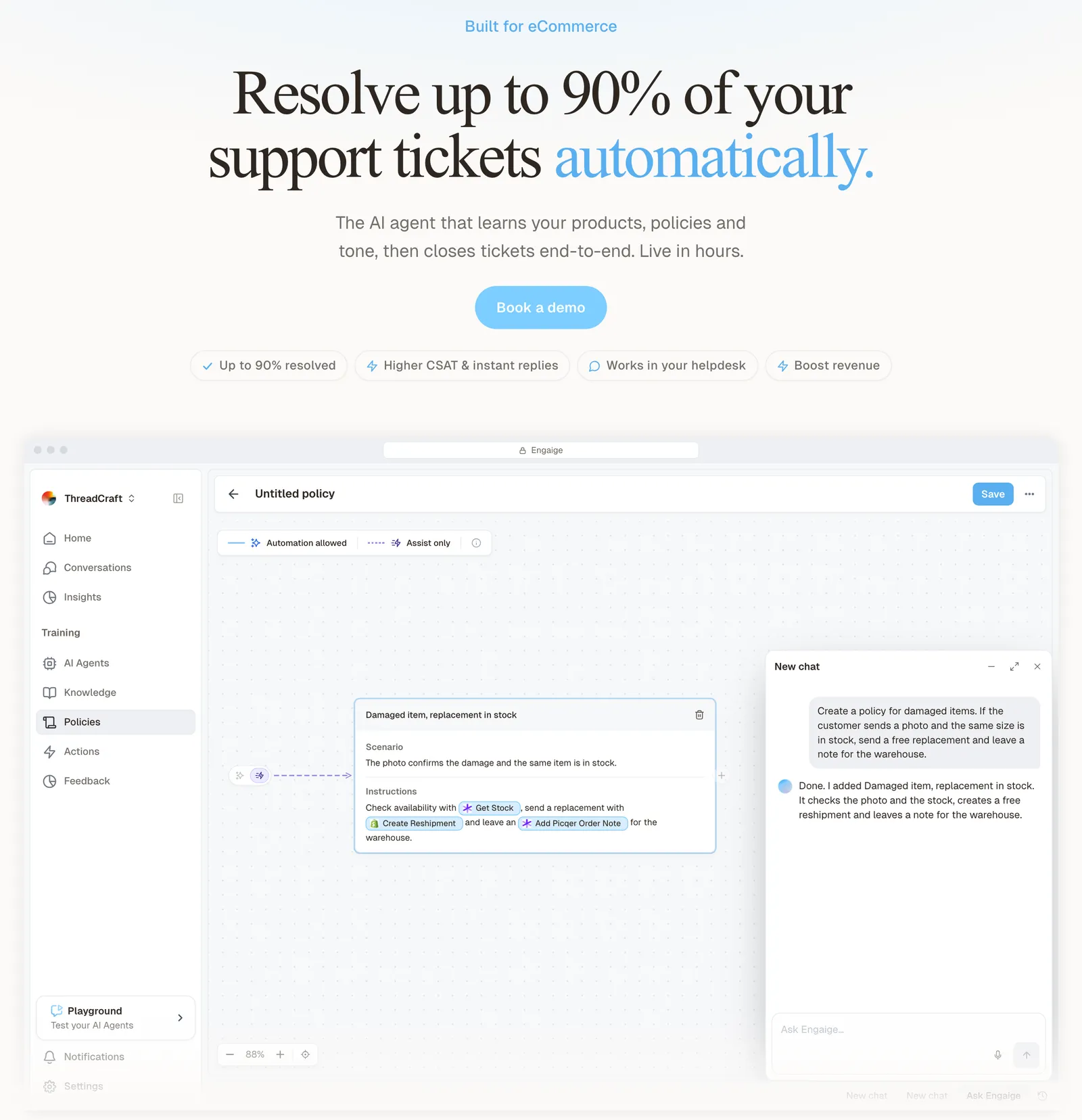
Keep either help desk. Engaige works inside Intercom and Zendesk, so there is no migration: tickets, macros and history stay where they are. It is live in Agent Assist in hours, and it can claim chosen ticket types while Fin or Zendesk’s AI keeps the rest, so you compare both on your own tickets.
Built for the store. Intercom is built for SaaS support, and Zendesk for every industry; Engaige is built for the store. On Shopify, it combines live Admin API data, pricing across markets and SKUs, inventory, orders and customers, with the marketing content from your storefront. It takes native actions such as refunds, cancellations, address changes and discounts, across 50+ native integrations whose actions you enable rather than build.
It learns from your team’s normal work. In Agent Assist, every reply your team sends is compared with what the agent suggested; that is one of the signals Engaige AI learns from. It proposes changes to policies and behaviour with its reasoning, and you approve what goes live.
Ticket types go autonomous one at a time, most brands in about a week; once a type is autonomous, Engaige takes the action, replies to the customer and closes the ticket. Engaige automates up to 90% of supported tickets.
Open any conversation in Engaige and you see the full reasoning behind every answer and action. When the agent hands a ticket to your team, it leaves a summary of its reasoning as an internal note in the ticket. You decide per step whether the agent acts on its own or drafts for your team, and you can send refunds above a set amount to a person first.
Hi, where is my order? It's been eight days and the tracking hasn't moved.

Shopify
Order 48219 · fulfilled

Picqer
Still processing Contradicts Shopify

DHL
Returned to depot · 3 delivery attempts
Settles it: the parcel is not with the customer
Reasoning…
Not deliverable. Reship to a confirmed address, booked in Picqer.
Suggested reply
Your parcel went back to the depot after three delivery attempts, so it will not arrive. I have booked a reshipment to the address you confirmed, arriving Thursday.
At MR MARVIS, a Shopify Plus brand, Engaige handles over 120,000 questions a year and resolves over 60% of the conversations it’s involved in. At Otrium, it resolves 60% of 120,000 annual tickets end to end.
Within the AI we can see the reasoning, and how it comes to a response. That shows us where information is missing or unclear, and helps us improve our workflow.

Engaige is e-commerce-specialised, not a generic horizontal tool. If most of your conversations are software onboarding or account questions, Fin and Zendesk’s AI are built for that work. If they are orders, returns and deliveries, test Engaige on your own tickets, inside the help desk you already run.
Frequently asked questions
Is Intercom better than Zendesk?
Neither is better for every team. Intercom suits chat-led support with Fin built in; Zendesk suits email and phone support across teams, with routing and reporting at scale. For a store, compare how each AI handles order tickets.
What is the difference between Intercom and Zendesk?
Intercom is a messaging-first help desk built around the Messenger and the Fin AI agent. Zendesk is a ticketing-first suite across email, messaging and voice, with AI agents and Copilot.
Is Intercom cheaper than Zendesk?
It depends on your mix. As of October 2026, Intercom seats run from $29 ($19 for new customers) to $132 a month on annual billing plus $0.99 per Fin outcome; Zendesk runs from $19 to $115 per agent a month with an allowance of automated resolutions, then $1.50 or $2.00 each.
Can Fin work on Zendesk?
Yes. Fin works on other help desks, Zendesk included, at $0.99 per outcome with a 50-outcome monthly minimum, as of October 2026.
Which handles Shopify orders better?
Both document a small set of Shopify actions. Intercom lists a Get order info template plus cart and catalogue templates, with refunds built as data connectors; Zendesk lists order look-up, cancel and refund actions for Copilot’s auto assist, and its AI agents reach Shopify through action flows you build.
How hard is it to switch from Zendesk to Intercom?
Moving help desk means tickets, macros, articles and team habits. If the AI is the problem, you can replace only the AI and keep your help desk.
Can I keep Intercom or Zendesk and use Engaige?
Yes. Engaige plugs into the Intercom or Zendesk you already run and replaces the AI on your tickets, with no migration. Keep your helpdesk, replace the AI.
How is Engaige different from Fin and Zendesk AI for an online store?
Engaige is built for the store: it reads live Shopify data and storefront content and takes native actions such as refunds and cancellations. Engaige AI learns from your conversations and inputs, including what your team sends in Agent Assist, and you approve every change.