Salesforce Commerce Cloud (SFCC, formerly Demandware) is the enterprise end of e-commerce: multi-site, multi-language storefronts run by teams that buy software through RFPs rather than an app store. Salesforce announced its $2.8 billion acquisition of Demandware on 1 June 2016, and the old name still circulates: vendor docs and even Salesforce’s own B2C documentation namespaces still say Demandware.
That heritage shapes this list. On Shopify, dozens of AI agents publish deep integrations. On SFCC, almost every vendor claims “enterprise” and “Salesforce”, but only three put a genuine Commerce Cloud basis in writing under their own name. So this is not a padded top 10: it is those three, the two routes buyers get offered anyway, and an exclusion note that does honest work.
This page is the SFCC drill-down of our wider guide to best AI chatbots. Running on Shopify instead? That field looks completely different: see our Shopify comparison. One of the five here (Engaige) is ours, so we show our working: the methodology below applies to us too. For the platform-agnostic shortlist across every helpdesk, see our guide to the best AI agents.
How is this list created?
This list is generated from what each tool publishes about Salesforce Commerce Cloud, in two tiers. The first tier is the tools that publish a genuine SFCC basis under their own name: Agentforce built into the platform, DigitalGenius through public integration docs, Engaige through a first-party integration page.
The second tier is the two routes enterprise buyers will be offered anyway, ranked and labelled by what they actually publish: Zendesk, a build-it-yourself path through its generic integration builder, and Gladly, a marketing claim without documentation.
Why rank that second tier rather than exclude it? Because buyers will meet Zendesk and Gladly in every enterprise RFP regardless, so the useful move is to assess what each publishes rather than pretend they do not exist. Vendors that publish neither an SFCC basis nor a credible enterprise route are left out and named in the exclusion note below.
How far that published integration lets the AI act on B2C Commerce order data then carries the joint-heaviest weight in the six-criterion matrix that orders this list. For SFCC the bar is documentation, not marketing: an RFP can hold a vendor to a doc, not to a homepage adjective.
One test for every number you’ll see, ours included: which named customer produced it, over what period, and what does the vendor count as “resolved”? A rate with none of those attached is a marketing figure, not a benchmark. Resolution figures below are vendor-stated unless noted, and how well a vendor substantiates its own claims counts toward its transparency score.
There is a fourth test, and it is a buyer’s test rather than a reading test: ask every vendor, us included, to execute a refund or cancellation in a sandbox on your store before you sign. Documentation tells you what is claimed; the sandbox tells you what actually happens on your org.
Why does “integrates with Salesforce” rarely mean Commerce Cloud?
Because Salesforce is two different products to a support stack. Service Cloud is the CRM and ticketing side, where cases, contacts and agent consoles live. Commerce Cloud, the former Demandware, runs the storefront and owns the order data. Most AI vendors’ “Salesforce integration” connects to Service Cloud, so the AI sees tickets, not commerce.
That distinction decides what the AI can actually do. A Service Cloud integration lets an AI agent read and write cases. Only a Commerce Cloud integration lets it look up an order in the storefront’s system of record, check fulfilment state, and act on it. For a support team on SFCC, the second one is the job.
The same logic applies to vendor numbers. Resolution rates do not transfer across platforms: what a vendor resolves on Shopify or through Service Cloud says little about SFCC, where documented integration depth determines what is achievable. Depth is not the number of integrations a vendor lists; it is how far the AI can act per integration. The score matrix further down formalises exactly that.
Apply the inclusion rule and the famous enterprise roster thins out fast. Ada, Kustomer, Sierra, Decagon, Intercom Fin, Forethought and eDesk all list Salesforce integrations that are Service Cloud or CRM-side: Kustomer’s Salesforce page and Fin’s Salesforce integration are typical, and we verified each vendor’s integration directory the same way. None publishes an SFCC integration.
Gorgias publishes no first-party SFCC integration either; a connection exists only via third-party iPaaS (Patchworks, which claims cancel and refund flows, a third-party claim). And the whole DTC tier (Yuma, Siena, Richpanel, Tidio) publishes no SFCC integration at all. Everyone claims enterprise; few put it in writing.
What should an SFCC merchant look for in an AI support agent?
Three things, in this order, when you size up any AI customer support tool for Salesforce Commerce Cloud. First, a published integration you can cite in the RFP: a cartridge, documented API connection or first-party docs, not a logo wall. Second, published action depth: does the documentation cover acting on order data (refunds, cancellations, subscription changes), or only retrieving it? Third, a pricing model your finance team can forecast at enterprise ticket volumes.
The depth question matters because order data is where resolution happens. “Where is my order?” needs a storefront lookup; “cancel it” or “refund it” needs a write action with your policy applied. Tools that stop at data retrieval still leave the action to a human, which caps how many tickets actually disappear.
One caveat on every rate below, ours included: a resolution rate only means something by ticket complexity. The easy bulk (order status, returns, address changes) is table stakes that any modern AI clears; the hard middle (partial refunds, complex returns, judgement calls) is the real test. We set out how to read a resolution rate in our e-commerce guide.
And because SFCC buying is RFP-driven, substantiation is a feature in itself. A vendor that publishes its integration docs, names an SFCC customer and attaches outcomes gives your procurement team something to verify. A vendor that claims Salesforce in a blog post does not.
Should integration breadth count for anything?
Less than the brochures suggest. Integration counts are countable, which is why vendors lead with them: eDesk states it “natively connects with over 300+ marketplace, web store and social channels” (its integrations page, vendor-stated), and Commerce Cloud is not among them: exactly the breadth-versus-depth trap on SFCC.
A count answers “can we start?”: breadth plus speed gets you going quickly. Depth answers whether the hard tickets, the refunds and cancellations, get resolved in month six, and that is only knowable from what each vendor publishes per integration.
And eDesk is not alone: most long integration lists do not include Commerce Cloud at all, as the exclusion note above shows. On SFCC the counts do not even answer “can we start?”, because Commerce Cloud is rarely on the list; read the docs instead.
And no tool covers everything natively, us included. If a connection you need is not there yet, we build it on demand and you are live in about a week. That is why this list scores published depth rather than taking anyone’s word for it.
Depth is the axis that actually orders this list, so here it is in one picture. It measures how far each tool’s published SFCC integration lets the AI act, from reading order data to executing refunds, cancellations and subscription changes through the API.
A tool is credited for depth only on documented or claimed capability; where action capability is not documented it is noted “action docs not published” rather than scored on faith. Engaige leads on a documented API that executes refunds, cancellations and subscription changes; DigitalGenius and Agentforce document order-data and status level; Zendesk’s depth is whatever you build. Depth measures how far the AI can act per the vendor’s own documentation or stated claim, not the number of integrations. Source: public documentation + our own analysis, June 2026.
That insistence on substantiation is not hypothetical caution. An Agentforce practitioner on r/salesforce described auditing their own deflection dashboard:
April 2026 Reddit We were seeing 30% deflection rate shown in the dashboard which really impressed people. We ran a big audit - a full manual review of nearly 700 conversations with the agent and each was given various tags in a spreadsheet to understand performance. It was actually deflecting 2%. · r/salesforce View on RedditThe list: top 5 AI agents and support chatbots for Salesforce Commerce Cloud (2026)
The entries follow the weighted ranking from the score matrix further down. For each tool: what its published SFCC integration actually covers, what speaks for it, and the catch. Five entries: the three that publish a genuine SFCC basis, plus the two enterprise routes buyers will be offered anyway, labelled by what they publish.
1. Engaige
letsengaige.com (that’s us!)
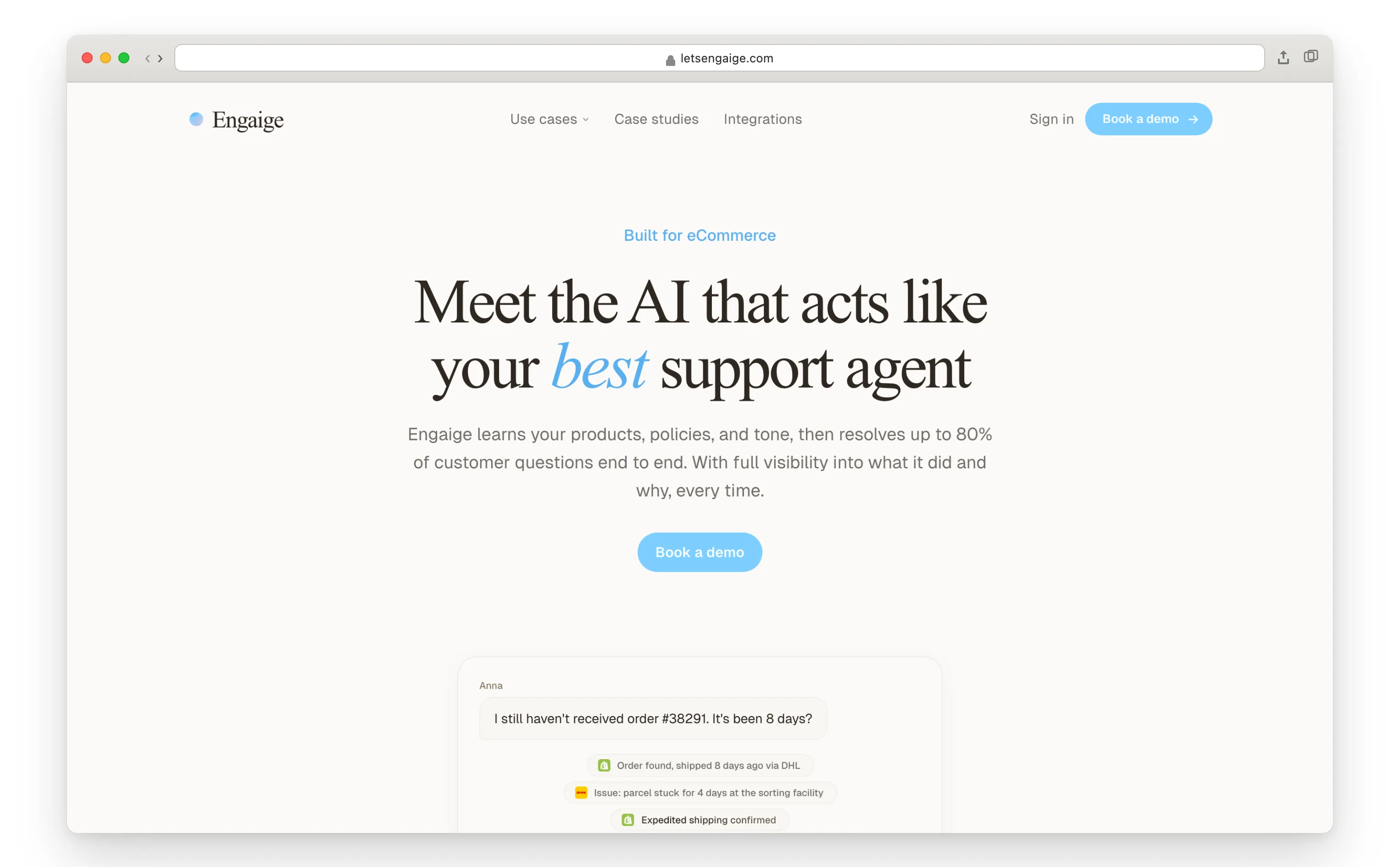
Engaige is a continuously improving AI agent for customer service that resolves tickets end to end: it understands your products, policies and workflows, configured in plain language through Engaige AI, no prompt engineers required.
Engaige AI is configuration and learning, not a setup wizard: the agent starts in Agent Assist and learns from your team’s normal work from day one. What your team actually sends compared with what the agent suggested is one of its training signals, and Engaige AI proposes changes to policies and behaviour with its reasoning, which you approve.
When a ticket type has learned enough, often within about a week, you switch it to autonomous, where it keeps learning from live outcomes and from the cases it hands back to a human.
The full reasoning for every answer and action sits in the Engaige dashboard, and at a hand-over the agent leaves a reasoning summary as an internal note on the ticket. Policies support thresholds and a per-step choice between Automated and Agent Assist, tested in the Playground before launch.
On Salesforce Commerce Cloud it connects through a documented API and executes refunds, cancellations and subscription changes. The integration is listed on our integrations page. If a connection you need is not there yet, we build it on demand and you are live in about a week.
That depth statement is ours, so the same put-it-in-writing test this list applies to everyone else applies to us: challenge it before you take it at face value.
The verified outcomes, with the case studies open for inspection: Otrium resolves 60% of 120,000 annual tickets autonomously, and HelloPrint automated 80% of support, cut first-response time by 90%, and shrank its team from 100 to 28. Neither outcome is an SFCC deployment, so apply the platform-transfer rule above to our numbers too.
On time-to-value the honest note is about the ceiling, not the launch: you are live in Agent Assist within hours, then it keeps climbing as Engaige AI learns from your team’s replies: most brands are autonomous in about a week, toward up to 90% of supported tickets, our ceiling at the deepest integrations.
The built-in Agentforce is live the moment you switch it on, so here we score level with it on speed, not ahead.
Stated SFCC integration covers (our claim, held to the same test): reading order data in real time; processing refunds and cancellations per your policy; handling subscription changes; all via documented API.
Key features:
- Continuously improving AI agent: configured in plain language through Engaige AI (no prompt engineers), it learns from your team’s replies in Agent Assist, then from live outcomes and hand-offs once autonomous
- Acts on Commerce Cloud order data via documented API: refunds, cancellations, subscription changes
- Resolves tickets end to end by understanding your products, policies and workflows
- Integration stated on a public page an RFP can cite
Pros
- The deepest published action depth on this list: we score depth 5 because Engaige takes all the actions an SFCC ticket needs (refunds, cancellations, subscription changes) via documented API, stated on a public integration page. That is our claim, held to the sandbox test; the published-versus-claim distinction lives in our transparency score, not in a depth deduction
- Named, openable outcomes (Otrium 60%, HelloPrint 80%) rather than a bare headline rate
- A flat monthly fee tied to your ticket volume, predictable as you scale
Cons
- Reaches its highest resolution ceiling over a few weeks as Engaige AI learns your policies, not on day one, though you are live in Agent Assist within hours
- Not the built-in option: Agentforce is in-platform and live the instant it is switched on, while Engaige goes live in Agent Assist within hours, then climbs to a higher ceiling
The catch: the depth statement is ours, so verify it the way this list tells you to verify everyone: ask us to execute a refund or cancellation in a sandbox on your store before you sign.
Best for: SFCC merchants who want AI that acts on orders, with the action depth and the outcomes both in writing.
Engaige offered control, flexibility, and the ability to really incorporate AI in a more human way.

Engaige proved to be invaluable. Their hands-on support during the implementation phase resulted in significant improvements to our automated resolution rate and CSAT.

2. DigitalGenius
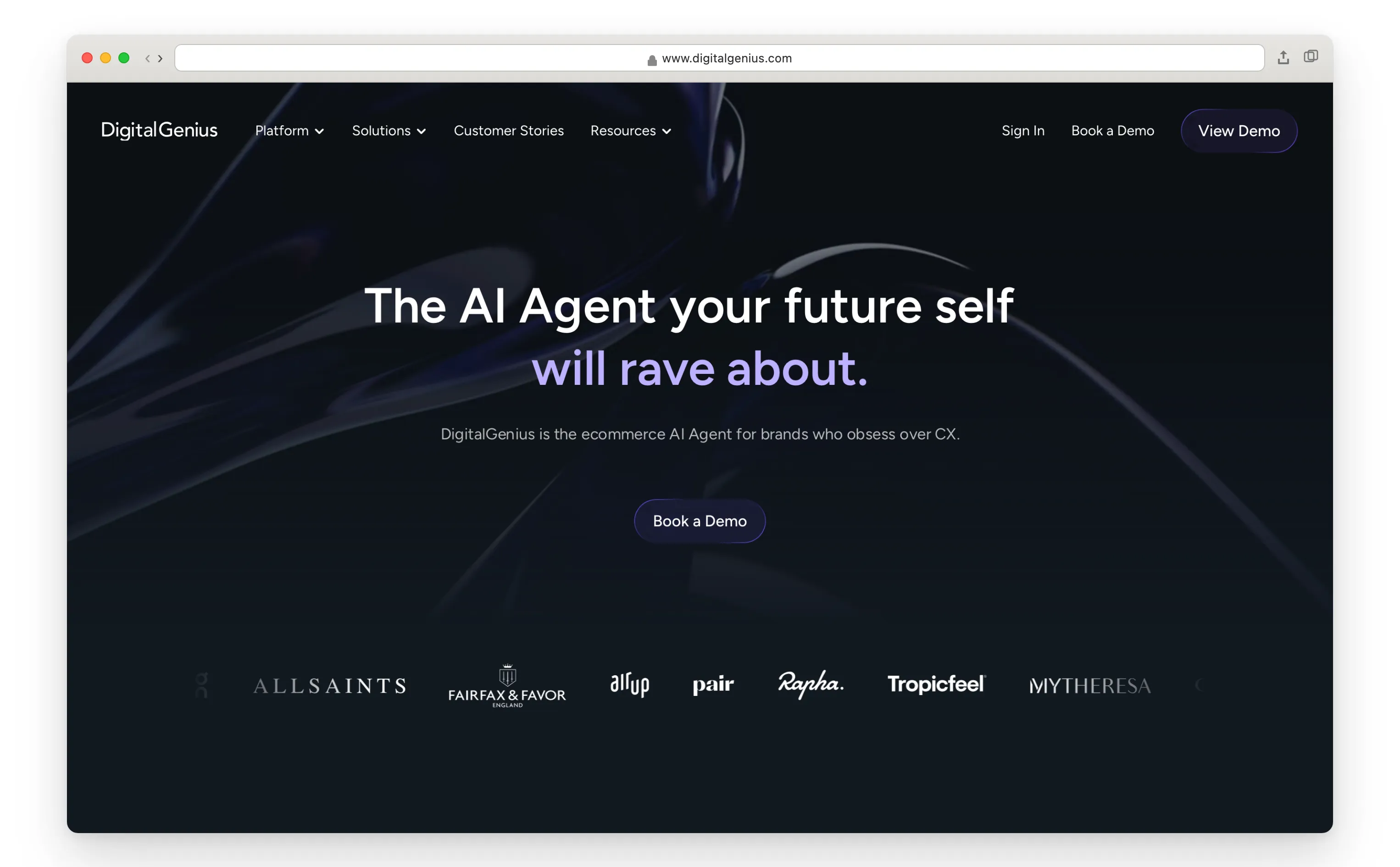
DigitalGenius is the documented challenger, and the only third party besides us that publishes genuine SFCC docs. Its public documentation describes a “CommerceCloud (Demandware) Flow Interface” (integration docs) connecting via the Open Commerce API (Shop APIs) with no custom development. Note the page title: the Demandware name is still alive in working docs.
What those docs show is order and refund data retrieval: finding orders by email address or order number. DigitalGenius’s wider action claims (returns, order edits, replacements) sit at homepage level and are not verified in the SFCC docs, so score the documented layer and ask for the rest in a demo.
Its substantiation is the strongest of any challenger here. It names an actual SFCC customer: SNIPES, which it states integrates with Salesforce Service Cloud, Salesforce Commerce Cloud and DHL, with accuracy to 99% (vendor-stated). At sportswear brand On, it states it cut wait times by 93% (vendor-stated).
Published SFCC integration covers: order and refund data retrieval through the Open Commerce API, with no custom development per its docs.
Key features:
- Public SFCC documentation via the Open Commerce API (Shop APIs), no custom development per its docs
- Order and refund data retrieval: finding orders by email address or order number
- Named SFCC customer: SNIPES, integrating Service Cloud, Commerce Cloud and DHL (vendor-stated)
- Enterprise retail track record (On, AllSaints)
Pros
- Public, named SFCC documentation, rare in this field and exactly what an RFP needs
- A named SFCC customer (SNIPES) plus enterprise retail outcomes (On, AllSaints)
- Built for enterprise retail support, the same segment SFCC serves
Cons
- Pricing is quote-based, not public
- The SFCC-documented depth is data retrieval; the wider action claims (returns, order edits, replacements) sit at homepage level
The catch: the platform-wide action claims may well hold, but on Commerce Cloud they are not yet in the docs, so make a sandboxed write action part of the demo.
Best for: enterprise retailers who want a proven SFCC-documented challenger and will verify write actions during procurement.
3. Salesforce Agentforce
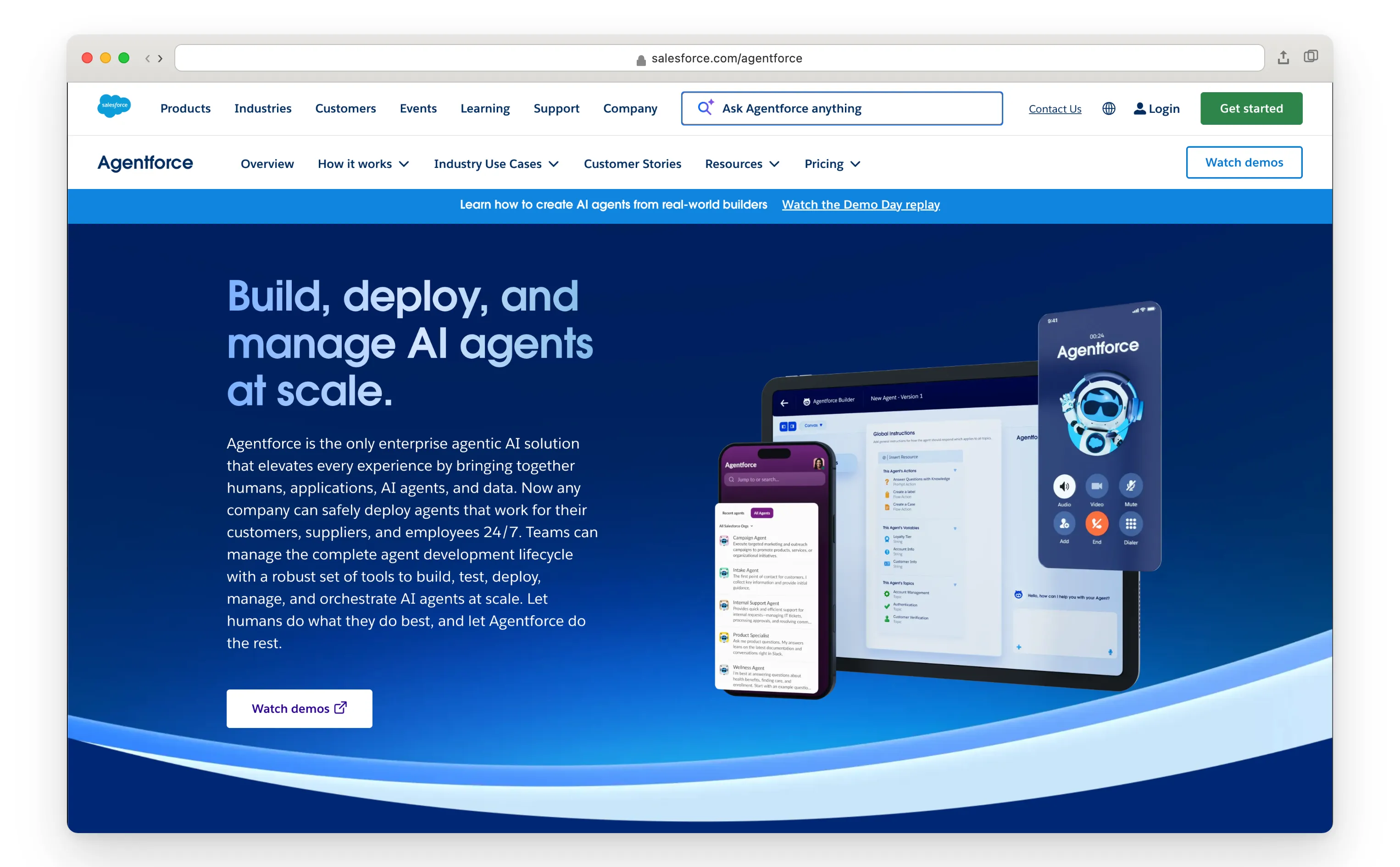
Agentforce is the incumbent by definition: Salesforce’s own agentic AI, built into the platform, with published commerce agents including Merchant, Buyer and Personal Shopper (Salesforce unified commerce announcement, vendor-stated; Salesforce’s pages block automated verification, so re-confirm details on the live page). For an SFCC merchant it is the default to evaluate first, because there is nothing to integrate.
Read the published shopper-agent topics closely, though: they cover product recommendations, order search and status, and cart links. Refund and RMA handling do not appear in the published shopper topics, so make Salesforce demonstrate those flows on your org before you assume them. Published topics cover information and shopping assistance; the acting-on-orders layer is the thing to probe.
Pricing is usage-based, two ways: $2 per conversation, or Flex Credits at $0.10 per standard action ($0.15 for voice; $500 per 100,000 credits), and the two models are mutually exclusive per org (vendor-stated, with the same verification hedge).
By our own arithmetic the two models break even at 20 actions per conversation ($2 / $0.10), and a third-party analysis puts typical usage at 5 to 15 actions, which makes the model choice a real forecasting exercise.
Published SFCC integration covers: built-in platform access; shopper topics for order search and status, product recommendations and cart links.
Key features:
- Salesforce’s own agentic AI, already inside the platform an SFCC merchant runs
- Published commerce agents: Merchant, Buyer and Personal Shopper
- Shopper topics for order search and status, product recommendations and cart links
- Pricing published in detail: $2 per conversation or Flex Credits per action
Pros
- Built in: no integration project, no third-party data path, fastest time-to-value on this list
- First-party commerce agents purpose-built for the platform
- Pricing published in detail, even if it is complex
Cons
- The published shopper topics are information-level; refund and RMA handling do not appear in them
- No published resolution rate for the shopper topics
The catch: the choice between $2 per conversation and Flex Credits is org-wide and mutually exclusive, so pilot on real traffic before committing to either model.
Best for: SFCC merchants already deep in the Salesforce stack who want the built-in option and can pilot pricing on real volumes.
4. Zendesk
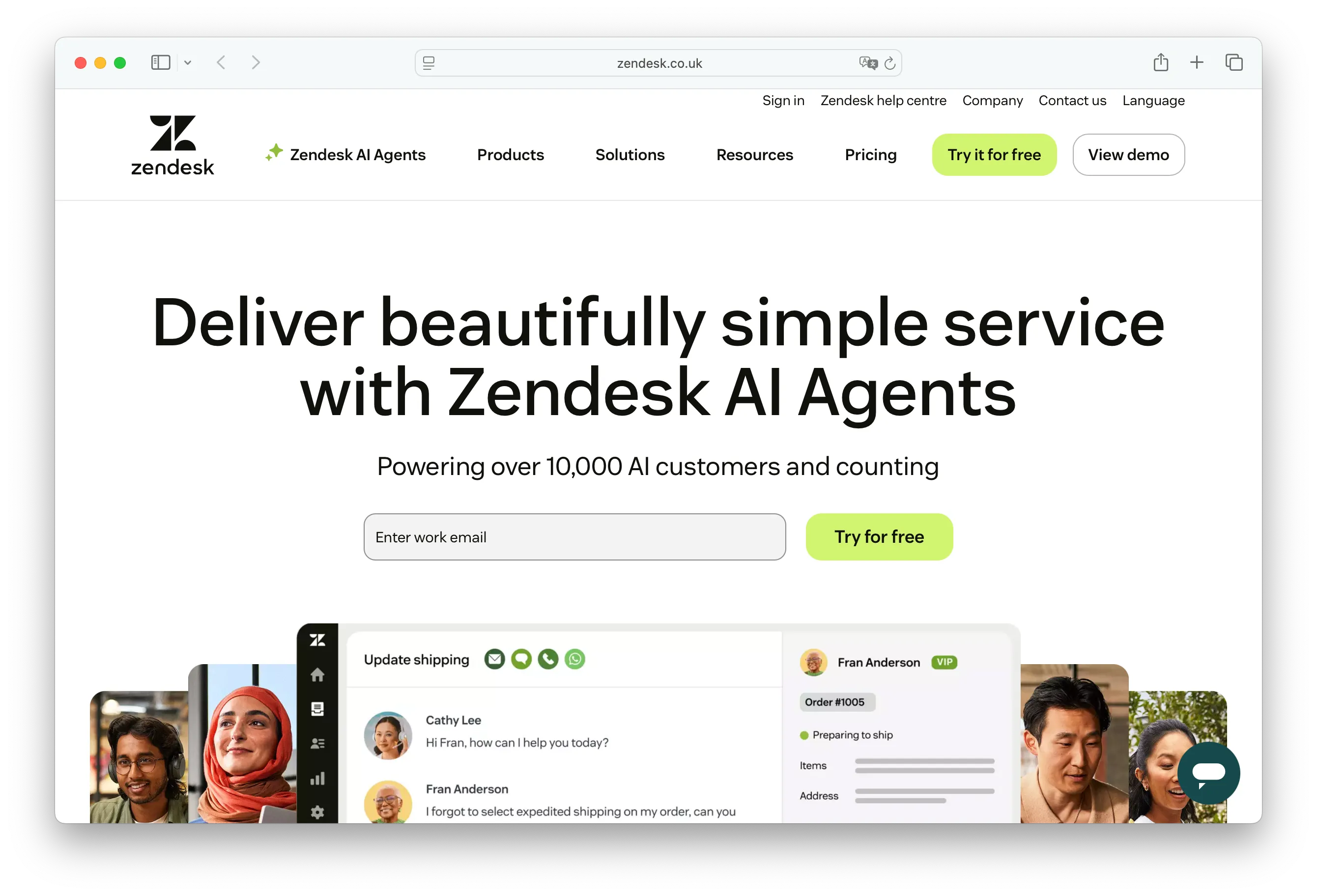
Zendesk is the build-it-yourself enterprise route. Its AI is genuinely strong horizontally: Zendesk states its agents “routinely resolve over 80% of interactions” (acquisition announcement, vendor-stated). But its named Salesforce integration is CRM-side, and it publishes no SFCC cartridge or connector. Commerce Cloud is reachable only through its generic no-code integration builder.
That means the SFCC depth is whatever your team builds against the Commerce Cloud APIs. The builder is no-code, but the data mapping, the order actions and the maintenance are yours. For an organisation with integration engineers and a multi-system stack that can be acceptable; it is custom work all the same, owned by you rather than the vendor.
Published SFCC integration covers: no published SFCC connector; Commerce Cloud is reachable via Zendesk’s generic no-code integration builder, i.e. custom API work.
Key features:
- Horizontal AI agents with a published headline rate (over 80%, vendor-stated, not SFCC-specific)
- Generic no-code integration builder to reach the Commerce Cloud APIs
- Enterprise-grade routing, SLAs, QA tooling and analytics
- Named Salesforce integration, which is CRM-side (Service Cloud)
Pros
- Strong horizontal AI with published transparency and QA tooling
- Enterprise-grade routing, SLAs and analytics around whatever you build
- One platform across far more than commerce support
Cons
- No published SFCC cartridge or connector: the Commerce Cloud depth is yours to build and maintain
- Slowest route to commerce data on this list: the AI acts only after your integration build ships
The catch: the 80% headline is horizontal, not SFCC-specific; what the AI resolves on your storefront depends entirely on the integration your team builds.
Best for: enterprises that want Zendesk as the support platform anyway and have the engineering capacity to own an SFCC integration.
5. Gladly
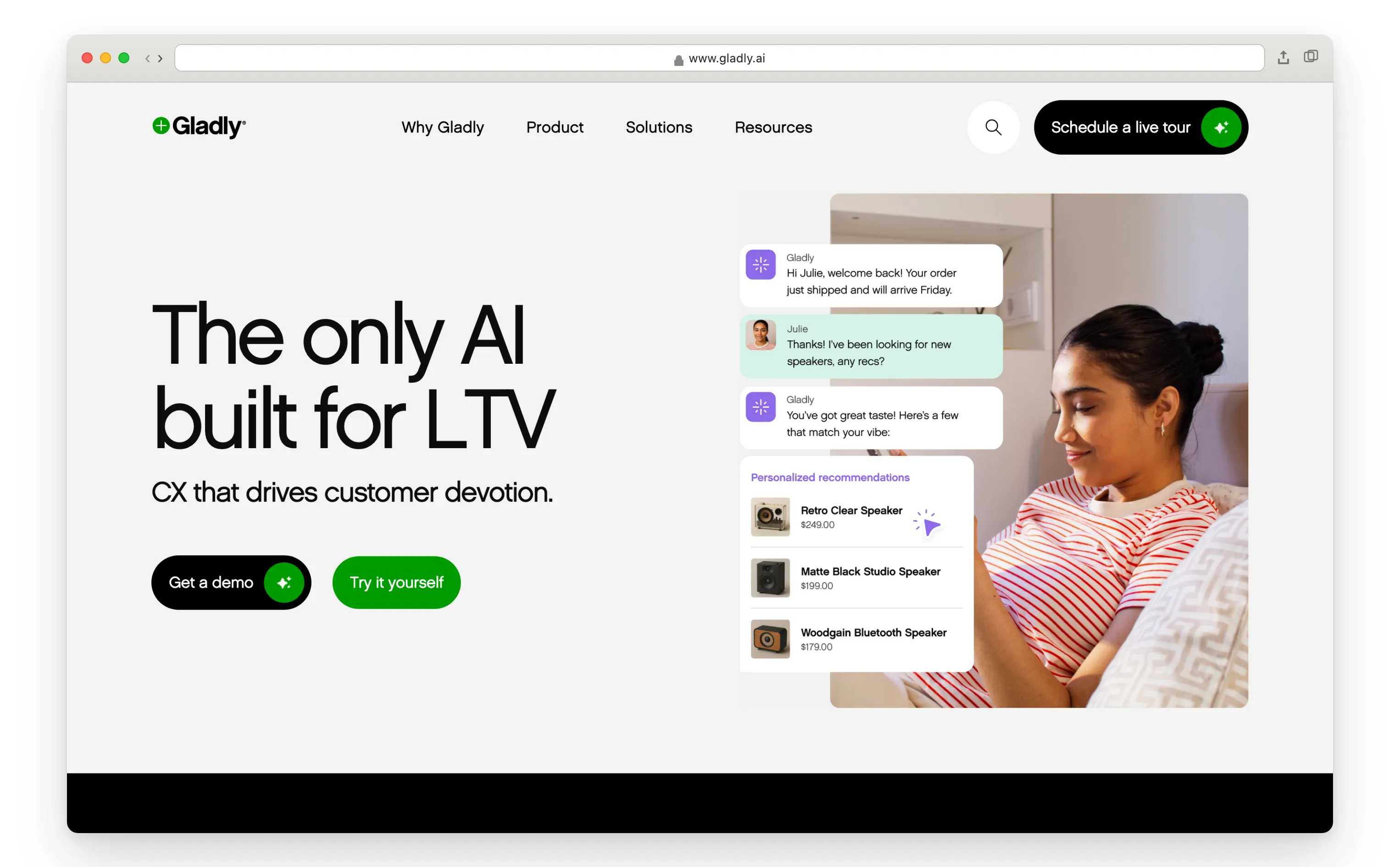
Gladly is the “claims, doesn’t document” entry, included precisely because it is the pattern SFCC buyers will meet most often. Its marketing states it offers “native connections to Shopify, Salesforce Commerce Cloud” surfacing product, shipping and loyalty data (Gladly blog, vendor-stated). But its help centre publishes no SFCC integration documentation at all.
By the vendor’s own description, the claimed connection is read-level: surfacing data, not acting on orders. Without a doc, an RFP cannot verify even that. We do not say Gladly cannot connect to SFCC; we say it does not publish how, and on this list publication is the qualifying axis.
Published SFCC integration covers: nothing published; the marketing claim describes surfacing product, shipping and loyalty data.
Key features:
- Customer-centric agent desktop with a single lifelong conversation timeline
- Explicit e-commerce positioning, with SFCC named in its marketing
- Claimed SFCC connection surfaces product, shipping and loyalty data (vendor-stated)
Pros
- An agent experience built around the customer rather than the ticket
- Naming SFCC at all puts it ahead of the CRM-side vendors that never mention Commerce Cloud
Cons
- No SFCC integration documentation in its help centre, so an RFP has nothing to verify
- By the vendor’s own description, the claimed connection is read-level: surfacing data, not acting on orders
- No SFCC-scoped pricing to assess; quote-led
The catch: if Gladly is on your shortlist, make a written integration spec the first RFP ask, and a sandboxed refund the second.
Best for: teams evaluating Gladly for its agent experience who are prepared to demand SFCC documentation during procurement.
Comparison of the best AI agents for Salesforce Commerce Cloud
In one view: Engaige publishes the deepest action depth (refunds, cancellations, subscription changes), DigitalGenius documents data retrieval through the Open Commerce API, Agentforce is built in but information-level in its published shopper topics, Zendesk offers a build-it-yourself route, and Gladly a claim without documentation. The table summarises what each publishes.
| Tool | Published SFCC basis | Inside SFCC it can (as published) | Automation level | Key limitation |
|---|---|---|---|---|
| Engaige | Listed on our integrations page; documented API (our claim) | Read orders; process refunds and cancellations; subscription changes | End-to-end resolution (named 60-80% outcomes, up to 90% ceiling) | Live in Agent Assist within hours; full ceiling over weeks |
| DigitalGenius | Public SFCC docs (Open Commerce API) | Retrieve order and refund data by email or order number | Autonomous within documented scope; wider claims homepage-level | SFCC docs verify data retrieval, not write actions |
| Salesforce Agentforce | Built in (Merchant, Buyer, Personal Shopper agents) | Order search and status, recommendations, cart links | Autonomous within published topics | Published topics are information-level; no published resolution rate |
| Zendesk | Generic no-code integration builder only | Whatever your team builds against SFCC APIs | Strong horizontal AI; SFCC depth is yours to build | No published SFCC connector |
| Gladly | Marketing claim, no integration doc | Surfacing product, shipping and loyalty data (claimed) | Read-level at best, undocumented | Publishes no SFCC integration documentation |
How do they score side by side?
Scores are 1-5 per criterion, weighted and summed to a score out of 5, highest first. The model behind the weighting: a tool’s resolution ceiling is roughly its action depth times its integration breadth, with depth the heavier multiplier, which is why depth and resolution carry the joint-heaviest weight at 25% each.
The criteria and weights match our e-commerce comparison, but every criterion is scored for an SFCC deployment specifically, pricing and configurability included, so a vendor’s scores can differ across our platform guides and totals are not 1:1 comparable.
Our claims, pricing and configurability are the same on every platform; time-to-value is scored per platform, so our row can shift by a cell between guides, and competitor rows move because theirs differ. Based on public information, June 2026.
We are Engaige, so hold our own row to the same test. The scores credit what is published and verifiable: named outcomes over homepage claims, docs over marketing, and substantiation counts toward transparency.
Every Agentforce cell traces to a Salesforce-published source or is marked with the verification hedge above.
| Tool | SFCC depth (25%) | Resolution (25%) | Pricing (15%) | Transparency (15%) | Time-to-value (10%) | Config (10%) | Weighted |
|---|---|---|---|---|---|---|---|
| Engaige | 5 | 5 | 5 | 4 | 4 | 5 | 4.75 |
| DigitalGenius | 3 | 3 | 2 | 4 | 3 | 3 | 3.0 |
| Salesforce Agentforce | 3 | 3 | 2 | 3 | 4 | 3 | 3.0 |
| Zendesk | 1 | 4 | 2 | 4 | 2 | 3 | 2.7 |
| Gladly | 1 | 2 | 2 | 2 | 2 | 3 | 1.9 |
A fair word on our own row. We do not own the platform: Agentforce is built in and live the instant you switch it on, so on time-to-value we score level with it, not ahead, and DigitalGenius’s public SFCC docs earn it the same transparency score we hold ourselves to.
Engaige’s lead comes from published action depth (refunds, cancellations, subscriptions, stated on a public page), flat predictable pricing, and plain-language configurability, applied to outcomes you can open.
Hold our numbers to the same test as everyone else’s. Our named, verifiable outcomes are Otrium (60% of 120,000 annual tickets) and HelloPrint (80%), each a full case study you can read. The “up to 90%” on our homepage is our ceiling at the deepest integrations: the same kind of vendor-stated ceiling you should challenge every supplier on, us included.
On Agentforce and DigitalGenius depth: both score 3 because their published SFCC layer is order data retrieval and status-level shopping assistance. Both vendors claim more platform-wide; when those claims land in SFCC-published topics or docs, the scores should rise. We score what is in writing, which is the whole premise of this page.
Verdict per criterion
No tool wins on everything, which is why the verdict is split per criterion. Engaige takes published action depth, pricing predictability and configurability; Agentforce, the built-in incumbent, is live instantly and Engaige scores level with it on time-to-value; DigitalGenius shares the transparency lead through its public SFCC docs; Zendesk holds the highest horizontal resolution headline. Per criterion, the picture looks like this.
- SFCC-native action depth. Engaige leads on published depth: refunds, cancellations and subscription changes stated publicly. Agentforce and DigitalGenius document order-data and status level. Zendesk’s depth is whatever you build. Gladly publishes none.
- Resolution. Zendesk states the highest headline (over 80%, vendor-stated, not SFCC-specific). Engaige holds the named, openable outcomes (60% and 80%). Agentforce and DigitalGenius publish no SFCC resolution rate.
- Pricing predictability. Won by flat pricing (Engaige). Agentforce’s usage models are published in detail and mutually exclusive per org. DigitalGenius is quote-based; Zendesk combines seats with per-resolution fees.
- Transparency and control. DigitalGenius earns full credit for publishing real SFCC docs and a named SFCC customer; Engaige for openable case studies. Gladly scores lowest: claims without documentation.
- Time-to-value. Agentforce is live the instant you switch it on, built into the platform; Engaige scores level with it, live in Agent Assist within hours through Engaige AI, and unlike a switch-on tool it keeps learning and climbing to a higher ceiling. Zendesk is slowest: the integration must be built before the AI touches commerce data. The ramp-up we explain in the e-commerce guide.
- Configurability. Engaige is run in plain language by a CX team. Agentforce and Zendesk are powerful but admin-led and builder-led respectively.
What does an AI agent for Salesforce Commerce Cloud cost?
Four different models, which makes like-for-like comparison the real work when you price an AI customer support tool for Salesforce Commerce Cloud. Agentforce is usage-based ($2 per conversation, or Flex Credits per action, never both). DigitalGenius is quote-based. Zendesk combines seats with per-resolution fees. Engaige is a flat monthly fee tied to your ticket volume, predictable as you scale. The honest comparison is total cost per resolved ticket.
| Tool | Published pricing model | What scales the bill |
|---|---|---|
| Engaige | Flat monthly fee tied to a ticket volume | Volume tier, agreed up front |
| Salesforce Agentforce | $2 per conversation OR Flex Credits: $0.10 per standard action, $0.15 voice, $500 per 100,000 credits; models mutually exclusive per org (vendor-stated) | Conversations or actions consumed |
| DigitalGenius | Quote-based, not public | Negotiated scope |
| Zendesk | Seats + per-resolution fees | Seats and resolved volume |
| Gladly | No published SFCC integration, so no SFCC-scoped pricing to assess | Quote-led |
The Agentforce model choice deserves its own line in the business case. At $0.10 per standard action, a conversation that needs many actions can cost more than the $2 flat conversation rate; the two models break even at 20 actions per conversation by our own arithmetic ($2 / $0.10), while a third-party analysis puts typical usage at 5 to 15 actions. Because the models are mutually exclusive per org, pilot on real traffic before committing.
FAQs about AI agents for Salesforce Commerce Cloud
The questions SFCC buyers ask most often, answered from what the vendors publish.
What is the difference between a Salesforce Service Cloud and a Salesforce Commerce Cloud integration?
Service Cloud is Salesforce’s CRM and ticketing product; Commerce Cloud (formerly Demandware) runs the storefront and owns the order data. An AI vendor integrated with Service Cloud reads and writes cases. Only a Commerce Cloud integration lets the AI look up and act on B2C Commerce orders, which is where support resolution actually happens.
Does Salesforce have its own AI agent for Commerce Cloud support?
Yes. Agentforce is built into the platform, with published commerce agents (Merchant, Buyer, Personal Shopper). Its published shopper topics cover order search and status, product recommendations and cart links. Refund and RMA handling do not appear in the published shopper topics, so have Salesforce demonstrate those flows on your org during evaluation.
Which AI vendors actually publish a Salesforce Commerce Cloud integration?
Of the tools we assessed, Engaige publishes a first-party SFCC integration page (documented API: refunds, cancellations, subscription changes) and DigitalGenius publishes SFCC docs via the Open Commerce API. Agentforce is built in. Zendesk offers only its generic integration builder, and Gladly claims SFCC in marketing without publishing documentation.
What does an AI agent for Salesforce Commerce Cloud cost?
It depends on the model: usage-based for Agentforce ($2 per conversation or Flex Credits per action, mutually exclusive per org), quote-based for DigitalGenius, seats plus per-resolution fees for Zendesk, and a flat monthly fee tied to ticket volume for Engaige. Compare on total cost per resolved ticket, not the per-unit headline.
Can an AI agent process refunds on Salesforce Commerce Cloud?
It depends on the published integration. Engaige states refunds, cancellations and subscription changes on its public SFCC integration page. DigitalGenius’s SFCC docs cover order and refund data retrieval. Agentforce’s published shopper topics cover order search and status rather than refunds. Make written refund-flow documentation a standard RFP requirement.