Running a Shopware store comes with countless support tickets, from shipping delays to return requests and product questions. As your store grows, your support team can’t keep up. That’s where an AI customer support tool for Shopware comes in.
In this list, we break down the top 8 AI agents and support chatbots for Shopware so you can pick the best solution for your business. It is the Shopware drill-down of our wider guide to best AI chatbots; platform-agnostic tools live there.
On Shopify instead? That roster lives in the Shopify edition. One of the eight (Engaige) is ours, so we show our working: the methodology below applies to us too. For the platform-agnostic shortlist across every helpdesk, see our guide to the best AI agents.
Shopware is the leading German commerce platform, and the field around it looks different from Shopify’s. It is enterprise and mid-market weighted, open-source at its core with a cloud tier, and roughly three quarters of its stores sit inside the EU.
That changes the roster: several big-name AI agents that act deeply on Shopify do not integrate with Shopware at all, and the tools that do are often German or European. So the decisive question on this page is sharper than usual: who genuinely acts through the Shopware API, rather than just chatting on top of it?
How is this list created?
This list is generated based on the Shopware integration each tool publishes. The inclusion rule: a tool must offer a genuine Shopware integration, as a Shopware Store plugin or a documented API connection, and a tool that does not publish one is left out, by name.
Integration depth, how far that integration lets the AI act (from reading order data, to processing refunds and cancellations, to editing subscriptions), then carries the joint-heaviest weight in the six-criterion matrix that orders this list. Depth matters most, but it does not decide the ranking alone.
One test for every number you’ll see, ours included: which named customer produced it, over what period, and what does the vendor count as “resolved”? A rate with none of those attached is a marketing figure, not a benchmark. Resolution figures below are vendor-stated unless noted, and how well a vendor substantiates its own claims counts toward its transparency score.
There is a fourth test, and it is a buyer’s test rather than a reading test: ask every vendor, us included, to execute a refund or cancellation in a sandbox on your store before you sign. A live sandbox action settles in minutes what a plugin listing can leave vague, and on Shopware that gap between “chats in your shop” and “acts in your shop” is wide.
What should you look for in a Shopware AI agent or support chatbot?
If you’re scaling your Shopware support team and looking to automate tickets with AI, here’s what to look for in an AI agent.
A real Shopware integration, not just a chat widget
Plenty of tools will embed a chat box on a Shopware storefront in minutes. Far fewer connect to the Shopware API so the AI can pull a live order, check a delivery status, or read a customer’s history. The first kind answers general questions; the second kind resolves “where’s my order?” with the actual tracking detail.
On Shopware specifically, many integrations are community or partner plugins that only sync data or place a widget, so check what the connection actually reads and writes before you judge it.
Breadth versus depth: two different questions
Integration breadth is easy to count, which is why vendors lead with it: eDesk states on its integrations page that it “natively connects with over 300+ marketplace, web store and social channels”, and Yuma lists 60+ on its integrations page (both vendor-stated). Counts answer the question “can we start?”: will the tool plug into the stack you already run.
Depth answers the question that matters in month six: do the hard tickets still get resolved? Breadth plus launch speed gets you started; depth is what still resolves refunds and cancellations when the course gets hard. This split is sharper on Shopware, where many tools connect quickly as a widget or plugin but never act on an order.
If a connection you need is not there yet, we build it on demand and you are live in about a week.
Ability to take actions (not just suggest replies)
Unlike simple chatbots that only suggest text, the best AI agents can take actions in your Shopware store, like processing refunds, cancelling orders, or updating shipping details. This is where the Shopware field thins out fast.
A customer asking about an order often doesn’t just want information, they want a problem solved: a cancellation before dispatch, a refund on a lost parcel, a corrected address. An agent that can only answer hands every one of those back to your team.
One caveat on every rate below, ours included: a resolution rate only means something by ticket complexity. The easy bulk (order status, returns, address changes) is table stakes that any modern AI clears; the hard middle (partial refunds, complex returns, judgement calls) is the real test. We set out how to read a resolution rate in our e-commerce guide.
Trained on your business policies
Your AI agent should understand your unique return windows, shipping rules, and discount policies so it always gives accurate, on-brand responses.
For example, if you have a 30-day return policy on shoes but final sale on accessories, the AI will know not to promise a refund where it isn’t allowed. By being trained on your policies, it helps avoid misunderstandings, reduces escalations, and makes sure customers always get consistent, reliable answers, in German, English or whatever languages your storefronts run.
Context-aware: sees orders, history, and knows your tone of voice
A context-aware AI agent doesn’t just see the latest message, it has visibility into the customer’s entire order history and past support interactions.
If someone writes in about a missing item, it can check their recent orders and see that part of the shipment went separately, then respond with the tracking detail in a tone that matches your brand. This matters more on Shopware than on a single-storefront platform, because B2B and multi-store setups carry more context per customer, not less.
Proven ROI through reasoning, ticket deflection and resolution
One of the biggest benefits of a strong AI agent is its ability to deflect and resolve the repetitive tickets that take up most of your team’s time, like “Where’s my order?” or “How do I return this?”. But ROI isn’t just about automation, it’s about reasoning. A good AI agent can understand what your customer is really asking, apply your policies and context, and choose the right next step automatically, then act on it.
Shopware merchants are clearly moving this way: Shopware’s own 360-merchant Händlerumfrage 2026 found that around 70% already work with AI and 44% plan to invest specifically in it (vendor-stated). But practitioners building agents on Shopware are blunt about the catch, that a thin chatbot is not the same as an agent that survives a real store:
May 2026 Reddit Most agentic-commerce demos I see online are a single agent plus RAG over a product catalog. That shape works for a 200-SKU demo. It breaks the moment you put it in front of a real shop. · r/AI_Agents, building agentic commerce on Shopware View on RedditThat is exactly the line this list sorts on: a chat widget bolted onto your storefront, versus an agent with the integration depth to act when a real Shopware store gets complicated.
What’s the difference between a chatbot and an AI agent for a Shopware store?
People use “chatbot” and “AI agent” interchangeably across AI customer support, but for a busy Shopware store the difference decides how many tickets actually disappear. On Shopware there are really three patterns, and vendors rarely advertise which one they are: a bot that only chats, an integration that gives your human agents context and actions, and an AI agent that acts on its own.
A basic chatbot is usually rule-based or keyword-triggered, or a thin storefront bot
Many Shopware chat plugins follow simple scripts, or wrap a general language model around your product catalogue to answer FAQs and recommend products. They can be genuinely useful for pre-sales questions, but they can’t read a specific order or take meaningful action in your store. If a customer asks to cancel an order or check a delivery, the bot typically points them to a contact form or a help page.
Pros and cons:
- Cheap and quick to install from the Shopware Store
- Good for product discovery and very simple FAQs
- Can’t access live Shopware order data or perform actions
- Often frustrate customers with dead ends (“please contact us”)
An agent-side or assist integration helps your humans, not your AI
This is the Shopware middle tier, and most of the field sits here. A helpdesk plugin like Re:amaze syncs customer data and gives your agents context and chat inside one inbox; Userlike adds Copilot-style suggestions for the human handling the conversation. The data and assist are real, but the labour stays with your team: a person still reads the order and clicks the action. It speeds agents up rather than removing tickets from the queue.
Pros and cons:
- Useful context and faster handling inside one inbox
- Human judgement on every sensitive action
- Every action still consumes agent time
- The AI layer, where one exists, drafts or suggests rather than resolves
An AI agent is designed to automate support tasks, not just answer questions
It connects to your Shopware store and helpdesk through the API, so it can check real-time order data, process refunds, cancel orders, or update addresses. For example, if a customer messages “Can I cancel order #1234?”, the AI agent can check whether it has shipped and cancel it immediately, updating the customer without any human intervention.
Pros and cons:
- Can handle real support tasks end to end
- Personalised responses with real order data
- Reduces workload for your team by solving issues automatically
- Slightly more complex to implement (needs API integration and training)
When evaluating the tools on this list, you’ll see all three patterns marketed under the same “AI support” banner, so it’s important to look carefully at what they actually do inside Shopware. The entries below say plainly which tier each tool occupies, in the vendor’s own words wherever possible.
How deep does each tool act inside Shopware?
Before the list, here is the qualifying axis in one picture. Depth measures how far each tool’s integration lets the AI act in your store, from reading order data (shallow) to autonomously processing refunds, cancellations and subscription changes (deep).
Engaige leads this list overall and matches the full action set a Shopware ticket needs. Minimal is the only competitor whose Shopware integration claims the same end-to-end action capability, so it ties Engaige on this documented-and-claimed depth axis alone, but the overall ranking below also weighs resolution, pricing and transparency, where Engaige comes out on top. Everyone else is shallower on Shopware than they are on Shopify.
Depth measures how far the AI can act per the vendor’s own documentation, not the number of integrations. A tool is credited for depth only on documented or claimed capability; where action docs are not published we note “action docs not published”, never “can’t”. Source: public documentation plus our own analysis, June 2026.
The list: top 8 AI agents and support chatbots for Shopware (2026)
Alright, enough with the theory. The entries follow the weighted ranking from the score matrix further down. What exactly does each tool do inside Shopware, how do they differ, and what’s the best use case for each?
1. Engaige
letsengaige.com (that’s us!)
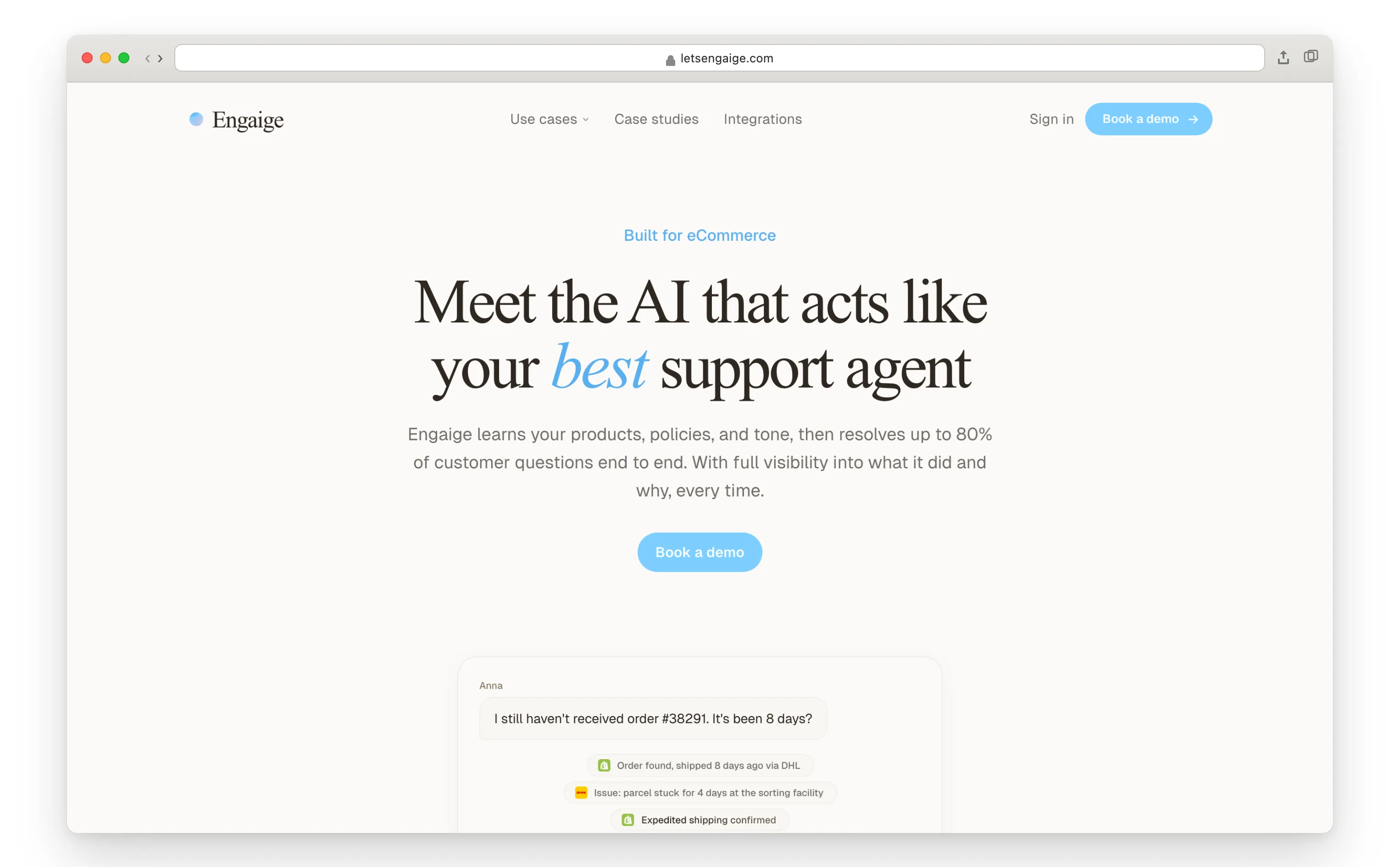
Engaige is a continuously improving AI agent for customer service, built for support teams in industries like fashion, beauty, and electronics, and it connects to Shopware through the documented API.
It doesn’t just respond to tickets: it resolves them end to end by understanding your products, policies, and workflows, configured in plain language through Engaige AI.
You go live in Agent Assist within hours, and from day one it learns from your team’s normal work: what your team actually sends compared with what the agent suggested is one of its training signals, and Engaige AI proposes changes to policies and behaviour with its reasoning, which you approve. We found no competitor that publicly describes learning from that everyday gap with changes a human approves.
Once a ticket type has learned enough, often within about a week, you switch it to autonomous, where it keeps learning from live outcomes and the cases it hands back to a human.
So it learns in both modes. The full reasoning for every answer and action sits in the Engaige dashboard, and at a hand-over the agent leaves a reasoning summary as an internal note on the ticket. Policies support thresholds and a per-step choice between Automated and Agent Assist, tested in the Playground before launch.
The verified outcomes, with the case studies open for inspection: Otrium resolves 60% of 120,000 annual tickets autonomously, and HelloPrint automated 80% of support, cut first-response time by 90%, and shrank its team from 100 to 28.
The “up to 90%” we state is our ceiling at the deepest integrations, the same kind of vendor-stated ceiling you should challenge every supplier on.
Inside Shopware it can: read orders, products and customer history in real time; process returns and refunds per your policy; change addresses; handle warranty claims; manage subscription changes, across multi-language and B2B storefronts.
If a connection you need is not there yet, we build it on demand and you are live in about a week.
Key features:
- AI agent trained on your company’s policies, in plain language (no prompt engineers)
- Integrated with Shopware, plus payment, shipping and returns tools
- AI agent integrated with your product catalogue
- Automates conversations via email, chat and social
- You can test and preview your AI agent outputs before they go live
Pros
- Resolves the repetitive middle end to end: named outcomes of 60% (Otrium) and 80% (HelloPrint), with up to 90% as our stated ceiling
- Full control and transparency over AI behaviour
- A flat monthly fee tied to your ticket volume, predictable as you scale
Cons
- Reaches its highest resolution ceiling over a few weeks of policy training, not on day one, though you are live in Agent Assist within hours
Best for: Shopware stores in fashion, beauty and consumer electronics looking to scale customer service with deep automation.
Engaige offered control, flexibility, and the ability to really incorporate AI in a more human way.

Engaige proved to be invaluable. Their hands-on support during the implementation phase resulted in significant improvements to our automated resolution rate and CSAT.

2. Minimal
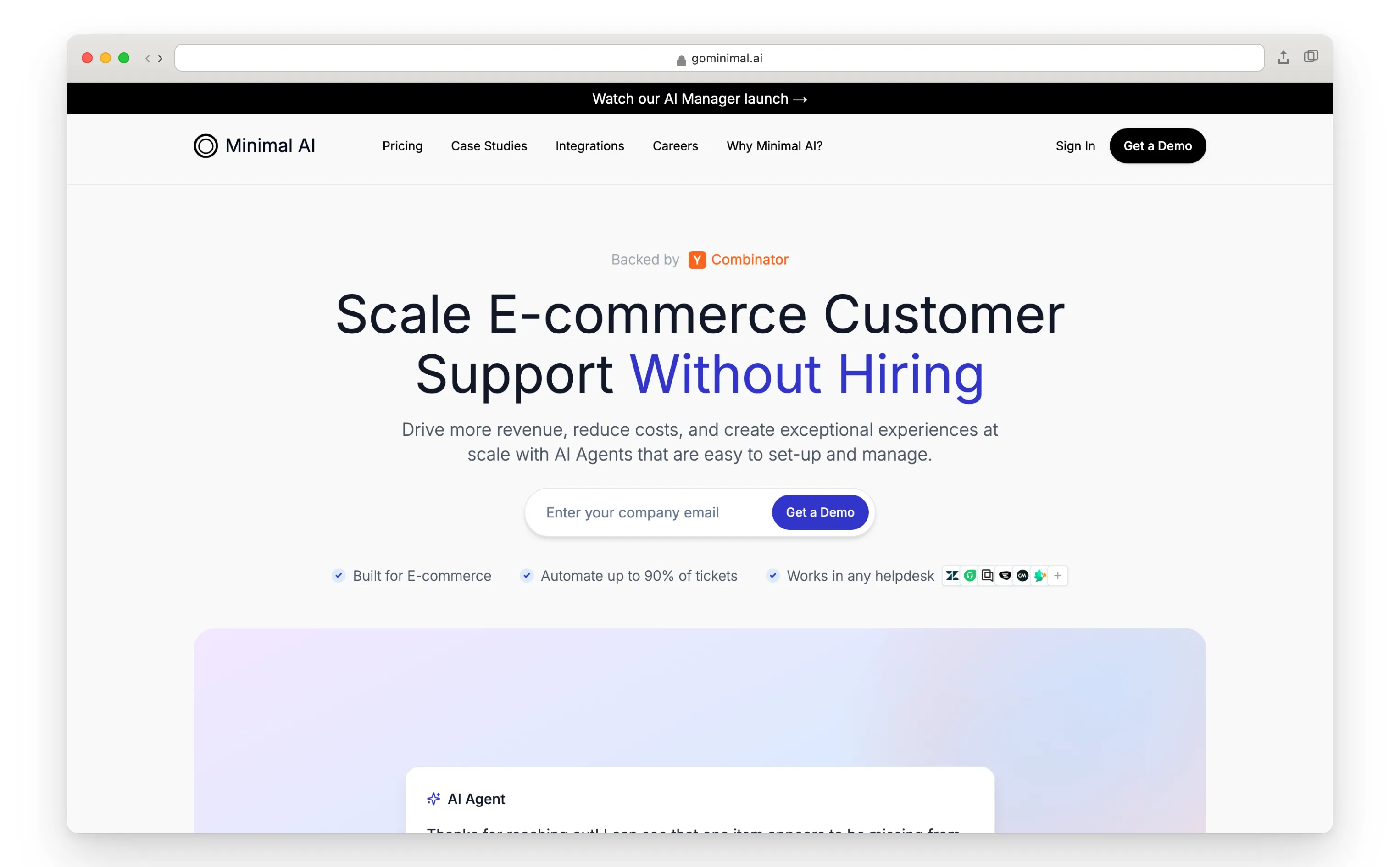
Among the tools here, Minimal’s Shopware integration is built to act rather than only chat. Its Shopware integration page states the AI “can take any action in Shopware that you can”, connecting through the API to read orders, customers, products, shipments and returns, and to write changes like order-status updates, order notes and customer updates. Minimal states it can “automate up to 90% of tickets” (vendor-stated).
The catch: its Shopware page frames depth as “anything the API exposes” rather than individually documenting the high-stakes actions (full and partial refunds, cancellations, subscription edits) the way it does on some other platforms, and it publishes no Shopware-specific pricing or named case study. So on claimed depth the scores meet, but Minimal trails Engaige on substantiation and proven resolution.
Inside Shopware it can: read orders, customers, products, shipments and returns; update order status, add order notes, update customer records; take further API-exposed actions per its own claim.
Key features:
- API-based Shopware integration built around taking actions
- Broad action claim (“any action you can take”)
- Multi-platform agent across Shopify, Magento, BigCommerce and more
Pros
- The only competitor on this list claiming end-to-end action capability on Shopware
- Genuinely positioned as an agent, not a widget
Cons
- Specific high-stakes actions (refunds, cancellations) not individually documented on the Shopware page
- No Shopware pricing or named case study published
Best for: Shopware merchants who want an action-taking agent and are comfortable validating the specific actions in a sandbox first.
3. Tidio
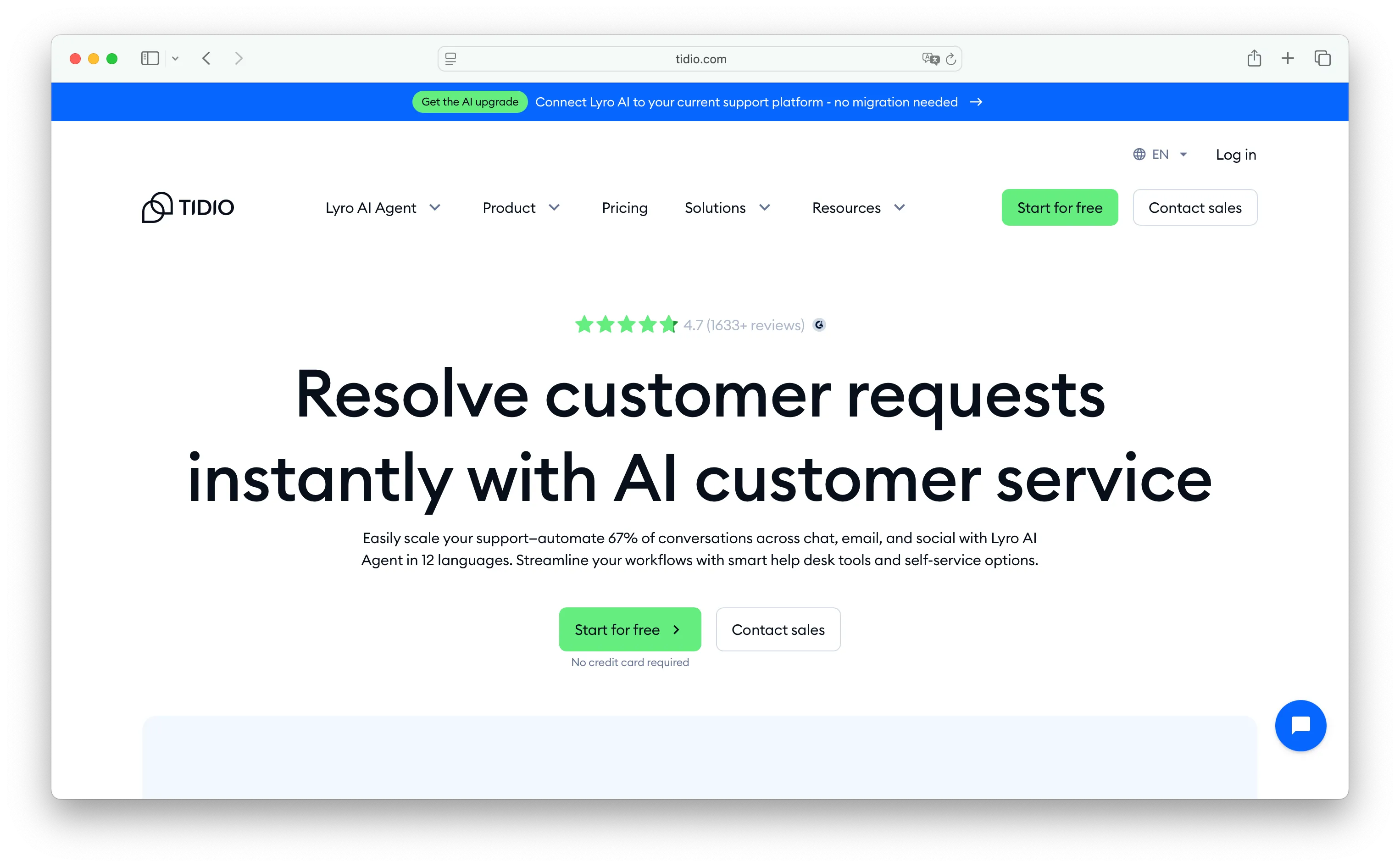
Tidio is a popular live-chat and AI tool for small and medium businesses, and it is a Shopware Technology Partner. Its AI agent, Lyro, focuses on FAQs and simple replies, and Tidio states Lyro “resolves up to 70%” of common questions with Flows automating “up to 40%” (both vendor-stated, not Shopware-specific).
The catch on Shopware: the install is a JavaScript embed rather than a deep native app, and Lyro’s transactional action templates (such as order status) connect to a Shopify store’s API, with Lyro targeted at SMB Shopify and WooCommerce stores. On Shopware it is effectively chat, Flows and FAQ answering, with no documented order actions.
Inside Shopware it can: run live chat and chat Flows; answer product and FAQ questions; escalate to your team. Order actions are not documented on Shopware.
Key features:
- Quick script-based install, good for small and medium businesses
- Customisable chat widget and omnichannel inbox
- Lyro AI for multilingual FAQ answering, with a money-back guarantee on its Shopify and WooCommerce deployments
Pros
- Easy to set up, fast time-to-value
- Combines live chat and AI in one affordable platform
Cons
- On Shopware, Lyro’s documented actions are FAQ-grade; transactional actions are confirmed for Shopify, not Shopware
Best for: smaller Shopware stores that want a quick, affordable chat and FAQ assistant rather than autonomous resolution.
4. Userlike
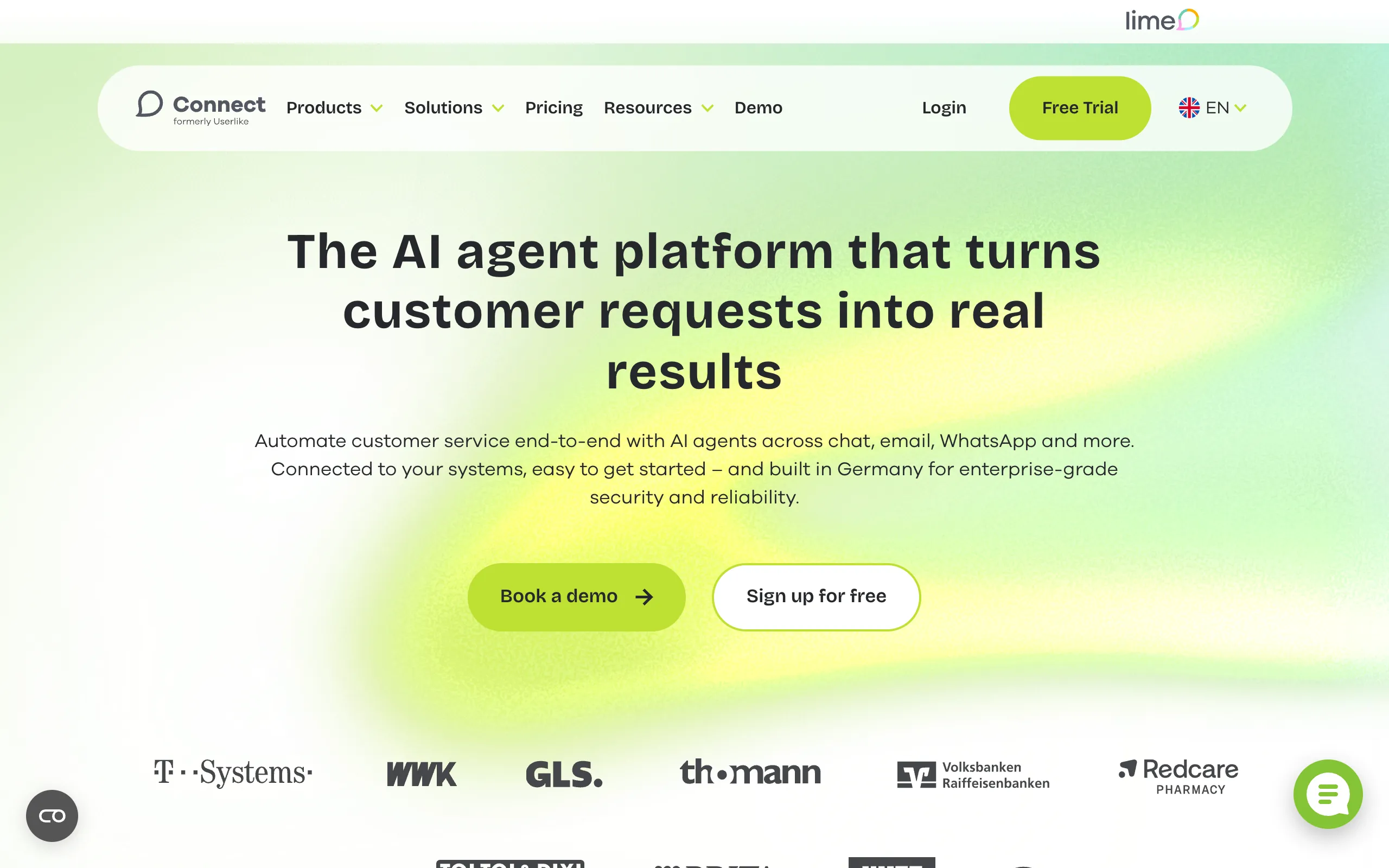
Userlike is a German live-chat and messaging platform with a native plugin on the Shopware Store (Lime Connect). It markets “Connect AI”, described as “autonomous AI agents that independently process requests, understand context, and make decisions”, alongside Copilot-style summaries and suggestions for human agents. As a German vendor with GDPR-friendly hosting, it is a natural fit for DACH-market Shopware stores.
The catch: that autonomous-agent claim is made at the Userlike platform level, and the specific Shopware order actions the AI can execute are not enumerated, so on documented evidence it sits at agent assist with the potential for more. Confirm the exact write actions on your store before counting on them.
Inside Shopware it can: run live chat across channels; provide AI agent assist and Copilot suggestions; route and automate workflows. Specific Shopware order actions are not documented.
Key features:
- Native Shopware Store plugin from a German vendor
- “Connect AI” autonomous-agent positioning plus human-agent Copilot
- Strong DACH-market and data-protection fit
Pros
- Genuine native Shopware integration with European hosting
- Good fit for German-language, GDPR-sensitive operations
Cons
- Shopware-specific AI actions are not documented; autonomous claim is platform-level
- Plugin reviews are mixed (3.5/5), with one noting it is not multilingual
Best for: DACH-market Shopware stores that want a German live-chat platform with AI assist and a clear data-protection story.
5. moinAI
moinAI is a German conversational-AI vendor with a dedicated Shopware integration. It is built to answer: its Shopware page describes handling “shipping-status inquiries and other important information directly via chatbot”, with self-service deflection across German and other languages.
The catch: the documented depth is read and look up, not act. There is no published refund, cancellation or order-edit capability on its Shopware integration, and the page points more complex needs to a sales conversation. It is a capable deflection and FAQ layer rather than an action-taking agent.
Inside Shopware it can: answer FAQs and product questions; surface shipping-status and order information; deflect repetitive enquiries. Order actions are not documented.
Key features:
- Native Shopware integration from a German vendor
- Strong conversational-AI builder and multilingual deflection
- Established DACH customer base
Pros
- Purpose-built conversational AI with a real Shopware integration
- Good German-language self-service and deflection
Cons
- Documented depth is information lookup, not order actions
- Deeper capabilities require a sales conversation rather than being published
Best for: Shopware stores that want strong German-language FAQ and shipping-status deflection without expecting autonomous order actions.
6. Re:amaze
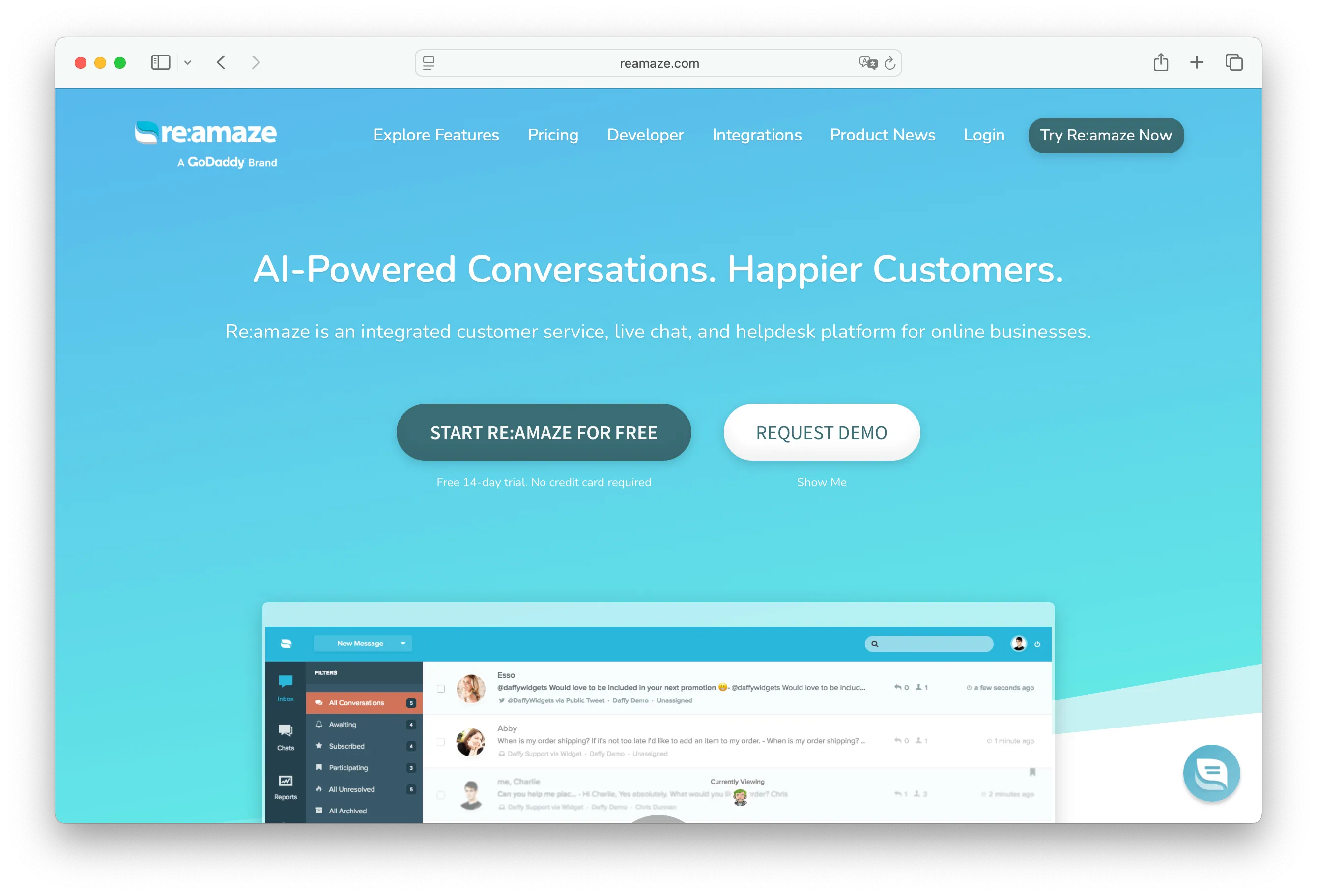
Re:amaze is a multichannel e-commerce helpdesk that unifies email, live chat and social. On Shopware it qualifies through a third-party plugin built by the partner WSNYC rather than a first-party integration, syncing customer information and embedding live chat, FAQ and a contact form.
The catch: the plugin is partner-maintained and its Store listing notes it is “not compatible with the newest Shopware version” (listed for 6.5.x), and it documents no autonomous order actions on Shopware. The Re:amaze AI elsewhere drafts and summarises rather than resolving autonomously.
Inside Shopware it can: sync customer data; embed live chat, FAQ and contact forms; give agents context. Autonomous order actions are not documented.
Key features:
- Unified inbox across email, live chat and social
- Third-party Shopware plugin (€79/month) with a free trial
- AI that drafts and summarises for agents
Pros
- Brings multichannel support into one inbox
- Flat plugin pricing is predictable
Cons
- Integration is partner-built, with a newest-version compatibility caveat
- AI is assistive, not action-based, on Shopware
Best for: teams that want a multichannel helpdesk with Shopware chat and are comfortable with a partner-maintained plugin.
7. Crisp
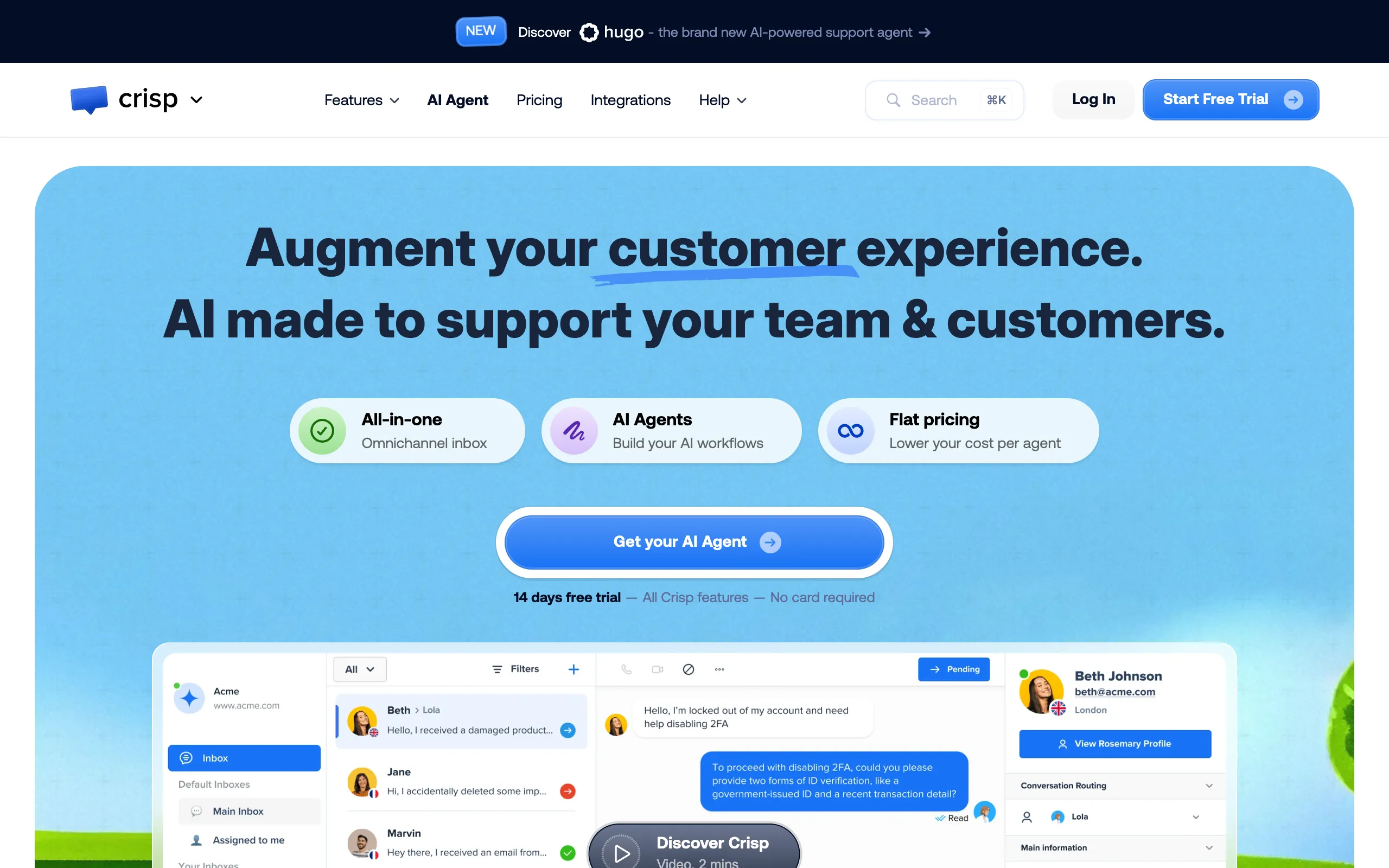
Crisp is a European business-messaging platform, and on Shopware it connects through a community plugin built by the agency CodeGiganten. It places the Crisp chat widget on your storefront via your Website ID, with co-browsing on higher tiers.
The catch: this is a widget integration, not an order-data one. It does not read live Shopware orders or take actions, and an older listing flags a newest-version compatibility caveat. It is a clean way to add chat and a chatbot to a Shopware shop, but the AI works on what you feed it, not on your store data.
Inside Shopware it can: embed the Crisp chat widget and chatbot; enable co-browsing on Pro. It does not read order data or take order actions.
Key features:
- Affordable European messaging platform with a free plugin
- Chat, chatbot and co-browsing
- Simple Website-ID install
Pros
- Low-cost way to add chat and a bot to Shopware
- European vendor with a generous entry tier
Cons
- Widget-only: no live Shopware order data or actions
- Community-maintained plugin with a compatibility caveat
Best for: small Shopware stores that want affordable chat and a lightweight bot, not store-level automation.
8. Shopware Store AI plugins (the try-first baseline)
Shopware ships no native customer-support chatbot. Its own Copilot is a merchant-side admin assistant (content generation, image keywording, review summaries), and its newer “Agentic Commerce” AI is about storefront sales and discovery, not support deflection. So unlike Shopify, there is no free first-party inbox to try first.
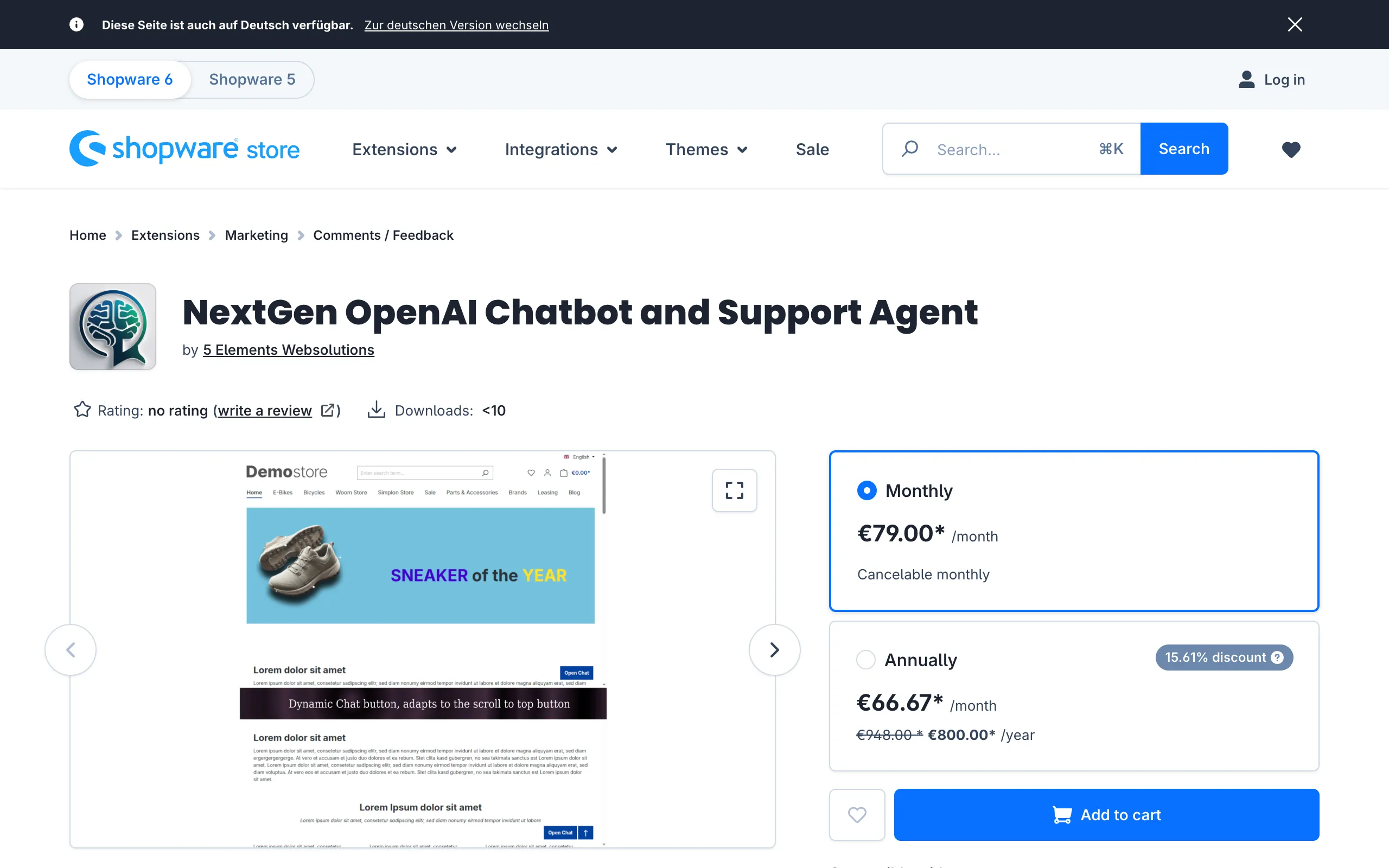
The practical baseline is therefore a paid Store plugin. Options like the “NextGen OpenAI Chatbot and Support Agent” plugin (from €79/month) or the cheaper “All-in-One AI Shop Assistant” plugin (from €39.99/month) wrap a general language model around your storefront for 24/7 product Q&A and FAQ answering.
They answer well; they do not process refunds, cancellations or order changes.
Inside Shopware it can: answer product and FAQ questions from storefront data; offer natural-language product search. It does not take order actions.
Key features:
- Installs directly from the Shopware Store
- Storefront product Q&A and FAQ answering
- Low monthly cost
Pros
- The cheapest, fastest way to add an AI assistant to Shopware
- Useful for pre-sales and product discovery
Cons
- Answers only: no live order data or actions
- Third-party listing claims, with no credible resolution benchmark
Best for: Shopware merchants who want a low-cost storefront assistant for product questions before investing in automation.
Comparison of the best AI agents and support chatbots for Shopware stores
| Tool | Best for | Inside Shopware it can | Automation level | Key limitation |
|---|---|---|---|---|
| Engaige | Automating support at scale | Read orders/catalogue, refunds, returns, address changes, warranties, subscriptions | End-to-end resolution (verified 60-80%, up to 90%) | Initial policy-training phase |
| Minimal | An action-taking agent | API actions: order status, notes, customer updates, “any API action” | Autonomous (up to 90% vendor-stated) | Refunds/cancels not individually documented; flat per-ticket pricing public, no Shopware case study |
| Tidio | Affordable SMB chat and FAQ | Live chat, Flows, FAQ answers | FAQ-grade on Shopware (70% vendor-stated, not Shopware) | Lyro order actions are Shopify-only |
| Userlike | DACH chat with AI assist | Live chat, AI assist, Copilot, workflow automation | Agent assist (autonomous claimed, undocumented on Shopware) | Shopware actions not documented |
| moinAI | German FAQ and shipping deflection | FAQ answers, shipping-status lookup | Deflection and lookup | No documented order actions |
| Re:amaze | Multichannel helpdesk + chat | Customer sync, live chat, FAQ, contact form | Assist only | Partner plugin; newest-version caveat |
| Crisp | Low-cost chat and bot | Chat widget, chatbot, co-browsing | Assist only | Widget-only; no order data |
| Shopware Store plugin | Try-first storefront assistant | Product Q&A, FAQ, product search | Answers only | No order data or actions |
How do they score side by side?
Scores are 1-5 per criterion, multiplied by weight, summed to a weighted score out of 5 (rounded to one decimal), sorted highest first. The criteria and weights match our e-commerce comparison, but depth and time-to-value are scored for a Shopware deployment specifically, so totals are not 1:1 comparable across guides.
The ranking model behind it: a tool’s resolution ceiling is roughly its action depth times its integration breadth, with depth the heavier multiplier, which is why depth and resolution carry the joint-heaviest weight. Based on public information and our own research, June 2026. We are Engaige, so hold our own row to the same test: the scores credit named outcomes you can open over homepage claims, and substantiation counts toward transparency.
| Tool | Resolution (25%) | Shopware depth (25%) | Pricing (15%) | Transparency (15%) | Time-to-value (10%) | Config (10%) | Weighted |
|---|---|---|---|---|---|---|---|
| Engaige | 5 | 5 | 5 | 4 | 5 | 5 | 4.85 |
| Minimal | 4 | 5 | 4 | 3 | 4 | 4 | 4.1 |
| Tidio | 3 | 2 | 4 | 3 | 5 | 5 | 3.3 |
| Userlike | 3 | 3 | 3 | 3 | 4 | 4 | 3.2 |
| moinAI | 3 | 2 | 3 | 3 | 3 | 4 | 2.9 |
| Re:amaze | 2 | 2 | 4 | 3 | 3 | 3 | 2.7 |
| Crisp | 2 | 1 | 4 | 3 | 4 | 3 | 2.5 |
| Shopware Store plugin | 2 | 1 | 4 | 2 | 4 | 3 | 2.4 |
A fair word on the top of the table. Engaige leads the weighted ranking overall. We match Minimal on Shopware action depth (5 each): both are built to take the full action set a Shopware ticket needs, from refunds to cancellations and subscription changes.
That is our claim, held to a sandbox test. Minimal ties only on that claimed-depth axis and trails on proven resolution and the weighted total, because it publishes no Shopware-specific pricing or named case study.
Engaige leads the resolution axis here; what sets it apart further is substantiation (Otrium 60% of 120,000 annual tickets, HelloPrint 80%) and flat, predictable pricing, applied to outcomes you can verify in named case studies.
Hold our numbers to the same test as everyone else’s. The “up to 90%” on our homepage is our ceiling at the deepest integrations, the same kind of vendor-stated ceiling you should challenge every supplier on, us included.
Verdict per criterion
No tool wins on everything. Per criterion, the picture looks like this.
- Resolution level. Won by the agents built to act on the harder middle of refunds and exceptions (Engaige, with Minimal close behind on its own claim). The assist and FAQ tools clear the easy bulk but hand back the rest.
- Shopware-native action depth. Engaige and Minimal both score 5: both take or claim the full action set a Shopware ticket needs, with Engaige’s actions held to a sandbox test. Userlike sits mid on agent assist; the rest are FAQ, lookup or widget level.
- Pricing predictability. Won by the flat models (Engaige and Minimal, plus the flat plugin tiers of Re:amaze, Crisp and the Store plugins). Conversation-metered tools track conversation volume, and what decides cost is per resolved ticket: an unresolved ticket falls back to a human.
- Transparency and control. Engaige leads on preview, approvals and named, openable outcomes; most others publish capability claims without Shopware-specific evidence.
- Time-to-value. Led by Engaige and the script-and-widget tools. Tidio, Crisp and the Store plugins install in minutes; Engaige matches them through Engaige AI, live in Agent Assist within hours and set up in plain language, and unlike a widget it keeps climbing to a higher ceiling, the ramp-up we explain in the e-commerce guide.
- Configurability. Won by the plain-language tools (Engaige, Tidio) a CX team can run without a developer.
What does an AI agent for Shopware cost?
AI agents and chatbots for Shopware cost one of three ways: a flat monthly Store-plugin fee (Re:amaze around €79/month, the AI Store plugins from €39.99 to €79/month) that stays predictable; a platform subscription with conversation-metered AI (Tidio, Userlike, moinAI, Crisp); or a flat monthly fee tied to your ticket volume, predictable as you scale and aimed at resolution rather than chat (Engaige).
Minimal publishes flat per-ticket pricing (from €489/mo), though not a Shopware-specific rate.
Because Shopware ships no free native support bot, there is no zero-cost baseline the way Shopify Inbox provides one. The honest comparison is total cost per resolved ticket, not the headline per-month price: a cheap plugin that answers but never acts still leaves every refund, cancellation and exception with your team.
FAQs about AI agents and support chatbots for Shopware
What is the difference between a chatbot and an AI agent for a Shopware store?
A chatbot answers questions, usually from scripts, FAQs or your product catalogue, and hands anything real to your team. An AI agent connects to your Shopware store through the API and acts: it reads the order, applies your policy, and processes the refund, cancellation or address change itself. The dividing line is whether it acts in Shopware or only chats on top of it.
Does Shopware have its own AI for customer support?
Not for customer-facing support. Shopware’s Copilot is a merchant-side admin assistant (content generation, review summaries, customer classification), and its Agentic Commerce features focus on storefront sales and discovery. There is no native, free support chatbot equivalent to Shopify Inbox, so the baseline on Shopware is a paid Store plugin or a third-party AI agent.
How many tickets can an AI agent resolve for a Shopware store?
AI customer support typically resolves 40-80% of repetitive tickets, depending on how deeply the tool integrates with your store. On Shopware the gap is wide because many tools only chat or look up data: those clear the easy bulk, while an agent that acts through the API can resolve the harder middle. Vendor headline rates are best-case ceilings, not guarantees, so pilot on your own ticket mix before you commit.
Which AI tools actually take actions on Shopware, rather than just chatting?
On documented evidence, very few. Engaige acts end to end through the Shopware API (refunds, cancellations, address changes, subscriptions), and Minimal claims the same broad capability.
Most other tools (moinAI, Tidio on Shopware, Re:amaze, Crisp and the Store plugins) answer questions or look up data rather than executing order changes. Notably, Gorgias’s documentation states its AI Agent requires a connected Shopify store and is not supported on several non-Shopify platforms, so it does not act on Shopware either.
What does an AI agent for Shopware cost?
A flat Store-plugin fee (predictable), a platform subscription with conversation-metered AI, or a flat fee tied to a ticket volume aimed at resolution. There is no free native baseline as on Shopify. Compare tools on the total cost per resolved ticket, not the per-month headline.