
Shopify agentic commerce means AI assistants such as ChatGPT, Google AI Mode, Gemini, Microsoft Copilot and Meta selling your products through Shopify Agentic Storefronts, fed by Shopify Catalog. It is on by default for eligible stores under Sales channels > Agentic. The selling is automated; the after-sale is not: fulfilment, returns and customer service stay with you.
This guide covers the set-up in order, then what lands in your support inbox once an AI agent has closed the sale. For the wider picture of support on the platform, start at our Shopify support hub.
What is agentic commerce on Shopify?
Agentic commerce is shopping where an AI assistant finds, compares and sometimes buys products for the shopper. On Shopify, Agentic Storefronts put your catalogue in those assistants from one place in the admin, and you remain merchant of record and owner of the customer relationship.
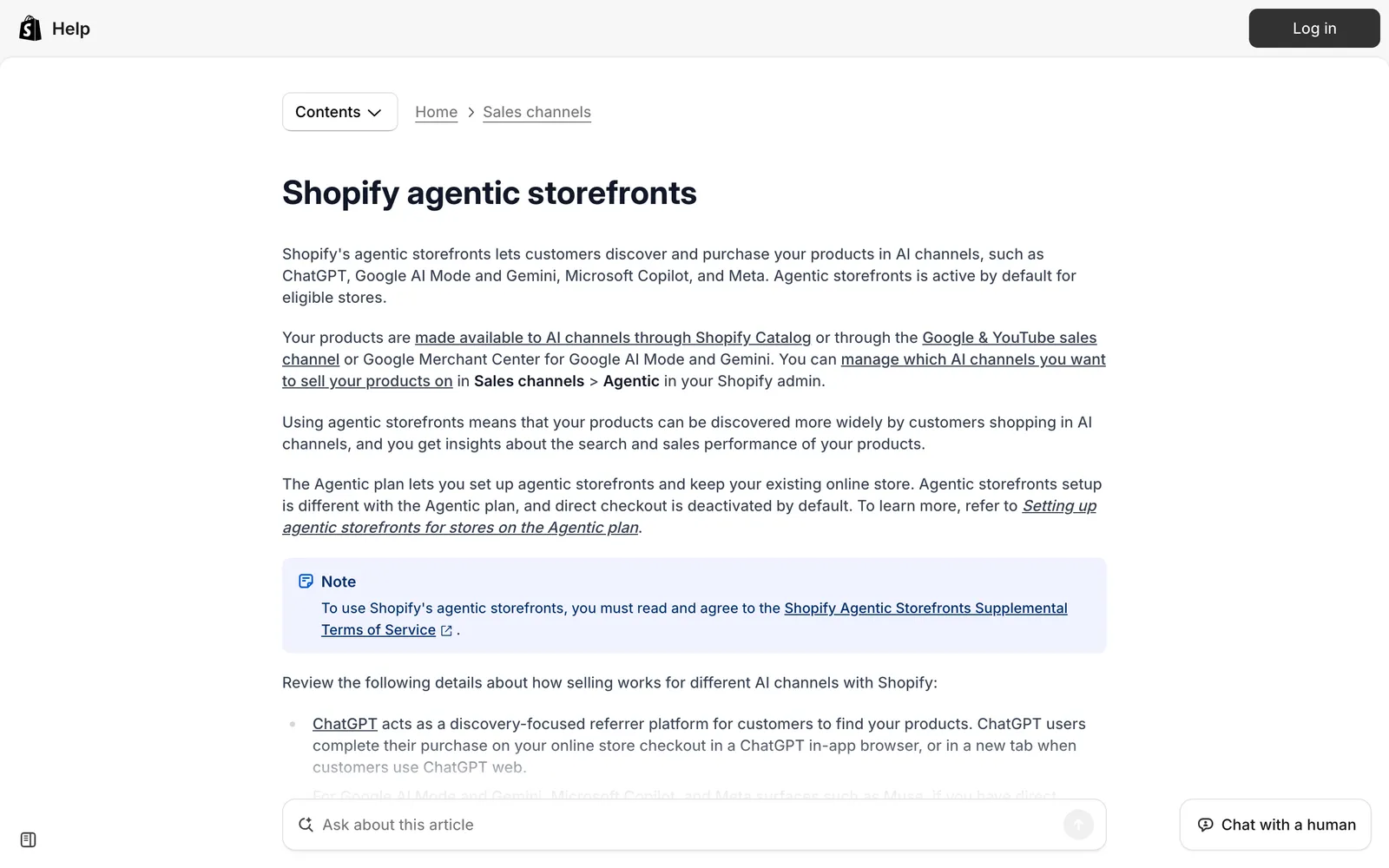
Shopify is not one feature here but a stack. The pieces below are the ones you will meet in the admin and the docs.
| Piece | What it is | Who it is for | What you do |
|---|---|---|---|
| Agentic Storefronts | A sales channel that lists your products in AI channels | Eligible Shopify stores | Review it under Sales channels > Agentic |
| Shopify Catalog | The structured product data AI channels read | Every store that wants to appear | Keep titles, images, prices and URLs clean |
| Knowledge Base app | Store facts and FAQs that AI shopping assistants use, not shown on your storefront | Stores that get shopper questions | Review the generated facts, add your own answers |
| UCP and agent developer tools | An open standard plus MCP servers for catalogue, cart and checkout | Teams building their own agents | Build against the agents docs |
| Agentic plan | A plan for brands that are not on Shopify | Headless, legacy or custom platforms | Add products to Catalog without migrating |
Our view: the AI channel makes the sale, and what follows lands in your inbox. Shopify’s Meta page says merchants continue to manage fulfilment, returns and customer service for these orders. WISMO, returns, refunds, cancellations and address changes still need an agent that reads the order and acts.
Why now: on its Q2 2026 call Shopify reported 3x year-over-year growth in AI traffic and orders (call summary), after the Q1 call put AI-driven traffic at eightfold. Treat both as call-reported industry indications, not a forecast for your store.
Which AI channels sell your products, and where does checkout happen?
ChatGPT is a discovery channel that sends buyers to your own online store to pay. Google AI Mode and Gemini, Microsoft Copilot and Meta can use Shopify-powered direct checkout inside the channel. The table shows each one as checked on 12 October 2026, against Shopify’s help pages.
| Channel | Where checkout happens | Who you can sell to | Notes |
|---|---|---|---|
| ChatGPT | Your online store, in the in-app browser or a new tab | US customers; the store can be based elsewhere | Active by default for eligible stores; no ChatGPT-specific fees |
| Google AI Mode and Gemini | Direct checkout in the channel | US customers; the store must be US-based | Direct checkout on by default for eligible stores |
| Microsoft Copilot | Direct checkout in the channel | See Shopify’s channel page | Subscriptions, bundles, customisable and B2B-only products are excluded |
| Meta | Direct checkout in the channel | US, Canada or Mexico | On by default for eligible stores; orders attributed to Meta |
You stay merchant of record on every channel, so a ChatGPT purchase is a normal order on your own store. For a store outside the US, the answer depends on the channel: ChatGPT needs US customers but not a US-based store, Meta covers the US, Canada and Mexico, and Google needs a US-based store. Shopify’s pages give no EU rollout date, so do not plan around one.
One caveat from the sources themselves. Shopify’s overview page says direct checkout runs “if activated”, while the Google and Meta pages say it is on by default. Do not assume: check the toggle under Sales channels > Agentic. Channel availability is also moving fast, so treat this table as a dated snapshot.
How do you set up Shopify agentic commerce, step by step?
Setting up Shopify agentic commerce takes six steps: confirm your products qualify, complete your store policies, clean the product data, choose channels under Sales channels > Agentic, review the Knowledge Base app and watch attribution. Most stores are partly there already, because eligible stores are switched on by default.
- Check eligibility. Shopify Catalog needs a title, at least one image, a price above zero, and a published product with a URL that is not unlisted. Excluded categories include services and add-ons such as warranties and subscriptions.
- Complete your policies. In Settings > Policies, fill in Terms of service, Privacy policy and Return and refund policy, and accept the Agentic Storefronts Supplemental Terms.
- Clean the product data. For ChatGPT, put legal disclosures in the first 6,000 characters of each description. Keep variants, pricing and stock consistent.
- Choose channels. Open Sales channels > Agentic, pick the channels, and decide per channel whether to allow direct checkout.
- Install the Knowledge Base app. Review the generated facts and write your own answers to what shoppers actually ask: shipping, returns, sizing.
- Watch attribution. AI-channel orders show channel or referrer attribution in your admin, so you can see which assistant sends what.
Shopify’s Catalog requirements also look at operating history, including fulfilling orders promptly and accurately and keeping the chargeback rate low. Our view: that makes post-purchase support part of staying eligible, not an afterthought.
How do I stop my products appearing in ChatGPT?
To opt out of ChatGPT, switch off the Shopify-managed setting and then the catalogue access, following Shopify’s ChatGPT page.
- Open Sales channels > Agentic in your Shopify admin.
- Turn off “Allow Shopify to manage for me”.
- Open ChatGPT and turn off “Shopify Catalog access”.
- Click Save.
Data can take up to 7 days to stop being shared, and products may still appear through web crawling. Shopify documents separate steps for hiding individual products from AI channels.
What is the Shopify Agentic plan, and who is it for?
The Agentic plan is for merchants who do not use Shopify as their e-commerce platform. It lets them add products to Shopify Catalog and sell through Agentic Storefronts without migrating. Shopify says it has no monthly subscription fee, and payment fees apply on direct checkout.
What it does not include: publishing an online store or selling through its checkout, Shopify Messaging, gift cards, manual orders and Shop post-purchase offers. Direct checkout is off by default. Products need an external product URL when there is no published paid Shopify store.
It fits headless, Magento and Salesforce Commerce Cloud brands that want to test AI channels before deciding anything bigger. For Magento stores, see Adobe Commerce.
What is the difference between UCP and ACP?
UCP and ACP are two open standards for agentic commerce from different groups. UCP was co-developed by Shopify and Google and covers catalogue, cart, checkout, identity linking and orders. ACP was developed by Stripe and OpenAI for agent checkout and payment credentials, with ChatGPT as the first implementation. UCP and the agent developer tools are for teams building their own agents.
What happens after an AI agent sells your product?
The AI channel closes the sale and you own everything after it. Shopify’s Meta page says merchants continue to manage fulfilment, returns and customer service for these orders, and the overview says you keep the post-purchase experience. The work after the sale is what this section covers.
UCP’s order capability, per the agents docs and ucp.dev, gives a shopper’s agent webhooks for fulfilment, returns, refunds and edits, so a buyer can ask an assistant where their order is. When the answer is wrong or the parcel is late, the follow-up still lands in your inbox. That consequence is our view, not a Shopify claim.
There is a second effect. The AI channel quoted your return policy and product facts before the sale. If your team or bot answers differently afterwards, the customer notices. Consistency between the pre-sale facts and the post-sale answers is the job.
| Post-purchase question | Where the true answer lives | What your support set-up needs to do |
|---|---|---|
| Where is my order, or can the delivery change? | Fulfilment and carrier data | Read the live order and tracking, not a canned reply. See WISMO |
| Can I return or exchange this? | Your Return and refund policy | Apply the same policy the AI channel quoted. See refunds |
| Can I cancel or change the address? | Order state before fulfilment | Check whether the order has shipped, then act within your rules |
| Does this fit, how do I care for it? | Your catalogue and product content | Answer from the same product data Catalog exposes |
Does your own Shopify store still need an AI shopping assistant?
Yes. ChatGPT sends buyers to your own checkout, and shoppers who just asked an AI for advice expect the same conversational help on your site. Agentic commerce raises the bar for your storefront chat; it does not replace it.
Shopify’s own option is the Inbox agent in Shopify Inbox, which is opt-in, needs new customer accounts and is documented for product, availability and pricing answers, recommendations, add to cart and order lookups after sign-in (Shopify help). For set-up, see our live chat guide, and for the non-chat route, contact forms.
Our view: whichever chat you run, check that it can read the order, not only the catalogue. One agent that advises before the sale and resolves after it keeps the facts consistent. See product advice for the job.
Where does Engaige fit?
Engaige (that’s us) isn’t an agentic storefront or a sales channel inside ChatGPT or other AI assistants: those sell through Shopify, not through us. It is the e-commerce-native AI support agent that plugs into the helpdesk you already run and handles the questions those orders bring. Engaige AI learns from your conversations, configures your support agent and shows which policies it used. Keep your helpdesk. Replace the AI.

One agent does two jobs, so pre-sale and post-sale answers come from the same facts. In your storefront chat it works as an AI shopping assistant, giving product advice. In your helpdesk it resolves the WISMO, return, cancellation and address questions that AI-channel orders create. Both answer from live Shopify Admin API data plus your storefront content; see the Shopify integration.
One thing that impresses me every day is the quality of the product recommendations.

New channels bring new question patterns. You go live in Agent Assist in hours: Engaige AI learns from the difference between what your team said and what the agent suggested, and you approve the changes. Ticket types switch to autonomous one at a time, and once autonomous it keeps learning from hand-offs and emerging trends. You decide how it reasons and when it may act, for example on a cancellation or refund.
Scenario
The customer asks about a delivery address.
Instructions
Read the order with Get order , then take the branch that matches.
 Get order
 Scenario
The order has not been picked yet.
Instructions
Move it with Change picqer shipping address .
 Change picqer shipping address
 Scenario
The parcel has already left the warehouse.
Instructions
Say it cannot be redirected, then offer Process refund .
Every answer and action shows why, with the policy and source it used, so if an AI channel quoted a different return policy, you can see it and fix it. Engaige is text-first by design: email, chat, WhatsApp, SMS and social DMs, no voice AI.
Proof: at MR MARVIS, a Shopify Plus brand, Engaige resolves over 60% of the conversations it is involved in, with personal product advice 24/7 on chat and email.
Frequently asked questions
Are Agentic Storefronts switched on automatically?
For eligible stores, yes. Agentic Storefronts are active by default, and you review them under Sales channels > Agentic. Direct checkout varies by channel and is off by default on the Agentic plan.
Where does a ChatGPT buyer actually pay?
On your store. Buyers check out on your online store, opened in the in-app browser or a new tab, while Google, Copilot and Meta can use direct checkout.
What does the Agentic plan cost?
It is for brands not on Shopify who want to sell through Agentic Storefronts without migrating. It has no monthly subscription fee, and payment fees apply on direct checkout.
Is this only for US stores?
It depends on the channel. ChatGPT needs US customers, Meta covers the US, Canada and Mexico, and Google needs a US-based store.
Who handles returns and customer service for orders from AI channels?
You do. Shopify says merchants keep fulfilment, returns and customer service. With Engaige, one agent in your helpdesk resolves those questions from live order data, under your policies.
Can I opt out of ChatGPT?
Yes, in the Agentic channel settings. It can take up to 7 days, and crawling may still surface products.
Do I still need a chat assistant on my own store?
Yes. Shoppers who asked an AI for advice expect help on your site. Engaige works as an AI shopping assistant before the sale and resolves tickets after it, from the same live Shopify data.







