Running an online store means absorbing a flood of the same questions: where is my order, can I return this, can I change my address before it ships. As volume grows, those tickets do not get easier, and hiring does not scale with them. That is why e-commerce teams are moving from chatbots to AI agents to take the repetitive load.
But “AI chatbot” now covers everything from a genuine agent that resolves a refund to a glorified FAQ widget, and for an online store the gap between them is the whole story. A chatbot answers “where is my order?” with a link, or a rep pastes a reply from ChatGPT prompts. An agent reads the order, checks your policy, and fixes the problem.
This guide scores 11 of the most credible e-commerce AI tools on two questions: do they resolve the request in your store, or just draft a reply for a human to send? And once live, do they keep getting better from your own tickets, or plateau where you configured them?
It is the e-commerce drill-down of our broader best AI agents guide, so the enterprise-horizontal players live there and the store-focused tools live here. For inbound phone calls specifically, see our voice AI guide. Scores are based on public information and our own research as of June 2026.
What is an AI customer service chatbot for e-commerce?
An AI customer service chatbot for e-commerce, also called an e-commerce AI agent or an AI customer support tool, is software that handles store support conversations. The ones worth buying in 2026 are agents: they read the order, apply your policy, perform the action (a refund, an exchange, a subscription edit), and escalate cleanly when a case needs a human.
The difference is that last step. Ask “where is my order?” and a chatbot points to a tracking page; an agent reads the order status and, if something is wrong, fixes it. Gartner frames the destination as an “intelligent front door”: one entry point that understands intent, executes a transaction, and escalates when it should (Gartner, 2025). Everything below is graded on how close a tool gets to that inside a store.
Why are e-commerce teams moving from chatbots to agents in 2026?
Because the maths has tipped. Around 30% of customer service interactions were already handled by AI in 2025, projected to reach roughly 50% by 2027 (Salesforce, 2025). For a store, that volume is overwhelmingly the repetitive middle: WISMO, returns, refunds and order edits, which is exactly the work a true agent can take off your team. Operators feel that volume as a relentless, low-value load that is still expensive to staff with people. One described the squeeze on r/ecommerce:
June 2026 Reddit we get around 40-50 calls a day, majority of them are just order status, return requests, basic FAQs. nothing that actually needs a human but customers still call and expect someone to pick up... ended up just keeping two part time people on it which is expensive for what it is. · r/ecommerce View on RedditSource: Salesforce State of Service, 2025. 2026 figure interpolated between the 2025 actual and 2027 projection.
The catch is that vendor resolution rates are easy to claim and hard to reproduce. Headline figures of 60-89% are measured in the vendor’s best deployments; your real rate depends on your catalogue, your returns policy and how deeply the tool connects to your store. Treat them as ceilings, pilot before you commit, and remember the operator above: the test is whether it completes the messy multi-step case, not the easy order-status one.
A quick test for every number in this guide, ours included: which named customer produced it, over what period, and what does the vendor count as “resolved”? A rate with none of those attached is a marketing figure, not a benchmark. How well a vendor substantiates its own claims counts toward its transparency score below.
How should you evaluate an AI chatbot for e-commerce?
Score an AI customer support tool on seven criteria, not on its feature list. For a store, three carry the most weight: whether it genuinely resolves commerce actions, how deeply it acts in your store and order systems, and whether it keeps improving from your own tickets after go-live. The weights below are tilted for e-commerce on all three.
A tool’s resolution ceiling is roughly its action depth times its integration breadth, and self-improvement is what closes the gap between where it starts and that ceiling. That is why resolution carries the heaviest weight, with commerce depth and self-improvement joint second.
| # | Criterion | Weight | The question it answers |
|---|---|---|---|
| 1 | Resolution level | 25% | What share of tickets does it resolve autonomously, and how hard are they? Simple FAQ is table stakes; the differentiator is refunds, returns and multi-step exceptions. |
| 2 | Commerce-integration depth | 20% | How deeply can it act in your store and order systems (Shopify, WooCommerce, BigCommerce or Magento, plus your OMS, returns, subscriptions and 3PL), not just how many logos it lists. |
| 3 | Self-improvement | 20% | Does it keep getting better after go-live, from your own tickets? Top score needs a loop you can see and steer: the tool learns from what your team actually sends, proposes improvements with their reasoning, and you approve what goes live. Black-box “self-learning” claims score mid-table. |
| 4 | Transparency and control | 10% | Can you see what the agent did, preview replies, keep it from closing sensitive cases on day one, and configure it in plain language without developers? And does the vendor back its public rate with named customers? |
| 5 | Channel coverage | 10% | Which channels can the AI actually cover? Top score means an AI voice agent handles phone calls autonomously; a voice channel answered by humans scores lower; text-only scores lowest. Engaige is text-only by design (see our entry below), so we take this hit visibly. |
| 6 | Time-to-value | 10% | How fast does it ramp to a meaningful resolution level? Plug-and-play ramps fast but plateaus low; deep integration ramps slower but reaches higher. |
| 7 | Pricing predictability | 5% | How forecastable is the bill as orders grow? Per-resolution models scale the cost with success and can be uncapped. |
The criterion buyers underestimate is integration depth, and it starts with your platform. Most tools are Shopify-first; fewer reach BigCommerce, WooCommerce or Magento, so a Shopify-only agent is a non-starter if you run WooCommerce. Past that, a brilliant model on top of shallow store data answers confidently and wrongly, so the real bottleneck is usually how much order, returns and subscription context the tool can read and act on, and whether it handles the harder exceptions like a damaged item, not the cleverness of the model.
How should you read a resolution rate?
A resolution rate only means something once you know how hard the tickets behind it were. The easy majority, where is my order, start a return, change an address, is table stakes that every modern AI now clears. The real test is the hard middle: partial refunds, complex or multi-item returns, and the judgement calls where a confident wrong answer costs you a customer.
So a headline rate with no complexity mix behind it is a marketing figure, and a lower rate that genuinely includes the hard middle beats a higher one that is all FAQ. This is also why resolution, depth and self-improvement carry the heaviest weights: depth pushes resolution past the easy bulk into the harder cases, and a learning loop keeps pushing it after go-live. The vendor-stated 60 to 89% rates below are ceilings, and a ceiling without a complexity mix tells you little.
The hard middle, the ~25% band, is where vendors actually differ. Shallow tools escalate most of it to a human; depth is what pulls that band into the AI-resolved segment, which is why a rate is only as good as the complexity behind it.
It is the standard we hold our own numbers to. At Otrium Engaige resolves 60% of 120,000 annual tickets end to end, and at HelloPrint 80%, figures that include the hard middle rather than FAQ deflection, which is what makes them worth more than a higher rate earned on easy questions alone.
How fast should an AI agent ramp up?
An AI agent for an online store should be live in days and climbing from there: our own agent typically reaches 30-80% autonomous resolution by week 2 and up to 90% by week 4 at the deepest integrations. Ramp is the climb to a meaningful resolution level, which is not the same as being live.
A plug-and-play tool goes live in minutes but often plateaus low, on the easy bulk. The old trade was that a tool integrating deeply into your store took longer to set up; Engaige AI removes that, because you design the policy in plain language and test it against real tickets in a playground rather than building flows.
Do not confuse ramp with the resolution ceiling above: that is how high a tool can go, this is how fast it gets there. So you no longer have to choose launch speed over depth: fast to stand up through Engaige AI, and still climbing to a high ceiling. For the rollout itself, from audit to pilot to expansion, follow our customer service automation guide.
How do the leading e-commerce AI chatbots compare?
The best AI chatbots for e-commerce customer service in 2026 all act: the front-runners resolve refunds, returns and order edits in your store. The ranking splits on self-improvement, where Engaige leads at 4.8, ahead of Siena at 3.8 and Gorgias and Yuma at 3.7. Not 5.0: we take a deliberate channel-coverage hit for being text-only.
Act versus answer is still the entry filter, and it eliminates the assist tools that only draft replies. But among the tools that clear it, acting is table stakes and the improvement loop is the differentiator. Each note states what it resolves, who it is for, the main catch, and how it prices. Resolution figures are vendor-stated unless noted, and real-world rates are typically lower. Eleven tools follow, grouped on the act-vs-assist spectrum.
Autonomous e-commerce agents (built to act)
Engaige (that’s us)
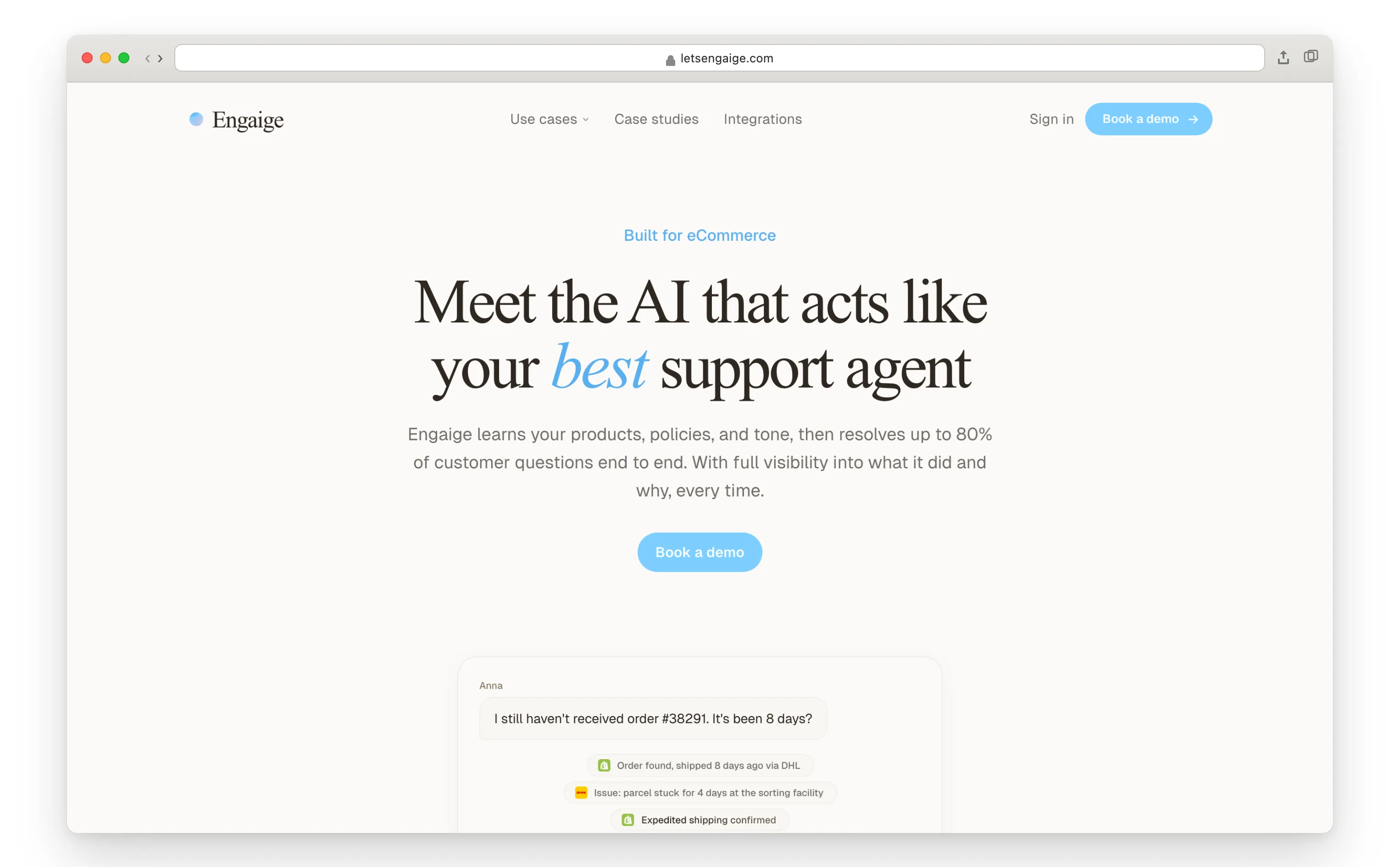
Engaige is an AI support agent purpose-built for e-commerce that resolves tickets end to end (WISMO, returns, refunds, subscription and warranty changes) on top of your existing helpdesk and store backend. What sets it apart is that it keeps improving itself.
The self-improvement loop, in short:
- Live in Agent Assist in hours: the agent drafts replies, your team sends them, nothing closes without a human.
- It learns from the gap between what the agent suggested and what your team actually sent, and Engaige AI proposes improvements with the reasoning; you approve what goes live.
- Ticket types flip to autonomous as confidence compounds, most brands in about a week, up to around 90% of supported tickets.
- It keeps learning once autonomous, from emerging trends and the tickets it hands to a human: that loop is how MR MARVIS, on Shopify Plus, resolves over 60% of the conversations its agent handles across 120,000 questions a year.
You brief it all in plain language through Engaige AI, and every answer and action shows its reasoning and source.
Verified outcomes you can open: MR MARVIS on Shopify Plus resolves over 60% of the conversations its agent handles, across 120,000 questions a year, and gives personal product advice around the clock; Otrium resolves 60% of 120,000 annual tickets end to end; and HelloPrint automated 80% of support, cut first-response time by 90%, and shrank its team from 100 to 28.
It is also a shopping assistant, one agent doing two jobs. Alongside support it advises shoppers pre-sale and mid-purchase: it reads your live catalogue and storefront and recommends across the whole collection in your brand’s tone, the way it does for MR MARVIS and for HelloPrint’s large, technical catalogue. On product-advice tickets we see a 7-12% conversion uplift (first-party Engaige data).
Setup is fast and there is no migration: you go live in days on top of the helpdesk you already run, and if a connection you need is not there yet we build it on demand, live in about a week. Pricing is a flat package to a ticket volume, so the bill stays predictable as you scale. The honest catch: Engaige is e-commerce-specialised, not horizontal.
What Engaige doesn’t do: voice. Engaige is text-first by design: email, chat, WhatsApp, SMS and social DMs, no phone AI. A live call gives an AI seconds to reason; text gives it time to read the order, check your policy and act, so resolution quality is higher, and buyers increasingly reach for asynchronous text they can use anywhere, including in public. If phone is a big share of your mix, a voice specialist is the honest answer.
One thing that impresses me every day is the quality of the product recommendations.

Engaige offered control, flexibility, and the ability to really incorporate AI in a more human way.

Engaige proved to be invaluable. Their hands-on support during the implementation phase resulted in significant improvements to our automated resolution rate and CSAT.

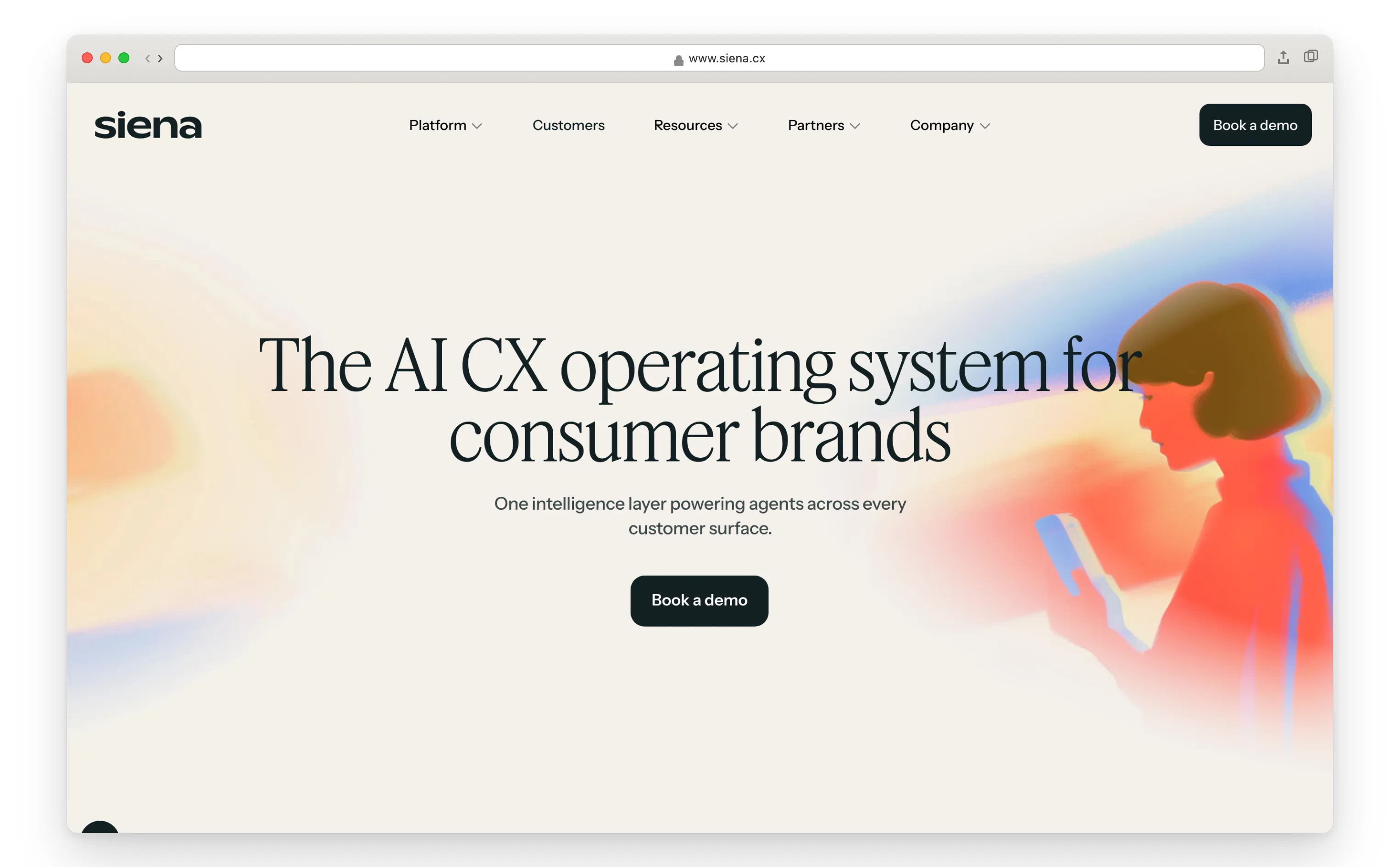
Siena positions itself as “the AI CX operating system for consumer brands” and runs agents that act, issuing refunds, generating labels and sending replacements in a single flow rather than drafting replies. It is built for DTC and states on its homepage that brands “automate up to 80% of customer interactions” (vendor-stated).
To its credit, Siena backs that headline with named case studies across its DTC roster (Spanx, HexClad, Prose, Coterie), publishing per-customer rates on its customers page from 80% at True Sea Moss down to 49% at Verb. Pricing is not public, so expect a quote. The catch: it is a newer platform and Shopify is the only commerce platform on its integrations page, so confirm anything beyond Shopify before committing.
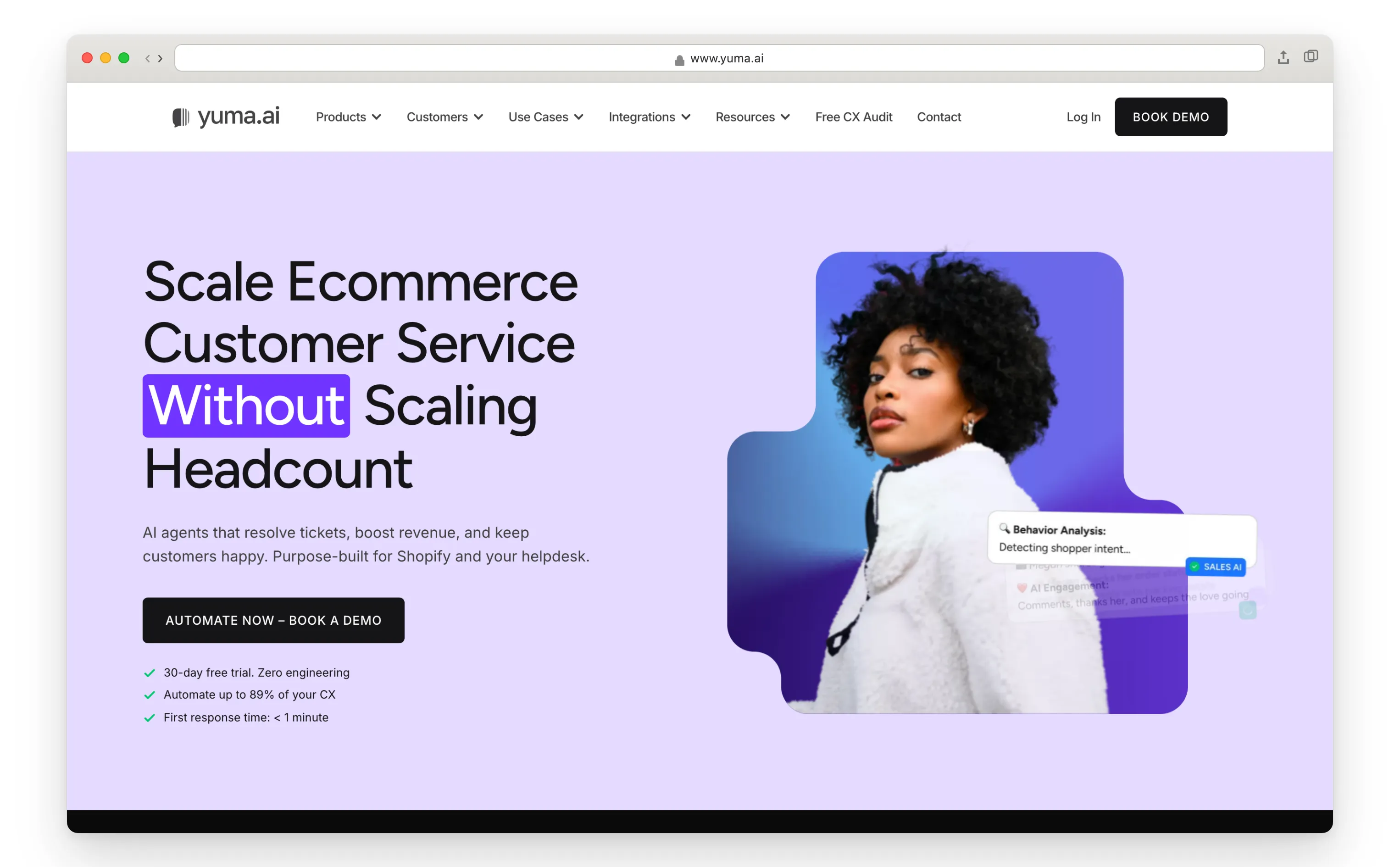
Yuma is an autonomous AI agent that sits inside your existing helpdesk and resolves e-commerce tickets end to end, taking real actions like refunds, label creation and subscription edits. It is purpose-built for Shopify and integrates widely (Gorgias, Zendesk, Kustomer, Re:amaze, Recharge, Loop, Klaviyo and more). Pricing is quote-based.
Yuma states on its homepage that “top deployments reach 89% automation” and, to its credit, publishes per-customer rates rather than one headline: 89% at EvryJewels, 70% at Clove, 64% at Tediber, down to 40% at The Koin Club (all vendor-stated). The catch: because it layers on your helpdesk, how deeply it can act depends on that underlying system and your integrations. We compare it directly with Gorgias’s own AI in our Gorgias vs Yuma comparison, with the wider field in our Yuma alternatives guide.
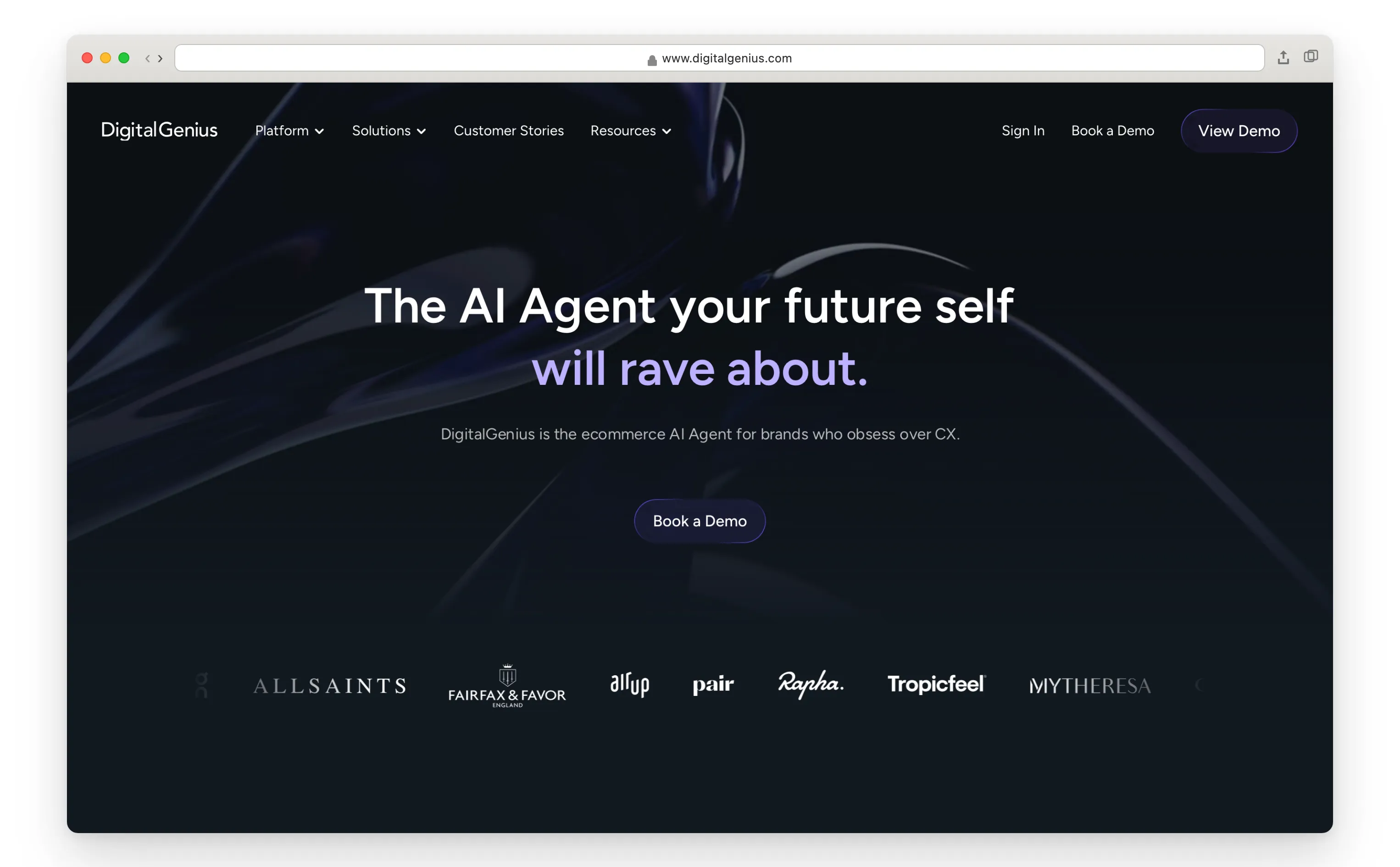
DigitalGenius is an e-commerce-built AI agent that fully resolves queries and processes returns, warranty claims and order amendments rather than only assisting. It serves established retail brands including On, AllSaints, Rapha and MyTheresa, and reports outcomes such as On cutting customer wait times by 93% (vendor-stated). Pricing is quote-based and it sits at the enterprise end. The catch: it is built for larger retailers, so implementation is heavier and it is impractical for a small store wanting a same-week launch.

Richpanel has shifted from an assist tool to an autonomous one: its AI agent now resolves refunds, order tracking, subscriptions and cancellations on its own, with the team handling approvals and exceptions. On its homepage it cites “70-80% resolved autonomously at maturity” and “50% guaranteed in the first 30 days” (vendor-stated), with named brands like Ridge, Jones Road Beauty and Shinesty, and integrates Shopify plus Recharge, Loop and 3PLs. The catch: deeper value needs full Richpanel platform adoption, and while WooCommerce and Magento are supported, its deepest transactional integrations (Recharge, Loop) are Shopify-side. We weigh that migration in our Gorgias vs Richpanel comparison, with the wider field in our Richpanel alternatives guide.
E-commerce helpdesks with an AI agent layer
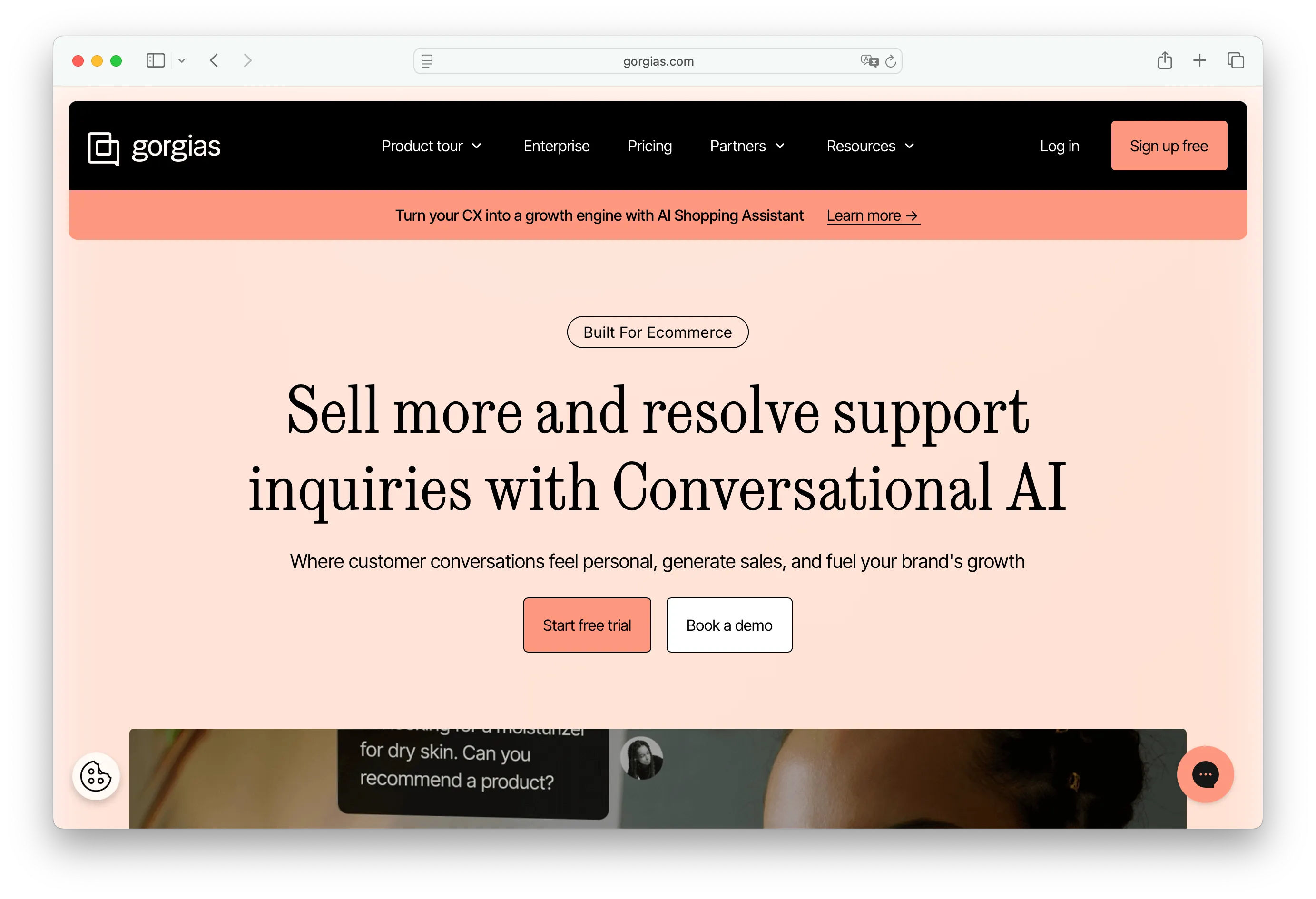
Gorgias is the Shopify-centric e-commerce helpdesk whose AI Agent now takes real actions, editing subscriptions, issuing refunds and updating shipping, and it states “60% of inquiries resolved instantly” (vendor-stated). The catch: its AI is bolted onto a ticketing tool rather than built AI-first, and its own named case studies land well below the up-to-60% it markets (for example Psycho Bunny at 26%). Pricing is per resolution on top of a ticket-volume helpdesk plan. See our Gorgias alternatives guide, or the Gorgias vs Zendesk comparison, for detail.
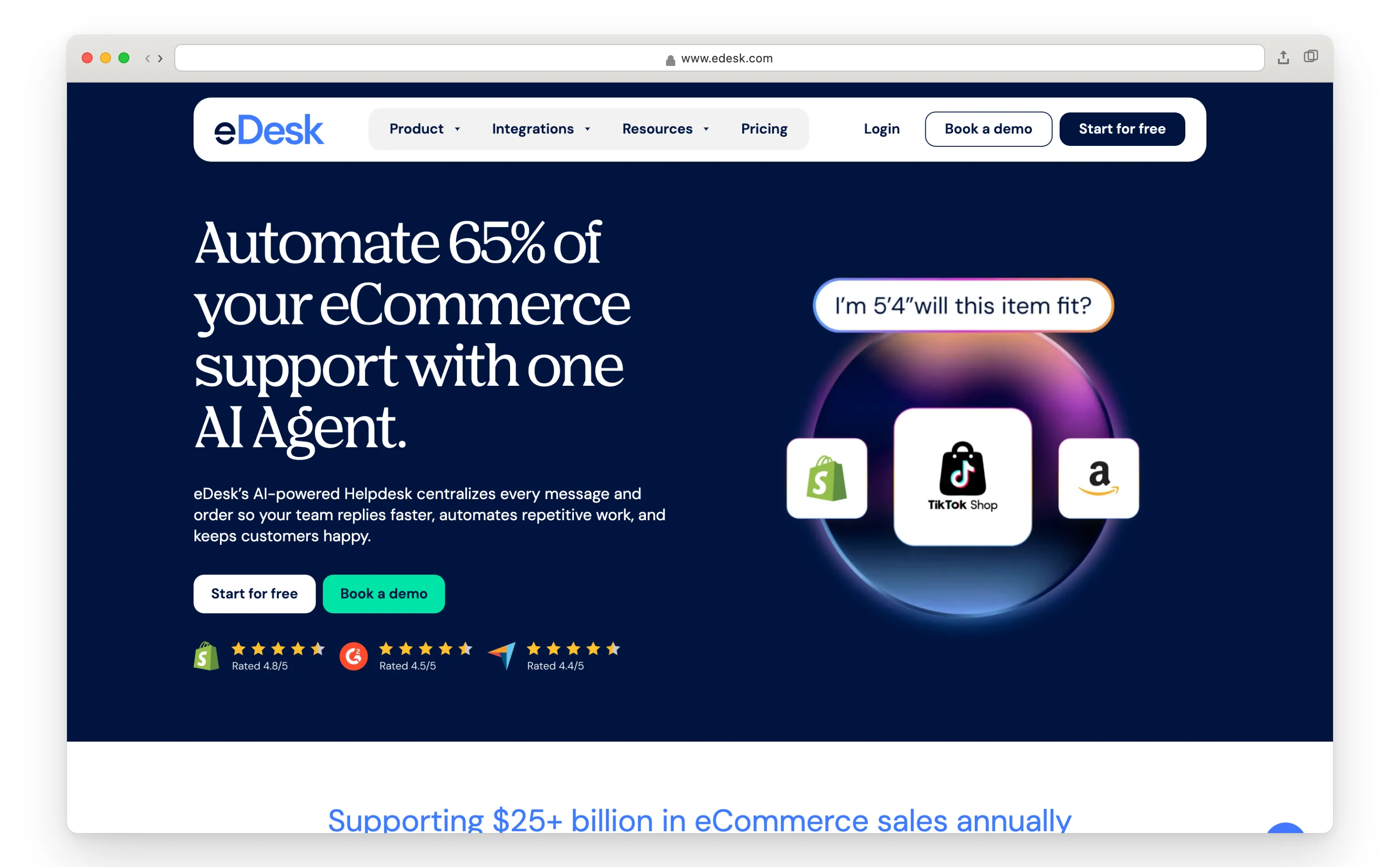
eDesk is an e-commerce and marketplace helpdesk whose AI agent, eDesk states, aims to “automate up to 65% of support across every channel” (vendor-stated), blending AI with rule-based automation. Its edge is channel and marketplace breadth: Shopify, WooCommerce, BigCommerce and Magento plus Amazon, eBay, Walmart and TikTok Shop, with named sellers including Superdry, Sennheiser and Carparts.com. Pricing is tiered. The catch: the automation leans more on rules and FAQs than deep autonomous reasoning, so it fits multichannel sellers more than brands needing complex case resolution.
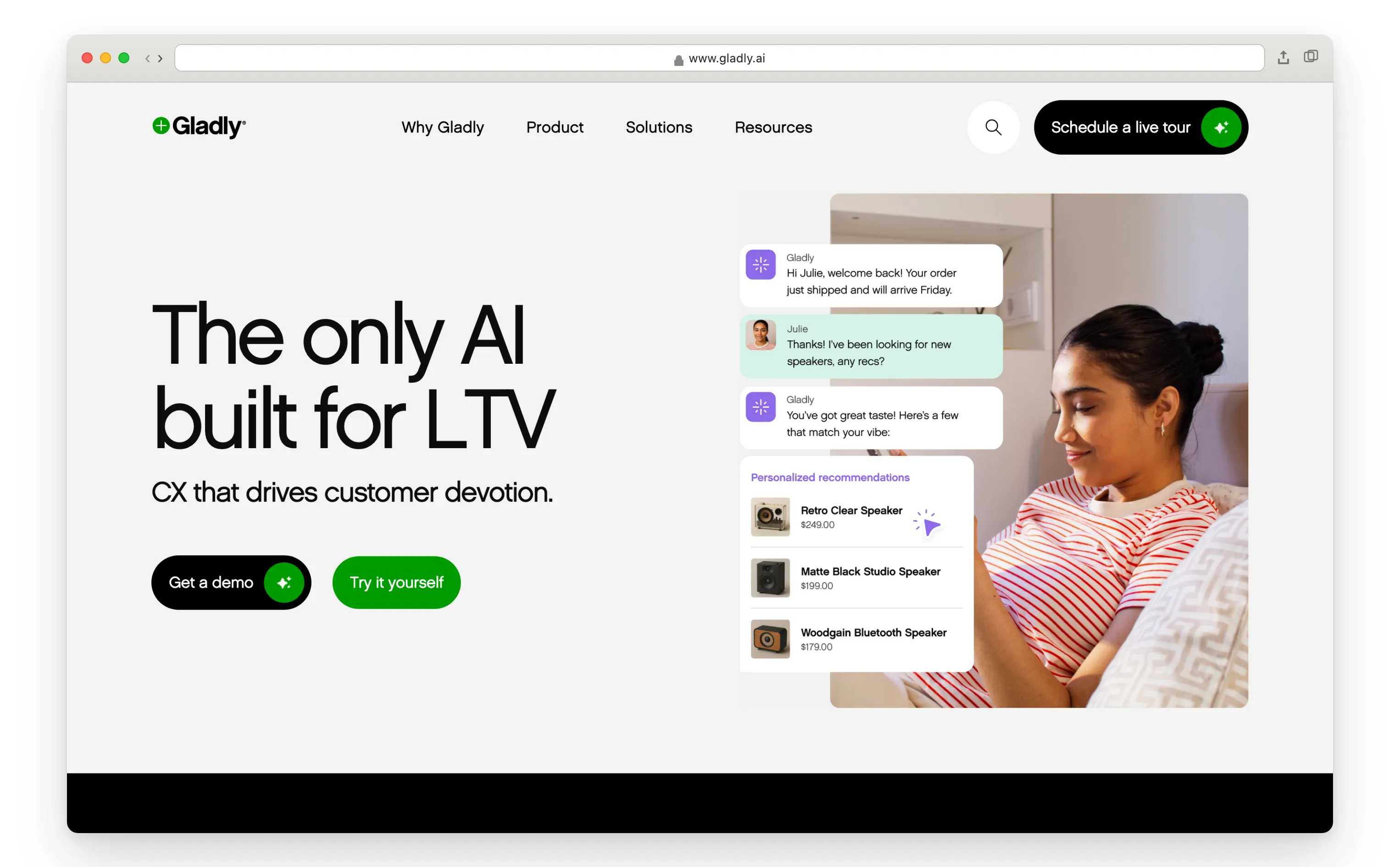
Gladly is a people-centred CX platform for premium consumer brands whose AI resolves conversations end to end, with Gladly stating “76% conversations fully resolved by AI” (vendor-stated, not attached to a named customer; the one named rate it publishes is 68% at The Black Tux). Named customers skew premium retail: TUMI, Ulta, Nordstrom, Hoka and Rothy’s.
Pricing is quote-based and positioned around lifetime value rather than ticket cost. The catch: it is built for established, higher-touch brands, its commerce-platform coverage is thin in public documentation, and it is not the fastest or cheapest route for a small store.
Kustomer is an AI-native CRM used across retail and other industries, so it is more horizontal than the e-commerce specialists here, but it has strong DTC names (Skims, Vuori, Everlane) and Kustomer states “70% of all conversations coming into chat are fully automated using Kustomer’s AI” (vendor-stated). Its agents resolve autonomously and it doubles as a full customer view. Pricing is quote-based. The catch: as a horizontal CRM it is not e-commerce-specialised out of the box, so commerce workflows need configuration and the platform is heavier than a focused store agent.
SMB and assist-leaning tools
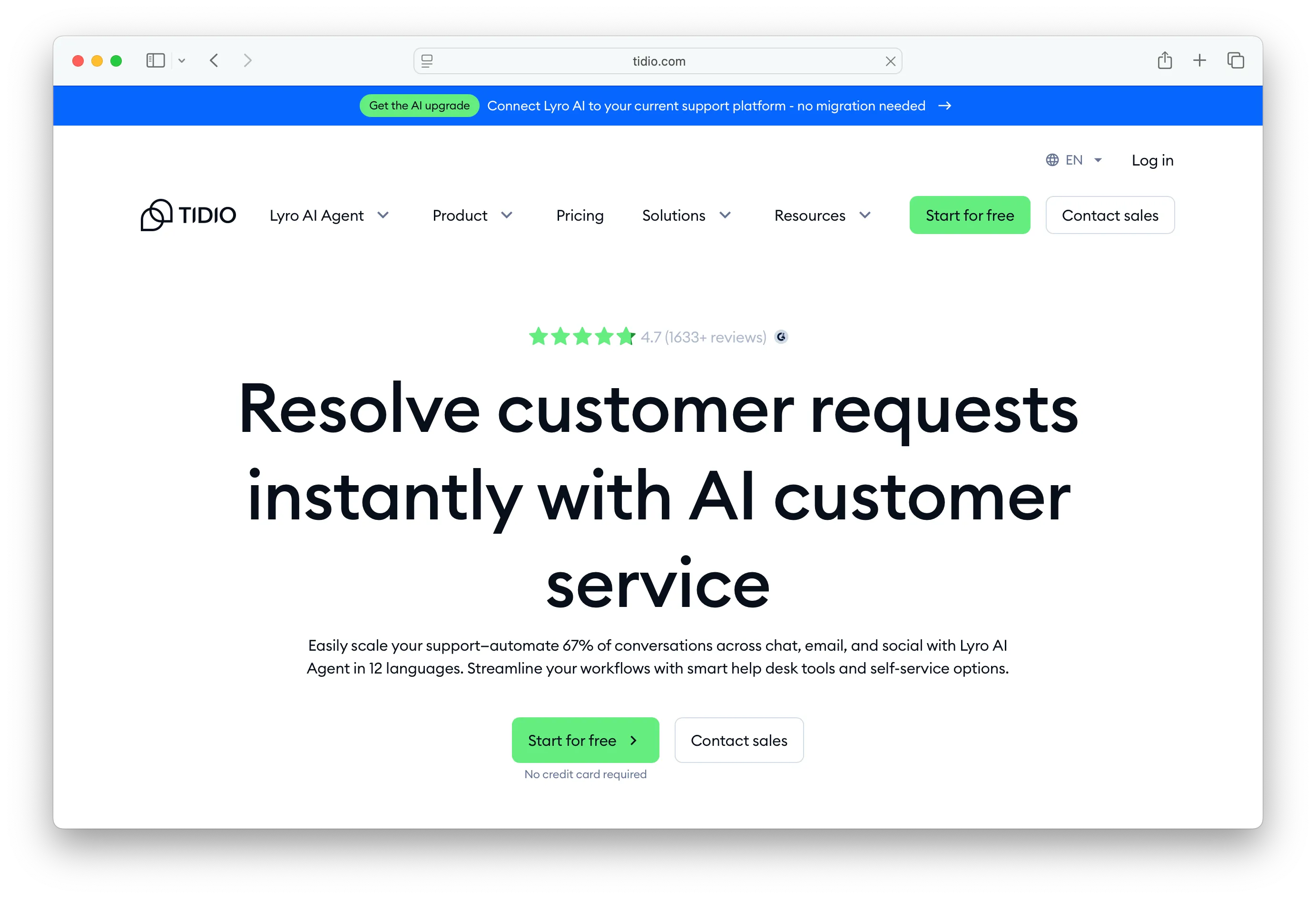
Tidio is an SMB-focused platform whose Lyro agent answers across chat and can take some support actions through connectors. Tidio claims a 64% average resolution rate (vendor-stated), backed by a money-back guarantee if Lyro does not reach at least 50%. Pricing is hybrid: flat helpdesk tiers plus a per-conversation Lyro add-on. The catch: it is strongest on FAQs, its autonomous commerce actions are newer and integration-dependent, and pricing can stack as conversations grow. Weighing it against Gorgias? The Gorgias vs Tidio comparison covers that.
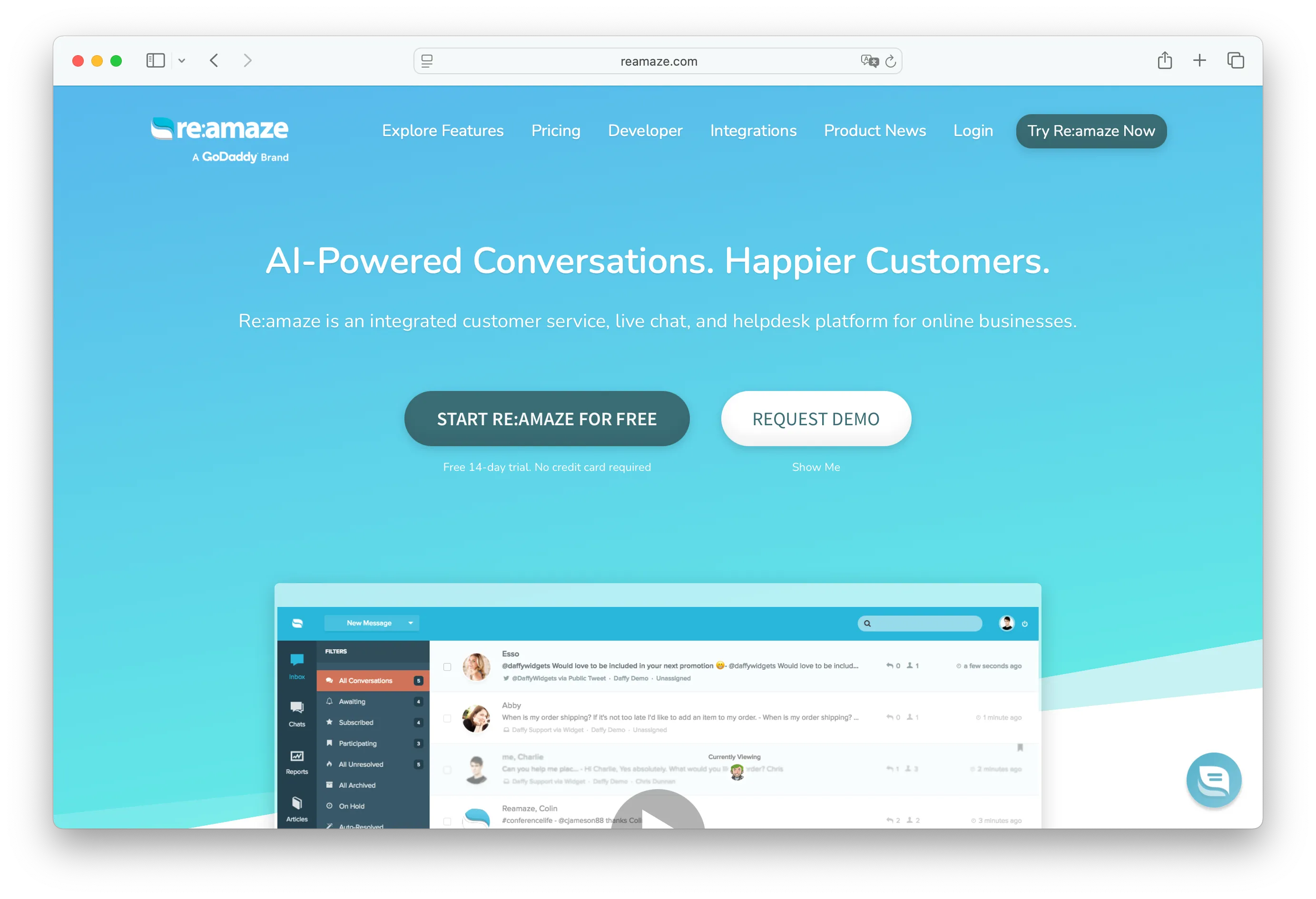
Re:amaze unifies chat, email, social and SMS in one inbox with AI that pre-drafts replies and summarises conversations rather than resolving autonomously. Agents can view and modify Shopify and BigCommerce orders from the dashboard, and named users include Printful and BuiltBar. Pricing is flat tiers, which is friendly for smaller teams. The catch: the AI is assistive, not action-based, so most tasks beyond information retrieval still need a human, and it does not name WooCommerce or Magento support.
How do the chatbots score side by side?
Engaige scores 4.8 of 5 across the seven weighted criteria, with Siena next at 3.8 and Gorgias and Yuma at 3.7. Not a clean sweep: Engaige takes the channel-coverage hit for being text-only by design. What separates the leaders is self-improvement, where Engaige is the only tool with top marks.
Scores are 1-5 per criterion, multiplied by weight, summed to a weighted score out of 5 (rounded to one decimal), sorted highest first. Based on public information and our own research, June 2026; channel coverage verified on each vendor’s own site in July 2026. We are Engaige, so hold our own row to the same test: the scores below credit named client outcomes you can open (Otrium, HelloPrint) over vendor homepage claims, and the weights reflect a typical e-commerce buyer. Your store will reweight them, which reshuffles the order.
Two notes for fair reading: transparency here also scores how well a vendor substantiates its own claims, so it is not 1:1 comparable with our agnostic guide, and weights differ per guide, so totals are not comparable across guides either. The “Which AI chatbot fits your store?” section below shows how reweighting shifts the order.
| Tool | Resolution (25%) | Commerce depth (20%) | Self-improvement (20%) | Transparency (10%) | Channel coverage (10%) | Time-to-value (10%) | Pricing (5%) | Weighted |
|---|---|---|---|---|---|---|---|---|
| Engaige | 5 | 5 | 5 | 5 | 3 | 5 | 5 | 4.8 |
| Siena | 5 | 4 | 3 | 4 | 3 | 3 | 2 | 3.8 |
| Gorgias | 4 | 5 | 2 | 4 | 4 | 4 | 2 | 3.7 |
| Yuma | 5 | 4 | 2 | 4 | 3 | 4 | 2 | 3.7 |
| DigitalGenius | 4 | 4 | 3 | 4 | 5 | 2 | 2 | 3.6 |
| Richpanel | 4 | 4 | 2 | 4 | 4 | 4 | 3 | 3.6 |
| Gladly | 4 | 3 | 3 | 4 | 5 | 2 | 2 | 3.4 |
| Kustomer | 4 | 3 | 3 | 4 | 5 | 2 | 2 | 3.4 |
| eDesk | 3 | 4 | 2 | 3 | 4 | 4 | 3 | 3.2 |
| Tidio (Lyro) | 3 | 3 | 2 | 3 | 3 | 5 | 4 | 3.1 |
| Re:amaze | 2 | 3 | 1 | 3 | 4 | 4 | 4 | 2.6 |
A fair word on the top of the table. Several tools advertise higher headline rates than our verified ones, and we checked how each substantiates them: Yuma and Siena publish per-customer rates with named brands, including unflattering ones, and their transparency scores credit that.
Our own row is not a sweep either. Engaige takes the channel-coverage hit, a 3, because we do not do voice, and that is deliberate: a live call gives an AI seconds to reason, while text gives it time to read the order, check the policy and act before it answers. We would rather be visibly text-only than quietly mediocre on the phone.
On depth, Engaige takes all the actions a ticket needs (refunds incl. partial, cancellations, order edits, subscription changes), which is our claim held to the sandbox test, so we sit at the top of depth. But depth alone no longer separates the leaders. What separates us is the self-improvement loop, a learning mechanism you can see and steer, and substantiation: named outcomes (Otrium 60% of 120,000, HelloPrint 80%), not homepage claims.
Hold our numbers to the same test. Our named, verifiable outcomes are Otrium (60% of 120,000 annual tickets) and HelloPrint (80%), each a full case study you can open. The “up to 90%” on our homepage is our ceiling at the deepest integrations: the same kind of vendor-stated ceiling you should challenge every supplier on, us included.
Verdict per criterion
Few tools lead on more than one or two criteria. The autonomous agents win resolution, Engaige wins commerce depth and self-improvement, the voice-capable platforms win channel coverage, flat-fee models win pricing predictability, and Engaige with the SMB plug-and-play tools wins time-to-value. Per criterion, the picture looks like this.
- Resolution level. Won by the autonomous agents (Engaige, Siena, Yuma) that act on the harder middle of refunds and exceptions. The assist-leaning tools lean on deflection and drafts.
- Commerce-integration depth. Engaige sits at the top: we take all the actions a ticket needs (refunds incl. partial, cancellations, order edits, subscription changes) on top of your helpdesk and order systems. Gorgias goes deep on Shopify; eDesk leads on channel and marketplace breadth. Breadth of logos is not the same as acting.
- Self-improvement. Won by Engaige: the agent learns from the gap between what it suggested and what your team actually sent, proposes improvements with the reasoning, and you approve what goes live, in Agent Assist and once autonomous. Most of the field improves only where you re-configure it, and a black-box learning claim gives you nothing to steer.
- Transparency and control. Engaige, Richpanel and the established platforms (Gorgias, Gladly, Kustomer, DigitalGenius) lead on preview, audit trails and visible decisions. Among the younger agents, Yuma and Siena earn credit for publishing per-customer rates, including unflattering ones; Tidio backs its 64% with a money-back guarantee. Control includes plain language: Engaige and Tidio are the tools a CX team runs without a developer.
- Channel coverage. Won by the platforms with their own AI voice agents: Gladly (Sidekick Voice), Kustomer (in-platform AI voice agents) and DigitalGenius, whose voice AI answers and resolves calls autonomously. Gorgias Voice, eDesk Talk, Richpanel and Re:amaze offer a phone channel answered by humans. Engaige does not compete here, by design: all textual channels, no voice.
- Time-to-value. Won by Engaige and the SMB plug-and-play tools (Tidio, Re:amaze): Engaige AI lets a CX team design and test the policy in plain language and go live in days with no migration, matching the plug-and-play tools for speed while reaching a far higher ceiling. Yuma’s one-click install ramps fast too; the heavier enterprise-retail platforms are built for a different buyer.
- Pricing predictability. Won by flat models (Engaige, Tidio’s core tiers, Re:amaze). Per-resolution (Gorgias) and quote-based outcome pricing (Siena, Yuma, Gladly, Kustomer, DigitalGenius) scale the bill with your volume.
Which AI chatbot fits your store?
The right tool depends on your platform, your store size and your hardest constraint: small stores automating early fit Tidio, Re:amaze or Richpanel; scaling Shopify brands need an agent that acts in Shopify and keeps improving from your tickets: Engaige (see the Shopify guide); multichannel sellers fit eDesk; and premium digital brands fit Gladly, Siena or Engaige.
| Store profile | Dominant tickets | The rule that shifts the choice | Tools that fit |
|---|---|---|---|
| Small DTC, early automation | WISMO, simple FAQs, easy returns | fast no-code setup over deep integration | Tidio, Re:amaze, Richpanel |
| Scaling Shopify brand | returns, refunds, subscriptions, order edits | needs to act in Shopify and keep improving from your tickets | Engaige (Shopify guide) |
| Multichannel and marketplace seller | cross-channel WISMO, marketplace cases | breadth across Amazon, eBay and TikTok plus the storefront | eDesk, Gorgias |
| Premium, high-LTV consumer brand | high-touch CX, product advice, complex returns | brand voice and lifetime value over raw deflection | Gladly, Siena, Engaige |
| Enterprise retailer | high volume, warranty, global | deep retail integrations and governance at scale | DigitalGenius, Kustomer |
| Phone-heavy support mix | inbound calls alongside text | needs an AI voice agent, which Engaige does not offer by design | Gladly, Kustomer, DigitalGenius, or a voice specialist (see our voice guide) |
No single tool wins every store. Match the agent to your platform, your volume and your hardest constraint. If you know your platform, the next drill-down is the platform guide: Shopify, WooCommerce, Magento guide, BigCommerce, Shopware or Salesforce Commerce Cloud. Each one rescores the field on that platform’s own action depth, and the rosters genuinely differ per platform.
What does an e-commerce AI chatbot cost?
E-commerce AI chatbots cost one of two ways: a flat fee tied to a ticket volume, which stays predictable as orders grow, or a per-resolution fee, typically around $1 to $2 per resolved ticket and often on top of a helpdesk seat fee. The autonomous enterprise tools are quote-based and rarely publish a rate.
Pricing usually has two layers:
- Platform fee. If the tool is a helpdesk (Gorgias, eDesk, Re:amaze, Tidio), you pay for the helpdesk itself before any AI, by agent seat on most and by ticket volume on Gorgias.
- AI layer. Charged either per resolution (Gorgias), as a flat package up to a ticket volume (Engaige, Tidio’s core tiers), or as a custom outcome-based quote (Siena, Yuma, Gladly, Kustomer, DigitalGenius).
The difference is predictability. A flat package to a ticket volume stays forecastable as you grow, while per-resolution and outcome-based pricing move the bill with your volume. The honest comparison is total cost per resolved ticket, not the headline per-unit price.
Frequently asked questions
What is the best customer support AI chatbot platform for e-commerce?
The best e-commerce AI chatbot does two jobs well: it answers from a built-in answer engine over your knowledge and order data, and it acts on the ticket (issues the refund, edits the order, processes the return) 24/7 rather than only drafting a reply. Engaige does both on top of your existing helpdesk and keeps improving from your own tickets after go-live. The full field, scored side by side, is in the comparison table above.
What are the best AI customer support tools for online stores in 2026?
The best AI customer support tools for online stores are the agents built to act in your store rather than answer: Engaige, Siena, Yuma, DigitalGenius and Richpanel resolve refunds, returns and order edits end to end, while assist tools only draft. Among the tools that act, the split is self-improvement: Engaige tops our weighted matrix at 4.8, taking a deliberate channel-coverage hit for being text-only, with the only improvement loop you can see and steer.
What is the difference between an e-commerce chatbot and an AI agent?
A chatbot answers questions from a script or FAQ. An e-commerce AI agent resolves the request by acting in your store: it reads the order, applies your returns and refund policy, performs the action (refund, exchange, order edit or subscription change) and escalates edge cases to a human. The dividing line is whether it acts or only replies. Engaige is an e-commerce AI agent that resolves WISMO, returns and refunds end to end.
Which AI agents take post-purchase actions for e-commerce?
Post-purchase is where the repetitive volume sits: where is my order, returns, refunds, exchanges, damaged items and subscription changes. Resolving these needs an agent that reads the live order and executes the action, not a bot that only quotes policy. Engaige takes these post-purchase actions end to end on top of your helpdesk, WISMO, returns and refunds including partial, damaged items and subscriptions, escalating edge cases to a human. The comparison table above shows which tools act versus only answer.
How much of my e-commerce support can AI actually resolve?
Typically 40-80% of repetitive tickets, rising toward the higher end with deep integration into your store and order systems. Vendor ceilings of 60-89% are best-case marketing figures, not guarantees, and real-world rates depend heavily on your catalogue, policies and data quality. Pilot before you commit.
Can an AI chatbot handle e-commerce customer support 24/7 and at high volume?
Yes, and this is where an agent pulls ahead of a human team. Because it acts without a person in the loop, it resolves repetitive tickets around the clock and absorbs peak-season and high-volume spikes without extra headcount, escalating only the edge cases.
Does Engaige handle phone support or voice AI?
No, by design. Engaige is text-first: email, chat, WhatsApp, SMS and social DMs. A live call gives an AI seconds to reason; text gives it time to read the order, check your policy and act, so resolution quality is higher. If calls dominate your mix, see our voice guide instead.
Which e-commerce AI agent learns from your past tickets?
Engaige learns from your team’s own replies. In Agent Assist it compares what the agent suggested with what your team actually sent, proposes improvements with the reasoning, and you approve what goes live; ticket types flip to autonomous as confidence compounds. That loop is how Otrium resolves 60% of 120,000 annual tickets end to end.
Should I pick a platform-specific or a platform-agnostic tool?
If your whole operation runs on one platform, a tool that acts natively in it will resolve more; if you sell across platforms or marketplaces, breadth wins. Gorgias and eDesk name WooCommerce, BigCommerce and Magento support; Siena lists only Shopify; many others are Shopify-first, so confirm your stack before committing. For the single-platform deep dive, see the guide for your store: Shopify, WooCommerce, Magento guide, BigCommerce, Shopware or Salesforce Commerce Cloud.
Is per-resolution or flat-fee pricing better for an e-commerce store?
Flat-fee pricing to a ticket volume stays predictable as you scale. Per-resolution and outcome-based pricing scales the bill with your volume, is often uncapped, and on a helpdesk it sits on top of a seat fee. Compare on total cost per resolved ticket, not the headline per-unit rate.